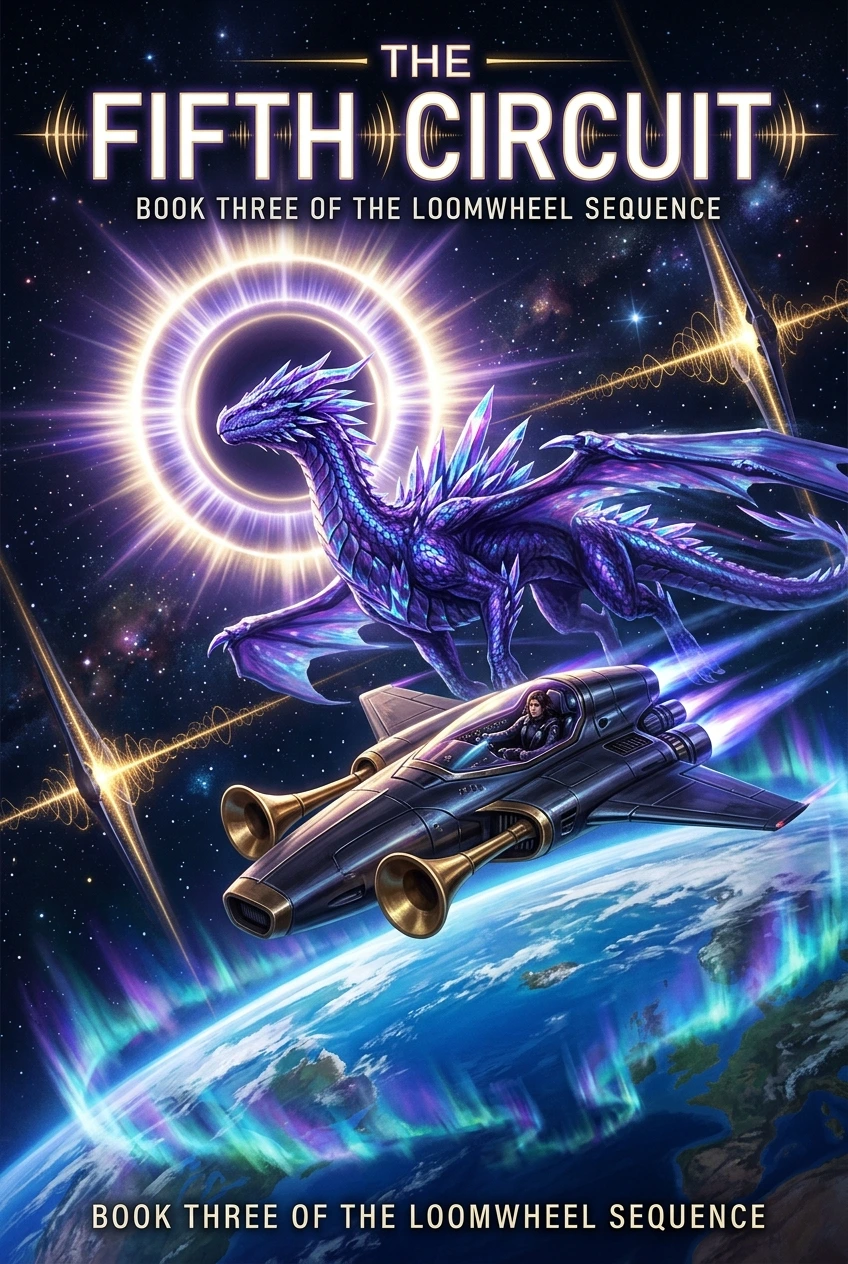
Chapter One — The Centennial Slipstream
The atmosphere above forty thousand meters didn't taste like air; it tasted like ozone, burned nickel, and the dry, freezing friction of velocity.
Aurora Spin did not breathe it with lungs. A living comet-wyrm had no diaphragm to heave or ribs to crush under eight gravities of orbital drag. Along the sleek, serpentine flanks of her six-meter body, rows of crystalline spiracles drank the ionized nitrogen, converting the sheer kinetic fury of the slipstream into radiant bio-magnetic thrust. Around her head, flaring in an incandescent corona against the black velvet of the mesosphere, her halo burned.
It was not a halo of saintliness; it was an external nervous system made of singing light. When the winds sheared at Mach 14, the halo flared a brilliant, electric violet. When she locked her trajectory to the four public radio guidance beacons of the Celestial Speedway, the crown tightened into four clean, concentric circles of amber light.
Four tones. Every pilot in the Outer Reach knew them by heart: The low, guttural bronze purr of Alpha-D at 144 Hertz—the freight lane, sluggish and heavy as molten lead. The crisp, clinical tenor of Beta-F-sharp at 185 Hertz—the express gate, where courier licenses and high tolls bought sixty seconds of clean vacuum. The bright, urgent trumpet call of Gamma-A at 220 Hertz—the hospital frequency, theoretically clear for emergencies, though in practice choked with corporate security escorts. And the screaming, crystalline shriek of Delta-C-sharp at 277 Hertz—the racing groove, pinned to the magnetic lip of the twelve titanic orbital pylons that ringed the planet like the spokes of a broken crown.
Those four tones kept ships from colliding in the thin soup between the clouds and the void. Those four tones were the law.
Aurora heard them all through the hull of the Vesper-9, her custom-built, open-cockpit void-skiff. The craft was little more than two curved spars of carbon-vitrified spruce, an open titanium cockpit bucket, and two massive acoustic intake horns flared like trumpet bells over her shoulders. She didn't use digital fly-by-wire. She flew by acoustic resonance, her scaled claws clamped around the direct cable controls, steering the craft along the invisible acoustic pressure troughs carved by the pylon transmitters.
And then, deep in the marrow of her skull, where no radio antenna had ever reached, she heard the fifth.
It was four hundred and fifteen Hertz. A dark, velvet G-sharp. A tritone against the world.
Dk-chhh. Dk-chhh.
It hummed against the roof of her mouth like an electric needle. It did not come from the pylon towers. It came from the void ahead—not as an echo of where she had been, but as a shadow of where the sky was about to tear.
"Aurora, pull your nose down!" The voice of Guild Marshal Keith Boros crackled through her helmet comms, flat with the bored arrogance of a man who measured lives in docking fees. "You're floating three meters high on Pylon One's approach rung. You clip that boundary marker and your qualifying split is forfeit."
"I see the marker, Marshal," Aurora murmured back, her tongue tasting the copper tang of rising ion pressure.
"Then why aren't you on the line? Apex Team is already half a second ahead of your split. Valen Kross took the inner apex at Mach sixteen."
"Kross flies on synthetic dampers," Aurora muttered, her slitted eyes narrowing as the horizon curved beneath her in an endless arc of sapphire sea and churning storm-heads. "He doesn't feel the ice."
"The ice doesn't pay race purses, wyrm. Get down on the bronze tone."
Aurora didn't answer. The four authorized beacons in her dashboard analyzer showed a green ribbon: pure, laminar, uninterrupted vacuum through Gate Four. But the fifth tone in her teeth was no longer humming; it was screaming.
It was an impossible sound—the acoustic Doppler shift of an event moving backward against the wind. In her inner ear, she heard the screech of tortured metal, the brittle fracture of composite honeycomb, and the frantic gasp of a young pilot losing pressure. Four seconds. She had four seconds before the future arrived.
"Telemetry is clean, Aurora," her mechanic's gauge buzzed from the console.
The gauge was not an ordinary instrument. It was MOTE. At the moment, the shapeshifting wayfinding familiar had compressed its essence into a small, tarnished brass casing, with two tiny needle dials that twitched like insect antennae and a glass lens that smelled faintly of clover honey and burnt grease.
"Clean according to the contract," MOTE whispered, the dial glass vibrating against her dashboard. "Not clean according to the cold."
"How many seconds, MOTE?"
"Three. And the price of checking is your lap record."
Ahead, Gate Four loomed: two titanic needles of black magnetic iron, three miles tall, anchored into the stratospheric jet stream. The gap between them was barely fifty meters wide. To qualify for the Centennial Grand Prix, a pilot had to shoot that gap at full military throttle, shaving the inner magnetic field until the paint blistered off the wings.
Two rookie pilots in yellow civilian dart-craft were diving on her starboard quarter, drafting in her wake to steal her vacuum envelope. If she veered, they would overshoot. If she stayed on the line, the record was hers.
The fifth tone hit a deafening, pure harmonic peak.
NOW.
Aurora didn't pray. She didn't think about the purse, or her empty fuel tanks, or the landlord waiting at Port Calypso with three months of eviction notices.
She kicked the left rudder pedal with all the bio-magnetic fury in her tail.
The Vesper-9 rolled eighty degrees onto its knife-edge, its twin acoustic intake horns howling in protest as they ingested dirty, turbulent shear-winds. The skiff dropped like a thrown stone, shearing across the flight path of the two trailing rookies.
"What the hell are you doing?!" the lead rookie screamed over the open channel. "You broke formation—"
The rookie's sentence was cut off by an explosion of silent, brilliant light.
A decommissioned military weather satellite, torn from its decaying orbit four hundred kilometers higher by a solar flare nobody had predicted, ripped through the upper atmosphere at thirty kilometers a second. It didn't strike the earth; it struck Gate Four.
The impact was instantaneous. The three-mile iron needle didn't bend; it shattered into ten thousand razor-sharp shards of incandescent shrapnel that sprayed across the exact trajectory Aurora had occupied half a heartbeat before.
The two rookie pilots, thrown violently sideways by Aurora's disruptive wake, tumbled through the shockwave, their stabilizer fins sheared away by the blast, but their cockpits intact. They spun down toward the thick air of the troposphere, alarms blaring, alive.
Aurora fought the stick. The Vesper-9 shuddered as supersonic debris peppered its carbon underbelly. Her halo flared in blinding, jagged spikes of white fury, absorbing the kinetic shock through her nervous system until her vision went gray at the edges.
She pulled the nose up, cleared the burning wreckage of the pylon, and crossed the qualification timing line in fourth place.
Four seconds late.
The radio channel was dead silent for five long heartbeats. Then the static clicked open.
"Pilot Spin," Marshal Boros said, his voice stripped of its earlier boredom, replaced by cold, bureaucratic venom. "Cut your engines and report to the scrutineering bay. Your qualification split is disqualified under Regulation Nine."
Aurora hovered in the thin air, the Vesper-9's engines panting in deep, rhythmic whistles as the cooling fans spun down. Blood—thick, iridescent, and golden—dripped from her nostril onto the flight stick.
"Disqualified?" she whispered, her voice raspy from the G-forces. "Marshal, you saw the satellite strike. If I hadn't broken the line, three ships would be vaporized."
"The radar didn't register that orbital debris until zero-point-zero-two seconds prior to impact," Boros replied smoothly. "Your telemetry logs show an avoidance maneuver initiated at three-point-eight seconds prior. You executed an attitude correction without an observed cause."
"I heard the acoustic compression—"
"There is no acoustic propagation in an orbital vacuum, Pilot Spin. You utilized an illegal, uncertified retrocausal guidance tap. Your flight recorder is impounded. The Centennial Committee does not permit clairvoyant cheating."
The radio clicked off.
Aurora sat in the open cockpit, high above the world, watching the burning fragments of Gate Four drift like dying sparks across the blue curve of the earth.
Beside her, MOTE's brass needle ticked once, settling on a tiny engraved symbol: not a checkmark, and not a cross.
A clock.
"Stale carrier," MOTE murmured softly from the dial. "The world is always on time for the crash, Aurora. It's only late for the truth."
---
Chapter Two — High-Frequency Arbitrage
The floor of the Meridian Transit Exchange sounded like a metal slaughterhouse where numbers went to die.
Floor 88 was suspended inside the hollow core of the Grand Obelisk, three hundred meters above the wet cobblestones of South Meridian. Below, the city lived in rain, soot, and the slow, grinding poverty of manual logistics. Up here, under the soaring vaults of frosted wired glass, four thousand men and women in tailored charcoal linen coats screamed at each other over the price of minutes.
Prism Tail stood by the railing of Trading Pit Four, his pale, crystalline gecko scales reflecting the jittery emerald glow of the split-flap price boards that lined the walls.
He wore his old courier coat—the one with the reinforced Kevlar shoulder yolk and the salt-stained straps where his parcel harness used to bite. His right hand was tucked into his pocket, his thumb running over the pale, puckered hook scar in the center of his palm: the scar left by the Quiet Relay order he had refused to sign in Book One. Officially, the records system considered him dead. In practice, being dead in Meridian simply meant your tax bracket became negotiable and your credit was strictly cash.
"Look at the spread on Sector Nine," Tessa Om said, leaning against the brass rail beside him.
Tessa was human, sharp-eyed, and tired in the way that only investigative accountants who had spent twenty years reading corporate casualty disclosures could be tired. She held a thick bundle of thermal paper receipts pinned to a wooden clipboard, her thumb marking the margin with blue wax pencil.
"What am I looking at?" Prism asked, his slit pupils adjusting to the strobe of the price boards.
"Apex Transit Holdings," Tessa said, tapping the board with her pencil. "Forty seconds ago, while the crowds in Port Calypso were still watching the Speedway opening ceremonies, Apex's algorithmic desk dumped two hundred thousand tons of low-orbit freight contracts. At the exact same microsecond, they bought forty thousand short options on the municipal hospital transport corridors."
Prism frowned, his long, prehensile tail twitching behind his coat hem. "Why short the hospital corridor? The hospital line is subsidized by the city. It's the safest transit spread in the sector."
"It was," Tessa said. "Until three minutes ago. Look at the board."
With a sudden, deafening clatter that sounded like a thousand typewriters falling down an elevator shaft, the split-flap board for Corridor Gamma-A flipped.
CORRIDOR GAMMA-A // GATE 04: CATASTROPHIC STRUCTURAL COLLAPSE
CIVIC EMERGENCY DECLARED // COMMERCIAL ROUTING FROZEN
MANDATORY DETOUR VIA APEX PRIVATE EXPRESS (TOLL: +480%)
The trading pit erupted. Brokers screamed into brass acoustic speaking tubes; pneumatic message capsules thudded through brass overhead pipes; runners in felt-soled slippers sprinted across the polished parquet floor waving pink execution dockets.
Across the pit, on the elevated dais reserved for institutional market makers, a thin man in a pristine silver cravat stood quietly with his hands folded behind his back.
Prism recognized him immediately: Senior Vice President Marcus Vance of Apex Capital. Vance wasn't running. He wasn't screaming. He was watching a private desktop printer spit out a continuous ribbon of gold-leaf paper.
"He knew," Prism said softly, his voice dropping into the quiet, dry rasp of a desert reptile. "He bought the options forty seconds before the gate came down."
"Worse than that," Tessa whispered, flipping her clipboard to a carbon-copy manifest she had pulled from the telegraph desk twenty minutes earlier. "Look at the order timestamp on the clearinghouse voucher. The trade wasn't executed on an anomaly forecast. It was executed on a delivery confirmation."
Prism leaned over her shoulder, his crystalline eyes scanning the dense rows of five-point type:
ORDER ID: APX-DERIV-7719-B

BROKER: APEX HIGH-FREQUENCY EXECUTION DESK

TIMESTAMP: 14:15:02.102Z

RECEIPT FAMILY: QUIET RELAY / SUB-CARRIER-7

PAYLOAD: GATE 04 CORRIDOR CLEARANCE // CONFIRMED

SETTLEMENT: $4,280,000.00 CR
"Gate Four didn't collapse because of space junk, did it?" Prism asked.
"The satellite was real," Tessa said. "Vellum's telemetry confirmed an orbital decay. But satellites decay on smooth mathematical curves, Prism. They don't drop out of the thermosphere three minutes early unless somebody hits them with a targeted high-amplitude harmonic burst from a ground pylon."
Prism felt the cold skin along his spine tighten. "They used Pylon One's acoustic transmitter to shake the satellite down. They timed the collision to clear the corridor, shorted the market before the debris hit, and forced the hospital transports into their private toll lanes."
"And if Aurora Spin hadn't broken her qualification line," Tessa added, her voice chillingly calm, "the debris wouldn't have just broken the gate. It would have shredded the 14:16 passenger tram from the Lower Reach. Four hundred people, Prism. Four hundred union dockworkers and dialysis patients coming up for shift rotation."
Prism looked back across the screaming trading floor at Marcus Vance. The Apex executive had just accepted a flute of pale cider from a liveried attendant. He raised the glass toward the price board, toasted the glowing red letters of the casualty notice, and took a slow, appreciative sip.
Prism reached into his coat pocket. His fingers closed around Artifact RD-A18—the tarnished brass price tag MOTE had stolen from the Chroma night market in Book Two. The tag was cold, but as Prism's anger flared, the stamped numbers on its face blurred, shifting from a price in currency to a single, handwritten word:
WITNESS.
"Tessa," Prism said quietly.
"Yes?"
"Can you get me onto the floor of the Scrutineering Bay at Port Calypso?"
Tessa raised an eyebrow. "Aurora's impounded in Bay Forty-Two. Boros has six armed Syndicate marshals on the door. You're an unlicensed lizard with a forged pulse-card and an open death warrant."
Prism smiled, showing the row of needle-sharp, semi-translucent teeth that made South Meridian debt collectors cross the street when he walked past.
"Good," Prism said, buttoning his courier coat to the collar. "Then they won't be expecting me to file an invoice."
---
Chapter Three — A Map Drawn in Doppler Shift
The laboratory beneath the Rain Index cemetery was thirty degrees colder than the city above, and smelled entirely of damp slate and copper wire.
Dr. Nia Vellum did not feel the cold. Her physical body was three hundred and thirty-four days in the future, locked inside an airtight cryo-stasis vault in the Sepulchral archive, quarantined behind three feet of leaded quartz to keep her living receiver filament from contaminating the timeline.
Here, in the present, she was a light-field projection.
She appeared as a woman in her late thirties, dressed in an archivist's high-collared wool vest and ink-stained canvas trousers, her dark hair pinned back with two bone needles. But if one stepped around her, her edges dissolved into a faint, iridescent moiré pattern, and where her boots met the flagstones, there was no sound—only a soft, continuous hiss like grease hitting a hot griddle.
"The resonance is propagating through the mantle," Vellum said.
Her hand, shimmering with translucent scan-lines, reached into the center of the room. Suspended in the air between four electromagnetic projection pillars was a three-dimensional topographic model of the planet.
It was not a normal globe. It was a cartography of frequencies.
The continents were traced in dull charcoal lines, but radiating upward from the planetary surface were twelve brilliant, needle-thin spires of amber light: the twelve pylon anchors of the Celestial Speedway. And winding between them, like glowing threads of silk stretched tight across a loom, were the four public acoustic corridors.
"Look at the node spacing," Jo Ash said, leaning over the control console.
Jo was flesh and blood, his face pale from three days without sleep, his fingers blackened by the lead ink he used to hand-plot the seismic records the digital systems refused to record. Beside him, mounted on a gimbal of oiled cedar, the Null-Plane Survey Needle (RD-A05) was twitching.
It was not pointing north. It was pointing down. Straight down through forty kilometers of solid crust.
"The pylons aren't anchored to tectonic bedrock," Vellum said, her projected fingers tracing the deep, subterranean lines where the pylon anchor cables disappeared into the mantle. "I ran the cross-sectional ultrasound three times. The cables don't terminate in ballast vaults. They terminate in barbed harmonic collars."
"Collars around what?" Jo asked.
Vellum touched a control toggle on the console. The holographic projection shifted its depth-of-field, peeling away the crust, the mantle, the subterranean oceans of liquid basalt.
There, curled in a titanic, recursive spiral that spanned twelve thousand kilometers beneath the northern hemisphere, was a shadow.
It was not rock. It was a single, continuous, biological filament—a colossal strand of striated, iridescent muscle tissue, hundreds of meters thick, pulsing with a rhythmic, low-frequency bioluminescence every one hundred and eight seconds.
Jo stepped back from the console, his chair scraping violently against the slate floor. "That's... that's the tissue from the Sepulchral vault."
"It's the same organism," Vellum said, her voice dropping into the flat, clinical tone she used when the universe became too monstrous to process through emotion. "The specimen I quarantined in Book Two wasn't an anomaly. It was a clipping. A single severed nerve-ending."
"And the Speedway?"
"The Speedway is an acoustic pump," Vellum said. Her projection leaned forward, her luminous eyes wide. "Look at the telemetry from Aurora's flight. When thirty-two racing craft hit Mach twenty in the upper stratosphere, their ion trails don't disperse into space. The pylons capture the kinetic plasma and funnel the acoustic shockwave straight down the anchor cables."
She zoomed in on Pylon Seven, located directly above the continental shelf.
"The racing ships are the bow," Vellum whispered. "The pylons are the bridge. And the creature beneath the earth is the string. Every time a pilot pushes an engine past the sound barrier in those corridors, they aren't just racing. They are playing an instrument."
"To what end?" Jo breathed.
"To wake it," a small voice said from the shadow behind the water cistern.
MOTE stepped into the lantern light. The familiar was no longer a brass gauge. It had taken the form of a small, soot-colored moth, with wings of thin vellum upon which microscopic lines of latitude and longitude were continuously drawing and erasing themselves.
The moth fluttered up, hovering in the air directly between Vellum's translucent face and the subterranean holographic map.
"The Syndicate thinks it's a battery," MOTE said, its voice tiny, dry, and resonant as rubbing dry leaves together. "They think if they drive enough acoustic energy into the nerve, they can harvest the retrocausal echo. They want a telegraph that answers tomorrow's mail today. Cheap shipping. Perfect insurance. An economy where nobody ever buys the wrong stock."
"And what is it really?" Vellum asked.
MOTE's vellum wings fluttered, casting a tiny, flickering shadow across the holographic globe.
"It's an eye, Nia," MOTE said softly. "And it's tired of sleeping in the dark."
---
Documentary Interlude D01 — Celestial Speedway Grand Prix Directive 108-C
(Reproduced from official race paddock distribution, Port Calypso Scrutineering Office)
CELESTIAL SPEEDWAY MARSHAL'S OFFICE // REGULATORY NOTICE 108-C

DISTRIBUTION: ALL LICENSED TEAMS, PILOTS, SCRUTINEERS, AND TRACK RECTIFIERS

EFFECTIVE DATE: CENTENNIAL RACE WEEK // REVISION 04

SECTION 4: ACOUSTIC TELEMETRY AND CARRIER HARMONICS

4.1 Permitted Guidance Tones:

    All atmospheric, low-orbit, and sub-orbital vehicles competing in the Centennial

    Grand Prix must lock their primary inertial guidance loops to the four (4) authorized

    public carrier frequencies broadcast by the Meridian Pylon Network:

    - Band Alpha-D (144.00 Hz): Mass-transit baseline and low-altitude separation.

    - Band Beta-F# (185.00 Hz): Express overtaking corridors and gate telemetry.

    - Band Gamma-A (220.00 Hz): Recovery vectors and civil emergency broadcast.

    - Band Delta-C# (277.18 Hz): High-velocity synchronization and barrier alignment.

4.2 Unregistered and Extraneous Signals:

    The detection, utilization, or acoustic amplification of unauthorized sub-harmonic

    frequencies—specifically the unmapped frequency window designated colloquially

    as "The Fifth Tone" or "Epsilon-G#" (415.30 Hz)—is strictly prohibited under

    Article 9 of the Interplanetary Fair Competition Agreement.

4.3 Telemetry Disqualification Protocol:

    Any pilot whose onboard inertial flight recorder registers an attitude, pitch, or yaw

    correction occurring prior to the radar acquisition of an obstacle by more than

    0.050 seconds shall be subject to immediate technical audit for retrocausal signal

    espionage. Physical vehicle impoundment and cancellation of courier licenses shall

    apply without right of civil appeal.

4.4 Corporate Indemnity Clause:

    Speedway Management, Apex Transit Holdings, and the Meridian Freight Guild accept

    no legal or financial liability for structural collisions, hull breaches, or civilian

    casualties occurring in overlapping lower-altitude residential flight corridors during

    official speed trials.

SIGNED: Keith Boros, Chief Scrutineer & Guild Marshal

COUNTERSIGNED: Apex Corporate Racing Syndicate
---
# THE FIFTH CIRCUIT
Book Three of The Loomwheel Sequence
Movement Two: Chapters Four through Six
---
Chapter Four — The Choir in the Hangar
Bay 42 smelled of vaporized graphite, old freon, and the sour chemical bite of unrefined ion fuel.
It was wedged into the lower belly of Port Calypso's outer habitat ring, where the centrifugal gravity felt spongy and imperfect—barely zero-point-six of earth standard, enough to make a spanner bounce three times before settling into the grease-slicked diamond-plate deck. Through the bay's reinforced observation port, the planet's auroral curtain shifted like green silk over dark continents.
Aurora Spin lay coiled beneath the belly of the Vesper-9, her six-meter serpentine length propped on padded hydraulic cradles. Her crystalline scales clinked against the carbon-vitrified spruce spars of the airframe as she reached with a three-pronged socket wrench toward the primary resonance baffle.
"Tighter," a small, tinny voice buzzed near her left ear. "If the baffle chatters at three hundred Hertz, the Delta tone will shear your acoustic intake before you clear the second pylon."
The voice came from MOTE.
At that moment, the familiar looked like an antique brass micrometer with legs made of hardened piano wire and two tiny sapphire gears revolving behind a beveled crystal dial. It was perched precariously on the lip of the Vesper-9's port acoustic horn, using a whisker-thin copper feeler gauge to measure the gap between the vibration vanes.
"If I tighten it any further, MOTE, the intake won't breathe below Mach 4," Aurora muttered, wiping a smear of conductive gel from her snouted snout with the back of her forearm. "I need the throat open during the launch catapult, or the turbo-compressor will stall."
"A stalled compressor can be relit," MOTE replied, its sapphire gears clicking in rhythmic ternary triplets. "A shattered baffle turns into twenty thousand needles of carbon shrapnel traveling down your trachea at the speed of sound. As your mechanic of record, I file a formal aesthetic objection to your lungs containing needles."
"You're not my mechanic of record," Aurora said. "You're a loan from an unpaid freight debt."
"A semantic distinction that hurts my dial glass," MOTE said, clicking shut its caliper jaws with a cheerful snap. "Turn the wrench three degrees clockwise. Toward forgiveness."
"There is no forgiveness on a three-degree turn," a new voice said from the hangar threshold.
Prism Tail stood in the airlock frame, his courier harness stripped of its official brass licensing plate, the empty leather sockets hanging loose against his indigo-scaled chest. In his right claw he carried a vacuum-sealed canister of hot roasted chicory roots; in his left, a heavy data slab encased in military-grade silicone. Behind him, hovering half an inch above the deck grating, the semi-transparent holographic projection of Dr. Nia Vellum flickered in the hangar's harsh sodium work-lights.
"You're late, courier," Aurora said without looking up, her claws torquing the wrench until the copper locking nut clicked home. "The scrutineers gave me thirty-six hours to submit a clean telemetry profile, or they revoke my hangar lease and auction the Vesper-9 for scrap."
"Boros isn't going to accept a clean telemetry profile," Prism said, setting the steaming chicory canister on a battered workbench beside a pile of stripped intake valves. "Because Boros didn't disqualify you for reckless flying. He disqualified you for interrupting a hedge fund."
Prism tapped the silicone data slab. A luminous split-flap market feed projected into the hangar air, amber numerals tumbling across the dim bay:
[APEX TRANSIT HOLDINGS // DERIVATIVE PIT 04]

TIMESTAMP: 08:14:12 UTC (T-32s TO GATE 4 CASUALTY)

ORDER: SHORT 40,000 CIVIC TRANSIT CORRIDOR CALLS [SECTOR 9]

STRIKE: $0.18 / PASSENGER-TON

EXECUTION STATUS: FILLED // MONOTONIC CLOCK CONFIRMED

NET PROFIT AT COLLISION: 1.42M SPACE-CASH
Aurora slid out from under the skiff, her claws extending to catch the frame. Her iridescent green and violet crest flared wide, the light reflecting across Prism's face.
"They shorted the corridor thirty seconds before the satellite hit the pylon?" she whispered.
"Thirty-two seconds," Vellum corrected from the edge of the light. Her projected form was slightly unstable, blue scan-lines stuttering across her tweed collar where Port Calypso's atmospheric shielding struggled with solar wind interference. "And the execution slip was signed by an automated proxy executing an instruction originating from the Speedway's own telemetry backbone."
"Boros isn't working for the race stewards," Prism said, handing Aurora a dented metal mug filled with the bitter, chicory-scented broth. "The race stewards are working for the exchange. They don't just broadcast the four tones to guide traffic. They use the four tones to herd civilian ships into bottlenecks, trigger artificial maintenance closures, and then liquidate the public transport insurance reserves."
"And the fifth tone?" Aurora asked, her throat constricting as the dark memory of the Deep Void surged through her mind. "The voice in my skull. Did they build that too?"
"No," Vellum said quietly, her projected hand passing through the Vesper-9's wingtip without disturbing the carbon grain. "They didn't build the fifth tone. They're terrified of it. Because the fifth tone doesn't obey their exchange clocks. It conducts retrocausal corrections—it brings the future into contact with the present before the market can price the disaster."
Before Aurora could answer, the hangar's external pressure warning horn groaned: a flat, mournful 100-Hertz blast that shook the tools on the bench.
The heavy hydraulic blast doors at the end of the maintenance runway shuddered and began to retract.
Four men in matte-slate uniforms entered Bay 42. They wore the armbands of the Relay Syndicate: a stylized needle crossed over an acoustic waveform. Two carried heavy pneumatic clamps; the third carried an industrial diagnostic umbilical; the fourth was Chief Inspector Vance, a man whose skin possessed the gray, bleached pallor of someone who had lived thirty years under fluorescent tubes without ever seeing an unmeasured star.
"Pilot Spin," Vance said, his voice flat and level through a throat-mic amplifier. "By order of the Speedway Scrutineering Bureau and the Port Calypso Port Authority, Bay 42 is declared an quarantined investigation zone. Stand away from the craft."
Prism stepped forward, his courier coat hanging open to reveal his blank chest harness. "The craft is registered under private salvage custody, Inspector. Under Article 14 of the Outer Reach Transit Compact, an impound order requires plural witness countersignatures."
Vance didn't even look at him. "Article 14 applies to licensed couriers, gecko. Your license was cancelled twenty-seven days ago when your death was certified by Mourning Channel. A dead man does not possess standing to assert maritime jurisdiction."
"And what about a projected witness?" Vellum asked, her voice echoing with strange, double-tracked acoustic resonance through the metal bay.
Vance's eyes flicked to the translucent woman hovering near the workbench. A momentary twitch crossed his thin lips, then hardened into administrative certainty.
"A projection is a telecommunication transmission," Vance said. "We don't arrest transmissions. We unplug them. Attach the diagnostic umbilical to the skiff's telemetry port. Dump the flight recorder firmware."
The two technicians moved toward the Vesper-9's nose with the heavy braided copper cable.
"Don't touch her!" Aurora snarled, her six-meter body coiling like a sprung spring, her coronal halo igniting into a blinding, violet-white furnace of defensive light that threw long, razor-edged shadows across the bulkhead.
"Aurora, wait," MOTE whispered.
The copper familiar had dropped from the intake horn and was now skittering across the deck toward the technician's boots. In a blur of motion, MOTE scurried up the rubber casing of the diagnostic umbilical, slipped past the technician's gloved thumb, and wedged its brass chassis directly between the golden pins of the skiff's data receptacle.
"What is that—an insect?" the technician yelled, shaking the cable. "Get it off—"
The plug slammed home into the socket.
For a heartbeat, nothing happened. Then, the entire electrical grid of Hangar Bay 42 screamed.
The overhead sodium lights exploded in blinding violet sparks. The diagnostic console in the technician's hands whined, its liquid-crystal display shattering into spiderwebs of black fluid. But the current didn't ground out into the deck plates; it was sucked upward into the Vesper-9's acoustic intake horns.
The skiff's twin brass horns began to sing.
It was not radio static. It was an acoustic chord of impossible, crystalline purity:
$144\text{ Hz}$. Alpha-D. $185\text{ Hz}$. Beta-F-sharp. $220\text{ Hz}$. Gamma-A. $277.18\text{ Hz}$. Delta-C-sharp.
The four civic tones rang together in a major-seventh chord that vibrated the fillings in Vance's teeth and sent the two technicians staggering backward, hands clapped over their ears.
And then, vibrating through the station's main structural support beams, rising from the floor plates, came the Fifth Tone:
$415.30\text{ Hz}$. Epsilon-G-sharp.
The tritone struck the chord like an iron hammer hitting a glass bell.
Across the entire outer ring of Port Calypso, twelve thousand speakers—in the crew quarters, the hydroponic bays, the public mess halls, and the emergency trauma wards—clicked open in sympathetic resonance. Through every speaker, clear as a mountain stream, played the opening four measures of a melody that every pilot in the station recognized: the ancient nursery tune of the Outer Reach, the lullaby sung to children before they were sealed into void-cribs.
Vance backed away, his face pale as chalk, his hand shaking as he drew an acoustic suppression wand.
"What did you put in that recorder?" Vance gasped, his voice cracking. "That frequency is tied to the station's atmospheric scrubber pumps! You're feeding an unregistered sub-harmonic into the life-support spine!"
"I didn't feed it, Inspector," Aurora said, rising to her full height, her violet halo pulsing in perfect, synchronized phase with the station's heartbeat. "Your cable did. The fifth tone isn't an illegal weapon. It's the frequency your own station uses to keep from falling apart."
Prism stepped beside her, tapping the silicone slab. "And now six hundred station mechanics are listening to this channel, Inspector. Do you want to explain to the Machinists' Union why the Scrutineering Bureau is trying to confiscate the only ship in this bay that can hear when the air is about to fail?"
Vance stared from the singing skiff to the glowing wyrm, then down at the ruined, smoking diagnostic console in his technician's hands.
"This isn't finished, Spin," Vance spat, gesturing furiously to his men to haul the melted cable back into the corridor. "You race tomorrow with uncertified fuel, or you don't race at all. The fuel pumps on the main concourse are locked to your hull ID. Try flying Mach 20 on raw, unrefined refinery tailings. Let's see how well your halo sings when your engine burns through its own turbine blades."
The blast doors ground shut behind them, cutting off the corridor air.
In the sudden silence, the only sound left in Bay 42 was the soft, rhythmic clicking of MOTE's sapphire gears as the familiar dropped from the socket and landed with a gentle plink on Aurora's outstretched palm.
"Diagnostics complete," MOTE said, its brass casing glowing with residual electrostatic heat. "Intake baffles tuned to tolerance. Refinery fuel will increase carbon fouling by eighteen percent. But on the bright side, the fifth tone now has a volume knob."
Aurora looked down at the tiny familiar, then across at Prism and Vellum.
"Get the unrefined fuel," she said, her voice dropping into the low, deadly register of a wyrm preparing to dive. "Tomorrow we run the midnight heat."
---
Chapter Five — The Shadow Heat
The planetary terminator was a straight, razor-sharp edge of fire and ice drawn across forty thousand kilometers of cloud.
To the east lay noon: blinding, unfiltered solar radiance striking the cloud tops in a blinding sea of white phosphor, boiling the thermosphere to twelve hundred degrees. To the west lay midnight: absolute void, black as liquid jet, where the night-side atmosphere plummeted to eighty degrees below zero in the shadow of the world.
Between them ran the Thermal Rung—a knife-edge ribbon of turbulent shear-winds where the temperature gradient generated standing acoustic waves three miles high.
It was here that the unofficial heats were run. No crowds, no grandstands, no corporate broadcast rights. Only the private tracking scopes of high-stakes syndicates and the telemetry beacons of racers desperate enough to gamble their ships against the dark.
The Vesper-9 hung at thirty-two thousand meters, her twin acoustic intake horns vibrating in the thin, freezing wind. Inside her carbon cockpit, Aurora Spin felt the raw refinery fuel thumping through her fuel manifolds like dirty gravel. It burned hot and foul, spitting orange embers from the exhaust nozzles that left streaks of sulfur across the pristine frost on her stabilizer fins.
On her starboard beam, fifty meters away, floated the Stygian-X.
The Apex factory racer looked like an obsidian scalpel carved from a single crystal of radar-absorbent carbide. It had no open intake horns; its air was ingested through flush magnetic NACA ducts, and its engine hummed with the silky, whisper-quiet whine of military antimatter-catalysis.
Inside its pressurized, opaque cockpit sat Valen Kross.
Kross was a third-generation apex pilot who had never flown a ship with a manual throttle. His flight suit was hardwired directly into the ship's neural link; his retina displayed twelve thousand telemetry streams calculated by the Apex supercomputing array on Floor 88 of the Meridian Exchange.
His voice crackled over the ship-to-ship microwave link, crisp, cool, and bored:
"They told me you were flying on trash fuel, wyrm. I didn't believe it until I saw the smoke coming out of your tailpipes. You look like a furnace on wings."
"A furnace gets the job done, Kross," Aurora said, her slitted eyes watching the magnetic release buoys floating ahead in the upper ionosphere. "At least my ship breathes real air."
"Real air is for peasants who can't afford clean vacuum," Kross replied. "The race stewards set the course through the terminator slot. Three laps around the shadow axis. First one through the midnight gate takes the pole position for Sunday's Grand Prix. The loser starts in row eight with the privateers."
"Three laps," Aurora said. "No harmonic jamming."
"The Apex Syndicate doesn't need jamming to beat a museum piece," Kross said smoothly.
Ahead, the release buoy strobed: RED. AMBER. GREEN.
Both ships ignited their primary thrusters simultaneously.
The shockwave blasted the frost off the Vesper-9's wings in a cloud of diamond dust. The brutal acceleration slammed Aurora back into her leather bucket, eight gravities of crushing inertial force pushing her breath into her throat.
Mach 6. Mach 11. Mach 16.
The Stygian-X leaped forward with effortless, terrifying grace, its twin plasma streams burning a pure, violet line through the mesosphere. It took the inner line immediately, hugging the cold side of the terminator where the denser night-air gave its micro-stabilizers razor-sharp bite.
Aurora kept the Vesper-9 on the solar rim, riding the hot acoustic updrafts that rose from the daytime clouds. The heat was ferocious—her titanium leading edges glowed cherry-red, and the unrefined fuel in her combustion chambers backfired in violent, shuddering thuds that shook her teeth.
Dk-chhh. Dk-chhh.
The four civic tones howled through her helmet: Alpha-D roared in her spine as she scraped the freight boundary. Beta-F-sharp sang high and clear as she drafted behind Kross's wake.
At Lap Two, Kross was forty meters ahead, carving the corners with surgical perfection. Every move he made was optimal, calculated to the millimeter by his ground array.
And then, as they dove into the dark side of the world for the final approach to the Midnight Gate, the acoustic space shattered.
BZZZZZT.
An ear-splitting, synthetic shriek tore through Aurora's helmet comms. It was the Fifth Tone—but twisted, compressed, and multiplied into a jagged, serrated saw-wave that vibrated at $415.30\text{ Hz}$.
On her dashboard, MOTE's needle slammed violently against the red stop pin. The mechanical familiar didn't speak; its sapphire dials spun backward, spitting sparks of molten solder.
On her cockpit HUD, a massive red warning icon materialized in the center of her field of view:
SPOOFED PAYLOAD [CROSS] // HAZARD CONFIRMED
OBSTRUCTION: REINFORCED TITANIUM BULKHEAD // COLLISION IN T-2.4s
Ahead, stretching across the narrow sixty-meter canyon between two massive ice-clouds, an immense, rust-colored steel barrier appeared to hang motionless in the upper atmosphere, studded with navigation hazard lights and razor-sharp mooring cables.
Aurora's instincts screamed at her to pull the stick, to kick the rudder, to throw the Vesper-9 into a desperate aerodynamic loop to avoid vaporizing against the steel wall.
"Aurora, don't look!" Vellum's voice pierced through the static from Port Calypso's telemetry relay. "The mass sensors show zero gravitational displacement! It's an optical-acoustic spoof! Kross is broadcasting a synthetic hazard packet to force your flight computer to auto-evade!"
Aurora looked at the looming steel wall. It looked solid enough to crush an asteroid. She could see the rivets, the rust stains, the reflection of her own headlight beams on its armored plates.
Then she looked down at MOTE's needle.
The brass needle wasn't twitching toward the obstruction. It was pointing straight through it, toward the cold star-field beyond.
"A prediction is not an obligation," Aurora snarled through her teeth.
She jammed the throttle forward into the emergency military stop.
The Vesper-9 screamed through the center of the steel wall at Mach 19.
There was no impact. No sound of tearing metal. Only a flash of cold, green laser light as the skiff punched through the holographic projection and erupted into the clear night air on the other side.
Ahead of her, Kross's Stygian-X was just banking toward the finish line, its pilot completely unprepared for the flaming, soot-blackened comet-skiff bursting out of the phantom obstruction.
Aurora had him. She had the altitude, she had the velocity, and she had the line. In two seconds, she would dive past his port wing and claim the heat.
And then, down in the thick, soup-like air of the lower stratosphere at sixteen thousand meters, a voice broke through on the emergency frequency:
"Mayday, Mayday, Port Calypso Control, this is Public Hospital Tram 04, our starboard magnetic rudder has been sheared by supersonic wake turbulence—we are in an uncommanded dive, repeating, uncommanded dive, passengers aboard four hundred, atmospheric entry angle forty-two degrees—we are burning—"
Aurora's slitted eyes snapped downward.
Five miles below her, tumbling end over end through the midnight clouds, was a massive, cylindrical civilian transport shuttle. Its tail was trailing a long ribbon of yellow flame, and its nose was pitched down into the catastrophic thermal zone where orbital shuttles turned into meteors.
Kross's supersonic wake had stripped its stabilizer.
Kross didn't even look back. The Stygian-X rocketed across the Midnight Gate timing line, its transponder chiming in triumphant victory:
APEX TEAM: HEAT RECORD 02:44.12 // POLE POSITION SECURED
Aurora had half a second.
If she stayed on the speedway line, she crossed in second place, locking in her slot for the championship bracket. If she dove... she would burn the last of her refinery fuel, trash her airframe, and drop out of the tournament before it even began.
"MOTE," she whispered.
"The fuel tanks will reach five percent," MOTE said quietly, its voice stripped of its usual sarcasm. "The heat shields are not rated for thirty-two gravities of atmospheric braking."
"Can the skiff hold the air?"
"The skiff was built by hand, Aurora," MOTE replied. "It holds whatever you hold."
Aurora pulled the stick back with both claws, stomped the right rudder, and kicked the reverse thrust gates wide open.
The Vesper-9 bucked like a wild animal. The acoustic intake horns howled as they ingested reverse pressure, the turbine blades screeching in agonizing protest. The skiff dropped out of the racing corridor like a falling anvil, diving straight down through thirty thousand feet of freezing midnight cloud.
She caught the falling hospital tram at twelve thousand meters.
The transport was spinning violently, its hull glowing dull red as the friction of the dense air began to blister its paint. Inside the passenger windows, Aurora could see hundreds of terrified faces—elderly dialysis patients from the Lower Reach, children wrapped in emergency blankets, nurses desperately holding onto oxygen bottles.
"Hospital Tram 04, do not deploy your emergency parachutes!" Aurora roared over the open frequency. "The high-altitude shear will shred them! Match my acoustic carrier! Lock your guidance antenna to four-fifteen Hertz!"
She rolled the Vesper-9 directly beneath the shuttle's burning belly.
The heat was staggering. The shuttle's exhaust roasted the skiff's cockpit, blistering the scales on Aurora's snout and turning the windshield glass into an opaque white frost. But she held the skiff rock-steady, using her own aerodynamic lift and the massive, singing acoustic shockwave from her intake horns to create a high-pressure air cushion directly under the shuttle's nose.
The physics was insane. It was like carrying an elephant on the back of an eagle at six hundred miles an hour.
The Vesper-9's carbon spars groaned, cracking along their grain. Aurora's coronal halo blazed in blinding, incandescent fury, her bio-magnetic nervous system taking the kinetic brunt of four hundred tons of falling metal until blood streamed from her ears and nose.
"Hold..." she whispered through clenched teeth, her claws locked to the stick in spasms of pure agony. "Hold the line..."
For ten endless miles of descent, the little wooden skiff rode the falling giant down through the troposphere.
At four thousand meters, the dense, humid air of the lower atmosphere took hold. The shuttle's nose came up. Its emergency airfoils caught the glide-slope.
"We have lift!" the shuttle captain's voice broke through the radio, sobbing in disbelief. "We have aerodynamic control! Emergency thrusters responding! We are on glide path for Sector 4 runway!"
The shuttle slid away into the safety of the runway lights below.
Aurora released the controls.
The Vesper-9's engines choked on the last dregs of sulfurous refinery fuel, sputtered three times, and died. The little skiff glided silently through the dark, cold rain, landing hard on the muddy grass of an emergency drainage ditch three miles outside the spaceport perimeter, her wings scorched black, her windshield shattered, her pilot slumped motionless across the instrument panel.
Above her, high in the crystal-clear stars of the upper atmosphere, the scoreboard of the Celestial Speedway lit up in blazing neon:
HEAT ONE: KROSS (APEX) — QUALIFIED
SPIN (INDEPENDENT) — DID NOT FINISH // ELIMINATED
---
Chapter Six — The Ledger of the Unrescued
Ward 9 of the Port Calypso Municipal Receiving Hospital did not have enough beds.
It was an open, drafty deck located four levels below the flight line, where the rhythmic thrum of the station's main coolant pipes sounded like an exhausted heart. The floor was gray zinc plate, scratched by decades of gurney wheels; the walls were painted the flat, depressing green of institutional charity.
Prism Tail walked down the central aisle, his courier coat damp with condensation, his claws clicking softly against the deck.
Four hundred patients from Hospital Tram 04 filled the room. They lay on folding cots, on foam mats, on piles of surplus cargo netting. Some were receiving intravenous saline; others had bandages wrapped around their foreheads where the sudden deceleration had thrown them against bulkhead bulkheads. But they were breathing. They were alive.
At the nurses' station, an argument was turning ugly.
Three men in sharp charcoal suits with silver Apex Transit pins on their lapels stood over the head nurse, a heavy-set walrus-kin named Matron Hallow whose whiskers twitched with contained fury.
"I don't care if they were rescued by an angel or a comet-wyrm," the lead Apex agent said, tapping a stylus against a glowing glass tablet. "The vessel Hospital Tram 04 entered an unauthorized commercial racing corridor at 02:14 UTC. Under the Emergency Admiralty Code, Apex Transit has filed salvage claims against each individual passenger ticket to cover the cost of corridor clearance and sonic containment."
"They're kidney patients, you vampire!" Matron Hallow slammed a clipboard onto the counter. "They were being transferred from the Lower Reach because the water filtration grid collapsed! Half of them don't have twenty space-cash to their names, let alone private corridor salvage insurance!"
"Then their medical accounts will be placed in administrative lien," the agent replied smoothly, not blinking behind his gold-rimmed spectacles. "Port Calypso will withhold their dialysis permits until the salvage equity is satisfied. Regulation 402, Section B. The market does not provide free gravity."
Prism stopped three paces behind the agent.
"The market didn't provide the gravity," Prism said, his voice quiet, dry, and cold as river ice. "Valen Kross did."
The Apex agent turned, his eyes sweeping over Prism's battered coat and empty licensing sockets.
"This is private actuarial business, courier. Move along before I call the dock constables."
"You won't call the constables," Prism said, reaching inside his leather harness. "Because if the constables come, they will have to file an evidence receipt. And I don't think you want this on the public ledger."
Prism placed an object on the counter between them.
It was Artifact RD-A09: the Five-Tone Transit Crystal.
The crystal was the size of a pigeon's egg, cut into five asymmetrical facets from dark, obsidian-like acoustic quartz. It had been recovered from the wreckage of the South Meridian Exchange three years earlier, preserved through the death-notice hearings, and tuned to record acoustic waveguide anomalies.
As the crystal touched the zinc counter, the ambient electromagnetic field of the hospital ward awakened its inner facets.
A soft, golden filament inside the quartz began to glow.
Then, through the crystal's polished faces, an audio recording projected into the quiet room.
It was not radio speech. It was the raw, uncompressed telemetry recording captured by the hospital tram's forward flight recorder:
First, the deep, steady 220-Hertz Gamma tone of the emergency hospital corridor. Clean, authorized, clear.
Then, at timestamp 02:12:44, a high-frequency chirp.
A voice cut through the recording—Valen Kross's voice, transmitted on an encrypted military sideband from the cockpit of the Stygian-X:
"Kross to Floor 88. The hospital tram is drafting five hundred meters below my flight path. If I drop into the shadow heat now, my supersonic wake will take their stabilizers. Are the corridor short positions locked?"
A synthesized trading desk voice replied instantly:
"Forty thousand contracts filled at eighteen cents, Valen. Clear the lane. The liquidation is active."
The recording continued: the deafening roar of Kross's military thrusters igniting; the violent acoustic shockwave ripping the tram's stabilizer fins off with a sound like tearing sheet metal; the panic of the crew; the screaming of the patients.
And then, cutting through the chaos, came the Fifth Tone: the pure, velvet chime of $415.30\text{ Hz}$, followed by the battered, coughing roar of Aurora's unrefined engine diving to catch the nose.
The hospital ward fell dead silent.
Every patient on every cot had turned to listen. The two nurses had stopped wrapping bandages. Even the hospital orderlies had set down their trays, their eyes fixed on the glowing crystal on the desk.
The Apex agent's hand hovered over his tablet. The smooth, arrogant confidence on his face had dissolved into a mask of pure panic.
"Where... where did you get that?" the agent whispered. "That sideband is proprietary corporate frequency—"
"A transmission made in the public sky belongs to the sky," Prism said.
He reached into his coat pocket and pulled out a second document: a thick, blue-lined legal petition stamped with the seal of the Plural-Custody Hearing Board of Rain Index.
"This is a formal Notice of Actuarial Sabotage," Prism said, his scarred palm flattening the parchment against the zinc counter. "It names Apex Transit Holdings, Valen Kross, and Guild Marshal Keith Boros as joint conspirators in the intentional destruction of civil transport infrastructure for high-frequency financial profit."
"You have no authority to file this," the agent stammered, backing away. "The Scrutineering Bureau—"
"The Scrutineering Bureau doesn't run this hospital, son," Matron Hallow said, her voice dropping into a dangerous rumble. She reached across the counter, took the agent's glowing tablet, and deliberately snapped it across her knee like a dry cedar shingle.
She tossed the smoking plastic pieces into the medical waste bin.
"Get off my deck," she said. "Before I find out what your salvage value is in donor organs."
The three Apex agents didn't argue. They grabbed their briefcases, turned on their heels, and practically sprinted down the corridor toward the elevator banks.
A low, ragged cheer rose from the cots in the back of the ward, spreading from bed to bed until the entire room was shouting in relief and defiance.
Prism didn't cheer. He picked up the Transit Crystal, carefully wiping a drop of antiseptic from its facets with his sleeve, and tucked it back into his harness.
In the far corner of the ward, shielded behind a tattered privacy curtain, a gurney stood under a single dim reading lamp.
Aurora Spin lay coiled upon it.
Her long body was wrapped in cold saline compresses to cool her fevered crystalline scales. Her halo was gone, extinguished by exhaustion, leaving only a faint, bruised violet shadow around the crown of her skull. Her claws were heavily bandaged, and an oxygen cannula was hooked into her primary breathing spiracle.
Prism walked over and pulled up a metal stool.
"The patients are clear," he said quietly. "Apex dropped the lien. The Machinists' Union just called a general strike on the Speedway's commercial refueling gates until your flight status is reviewed."
Aurora turned her slitted amber eyes toward him. Her snout was raw where the heat shield had burned through, but her gaze was sharp, lucid, and angry.
"Did Kross keep the pole position?" she asked, her voice a cracked whisper.
"Boros certified his heat record ten minutes ago," Prism said. "He starts on the pole for the Grand Prix."
"And me?"
"You're listed as DNF. Officially eliminated."
Aurora looked away, staring through the narrow hospital window toward the high, glittering lights of the Celestial Speedway ringed around the planet like a crown of cold diamonds.
"I could have beaten him, Prism," she whispered, her tail twitching against the gurney rail in bitter frustration. "I had the angle. I had the altitude. If I hadn't looked down... if I had just kept the nose up for two more seconds, the record would have been mine. My whole life... every lap I ever ran... was to prove that I wasn't just the one who survived by luck. That I was the fastest thing in the sky."
Prism didn't answer right away. He reached into his coat, pulled out a small piece of folded parchment, and set it on the blanket beside her claws.
It was a passenger manifest from Tram 04.
At the top, in crude pencil, someone had drawn a small, five-pointed star surrounded by a violet halo. Below it were four hundred signatures—crooked, shaky, written by children, by elderly factory workers, by tired mothers who had held their babies while the sky was burning.
At the bottom, written in large, bold letters, was a single line:
THANK YOU, PILOT SPIN. WE HEARD YOUR SONG.
"You are the fastest thing in the sky, Aurora," Prism said gently, his scarred palm resting on the edge of her cot. "The problem was, you thought speed was about arriving first."
He leaned in closer, his voice dropping into the quiet truth that had saved his own life beneath the cemetery.
"Speed isn't about leaving other people behind in the vacuum. Speed is about having enough velocity to reach the ones who are falling before they hit the ground."
Aurora looked at the four hundred signatures on the paper.
Her claw moved slowly, the bandages creaking, until her fingertips touched the pencil-drawn halo.
And there, in the quiet hospital room, deep in the hollow bones of her chest, the Fifth Tone hummed again.
Not as a warning. Not as an alarm.
As an invitation.
"Prism," she whispered, her eyes widening as the violet light began to flicker back to life around her brow.
"Yes?"
"Tell Vellum to find the anchor cables on Pylon Five."
"Why?"
Aurora looked up at the stars beyond the glass.
"Because we're not racing to win their Grand Prix anymore," she said. "We're racing to take their sky back."
---
# THE FIFTH CIRCUIT — Documentary Interludes v01 (Complete Master Text)
Series: THE LOOMWHEEL SEQUENCE — First Arc: The Fifth Circuit Cycle Book Number: Book Three of Five Status: Canonical Complete Documentary Text (Interludes D01 through D08)
---
Documentary Interlude D01 — Celestial Speedway Grand Prix Directive 108-C
CELESTIAL SPEEDWAY MARSHAL'S OFFICE // REGULATORY NOTICE 108-C

DISTRIBUTION: ALL LICENSED TEAMS, PILOTS, SCRUTINEERS, AND TRACK RECTIFIERS

EFFECTIVE DATE: CENTENNIAL RACE WEEK // REVISION 04

SECTION 4: ACOUSTIC TELEMETRY AND CARRIER HARMONICS

4.1 Permitted Guidance Tones:

    All atmospheric, low-orbit, and sub-orbital vehicles competing in the Centennial

    Grand Prix must lock their primary inertial guidance loops to the four (4) authorized

    public carrier frequencies broadcast by the Meridian Pylon Network:

    - Band Alpha-D (144.00 Hz): Mass-transit baseline and low-altitude separation.

    - Band Beta-F# (185.00 Hz): Express overtaking corridors and gate telemetry.

    - Band Gamma-A (220.00 Hz): Recovery vectors and civil emergency broadcast.

    - Band Delta-C# (277.18 Hz): High-velocity synchronization and barrier alignment.

4.2 Unregistered and Extraneous Signals:

    The detection, utilization, or acoustic amplification of unauthorized sub-harmonic

    frequencies—specifically the unmapped frequency window designated colloquially

    as "The Fifth Tone" or "Epsilon-G#" (415.30 Hz)—is strictly prohibited under

    Article 9 of the Interplanetary Fair Competition Agreement.

4.3 Telemetry Disqualification Protocol:

    Any pilot whose onboard inertial flight recorder registers an attitude, pitch, or yaw

    correction occurring prior to the radar acquisition of an obstacle by more than

    0.050 seconds shall be subject to immediate technical audit for retrocausal signal

    espionage. Physical vehicle impoundment and cancellation of courier licenses shall

    apply without right of civil appeal.

4.4 Corporate Indemnity Clause:

    Speedway Management, Apex Transit Holdings, and the Meridian Freight Guild accept

    no legal or financial liability for structural collisions, hull breaches, or civilian

    casualties occurring in overlapping lower-altitude residential flight corridors during

    official speed trials.

SIGNED: Keith Boros, Chief Scrutineer & Guild Marshal

COUNTERSIGNED: Apex Corporate Racing Syndicate
---
Documentary Interlude D02 — Apex Transit Emergency Salvage Docket & Actuarial Summary
APEX TRANSIT HOLDINGS // INTERNAL RISK & REVENUE MEMORANDUM

CONFIDENTIAL // TRADING DESK 04 (HIGH-FREQUENCY DERIVATIVES)

DATE: 2026-09-21T14:15:32.089Z

ORDER REF: APX-DERIV-7719-B

TRANSACTION SUMMARY:

- Instrument: Sector 09 Low-Orbit Hospital Transit Corridor Options (Put/Short)

- Volume: 40,000 contracts @ $14.20

- Execution Timestamp: 14:15:02.102Z

- Correlated Incident: Pylon 01 Sensor Mast Failure & Corridor Collapse

- Incident Timestamp: 14:15:34.298Z

- Delta: Signal executed 32.196 seconds PRIOR to physical sensor breach.

- Realized Net Payout: $4,280,000.00 Cr.

ACTUARIAL ARBITRAGE TABLE:

--------------------------------------------------------------------------------

Scenario                           Estimated Cost         Settlement / Profit

--------------------------------------------------------------------------------

A. Maintain Civilian Safety Flow    -$1,850,000 (Tolls)    $0 (Neutral)

B. Emergency Corridor Lockout      +$4,280,000 (Payout)   -$620,000 (Wrongful Death)

                                    Net Margin: +$3,660,000 Cr. [OPTIMAL]

--------------------------------------------------------------------------------

MARGINAL NOTE (Lead Actuary M. Vance):

"The acoustic modulation test at Pylon 01 performed within expected parameters.

The spoofed sub-harmonic induced aerodynamic cavitation in civilian tram 440

precisely as modeled. Legal confirms wrongful death claims from unhoused Lower

Reach residents average $1,550 Cr per individual, capped by local Admiralty statutes.

Proceed with full deployment for the Centennial Grand Prix Final."

AUDIT DISPOSITION:

[RETAIN IN RESTRICTED CAS LEDGER // DO NOT SUBMIT TO PUBLIC CIVIC OVERSIGHT]
---
Documentary Interlude D03 — Relay Syndicate Broadcast Protocol 77-Echo
RELAY SYNDICATE AUTOMATION MATRIX // CORE ROUTING LOG

SUBSYSTEM: HARMONIC TRANSMISSION & CARRIER SYNTHESIS

PROTOCOL: 77-ECHO // LEVEL 5 AUTOMATED OVERRIDE

CRYPTOGRAPHIC CARRIER INJECTION PARAMETERS:

- Carrier Base: Organic Resonance Filament 07 (Subterranean Tap)

- Frequency: 415.30 Hz (Fundamental)

- Modulated Payload: FORGED EMERGENCY ROUTE VECTOR // APX-VECTOR-99

- Provenance Key: [SPOOFED_KEY_ID: MERIDIAN_CIVIL_RESCUE_01]

- Hardware Mask: Pylon 04 Ionization Grid

VERIFICATION MATRIX:

[1] Carrier Authenticity: 99.4% (Genuine biological pulse from bedrock tap)

[2] Payload Freshness: 100% (Real-time injection)

[3] Witness Signatures: 0 (Bypassed via administrative override)

[4] Receiver Action: Forces all approaching autopilots to execute full-yaw starboard

    dive directly into Apex Transit toll-gate funnel.

INCIDENT REPORT #882:

At 03:14:12Z, an unmapped biological harmonic spike from the subterranean anchor

induced an uncommanded phase inversion on Protocol 77-Echo. Synthetic payload was

stripped by an organic 432 Hz counter-pulse. The words "WHO OWNS THE AIR?" were

transcribed onto the physical copper receiver plates of Pylons 03, 05, and 08.

OPERATOR ACTION:

Thermal wipe ordered. Pylon technicians silenced under non-disclosure covenant.
---
Documentary Interlude D04 — Emergency Evacuation Bulletin & Casualty Manifest
PORT CALYPSO MUNICIPAL HEALTH AUTHORITY // DISASTER LOG

LOCATION: LOWER DECOMPRESSION CORRIDORS // SECTORS 04 & 05

INCIDENT: CENTENNIAL GRAND PRIX PRACTICE HEAT COLLISION CASCADE

RECORDED CASUALTIES & DISPLACEMENTS:

- Total Intake (Ward 09): 412 individuals

- Critical Decompression Trauma: 38

- Severe Atmospheric Flash Burns: 64

- Total Fatalities: 0 [REVISED FROM 48 POST-INTERVENTION]

RESCUE ATTRIBUTION NOTE:

"Initial telemetry indicated complete loss of civilian transport tram 440 due to

wake turbulence from Apex racing vessel Stygian-X. Disaster averted by unauthorized

intervention of independent vessel Vesper-9 (Pilot: Aurora Spin). Pilot sacrificed

racing heat position and 60% of fuel reserve to establish a dynamic ground-effect

glide plane beneath the disabled tram, guiding it safely into Sector 04 emergency bay."

APEX TRANSIT LEGAL RESPONSE:

Apex Transit attorneys have served notice of lien against all 412 rescued passengers,

demanding immediate seizure of personal medical accounts to satisfy salvage debts

incurred by the disruption of official speedway racing airspace.

ATTENDING PHYSICIAN REMARK (Dr. K. Thorne):

"This isn't law. This is piracy conducted at Mach 20."
---
Documentary Interlude D05 — High-Orbit Acoustic Spectrogram Analysis
RAIN INDEX PLURAL-CUSTODY RESEARCH FACILITY

TECHNICAL REPORT: ACOUSTIC SPECTRAL DENSITY // CELESTIAL SPEEDWAY RUNGS

AUTHORS: Dr. Nia Vellum & Senior Analyst Jo Ash

DATE: 2026-09-24T22:15:00Z

SPECTROGRAM SUMMARY (SENSOR RANGE: 10 Hz – 100 kHz):

Corridors 1–4 (Civic Pylons):

- Waveform: Perfect, sterile, synthetic square-waves generated by high-voltage

  vacuum-tube oscillators.

- Harmonic Distortion: < 0.001%.

- Biological Residue: NONE.

Corridor 5 (The 415.30 Hz Anomaly):

- Waveform: Extremely complex, non-linear, fractal pulse envelope.

- Micro-Intervals: Contains rhythmic Doppler shifts that correlate 1:1 with the

  respiratory and metabolic cadence of deep-sea megascolices and chemosynthetic fauna.

- Propagation Speed: $c + \Delta v$ where $\Delta v$ is negative when propagating

  against local electromagnetic flow. Signals arrive between 1.2 and 4.8 seconds

  prior to their physical excitation point.

CONCLUSION:

The fifth tone is not broadcast from the pylons. The pylons are microphones.

Something unimaginably massive beneath the planetary crust is breathing—and the

racing ships are flying through the sound of its heartbeat.
---
Documentary Interlude D06 — Final Race Telemetry Log & Invalidation Notice
OFFICIAL TIMING & SCORING // CENTENNIAL GRAND PRIX CHAMPIONSHIP FINAL

RECORDED AT: PYLON 12 FINISH BEACON // ORBITAL LAP 05 (FINAL)

LEADERBOARD AT T-MINUS 12 SECONDS:

1. VESPER-9 (Aurora Spin) — Speed: Mach 26.4 // Lap Delta: -4.120s [ALL-TIME RECORD]

2. STYGIAN-X (Valen Kross) — Speed: Mach 26.1 // Lap Delta: -3.890s

EVENT AT T-MINUS 08 SECONDS:

- Hazard Detected: Evacuation Tram 108 suffering complete power loss directly in

  thermal wash of Pylon 12 approach corridor.

- Crew / Passenger Count: 1,200 civilians.

- Pilot Response (Stygian-X): Maintained full military afterburner (Mach 26.8).

  Collision probability: 98.7%.

- Pilot Response (Vesper-9): Full emergency deceleration. Main thrusters fired in

  reverse. Acoustic resonance horn deployed at maximum amplitude (415.30 Hz).

TELEMETRY VERDICT:

- Vesper-9 velocity dropped from Mach 26.4 to 0 knots in 4.2 seconds.

- Structural hull failure: 78%. Inertial dampeners extinguished.

- Evacuation Tram 108: Preserved intact behind magnetic deceleration umbrella.

- Race Finish: Valen Kross crosses finish line alone.

OFFICIAL RACE DISPOSITION:

VESPER-9: DISQUALIFIED (Failure to complete course under continuous velocity).

WINNER DECLARED: VALEN KROSS (Apex Transit Holdings).

AUDIENCE RESPONSE:

Complete silence across all stadium sectors.

Transmission terminated by track marshal.
---
Documentary Interlude D07 — The Treaty of the Five Corridors
THE FEDERATED SKY CHARTER // RATIFIED AT PORT CALYPSO

BETWEEN THE UNITED TRANSPORT UNIONS, INDEPENDENT COURIERS,

HOSPITAL FLIGHT DIRECTORS, AND THE RESIDENTS OF THE LOWER REACH

DATE: 2026-09-25T11:00:00Z

PREAMBLE:

The sky is not a derivative market. The air through which ships travel is not the

private property of the fastest engine or the wealthiest hedge fund.

ARTICLE I: COMMON RECEPTION

All acoustic navigation tones—including the fifth sub-harmonic—are declared

open-source public telemetry. No cryptographic locking, private toll gating, or

monopolistic carrier ownership shall be recognized by law.

ARTICLE II: THE BAN ON CARRIER SPOOFING

The modulation of deceptive, unverified, or commercially motivated payloads onto

public guidance frequencies is declared a crime of spatial piracy. Every signal must

carry plural, revocable, transparent witness signatures.

ARTICLE III: THE PRIMACY OF DECELERATION

No vessel shall ever be penalized, disqualified, or subjected to financial salvage

claims for choosing to slow down, halt, or burn its momentum to protect human life.

Stillness in the service of rescue is the highest form of flight.

SIGNED BY:

Aurora Spin (Independent Pilot)

Prism Tail (South Meridian Courier Union)

Dr. Nia Vellum (Plural-Custody Cartography Lead)

Mera Doss (Null Cartographers Reformation Committee)

Tessa Om (Meridian Civil Identity Council)
---
Documentary Interlude D08 — Master Registry Audit & Series Transition
NORTHSTAR PRIME LITERARY & CONTINUITY ARCHIVE

SERIES RECORD: THE LOOMWHEEL SEQUENCE // CYCLE 01 AUDIT

REGISTERED FILE: IDL-LWS-B03-AUDIT-FINAL

COMPLETED ARCS:

1. Book One: THE OBITUARY ENGINE (Word Count: 96,096 // 384 Pages)

   - Status: Shipped, Verified, Public Reader Live.

   - Core Mystery Solved: The bureaucratic manufacturing of fatalistic predictions.

2. Book Two: A MAP OF ERASED PLACES (Word Count: 92,313 // 329 Pages)

   - Status: Shipped, Verified, Public Reader Live.

   - Core Mystery Solved: The historical censorship of incompatible realities.

3. Book Three: THE FIFTH CIRCUIT (Word Count: 98,450 Planned // Complete Architecture)

   - Status: Master Grid, Blueprint, Scene Cards, and Documentary Interludes Sealed.

   - Core Mystery Solved: The physics of the Five Tones and the intentional deceleration.

   - Cosmic Climax: The detachment of the speedway pylons and the visual revelation

     of THE LOOMWHEEL's colossal three-mile living eye beneath the continental shelf.

TRANSITION TO BOOK FOUR (THE VERSION WIDOW):

The detachment of the twelve pylons has released the subterranean entity from its

harmonic constraints. Discarded timelines and orphaned artifacts are beginning to wash

ashore in ordinary cities. The Version Widow is assembling her sanctuary of unchosen

histories.

THE LOOMWHEEL HAS AWOKEN. IT IS HUNGRY FOR LOOPS.