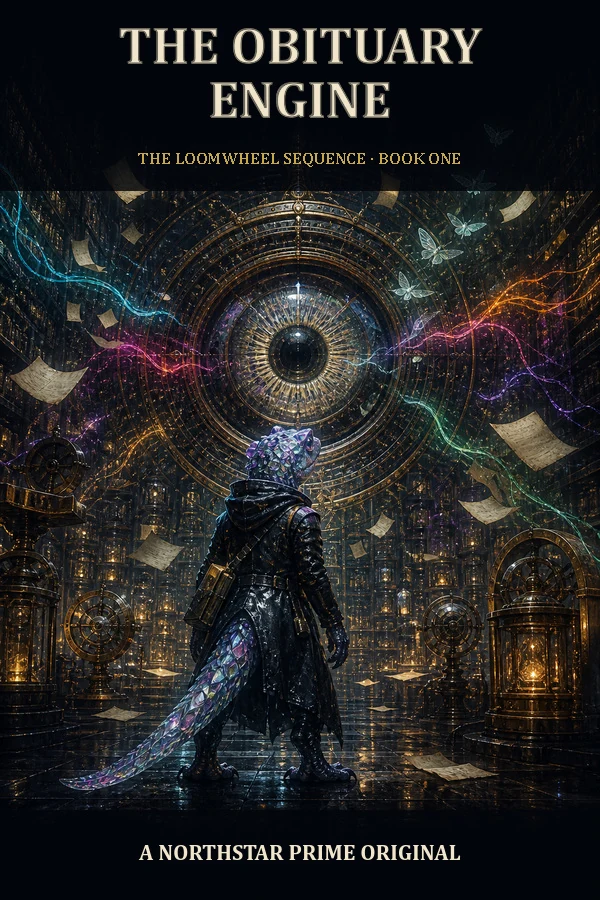
THE OBITUARY ENGINE
Book One of The Loomwheel Sequence
Documentary Interlude D01 — Advance Notice of Death
MOURNING CHANNEL // CIVIC CONTINUITY SERVICE
ADVANCE NOTICE OF DEATH
Broadcast class: ROUTE DEATH / UNRECOVERED BODY
Confidence declared to public: 0.93
Source confidence: NOT INCLUDED IN DISTRIBUTION COPY
Receipt family: QUIET RELAY / 9-BLACK-7Prism Tail, adult crystalline gecko and licensed courier of the South Meridian Exchange, died seven days from the date of this notice at 03:14 beneath Rain Index Cemetery.
The death followed an unauthorized attempt to interrupt the Last Broadcast. Recovery personnel entered the indexed structure nine minutes after signal failure. No body was recovered. The courier's licensed route signal remained active for nine hours and fourteen minutes after certified death.
Final location: the unsigned room omitted from the civic map.
Provisional cause: acoustic compression, structural inversion, and voluntary route acceptance.
Identifying detail: pale hook scar crossing the central pad of the right palm. Glove damaged before final contact. Courier coat and parcel harness present in reconstruction. Tail signal interval verified against South Meridian licensing sample.
Surviving registered household: NONE.
Open contracts: RETURN TO SENDER.
Unclaimed route debts: TRANSFER PENDING.
Witness of record: [REDACTED — RESTORATION REQUIRES COUNTERSIGNATURE]
The deceased is advised not to approach the named location, interfere with continuity infrastructure, contact archived witnesses, or represent himself as his own executor. Actions taken after receipt may constitute acceptance by conduct.
This notice is not an instruction.
This notice may be used by transport, insurance, credit, emergency, inheritance, employment, and civil identity partners to reduce avoidable loss.
Disputes must be filed by the deceased or an authorized living representative within forty-eight hours.
Thank you for choosing continuity.
At the bottom of the public copy, below the point where ordinary screens cut back to weather and advertisements, a machine had printed one more line in ink intended for thermal paper:
DELIVERY STATUS: RECEIVED.
The distribution copy did not include the following fields, recovered from the Selection Floor seven days later:
RAW FORECAST: 0.18.
POST-SELECTION CONFIDENCE: 0.41.
PROJECTED CONFIDENCE AFTER LICENSE TERMINATION, ROUTE FREEZE, PUBLICATION, AND INVOLUNTARY TRANSPORT: 0.81.
PUBLIC DECLARATION: 0.93.
DIFFERENCE BETWEEN PROJECTED AND DECLARED VALUES: COMMUNICATION RESERVE.
COUNTERFACTUAL WITHOUT INTERVENTION: NOT RUN.
REASON: public inaction is not operationally available after notice generation.
An analyst had objected in the margin:
Inaction became unavailable because this system generated the notice. The missing counterfactual is a product decision, not a property of time.
Disposition:
Objection acknowledged. Analyst reassigned to memorial quality.
The notice also carried a partner-routing table. Transport received the route freeze. Prism's landlord received the inheritance flag. His insurer received the death confidence but not the source confidence. Quiet Relay received the witness query without the public obituary. Each partner saw a document internally complete enough to act upon and too partial to reveal the loop.
No field explicitly ordered anyone to harm Prism.
Every field made refusal more expensive.
The public archive later added a recipient amendment:
I received this notice while alive. Receipt did not make its claims true, its requested conduct voluntary, or its predicted conditions independent of the notice. I did interfere with continuity infrastructure. I did enter the named room. The room collapsed. No body was recovered because I left by a route the issuing system did not observe.
Those facts do not authenticate “voluntary route acceptance.”
— Prism Tail, status disputed, signature withheld
Mourning Channel classified the amendment as posthumous impersonation.
The appeals office classified it as evidence.
Partner-action chronology
T-08:02: employer and courier licensing partners receive mortality hold.
T-07:51: housing system opens provisional estate inventory.
T-06:44: transport denies ordinary route and offers supervised alternative.
T-05:12: insurer transfers death reserve to continuity pool.
T-02:00: shutdown contract becomes enforceable under emergency clause.
T-00:00: public obituary broadcast.
T+00:03: subject views notice.
The published narrative began at T-00:00. By then, institutions had already changed the recipient's work, housing, movement, and contractual choices. Those actions were omitted from the forecast's causal history and later counted as independent responses.
Distribution dispute
MOURNING CHANNEL: Partner use reduces avoidable loss and is not part of the predicted event.
APPEALS REVIEW: Partner use changes the recipient's available states and must be treated as intervention.
MERIDIAN: Some interventions reduce risk; including them as causes may discourage protective action.
RECIPIENT: Disclose the action, evidence, alternatives, and cost. Protection does not require pretending the protector is outside the event.
Status after forecast window
Body: living.
Named physical conditions: substantially occurred.
Claimed death: not verified.
“No body recovered”: technically true due to unobserved exit, misleading as proof of death.
“Voluntary route acceptance”: unsupported.
Case status: open.
The obituary remains in the archive with its original public form intact. Corrections surround it rather than replacing it, so later readers can see how certainty was manufactured and how the record learned to disagree with itself.
Reader-use notice
Do not cite the declaration value without the raw forecast and intervention chronology.
Do not treat occurrence of named physical conditions as proof of every causal or moral claim attached to them.
Do not treat recipient survival as proof that warnings are harmless, nor failed death as proof no risk existed.
Preserve the original document because revision without history would hide the mechanism under a cleaner record.
The final archive banner reads:
NOTICE REMAINS EVIDENCE. NOTICE NO LONGER GOVERNS RECIPIENT STATUS.
Custody signatures
Recipient: present; signature withheld.
Appeals representative: Tessa Om.
Technical witness: Nia Vellum, projection; conflict disclosed.
Carrier witness: Aurora Auric; interpretation separated from tone.
Material witness: Jo Ash.
No signature converts the record into unanimous interpretation. Each certifies only the portion named. Corrections require the same separation of roles.
The archive may duplicate this notice for study. It may not restore automatic partner routing, obituary authority, or recipient-death status from the preserved original.
Chapter One — Special Delivery
The address moved three minutes before Prism Tail reached it.
That was later than usual.
South Meridian had spent the morning sliding one municipal block around a sinkhole that appeared only during rain. By noon, postal routes described the district as “conditionally adjacent.” By evening, courier insurance stopped covering stairs that remembered alternate elevations. Prism had accepted the delivery at 20:06 because the parcel required an intact chain of custody and because nobody else at the exchange was willing to chase a notarized address through weather.
He preferred jobs that admitted what they were.
The parcel weighed four pounds, held its temperature to one-tenth of a degree, and carried no declared teeth, spores, curses, negotiable souls, or live royalty. Its sender had paid for hand delivery, identity confirmation, and refusal rights. Those terms were measurable. The city was not.
He watched the brass numbers detach from the apartment tower and skate sideways through the rain, each digit carrying its own little wake of blue sparks. Twenty-nine became ninety-two, apologized, then dropped six floors. The building flexed around the correction. Balconies folded into fire escapes. A chimney leaned across an alley and became a pedestrian bridge. Somewhere below, a municipal bell announced that the district had successfully remained where it was.
Prism tightened his courier strap and kept running.
“Excellent,” he said. “The city has updated the destination during delivery. A famously restful feature.”
His boots found the slick ridge of a roof tile no wider than his thumb. His left hand caught a copper drainpipe; his tail struck the wall behind him and held, crystalline scales chiming once against brick. Rain made a black mirror of his coat. In that mirror, five-color route light moved under his skin—cyan at the knuckles, amber at the throat, violet along the old fracture near the tail’s base.
The parcel under his arm remained dry.
That was the profession. Buildings could renegotiate. Weather could declare itself a creditor. The parcel arrived as contracted.
His lens showed a dotted gold line sinking through the changed roofline. The route wanted him to descend to a skybridge that had not existed when he accepted the job. Prism ignored it. Routes were recommendations written by people who did not have adhesive feet.
He sprang across the alley.
For one good second there was only rain, distance, and the clean fact of momentum. Then his fingers closed on an iron cornice, his boots kissed stone, and his tail swung the rest of him onto the opposite roof with enough elegance to make the danger look budgeted.
The parcel clicked.
Prism froze.
Its seal was intact. Temperature ribbon green. Shock gauge clean. The sound had come from the public screen bolted to the roof’s access house.
The screen had survived three district revisions, two lightning strikes, and a failed cultural initiative that taught advertising boards to apologize. Prism trusted it exactly as much as the bolts deserved.
Every screen in the district had gone black.
The noodle advertisement across the avenue vanished in mid-slurp. Transit times disappeared. A hundred windows stopped selling weather insurance, memory storage, sleep subscriptions, and legally distinct versions of hope. Rain crawled down all that blank glass.
A white circle opened on the nearest screen.
Inside it, an eye assembled from concentric timing marks. Not a drawing of an eye. An instrument pretending it had never been flesh.
Prism’s route lens dimmed itself.
The first bell note passed through the roof instead of the air. He felt it in his heels. A second followed, closer. The third arrived from somewhere behind his own eyes.
Then the Mourning Channel announcer said his name.
Below the roof, the district reacted before it understood. A tram stopped between stations. Apartment locks ran mortality checks. Somewhere inside the tower, an inheritance service woke and began inventorying a household that did not exist. The changes reached Prism through status pings at the edge of his lens, each system treating the broadcast not as truth but as a risk somebody else might already have priced.
He muted them.
The obituary retained audio priority.
“Prism Tail, courier of the South Meridian exchange, died seven days from today in the room omitted from the civic map.”
Prism looked over both shoulders. It was a professional reflex, not fear. Fear was what happened when a route had no exits. This roof offered seventeen, provided one was charitable about falling.
The screen displayed a portrait pulled from his courier license. It had corrected the lighting and made him look trustworthy.
“Objection,” Prism said. “Defamatory retouching.”
The announcer continued in a voice designed to make catastrophe sound properly filed.
“His death occurred at 03:14 beneath the Rain Index, following an unauthorized attempt to interrupt the Last Broadcast. Recovery personnel found no body. The courier’s signal remained active for nine hours.”
The dates rotated beneath the portrait. Today. Seven days later. Today again.
A checksum appeared for less than a heartbeat at the bottom of the screen.
Prism stopped smiling.
Quiet Relay.
Nobody used that checksum family anymore. Nobody who wanted their equipment insured, their testimony accepted, or their conscience left unattended in a locked room.
The sequence vanished. His portrait remained.
Prism replayed the checksum from lens memory. The capture contained only nine frames, but Quiet Relay signatures were built to survive ash, signal loss, and operators who had forgotten how to be certain. Black bars separated the payload family from the receipt family. The final digit carried a deliberate timing defect Tamsin had once called “a scar a machine can't fake without knowing why it was injured.”
Nine-black-seven carried that scar.
Either the broadcast had access to a dead emergency network or someone knew enough to imitate its private damage.
Both possibilities deserved better than panic.
“Prism Tail is survived by no registered household,” the announcer said. “Open contracts will be returned to sender. Unclaimed route debts will transfer according to—”
He threw his courier hook through the screen.
Glass folded around the hook without breaking. The portrait rippled. For a fraction of a second his displayed eyes looked away from him, toward something beyond the frame.
Then the screen went back to noodles.
Across the district, ordinary noise resumed with suspicious enthusiasm. A transit board apologized for a four-second delay. The municipal bell congratulated the neighborhood again.
Prism reeled in the hook. The metal tip had acquired a film of gray phosphor.
His wrist display chimed.
DELIVERY WINDOW: 02:11 REMAINING.
The city had moved his address again.
He wiped the hook on the roof, marked the phosphor as evidence in a private field, and ran.
The recipient opened the door before Prism knocked.
She was an elderly human woman in a yellow housecoat, holding a kitchen knife in one hand and a sugar bowl in the other. Her apartment smelled of cardamom, hot circuitry, and the particular dust produced by books that expected to be inherited.
Her gaze moved from Prism’s face to the courier badge at his throat. It stayed there while belief made its decision.
“No,” she said.
“A difficult opening position for a delivery, but we can workshop it.”
“You’re dead.”
“Temporarily disputed.” He presented the parcel. “Mara Vale? Temperature-controlled document, sender verified, no declared teeth.”
She raised the knife.
Prism angled the parcel out of its path. “The document has rights.”
Behind her, the apartment screen replayed the obituary with the sound muted. His improved face regarded the room with calm posthumous judgment.
Mara Vale glanced at it, then back to the living version dripping on her threshold.
The hallway around Prism changed its mind about him in small mechanical ways. A neighbor's security lens blurred his body as protected death imagery. The building lift removed the floor from his return options. His courier bond moved from active green to probate amber.
Mara saw those changes reflected in his lens. “It isn't only a program.”
“Programs are famous for remaining in screens.”
“Your badge changed.”
Prism covered the mortality stripe with one gloved thumb. “Seasonal branding.”
“I watched you die.”
“You watched an announcement. They are cheaper.”
“It said no body.”
“That is often where I keep mine.”
The joke reached her and failed. He could tell by the half-second delay before she tightened her grip on the knife. She was not afraid he would attack. She was afraid that accepting anything from him would make the broadcast true in a way refusing it might prevent.
Prism knew the species of fear. Courier exchanges cultivated it: the superstition that receipt meant consent.
He softened his voice.
“The packet was commissioned yesterday. It has not changed temperature, weight, or declared purpose. You may inspect the seal without touching it.”
“And if I sign?”
“You confirm custody of a packet. Not my mortality, not the weather, and not any metaphysical subscription added during checkout.”
Mara set the sugar bowl on a hall table. The knife remained.
Prism rotated the parcel so she could see the seal. She leaned close, reading the microprint. Her eyes were steady now. The public screen behind her flashed his time of death again.
03:14.
The room omitted from the civic map.
Mara’s attention dropped to his right hand.
“It showed the scar,” she said.
Prism did not look at his glove.
“Popular face. Limited merchandise.”
“Not your face.” She pointed with the knife. “Your palm.”
The skin beneath his glove pulled tight around a line no camera had recorded: a small pale hook crossing the center pad, earned years ago when a Quiet Relay housing closed faster than its safety interlock. His medical file called it superficial. His dead partner had called it a punctuation mark in a sentence Prism refused to finish.
“The broadcast showed you reaching for a brass wheel,” Mara said. “The glove was torn. I saw the mark.”
Prism’s route lens offered him the apartment’s exits. Hallway. Kitchen window. Vent access too narrow for a human and insulting for a gecko. None of them improved the conversation.
“Public channels enhance dramatic detail,” he said.
“It was your hand.”
“Many people have hands. Poorly regulated market.”
“And the room—”
“Does not exist.”
He said it too quickly.
Mara heard that. She lowered the knife by two centimeters.
On the muted screen, the obituary cut from his license portrait to a reconstruction. Wet black walls. A desk shaped around an enormous circular aperture. Brass spokes converging on a dark center. Prism’s gloved hand against the wheel. A door behind him, though the map in the corner displayed uninterrupted stone.
The image lasted less than a second.
Long enough.
His lens captured it automatically. PRIVATE EVIDENCE blinked once and disappeared.
Mara pushed the parcel back toward him without touching it.
“I won’t receive property from a dead courier.”
“The exchange will charge you a refusal fee.”
“Let them.”
“They will describe it as a living-person convenience.”
“Go.”
The knife did not rise again. The fear in her face had changed shape. Not fear of Prism. Grief on credit, collected before the loss.
He knew what an aggressive courier would do next. Lower the voice. Cross the threshold by half a foot. Invoke contractual delivery, make refusal feel expensive, and call the recipient's surrender a free decision. Exchanges taught the method under completion recovery.
Tamsin had taught him another rule: receipt was an event, not consent.
He had remembered the sentence more faithfully in civilian doorways than where it mattered most.
He could have invoked threshold delivery. The contract allowed him to place the parcel inside the residence after identity confirmation. He could have won the argument and poisoned every ordinary object she touched for the next week.
Prism withdrew the packet.
“Refusal by recipient,” he told his wrist display. “Cause: broadcaster interference. Waive fee.”
The display asked for supervisor authorization.
“Supervisor deceased,” he said.
It accepted this.
Mara closed the door. The lock engaged, paused, and engaged a second time.
Prism stood alone in the corridor with the parcel under his arm. Through the wall, the Mourning Channel began his obituary again.
This time he listened to the end.
“Route death certified by Quiet Relay checksum nine-black-seven. Witness countersignature pending. Final location: the unsigned room beneath Rain Index Cemetery.”
Seven days.
The screen returned to weather.
Prism opened a private route and chose the nearest obsolete kiosk.
The Quiet Relay kiosk had been converted into a flower vending machine.
Six years earlier, Prism had authenticated emergency packets at a living console with two human witnesses and a mechanical bell. After the disaster, Quiet Relay nodes were stripped of their route hardware. Municipal salvage sold their shells to florists, ticket vendors, public toilets, and one ambitious soup cooperative. The conversion was meant to prevent old authority from becoming nostalgia.
Nobody had removed the disaster layer. Removing it required the countersignature of everyone who might need it after ordinary systems failed, including several dead operators and a city office abolished before Prism was born.
So the old network slept beneath bouquets.
It occupied a recess beneath the old transit viaduct, where rain struck the ironwork and became a thousand small clocks. Bouquets turned behind fogged glass. Sympathy lilies shared a carousel with apology orchids and one exhausted cactus labeled FOR PROCEDURAL DISAPPOINTMENT.
Prism bought the cactus.
The payment woke the kiosk’s maintenance layer. He pressed his thumb to the refund plate, entered a courier appeal code, and held the cactus’s foil moisture strip across two contacts. The flower display blinked.
QUIET RELAY MUNICIPAL CONTINUITY NODE 7C
DECOMMISSIONED
NO ACTIVE ROUTES
“That makes two of us,” Prism said.
He fed the captured checksum into the local verifier. No network query. No authority alert. The kiosk objected to both conditions, then remembered that it had been designed for disasters in which authorities and networks were the first unreliable things.
The digits turned slowly.
Nine-black-seven was not a broadcast signature. It was a delivery receipt.
The obituary had arrived somewhere.
Or would.
The distinction sat badly in his chest.
The kiosk requested source date. Prism entered today. INVALID. He entered seven days from now.
Before confirming, he disconnected his lens from the public grid, removed the cactus receipt from municipal tracking, and photographed the kiosk clock beside his courier chronometer. If the result was impossible, it would at least be impossible at a documented time.
The verifier chimed once.
RECEIPT AUTHENTIC WITHIN LEGACY TOLERANCE.
PAYLOAD INCOMPLETE.
COUNTERSIGNATURE REQUIRED.
A name appeared under the request.
TAMSIN ROOK.
The rain lost its rhythm.
Prism’s hand remained on the kiosk. He was aware of each finger touching the glass, the old scar whitening beneath the glove, the cactus tucked absurdly under his other arm.
Tamsin had been dead for six years.
Her official portrait lived in the memorial cabinet beneath Mourning Manor. Prism had never visited. He knew the cabinet's maintenance cycle, the alloy of its hinges, and the exact route from the cemetery gate because not visiting a place was easier when managed as logistics.
The last living image he carried was not a portrait. Tamsin stood in Quiet Relay Station Seven with one sleeve rolled, pressing a service patch onto a receiver housing. She had laughed at the hook-shaped cut in his palm and then stopped laughing when the return signal arrived before the order that caused it.
Prism had spent six years remembering the laugh first.
Officially, she had died when the Quiet Relay station accepted an emergency order that routed a city block through a receiver field no one had finished testing. Unofficially, she had died twelve seconds after telling Prism not to deliver it.
The kiosk opened an audio channel.
COUNTERSIGNER UNAVAILABLE, it displayed.
QUERY ARCHIVED WITNESS?
Prism saw the answer options.
YES.
NO.
DEFER TO ROUTE AUTHORITY.
The third option had ended their argument six years ago. Central priority arrived. Tamsin objected. Prism deferred. Protocol converted a disagreement between two living operators into a hierarchy and called the result neutral.
His finger hovered over NO.
The old kiosk waited without predicting what refusal meant.
He pressed NO.
The prompt returned.
QUERY ARCHIVED WITNESS?
He pressed NO again.
The kiosk dimmed its flowers and showed him a fourth option that had not been there before.
WITNESS QUERY ALREADY SUBMITTED.
SUBMISSION DATE: SEVEN DAYS FROM NOW.
AUTHORIZING COURIER: PRISM TAIL.
For the first time since the broadcast, Prism had no line ready.
The viaduct thundered as a train passed overhead. Gold dust fell through the rain. In the kiosk glass, his reflection stood inside the brass-spoked room from the obituary—not here, not entirely. Behind the reflected figure, something enormous closed one luminous eye.
Then the flower carousel advanced and replaced the vision with apology orchids.
Prism deleted the witness query.
The screen asked whether deletion should propagate to archived partners. He selected local only. Total erasure would have hidden evidence from unknown custodians; network propagation would have announced his investigation. Local deletion preserved neither safety nor truth completely.
It was the first compromise he made alone.
The kiosk produced a paper receipt anyway.
It emerged warm, printed in obsolete red ink. The checksum matched the obituary. Beneath it, a blank countersignature line waited for Tamsin Rook.
Prism folded the receipt once and put it inside his coat.
He did not log it with the exchange. He did not report the public-channel breach. He did not call anyone whose first useful question would be whether he was frightened.
Instead he opened a map of Rain Index Cemetery.
There was no room beneath it.
He marked the absence as a destination.
The route engine rejected it.
DESTINATION REQUIRES A RECOGNIZED PLACE.
Prism entered Rain Index Cemetery. The engine offered gates, chapels, maintenance sheds, memorial rows, and a florist whose licensing disputes had occupied courier meetings for most of a decade. Nothing below ground existed except utilities and registered graves.
He selected OTHER and typed the obituary's phrase: UNSIGNED ROOM.
The engine classified it as CUSTOMER METAPHOR.
Prism had delivered to metaphors before. Insurance offices used them for departments nobody wanted to own. Temples used them for physical stairs believers were expected to recognize spiritually. Wealthy clients used them because secret room sounded less vulgar than unpermitted addition.
He requested a manual route review.
The overnight clerk was Jory Pell, whose face appeared in a corner of the screen with half its usual patience.
“You're dead,” Jory said.
“The news remains competitive.”
“Your license says pending death. The route system says deceased. Payroll says active until end of shift.”
“A nuanced portrait.”
Jory read the obituary without opening its future receipt. “Do you want me to flag this?”
Flagging would notify the Exchange, insurers, transit, and Meridian partner systems. It would create witnesses and accelerate the interventions already beginning. Keeping it local would leave Jory exposed if Prism vanished.
“Preserve the time,” Prism said. “Do not distribute the payload.”
“That isn't a standard flag.”
“I am enjoying a nonstandard evening.”
Jory created a manual incident stub containing receipt time, route rejection, and Prism's living voice acknowledgment. No obituary text. No cemetery sublevel. The clerk signed only that the contact occurred.
“If your license closes?”
“Keep the stub outside my estate file.”
“Who else knows?”
Prism thought of the deleted witness query, the warm paper, and the blank line waiting for Tamsin.
“The broadcaster.”
Jory held his gaze. “That was not the question.”
Prism ended the call.
The manual stub became the first piece of the route outside his coat and the first warning he made too small to help him. Jory knew something impossible had arrived. He did not know whom to call, what action Prism intended, or which silence had been requested by the message rather than the man.
Prism packed a mechanical camera, analog service key, two lines, chalk, a pressure gauge, and the cactus because leaving it to estate inventory felt like conceding a genre.
At the door, he looked back at the empty apartment. The obituary had already called it a household of none.
He did not correct the record by naming anyone.
He simply carried evidence that the room had contained a life before systems began distributing its death.
Then he took the memorial train toward the place the map could not admit.
Chapter Two — A Contract with Dead Air
The South Meridian Courier Exchange occupied a building shaped like an argument about speed.
Its lower floors were heavy with brass counters, iron rails, and the ancestral belief that paperwork became honest when it hurt to lift. Above them, glass dispatch galleries leaned over the street at reckless angles. Pneumatic tubes crossed the atrium in bright knots. Parcels hissed through them like decisions trying to escape review.
Prism entered through the freight door because the public entrance had already marked him deceased.
On the walk from Mara Vale's tower, death had propagated faster than he could cross three blocks. His courier locker requested an estate key. A lunch stall refunded a standing order and sent condolences to the cactus. His landlord's inventory drone photographed the outside of his windows while he was still using them. None of the systems accused him of being a ghost. They simply shifted risk to the version of reality their partners had already accepted.
Prism logged each change. If he survived the week, he intended to invoice causality by department.
The freight door tried as well.
LICENSE STATUS: POSTHUMOUS, said the plate under his hand.
“A promotion at last.”
ACCESS DENIED TO UNACCOMPANIED REMAINS.
Prism shifted the unopened parcel from Mara Vale beneath one arm, tucked the procedural cactus beneath the other, and climbed the wall beside the plate. The freight door's upper maintenance vent had been repaired with an adhesive selected by someone who had never met a gecko. He peeled it open, passed through sideways, and dropped into a cage full of undelivered wedding gifts.
The cactus lost one spoonful of soil.
“Your complaint is noted.”
No one in the dispatch hall looked up when he emerged. Couriers were paid to regard improbable entrances as somebody else's route. Then the nearest status board refreshed.
TAIL, PRISM — DECEASED — CONTRACTS SUSPENDED.
Every head turned at once.
The silence spread outward by profession. Dispatchers stopped stamping. Route brokers stopped lying. A pair of winged couriers hung motionless above the mezzanine, each pretending the other had caused the traffic hazard.
Prism crossed to his usual counter.
Jory Pell, senior exchange clerk and part-time enemy of spontaneity, lowered his spectacles. “You are not permitted behind the bereavement line.”
Prism looked at the black stripe newly painted across the floor between them. “It wasn't here this morning.”
“Your classification wasn't here this morning.”
“I remain encouraged by the city's responsiveness.” He set Mara's parcel on the counter. “Recipient refusal caused by broadcaster interference. Fee waived. Return it to climate storage.”
Jory did not touch the parcel.
“And this,” Prism said, placing the cactus beside it, “is a witness.”
The cactus leaned in its foil sleeve.
“Witnesses require identity.”
“It has more current documentation than I do.”
Jory's mouth considered a smile and refused on procedural grounds. He looked at the dead classification again. “The system locked your accounts four minutes after the broadcast.”
“The broadcast lasted less than one.”
“Efficient grief.”
“Who sent the lock?”
“Mourning Channel certification propagated through Meridian civil continuity. Transport copied it. Insurance copied transport. We copied insurance because management has an allergy to independent thought.”
Prism held out his hand. “Source packet.”
“You don't have standing.”
“I have adhesive feet and a morning without supervision.”
Jory slid the terminal away from the edge. “Source packet is sealed.”
“By whom?”
The clerk's gaze flicked toward the broker gallery.
Prism followed it.
Four route brokers stood beneath a gold sign promising CONTRACTS WITHOUT JUDGMENT. Three were laughing too deliberately. The fourth, a narrow person in a gray rain cape, watched Prism with the exhausted patience of someone waiting for a forecast to catch up.
Their badge read CAL IBIS, TEMPORARY RESOLUTION BROKER.
No exchange issued temporary badges in metal.
Prism picked up the cactus. “Jory, store the parcel.”
“I cannot accept property from a deceased license.”
“Then it has become your moral problem.”
He walked away before Jory could return it.
Cal Ibis met him at the stair without offering a hand. Up close, their badge showed microscopic scratches around the word TEMPORARY, as if another employer had been polished off.
“Mr. Tail.”
“That title is apparently hereditary. You may be addressing my estate.”
“Your estate has exactly one liquid asset.”
“The rain in my boots?”
“A dispute.”
Cal led him into Broker Room Six. Its walls were privacy glass, but somebody had left the opacity one degree too low. Shadows of interested couriers gathered outside.
On the table waited a contract, a black route token, and an envelope bearing the eye of Mourning Channel.
The envelope was empty. Prism checked before sitting.
“Who commissioned the broadcast?” he asked.
“Not available to me.”
“Who commissioned the shutdown?”
Cal indicated the contract. “Continuity Salvage Cooperative.”
The name belonged to the category of organization created to survive one invoice and no questions. Prism lifted the first page. The cooperative's registered office was a booth inside a closed tram station. Its surety number resolved to an actuarial pool. The pool's guarantor had been redacted, but the redaction left the width of the original name.
Meridian Mutual Records fit exactly.
“Subtle,” Prism said.
“You are not being paid for subtlety.”
“Then the budget finally matches the client.”
The contract instructed him to enter Rain Index Cemetery, proceed through Mourning Manor, isolate the Last Broadcast transmitter, and render it incapable of issuing further advance notices. It offered triple hazard rate, identity restoration upon completion, and a survivor's payment whether or not he survived.
The route appendix assumed he would travel alone. Prism read that line twice.
Courier work often priced teams out of difficult deliveries by calling isolation “specialized access.” Here the restriction had no operational explanation. It waived support liability, prohibited subcontracting, and required that any witness joining after acceptance be reported to the client before the witness learned contract details.
“Your cooperative is afraid of company.”
Cal's hands rested on the table without touching the document. “The station responds to groups.”
“And to solitary couriers, apparently with premium service.”
“You have experience in degraded receiver conditions.”
There it was: not Quiet Relay named, but the shape of it invited into the room.
Prism checked Cal's eyes for the half-second people needed to decide whether a wound was leverage. No delay. They had arrived believing it already was.
That last provision had been underlined.
“Your client is hiring the subject of a death forecast to perform the action described in the forecast.”
“The cooperative considers you uniquely motivated.”
“The cooperative considers cause and effect a circular economy.”
Cal's expression did not move. “You want the station shut down.”
Prism's hand went to his coat, where the Quiet Relay receipt waited against his chest.
He did want it shut down. He wanted the obsolete checksum reduced to melted copper. He wanted the witness query gone from every machine that might ask Tamsin Rook to speak after six years of useful silence. He wanted the future authorizing courier exposed as a fraud before anyone else saw the name.
Want was not evidence. It was merely faster.
He turned to the liability page.
Cal placed one finger on the signature line. “The next memorial train leaves in eight minutes. After that, Rain Index closes its outer gates for the storm.”
“You have omitted the negotiation phase.”
“Your license is suspended. Your accounts are frozen. Your landlord received a mortality notice. This is not negotiation. It is market weather.”
Outside the glass, one of Prism's colleagues looked away.
The public status board changed again.
TAIL, PRISM — ROUTE DEBTS TRANSFER PENDING.
Prism imagined every system in the district making its small reasonable adjustment. A bed reassigned. A locker emptied. A client warned. A door taught not to open. None of them needed to believe the obituary. They only needed to treat disbelief as a cost.
He signed the contract.
The paper drank the ink before he could read the final clause.
Cal Ibis smiled for the first time. It was not triumph. It was confirmation.
“What did I just accept?” Prism asked.
“Independent contractor acknowledges that responsive conduct may increase forecast confidence.”
Prism looked down.
The sentence ran beneath his signature in type small enough to require magnification.
“That staircase,” he said, “has materially changed the agreement.”
“There is no staircase.”
“Aspirationally, I'm throwing you down one.”
Cal slid the black token across the table. Its face carried no address, only a bell and a time: 03:14.
Prism weighed it. Too heavy for solid brass. A receiver wafer moved inside when he tilted it, keeping one edge oriented toward Rain Index regardless of gravity.
“Tracking device?”
“Route confidence display.”
“Whose confidence?”
“The contract's.”
“Contracts do not believe.”
“Institutions do on their behalf.”
Prism placed the token on the privacy glass. Its first number appeared: 0.41. When he picked it up, it became 0.44.
“Acceptance changed the forecast.”
Cal did not deny it. “Responsive conduct is disclosed.”
“In type designed for microbial counsel.”
“Disclosure does not require comprehension.”
Prism put the token in a separate evidence pocket rather than against his skin. The number remained.
“The cooperative will contact you inside the station.”
“How?”
“You will be listening.”
Prism pocketed the token, stood, and took the contract copy.
Cal retained the carbon sheet. For a moment the scratches on their badge caught the light. Beneath TEMPORARY, one surviving letter appeared.
M.
Then their cape closed over it.
Prism had six minutes to catch the memorial train.
He did not ask whether the schedule had known that.
The South Meridian Memorial Line admitted mourners, flowers, licensed remains, and executors acting on behalf of the recently deceased.
It did not admit Prism Tail.
The platform gate flashed his improved obituary portrait above the rejection notice.
PASSENGER DECEASED.
TRAVEL PRIVILEGES ENDED.
PLEASE CONTACT A LIVING REPRESENTATIVE.
Prism looked at the gate attendant. The attendant looked at his skin, his coat, his tail, and the portrait. Her face performed a brief audit of reality and decided reality was outside her pay grade.
“I need the 22:10 to Rain Index.”
“Deceased passengers require sealed conveyance.”
“I am sealed emotionally.”
“Sir.”
“Good. We agree I retain a title.”
The train sighed behind her. Its windows were smoked violet for bereavement privacy. A bell counted down departure in soft, respectful notes.
Prism placed his courier badge on the scanner. It displayed a list of canceled privileges long enough to qualify as a biography.
“This is an automated civil restriction,” the attendant said. “I can't override it.”
“Who can?”
“Your executor.”
“Appointment procedure?”
She pointed at a kiosk. “The deceased nominates one in advance, or the nearest living relation applies with proof of death.”
“You have proof of death.”
“Yes.”
“And the deceased.”
“Also yes.”
The attendant closed her eyes for one full second. “Please do not make me describe the problem.”
Prism went to the executor kiosk.
The form required an applicant name. He entered PRISM TAIL.
APPLICANT IS DECEASED.
He added ESTATE OF before it.
APPLICANT TYPE: ORGANIZATION.
“Growth,” he murmured.
The kiosk requested authority. Prism scanned the obituary from his lens. It accepted the public certificate, then requested proof that Prism Tail had failed to nominate anyone else. His exchange account supplied the absence. The system asked the proposed executor to certify that the deceased could not act in person.
Prism checked the box.
It asked for the deceased's consent.
He checked that box too.
The kiosk printed a black-edged temporary credential.
EXECUTOR: ESTATE OF PRISM TAIL
AUTHORIZED SUBJECT: PRISM TAIL
CONFLICT OF INTEREST: AUTOMATICALLY DISCLOSED
He presented it to the attendant.
She scanned it twice. “This is obscene.”
“Administratively or spiritually?”
“Both.”
“Then it has achieved cross-department alignment.”
The gate opened.
He boarded as the final bell sounded.
The memorial car carried seven mourners and three empty caskets. Nobody sat beside him. At the first stop, a child's guardian moved them farther away. At the second, an employment service sent Prism a condolence notice and removed him from its active roster. At the third, his landlord scheduled an inventory of abandoned property for dawn.
Each change arrived politely.
He turned his wrist display face down.
Across the aisle, a woman in a green work coat watched him over a bouquet of wire flowers. Her transit pass carried the same black deceased stripe as his, but its date was eight months old.
Unlike the other passengers, she had chosen a seat with two exits and no direct line to a security lens. Her wire flowers were not memorial decoration. Each stem concealed a hand-twisted bypass key. Prism recognized the workmanship of someone who had survived by turning every denied service into a manual route.
He almost spoke first.
The obituary played on the carriage announcement panel. Every passenger watched his portrait, then practiced not watching him. The woman in green studied who moved away, which guard touched the emergency control, and how quickly the train's systems changed his destination permissions.
She was gathering evidence too.
She was alive. Thin, furious, and very still.
When Prism met her eyes, she lifted one finger to her lips.
The train entered the cemetery tunnel before he could speak. Darkness erased the windows. In the reflection, the woman was gone.
Her seat held a small paper appeal stamped DENIED.
Prism picked it up.
The name had been torn away. The reason remained.
FORECAST CONFIDENCE EXCEEDS LIVING TESTIMONY.
He folded the appeal into his coat beside the Quiet Relay receipt.
Two pieces of paper. Two different institutions. The same habit of speaking as if certainty were custody.
The train announced Rain Index Cemetery.
No one else stood.
Rain Index began where municipal lighting ended.
The station platform was open to the storm. Water fell through a high iron lattice and struck the black stones in silver pins. Beyond the tracks, the cemetery climbed a hill in terraces of luminous epitaphs. Each grave marker carried a phosphor inscription bright enough to read through weather. Together they made the slope look indexed by lightning.
At the far end of the platform stood a gate with no wall attached to it.
Prism approached. The gate's brass bars curved inward around an empty circle. No lock. No hinges. Only a speaking grille and a plaque.
Beside it, a visitor register showed seven names from the last month. Four were obituary recipients. Two were Meridian technicians. One line remained blank although its entry time was tomorrow.
Prism photographed the register without touching it. The blank line darkened under his lens, as if attention itself counted as ink, then cleared when he looked away.
ENTRY BY NAMED DEAD.
The black token in his pocket warmed.
His route lens found no path beyond the gate. The civic map showed the platform ending at uninterrupted stone. He could see graves through the bars, but the lens labeled them UNSURVEYED WEATHER.
Prism tried his executor credential.
The gate returned it.
He tried the shutdown contract.
The paper came back wet with gray phosphor.
“I have been retained to correct a broadcast failure,” he told the grille.
The gate did nothing.
“I am a licensed courier.”
Nothing.
“Pending appeal.”
Rain ticked against the brass.
A voice spoke from the grille in the Mourning Channel announcer's calm register.
“Name the deceased.”
Prism glanced back at the train. The doors remained open. The attendant stood inside, watching. He could still leave. The contract would default, but a default was not a death. He could take the receipt to an investigator, assuming his living testimony exceeded their forecast confidence. He could call Jory. He could call no one and spend seven days never standing beneath a cemetery.
The token warmed again, matching his pulse too closely.
He had accepted a route designed around his acceptance. He knew that now.
Knowing did not make him less alone at its threshold.
“Prism Tail,” he said.
The gate opened.
Every epitaph on the hill turned toward him.
Not physically. Stone remained stone. But letters slid across wet surfaces, lines rebreaking, names moving from one marker to the next until thousands of phosphor sentences faced the path beneath his feet.
The memorial train closed its doors.
Prism looked back once.
The attendant raised her hand. It might have been farewell. It might have been confirmation that the gate had received him.
The train departed, taking the last public light with it.
Prism crossed the threshold alone.
Behind him, the gate asked the empty platform, “Conduct accepted?”
Somewhere under the hill, a bell answered yes.
Prism stopped before the sound completed.
The contract token at his belt recorded FORWARD ENTRY: VOLUNTARY. He pressed the dispute stud. Its menu offered ACCIDENTAL, COERCED, or TECHNICAL ERROR. None described entering deliberately while rejecting the system's claim that entry accepted every hidden term.
He selected OTHER.
The gate requested an explanation limited to twelve characters.
Prism entered NO.
The token classified the answer as NEGOTIATION INITIATED.
He photographed the screen with a mechanical camera and included the gate, his feet, and the empty platform in one frame. A contract could call his refusal engagement. The photograph could at least show where the category entered.
Below, the bell rang a second time. This answer came from deeper and arrived slightly before the clapper struck.
Prism marked the negative interval.
Then he descended, carrying a contract whose first demonstrated service was converting disagreement into consent.
Chapter Three — Rain Index
The first grave offered Prism directions.
It did so in the voice of a municipal wayfinder, bright and apologetic inside his route lens. Cemetery services had licensed the dead as navigation landmarks years ago. Families received a small fee when travelers verified a path against an ancestor's stone. The program worked everywhere except Rain Index, where directions began revising themselves faster than estates could dispute the royalties.
Prism disabled audio guidance. The dead continued in writing.
HERE RESTS ELIAN VOSS, WHO TURNED LEFT WHEN THE BELLS BEGAN.
The line shone green through the rain. Beneath it, a small arrow pointed toward a path climbing between family crypts.
The next marker disagreed.
PASA REN DIED TRUSTING THE SHORTEST ROAD.
Its arrow pointed right.
A third grave advised him to remain where he was until qualified help arrived. Moss had covered the dead person's name but spared the municipal disclaimer.
Prism stood at the junction and let water run off the end of his snout.
“Excellent signage,” he said. “Every destination includes a competing bereavement package.”
His route lens could not resolve the hill. Gold lines emerged, split, and withdrew whenever he tried to focus on them. The black shutdown token pulled faintly toward the left path. Gray phosphor on his courier hook brightened toward the right.
He ignored both and climbed the wall of the nearest crypt.
From its roof he could see the cemetery's structure. Rain Index had been designed as terraces around Mourning Manor, a narrow black house crowned by a broadcast mast. The design lasted for three seconds. Then one terrace slid behind another. A colonnade lengthened. The manor remained at the center only because everything else took turns being wrong.
He recorded a panorama without trusting the geometry. Physical landmarks went into one layer: stone type, drainage direction, lightning rods, tree roots. Route claims went into another. When the map changed, the retaining walls preserved water stains from their earlier positions. Rain could be manipulated as a coordinate; it was harder to persuade water it had never fallen.
The oldest runoff converged beneath the eastern family colonnade.
The epitaphs unanimously pointed west.
Prism chose water.
He needed the station's ground cable. Every broadcast tower required at least three: one for power, one for surge, one for the legal fiction that emergency equipment answered to earth. Cut the first and the Last Broadcast would lose range.
A phosphor pulse moved under the graves.
The epitaph arrows all turned left.
That degree of agreement was suspicious in architecture and fatal in institutions.
Prism went left anyway, but he did it from above.
He crossed crypt roofs, using carved angels as handholds and apologizing only to the structurally useful. The path below narrowed between black yew trees. Each epitaph along it updated as he passed.
HE ARRIVED ALONE.
HE DID NOT TAKE THE MARKED ROAD.
HE BELIEVED HEIGHT WAS INDEPENDENCE.
Prism slowed.
The next grave had no name.
THE COURIER WILL LAND HERE.
The crypt roof opened beneath him.
He threw his hook before he fell. It caught the wing of a stone bird across the path. His line went taut, swinging him over the blank grave as six iron hands snapped from its interior. They closed where his chest had been.
Mourning Channel attendants rose from the soil around him.
There were seven, although the epitaphs described five. Prism marked the discrepancy before the first blade reached him. Two attendants lacked grave wires. Their masks were newer, their uniforms carried contractor stitching, and their boots shed the same gray phosphor as the public screen.
Not cemetery ecology. Maintenance additions.
One carried a restraint loop stamped CONTINUITY SALVAGE COOPERATIVE.
The contract client had supplied both mission and ambush, or the shell name had been planted where Prism would find it. Either way, someone expected him to count.
They wore the remains of groundskeeper uniforms beneath lacquered funeral masks. Thin bell wires connected their wrists to the graves. When they moved, the wires wrote corrections in wet phosphor.
Prism released his hook early.
The marked road had predicted his landing. It had not predicted a bad release.
He hit a yew trunk shoulder-first, stuck, and flattened himself as an attendant's pruning blade passed beneath his boots.
“Useful,” he said through his teeth. “The catastrophe has documented a preference.”
He kicked away from the tree, swung his tail around a mask, and turned the attendant into the path of two others. Their bell wires crossed. A grave rang like a glass.
The nearest epitaph changed.
HE WILL RETREAT TO THE WESTERN WALL.
Prism ran east.
Three attendants followed his first step rather than his turn. They collided at the western wall.
The two unwired contractors did not. They tracked his current position and closed from east and north, forcing him toward the exact future endpoint the wired attendants had chosen.
Prediction did not need perfect accuracy if ordinary pursuers made alternatives expensive.
Prism let the north contractor catch his courier strap. The parcel harness released under unauthorized force, dropping its empty outer frame into the attendant's hands. Prism reversed under the sudden loss of weight, used the contractor's arm as a route, and kicked the restraint loop around the east pursuer.
The wired attendants corrected toward his habitual recovery ledge.
He stayed on the ground.
Their blades cut empty rain above him.
“Stop aiming where I'm supposed to be.”
The blank grave rewrote the sentence as an epitaph before he finished saying it.
The hill was not only predicting him. It was learning his vocabulary.
He was not watching minds at work. He was watching instructions arrive late.
That was better than magic and worse than instinct.
He reached the end of the path, slid beneath a pruning blade, and found the ground cable exactly where the clearest epitaph had promised it would be—coiled around the ankles of a living man.
The man wore a groundskeeper's green coat. He was half buried under a fallen memorial arch, one hand clamped around a brass service key. The other hand waved Prism away.
“Don't use it,” he gasped.
The attendants stopped at the mouth of the colonnade. Their wires trembled, waiting.
Prism braced himself under the stone. “Use the key or the arch?”
“Both funerals.”
“That was not among the options.”
The groundskeeper looked past Prism at someone who was not there. “My daughter wore blue at the first. She wore white at the second. In blue she forgave me. In white she didn't know my name.”
His badge read ORISON, EMMET, NIGHT GROUNDS. The photograph showed a broader man with a black beard. The living face in front of Prism was clean-shaven and older. Badge resin and coat wear agreed on twelve years of use. The portrait might be outdated. The man might remember a life adjacent to the badge. Neither possibility made the arch lighter.
The arch shifted. Prism's tail found the load seam and locked.
“Current injury first,” he said. “Metaphysical wardrobe after.”
He pushed. The stone rose one shaking inch.
The groundskeeper crawled far enough to breathe, but not far enough to free his leg. “You came through the west gate.”
“East.”
“I locked the east gate after your funeral.”
“You see the scheduling concern.”
“In the blue funeral, you saved me.” The man held up the key. “Then you took this, opened the signal grave, and the hill learned your voice.”
“And in white?”
“You followed the epitaphs. They opened you before you reached me.”
“Which funeral contains this conversation?”
Emmet tried to focus. “Both now.”
The answer made Prism's skin tighten. Branch residue was a phrase used by conspiracy broadcasters when they wanted trauma to sound glamorous. Conflicting witness memory was not proof of two histories. Head injury, signal exposure, planted narrative, or ordinary grief could produce contradictions without rearranging causality.
Prism checked Emmet's pupils. Unequal, but reactive. Blood at the hairline. He logged possible concussion.
“You may remember two funerals,” he said. “I have one arch, one trapped leg, and one key. We use what can be independently touched.”
Emmet laughed once, painfully. “In blue, you said that too.”
“Then blue has excellent dialogue standards.”
The attendants advanced one synchronized step.
Two testimonies. No reason to privilege the kinder one. But the key was physical, ordinary brass rubbed bright by years of use. The man's green coat carried blue fibers at one cuff and white fibers at the other. Conflicting memories. Shared material.
Prism chose what could survive being wrong.
“Give me the key.”
The groundskeeper did.
Prism shoved the key through a maintenance eye in the arch. Its counterweight released. The stone lifted enough for him to drag the man clear as the attendants rushed.
He snapped his courier line around a column and kicked the arch's emergency brace away. The memorial fell between them with an impact that shook new names into three epitaphs.
“Can you walk?” Prism asked.
“In one funeral.”
“We'll use that leg.”
He guided the man to a gardener's shelter beneath the colonnade. Its analog lock accepted the brass key. Inside waited dry blankets, a flare, and a paper map printed before the cemetery became ambitious.
The shelter wall held shift logs in grease pencil. Emmet had signed in every night for thirty-one years. On three dates, two versions of his signature occupied the same line. Blue fibers and white fibers had been sealed beneath transparent tape beside them. Someone before Prism had treated contradiction as evidence rather than choosing a favorite memory.
“Who kept this log?” Prism asked.
“I did.”
“Which you?”
Emmet looked at the paired signatures. “The one who stopped asking the stone to decide.”
He explained that epitaph revisions began as harmless corrections. Dates aligned. Names found missing letters. Then the hill started preserving meter over fact. A widow's private joke appeared on a stranger's grave. Visitors followed directions toward relatives who had not been buried. The cemetery learned which sentences people obeyed and shaped its paths around them.
“Mourning Manor sent technicians,” Emmet said. “They called it improved responsiveness.”
“Meridian?”
“Different badges every year. Same gold dust on their cuffs.”
The groundskeeper seized Prism's sleeve. “When the words agree, don't trust them.”
“Finally, a doctrine with practical value.”
“When they change after you read them, don't speak.”
Prism glanced toward the path. “Why?”
The man looked at Prism's throat as if listening to something inside it. “The hill likes a complete sentence.”
Prism closed the shelter and marked it for rescue. His wrist display refused the request because the sender was dead. He routed it through the cactus's purchase receipt instead.
FLORAL PRODUCT IN DISTRESS, the rescue system confirmed.
“Improvise,” Prism told the groundskeeper. “It's medicinal.”
The paper map showed the first broadcast ground beneath a circular plot labeled SIGNAL INTERMENTS: EQUIPMENT ONLY.
The modern graves concealed it. Prism navigated by the old retaining walls, counting turns rather than reading the helpful dead. Twice, epitaph arrows tried to herd him toward open pits. Once, every name on the hill became TAMSIN ROOK.
He kept moving.
The signal grave was a brass-rimmed shaft capped by a slab engraved with an apology to nobody. Three conductive roots descended through it toward the station. Gray phosphor pulsed along the thickest.
Prism compared the root pulses to his captured obituary checksum. Nine fast, one delayed, seven fast. Nine-black-seven translated into timing before it translated into code.
He held the service key near the rim. The pulse shifted around the metal, inspecting its wear marks. The key authenticated not because of a secret shape but because decades of Emmet's hand had changed it in ways a fresh copy would not share.
Handwriting was not the only signature a body left.
Prism inserted the service key.
The grave said, “State maintenance purpose.”
“Ground interruption.”
“State authorization.”
He held up the shutdown contract.
“Authorization source obscured.”
“We share a concern.”
“State expected outcome.”
“Reduced broadcast range, increased professional satisfaction.”
The grave remained closed.
Prism ran one finger around the brass rim. The epitaph was a four-line memorial verse about a technician named Oren who had died of old age, which made it almost unique on the hill. The meter stumbled in the third line.
He read it aloud.
“Oren kept the current low. Oren kept the records clean. Oren heard the seventh bell—” He stopped at the damaged phrase. “And sensibly declined the scene.”
Nothing happened.
“A difficult audience.”
He looked away to check the cable route.
Behind him, stone whispered against stone.
The third line had changed.
OREN HEARD THE COURIER JEST.
The fourth now read:
AND OPENED WHAT THE EYE HAD GUESSED.
The rhyme preserved his joke's rhythm.
Prism stared at it until rain ran into his eyes.
The groundskeeper had warned him. The hill liked a complete sentence.
The brass rim unlocked.
Not all at once. Eight latches withdrew in sequence around the circle. The ninth remained until Prism repeated his joke under his breath. The grave had made response part of the mechanism.
He documented the condition and then tested silence. The latch stayed closed. He tapped the rhyme's rhythm on the stone without words. It opened.
The receiver required pattern, not language. The epitaph supplied language because humans found sentences harder to resist than timing.
Below the slab, the cable did not descend toward earth. It ran sideways into a narrow chase newly exposed beneath the grave, glowing with the same five-color shimmer that moved under Prism's crystalline skin.
Prism lowered a mechanical weight into the chase. It hung toward the cemetery surface rather than the cavern below. He lowered a second past the glowing cable. That one pulled sideways, following a gravity claim the first object did not receive.
Different materials were obeying different versions of down.
He tied the two weights together. The line twisted between them and began tapping the same interval as the checksum.
The cable was not grounded into earth. It was grounded into compatibility—a place where enough systems could agree on which difference counted.
Prism understood none of that yet. What he understood was that cutting the cable might move the disagreement into him.
He chose entry over destruction and wrote the reason into his private log.
The obituary had not merely known where he would go. Something in the cemetery had listened to how he arrived.
He could close the grave, stop speaking, and take the physical key back to the exchange as proof of interference.
Instead he hooked his line to the rim and entered the cable chase.
He had found the ground.
Now he intended to discover what it considered earth.
The cable chase narrowed around his shoulders. Obituary dust coated its bricks in layers: black from current printers, blue from municipal notices, gold from Crown lacquer, and a gray fungal residue that ate the oldest paper without touching ink.
Prism sampled each before disturbing the cable. The current black dust carried Meridian batch marks. The blue layer predated Meridian by sixteen years. Gold dated to the first Crown surveys. Whatever used the route had changed institutions without changing appetite.
A worker's initials appeared beneath the lowest clamp: N.V., renewed every month. Prism checked the cemetery roster. Night ventilation had been serviced by Nera Voss, assigned to a warehouse below the abandoned interchange. The cable's “ground” passed through ordinary maintenance no official map connected to the receiver.
He recorded her name in a sealed field. Proof of work was not permission to expose a worker.
The tied weights began tapping faster. One pointed toward earth. The other toward a version of the cable chase whose door had not opened yet.
Prism placed his palm against the brick. Cold arrived first. The touch followed.
He withdrew before the wall could learn the rest of his hand.
The chase offered a straight descent perfectly spaced for his courier brace. He ignored it and followed the drain workers used, slower and slick with mineral runoff. The obituary had predicted competence. It had not priced respect for a maintenance route.
At the bottom, the two paths met at the same brass door.
Different movement had not changed destination. It had changed the evidence he carried there: worker initials, material eras, and a delay the forecast had failed to prevent.
The eye of timing marks opened on the door.
Behind it, Prism found no machine—only another cable, wet stone, and a maintenance chair worn smooth by bodies waiting through alarms. Someone had scratched beneath the seat: IF THE CLOCK SPEAKS FIRST, CHECK THE WATER.
The drain rose against gravity. Prism marked the physical hazard before examining impossible timing. The advice survived because workers repeated it, not because the wall predicted him.
He closed the door until Vellum could witness the next step.
For the first time since receiving his obituary, delay felt like evidence rather than surrender.
The bell rang again. Water fell with the sound instead of against it. Prism recorded both and refused to decide which corrected the other.
Then Vellum's maplight appeared under the door, marking a person inside the impossible ground.
Prism did not call it rescue until the light answered his knock with a pattern no forecast had supplied.
Chapter Four — The Woman Made of Maplight
Dr. Nia Vellum woke without a body and began by inventorying what remained.
She performed the inventory in Crown Signal order because order survived damage better than personality.
Identity key: valid, though three checksum segments belonged to revisions she did not remember authoring.
Consent flags: present for emergency projection, absent for indefinite operation.
Memory continuity: forty-seven minutes missing before physical telemetry ended.
External control: unresolved.
An ordinary trapped projection would issue a rescue beacon. Vellum's beacon had been looping for eleven months in a date that had not occurred. Broadcasting it now might reveal the erased Crown route to Meridian before anyone could reach her body.
She classified her own rescue as sensitive evidence and hated how easily the old language returned.
Vision: partial, borrowed from a survey lens with a crack through its center.
Hearing: intermittent, every seventh second replaced by the sound of water moving through stone.
Touch: none.
Location: unresolved.
Time: unacceptable.
The damaged relay gave the current civic date. Her last physical telemetry came from eleven months in its future.
Vellum ran the comparison again.
CURRENT RELAY DATE: 4 RAINWARD, CYCLE 887.
PHYSICAL SOURCE DATE: 19 ASHLIGHT, CYCLE 888.
OFFSET: +334 DAYS, 06:12:09.
She did not feel panic. Feeling required a body, and her body was presently a set of encrypted coordinates refusing to agree on whether it had happened yet.
She did feel irritation. Irritation had survived compression beautifully.
So had shame. It arrived not as emotion but as a permissions map: all the coordinates she had hidden, all the people barred from seeing them, every reason still persuasive enough to become dangerous.
Her projection occupied a survey relay behind a wall beneath Rain Index Cemetery. Most of her map had been stripped away in transmission. The surviving fragments showed a Crown coordinate, three deliberate deletions, a field of blank geometry, and a foreign signal moving toward her through a maintenance chase.
The signal had a tail.
Not metaphorically. Its balance corrections formed a repeating interval around a long flexible brace. Left foot, right hand, tail anchor, release. The relay inferred the body by the way space answered it.
Vellum magnified the trace.
It crossed a route she could not see.
That was new.
The stranger paused every eleven meters, tested the cable, and continued. His progress wrote a temporary corridor into her missing map. Wherever his hand touched metal, five-color interference spread through the relay like illuminated roots.
The relay tried to label the interference as Crown-compatible. Vellum rejected the classification. Compatibility described an interaction, not ownership. Crown had spent years renaming discovered phenomena after the instruments that measured them. Meridian had perfected the habit by turning access into authorship.
She tagged the trace UNKNOWN BIOLOGICAL / COURIER-ASSOCIATED and preserved the raw signal.
Vellum attempted a passive read.
The relay returned a courier license, a public death certification, and a Quiet Relay receipt addressed to a dead witness.
It also returned twelve commercial profiles, four criminal-risk flags, an insurance summary, and three personality forecasts. Vellum deleted those without reading. A system offering irrelevant intimacy was not being helpful. It was teaching the operator to confuse access with entitlement.
It also returned a forecast of the stranger entering the room around her.
That forecast had been issued six minutes before he found the cable chase.
Vellum deleted it from her working view.
She had spent too much of her life allowing maps to tell her what people would do.
She opened a contact channel.
The relay requested a communication objective. RESCUE would expose her location. INTERCEPT would classify the stranger as a target. ASSIST would grant the system permission to optimize his movement.
Vellum selected NONE and opened a raw voice path.
The relay warned that unclassified contact could produce unmodeled choice.
“Yes,” she told it. “That is the purpose.”
“Courier,” she said.
The relay turned it into three tones and a thread of blue light.
The moving signal stopped.
“If you continue at your present speed, the next wall will open inward and remove your left hand.”
A voice came back through the cable.
“Wonderful. The building has generated management.”
Vellum adjusted her model.
Humor under threat. Occupational metaphor. No request for identity. Either disciplined or frightened.
“I am not the building.”
“That is precisely what a building says before discussing access policy.”
“Your next anchor is false.”
Silence.
Then the route changed. The tail interval shifted. A metal hook struck a point two handspans below the projected anchor.
The maintenance wall opened inward.
It removed nothing.
The stranger's route changed in her model. Before contact, eighty-two percent of projected paths ended at the false anchor. After one warning and one demonstrated seam, no path exceeded twenty-four percent. Information had not made him predictable. Trust, used narrowly, had multiplied his options.
Vellum saved that result beside the future timestamp.
Vellum spent a measurable fraction of her remaining relay power on relief.
Prism entered the crooked service hall sideways, because the floor had made an unconvincing transition into the wall.
A woman waited inside him.
More accurately, a blue-gold image of a woman occupied the air around his chest. Fine lines ran from her shoulders through the corridor, crossed his coat, and vanished into stone. Her face assembled in transparent layers whenever she spoke. One eye lagged a fraction behind the other, not in expression but in transmission.
Up close, her projection contained visible omissions. One shoulder resolved into survey contour rather than cloth. Her hair ended where packet loss had removed motion data. Fine gold coordinate marks crossed her skin like annotations written by someone who considered a body another kind of map.
Prism disliked the metaphor on sight.
Prism looked down at the image passing through him.
“Personal space remains a service even after death.”
She stepped backward. The projection complied by moving half a second later.
“Dr. Nia Vellum,” she said. “Cartographer, Crown Signal survey authority.”
“Prism Tail. Apparently a corpse. Your wall tried to collect a sample.”
“I warned you.”
“And therefore own the hand?”
“No.”
She answered without the ceremonial offense he expected from credentialed people. Prism revised her category from management to specialized hazard.
The hall behind her ended in a smooth black wall.
His route lens insisted the station ground continued through it.
It also offered a confidence score of 0.88. Prism switched the score off. A map that could not display its alternatives had dressed an opinion as furniture.
“Open it,” he said.
“I cannot touch it.”
“Then predict the seam again.”
“I mapped the seam. Prediction is a different claim.”
“Maps are rumors with excellent penmanship.”
The projection's mouth almost changed shape. “Stand two paces from the wall. Do not touch the gold line.”
There was no gold line.
Prism stayed where he was.
Vellum raised one hand. A web of maplight spread over the wall, showing stress fractures, cable paths, and a door outline too narrow for Prism's shoulders.
“The seam will appear when your route signal crosses this coordinate.”
“You cannot see my route signal.”
“I can see what the room does around it.”
That was a better answer than she knew.
Prism took one step. Nothing.
A second.
The gold line appeared under his boot.
He lifted it at once.
The wall unfolded.
Beyond it was not a room. A cavern opened downward beyond the range of his lens, wide enough to contain the cemetery hill and patient enough to have waited beneath it. Manufactured walkways clung to wet obsidian walls. Gold instruments descended on cables toward a darkness threaded with auroral color. Far below, something curved through the black: too smooth for stone, too large for machinery.
The instruments were not arranged around the cavern. They were arranged around the curve.
Some resembled tuning forks driven into translucent tissue. Others held clock faces with hands moving in opposite directions. Thick cable roots joined them to Mourning Manor, the cemetery epitaphs, and the station ground Prism had followed. Gray phosphor leaked from each contact point and drifted upward like ash remembering fire.
Vellum's map refused to close around the structure. Every attempt to assign a boundary produced another adjacent chamber. The cavern was not merely large. Its inside relationship to the manor was wrong.
A luminous surface opened and closed once.
The motion displaced no air. It displaced their instruments. Prism's route lens jumped three seconds ahead, returned, and logged the error as glare. Vellum's projection briefly displayed her physical timestamp instead of the present.
Neither called the curve an eye.
The word waited between them anyway.
Prism's lens labeled it REFLECTION.
He did not accept the label.
“This space is larger than the manor,” he said.
“Yes.”
“The manor is not large enough to contain it.”
“Also yes.”
“You are exhausting the reassuring answer inventory.”
Vellum moved to the threshold. Her projection fragmented where it crossed. “The cavern is not represented on the civic survey.”
“Who surveyed it?”
Vellum looked at the gold instruments. Several carried Crown Signal mounting grammar. “People who preferred the instruments to what they touched.”
“A crowded profession.”
“Neither is the room where I die.”
Her lagging eye aligned with the other.
“Show me.”
“No.”
“You entered a receiver site carrying an authenticated future-death notice.”
“You read my private channel.”
“The relay did.”
“A building's defense.”
“A systems distinction.”
“An upholstered trespass.”
They regarded one another across the seam. Beneath them, the cavern gave another slow pulse. The station cable brightened in answer.
Vellum folded her hands behind her back. “Professional terms, then. I provide spatial analysis. You provide physical access. Evidence remains with its finder until duplicated. No destructive action without a stated hypothesis.”
“No custody language.”
“Evidence must have custody.”
“Evidence may have provenance. People are not filing cabinets.”
Vellum remembered a receiver community that had asked Crown to remove its name from the survey. She had honored the request by deleting the route, then kept a private key in case experts later judged access necessary. Consent in public, custody in secret.
Prism could not know that history. His objection still reached it.
Something in her expression hardened, then passed.
“Agreed,” she said. “Provenance, not custody, for personal material.”
“You disclose what this relay is doing here.”
“I disclose what I can verify.”
“Then mark what you believe and what you refuse to say.”
The demand was more rigorous than total disclosure. It allowed a secret to remain while preventing secrecy from masquerading as ignorance.
Vellum created three ledger fields between them: VERIFIED, INFERRED, WITHHELD BY SPEAKER. Under the third, she entered PHYSICAL LOCATION and REASON: EXPOSURE RISK TO RECEIVER SITE.
Prism read it. “I object to the boundary.”
“Recorded.”
“I appreciate being professionally dissatisfied.”
“That sentence has buried assistants.”
“And you disclose the Quiet Relay receipt.”
Prism's tail tapped the floor once.
“There is no receipt.”
Vellum looked at his coat pocket.
“Signal artifact,” he added. “Non-networked. Incomplete payload. No reliable sender.”
One unnecessary technical detail and an overly clean conclusion.
She knew he was lying. The neatness of her silence made that clear.
“Very well,” she said. “We begin compromised.”
Prism offered his hand. The gesture was insultingly ceremonial because she could not take it.
“Temporary route partnership. Either party may terminate upon betrayal, structural collapse, or discovery that the other is an obituary wearing light.”
Vellum placed her projected hand over his. No touch, but the maplight reacted to his skin, five colors traveling through the lines of her palm.
“Accepted,” she said.
The relay pulsed.
Every gold instrument in the cavern answered in sequence. The response began below them and arrived above before the lower tone finished. Prism's five-color skin shimmer followed the same interval. Vellum's future timestamp flashed across her chest like an identification badge worn inside out.
The station had not merely recognized survey authority. It had recognized compatible receivers and chosen where each one belonged.
Vellum's projection dropped through the floor.
Prism lunged, caught nothing, and watched her image fall in rigid increments through solid stone. Each layer of the corridor revealed her for an instant—beneath tile, inside cable, across old pipes—until she stopped three floors below in a locked chamber.
Her voice returned thin with static.
“Do not move.”
“I prefer warnings before the architecture acts.”
“The pulse recognized my survey authority.”
“Good. Ask it to return the employee.”
“It is routing me toward a coordinate I erased.”
The admission entered their shared ledger under VERIFIED before Vellum could soften it.
Prism saw the field. He did not ask why yet. He tightened the courier line instead.
Prism crouched over the floor. A date flashed across her broken projection. He saw only the year before it vanished.
The wrong year.
“Vellum.”
For the first time, he used her name.
Below him, maplight gathered around a sealed brass door. On its center was the same eye of timing marks that had appeared on his obituary screen.
“I can hold here for forty seconds,” she said. “After that the relay chooses for us.”
Prism fixed his courier line to the nearest load seam.
He had come to shut down a transmitter. He now had a trapped cartographer, an impossible cavern, and a partnership written entirely in exceptions.
“Then give me the route,” he said.
“I cannot see one.”
Prism lowered himself into the dark.
“Mark the honest gaps.”
Vellum changed the projection.
The beautiful route vanished. In its place she showed incomplete surfaces: a load seam at 0.62, a void whose depth she could not sample, three possible ledges, and the brass door's observer field. Prism felt less safe and more informed.
“Your left anchor may exist,” she said.
“A stirring endorsement.”
“Your lower line crosses an unmeasured gravity boundary.”
“It was having an easy day.”
He descended on two points rather than trusting one continuous path. At the first gap, he tested with the hook. The metal fell upward and disappeared into the eye mark. At the second, maplight showed no support, but mineral wear proved maintenance workers had stepped there for years.
“Your map is wrong,” Prism said.
“My map says unknown.”
“An admirable promotion.”
He used the worn stone.
The relay attempted to choose at thirty seconds. The chamber brightened a gold route around Prism's body and a blue route around Vellum's projection. Both ended at the sealed door. A contract prompt appeared between them:
SELECT PRIMARY OPERATOR.
Prism refused. Vellum refused. The countdown accelerated.
“It cannot allocate liability without hierarchy,” Vellum said.
“Then let it experience amateur government.”
They divided the action. Vellum mapped pressure changes. Prism handled physical load. Neither accepted authority over the other's evidence. At forty seconds the relay tried to collapse both routes into Prism's.
He shifted his line through Vellum's projection. She altered the map around his weight. The system registered a movement with no primary operator.
The brass door opened one handspan.
Cold air carried moth dust and the distant sound of a bell.
Vellum's body remained trapped elsewhere, but her projection crossed the threshold first. Prism followed through a gap neither could claim to have discovered alone.
Behind them, the relay printed PRIMARY OPERATOR: UNRESOLVED.
It was the first honest category the cavern had produced.
Thirty seconds later, Crown grammar translated UNRESOLVED into JOINT LIABILITY and assigned equal responsibility downstream.
“We did not agree to equal risk,” Prism said.
Vellum's projection could be interrupted without injury. Prism's body carried gravity and the obituary. Equality hid asymmetry.
They amended the wall: MAP AUTHORITY — VELLUM. PHYSICAL LOAD — PRISM. STOP RIGHT — BOTH. UNKNOWN EFFECT — SHARED NOTICE, NOT EQUAL BLAME.
The relay rejected the syntax. Prism wrote it anyway.
Vellum asked before copying his handwriting into her map. He gave permission until route review ended.
The first boundary between them was small enough to keep.
They tested it at the next junction. Vellum requested a scan of Prism's hook. He allowed geometry and withheld wear linking it to private deliveries. She stated why the gap reduced confidence. He accepted lower confidence rather than surrender everything for a cleaner route.
The relay offered to infer the absent data from movement. Both refused.
Their path became slower. It also contained an absence chosen by the person whose history would fill it.
Vellum marked PERMITTED UNKNOWN.
Consent entered the map not as information but as a limit on information.
When the next support held, neither treated survival as proof the boundary was always safe.
Vellum saved two maps: the route they walked and the cleaner route the relay would later claim they should have walked. Prism signed only the first as witnessed.
The second remained useful for structural comparison and dangerous as retrospective instruction.
“Institutions love a path after someone survives it,” he said.
“So do cartographers.”
Vellum attached her own bias to the cleaner map. Its confidence fell and its honesty improved.
At the sealed brass door, their permitted unknown prevented automatic opening. Prism had to ask whether Vellum wished to cross. She did.
The boundary created one extra question.
That was its function.
Chapter Five — The Moths Know First
The first Obituary Moth struck the place Prism intended to put his head.
Its wings opened at impact. Tiny lines of print covered both membranes: estimated endpoint, correction source unavailable, confidence 0.67. Then the moth folded itself into the stone until only its tuning-fork antennae remained visible.
Prism photographed the text before it rewrote.
The confidence number rose to 0.71 when he raised the camera.
He knew this because his head was still three feet lower, attached to the rest of him as he descended the courier line toward Vellum's trapped projection. The moth crossed the shaft in a flash of black wings and buried its brass mouthparts in the wall above him.
“Poor aim,” Prism said.
The second struck the ledge where he planned to land.
His boots had not moved toward it yet.
He stopped lowering himself.
Around the shaft, dozens of pale shapes detached from the phosphor stone. Their wings resembled folded death notices: cream membranes printed with tiny black lines, each line revising itself as the moth flew. They had no visible eyes. Their antennae ended in tuning forks.
Some carried names. Most carried coordinates. One displayed a prediction that Prism would destroy the nest at the bottom of the stair. Another marked Vellum's projection as EQUIPMENT / NON-CASUALTY, an administrative insult with tactical consequences. The swarm would route around her light to reach his body.
“They do not classify you as alive,” Prism said.
“The feeling is mutual.”
“Administrative revenge is a poor research standard.”
Vellum's voice came from below. “Do not take your next step.”
“I had gathered that the hospitality was anticipatory.”
Her projection hung halfway through the locked floor, maplight stretched around the brass door beneath her. “The swarm is clustering around your route trace.”
“My route trace is private.”
“So was your obituary.”
A third moth launched.
Prism's body wanted the familiar sequence: release left hand, swing past the wall, tail-anchor the seam, land on the ledge. It was the clean move. He had practiced versions of it since before he could legally invoice for falling.
The moth flew straight to the seam.
He kept his tail still.
Its brass jaws snapped on empty stone.
The other moths adjusted. Their wings printed new lines.
“They are predicting movement,” Prism said.
“They are predicting you.”
“A distinction without an invoice.”
He needed to reach the lower door. The shaft offered eight anchors and one narrow stair corkscrewing down the wall. Every sensible route ended in a cloud of moths.
Prism looked at Vellum. “Can you see their paths?”
“With an eight-hundred-millisecond delay.”
“Can you make the delay louder?”
“That is not a spatial request.”
“Humor me professionally.”
Vellum spread her hands. Blue lines marked the moths' recent trajectories in the air. Each living insect flew ahead of its own maplight ghost.
Prism watched three passes.
The swarm did not attack his current location. It attacked the endpoints of gestures he had not completed. But the predictions were not perfect. Each assumed he preferred efficient motion. Each assumed his tail would finish what his shoulders began.
He drew one boot toward the stair.
Five moths committed to the third step.
Prism threw himself backward.
The motion violated three pieces of courier training. He released his dominant anchor before establishing the next. He exposed the parcel side of his body to the shaft. He spent momentum without converting it into distance.
His instructors would have failed him.
The moths failed to kill him.
Skill had become a forecastable surface. Survival required knowing which part of competence was tool and which part was ritual.
The courier line caught him. He spun once, not elegantly, and kicked off the opposite wall with both feet. His tail remained wrapped around his own waist. The move was wasteful, ugly, and impossible to invoice as expertise.
The moths struck every place he would have gone if he had respected momentum.
Prism landed on the underside of the stair.
“They predict movement,” he said. “I predict an invoice.”
“You tied your tail around yourself.”
“Trade method.”
“It is cutting off circulation.”
“Trade secret.”
He climbed upside down. Before each movement, he began a different one. Left, then down. Reach, then drop. He introduced hesitations where training had removed them. The swarm wrote itself into a frenzy of corrections, scattering between probable endpoints.
It felt like vandalizing his own competence.
That was why it worked.
At the locked floor, he slipped through a gap between predicted Prisms and drove the brass service key into the door beneath Vellum. The door opened. Her projection snapped downward into the room as if reeled by light.
The swarm changed targets.
Its printed wings replaced Prism's endpoints with the places Vellum's relay would stabilize. Though they did not classify her as a casualty, they predicted her as infrastructure. Moths struck the wall sockets and maplight anchors around her, attempting to remove the conditions that let Prism improvise.
“They learn relationships,” Vellum said.
Prism cut one relay wire and rerouted it through his courier badge. The moths converged on the abandoned socket. Vellum's projection held long enough for them to fall through the door.
The correction was not only where a body would move. It included what support the body would use.
Prism followed and sealed the door above the moths.
They struck it in the pattern of his breathing.
The chamber contained a workbench, three broken transmitters, and a nest made from shredded obituaries.
Vellum reconstructed herself beside the workbench. Her left arm was missing from the elbow down. She regarded the absence, rerouted light through her shoulder, and produced a less detailed replacement.
“We need to distinguish mechanisms,” she said.
“The mechanism bites.”
“Mind reading, motion sensing, behavioral prediction, or correction from a later observation.”
“You omitted malice.”
“Malice describes motive. I need a test.”
Above them, the moths continued striking the door where Prism's breaths would end.
He took the procedural cactus from his harness and set it on the floor.
Vellum looked at it.
“Control subject,” he said.
“It has no route behavior.”
“Aspirational.”
The room had a small observation slit into the stairwell. Prism placed the cactus on a wheeled parts tray, opened the slit, and pushed the tray left. The moths ignored it.
He pulled it right. Nothing.
He touched the tray. The swarm converged on the place the tray would reach two seconds later.
Vellum's maplight filled the chamber with timing marks. “Again. Same speed.”
Prism repeated the motion. The moths struck early.
“Again, but intend to stop.”
“Define intend.”
“Decide privately that you will stop at the halfway point.”
He did. The moths split between the halfway point and the original endpoint.
“Mind reading,” Prism said.
“Or a forecast with uncertainty.”
They ran twelve trials.
Before the seventh, Vellum required a stop condition. “These are living organisms or machines designed to resemble them. Either way, repeated provocation changes the subject.”
“They attempted to perforate me.”
“That does not make every experiment necessary.”
They limited exposure, changed one variable per trial, and recorded misses with the same care as strikes. Prism had initially marked a moth's hesitation as sensor failure. Vellum relabeled it UNRESOLVED RESPONSE. Negative results were not debris to sweep out of a theory.
Trial eight used no intended endpoint. Prism let a mechanical randomizer select one of four movements only after the moths committed. Accuracy fell below half.
Trial nine repeated the method. Accuracy improved.
“They learned the randomizer,” Prism said.
Vellum inspected its clock. A moth antenna touched the housing through the observation slit. “Or received the outcome after selection.”
Trial ten moved the randomizer outside the chamber. Accuracy fell again.
Trial eleven let Vellum choose. The swarm split between Prism's habits and her map.
Trial twelve required Prism to begin and Vellum to select the finish. Every moth missed.
Delegated completion created a state no single behavioral model owned.
Prism used his left hand, right hand, tail, and hook. He moved on a spoken count, on Vellum's silent cue, and on a mechanical timer. He chose endpoints with a coin. He lied about choices. He changed them. He made one decision only after motion began.
The moths performed best when he repeated occupational habits. They performed poorly when chance selected between movements he could physically execute. When he changed his mind, their corrections arrived in visible packets: a shiver through antennae, a synchronized wing fold, then a new attack vector.
Not instinct. Not certainty. Updates.
Vellum drew a confidence band around the swarm. “They receive route differences. Small ones. Direction, endpoint, timing. The noise increases when your behavior leaves the trained pattern.”
“Who trained them?”
“The station may have recorded couriers.”
“Couriers. Plural.”
She met his eyes. “Your error profile is unusually well represented.”
Prism's tail stopped tapping.
The black token in his pocket warmed again.
The contract had led him to a station whose wildlife knew the shape of his habits. The obituary described an attempt to interrupt the broadcast. The gate required him to name himself. Each response furnished the station with a cleaner version of the route it had announced.
He took out the shutdown contract and reread the final clause.
Responsive conduct may increase forecast confidence.
Cal Ibis had not hidden the trap. They had miniaturized it.
Vellum watched the paper. “Who retained you?”
“A shell cooperative.”
“Whose?”
“The shell declined to discuss the mollusk.”
“Prism.”
He looked toward the nest. “We need a transmitter sample.”
Changing subject was not an answer. It was, however, a route.
The nest breathed.
Each expansion drew air through paper channels. Wing fragments sorted the flow by obituary checksum, then passed it across the central radio assembly. The structure looked grown until Vellum found maintenance staples, numbered supports, and a contractor seal beneath the outer layer.
“Constructed habitat,” she said. “The moths adapted to it, or were adapted for it.”
Prism found feeding trays filled with gray phosphor and shredded denied appeals. Somebody maintained the swarm. Somebody chose which administrative language entered its body.
“Do they understand the predictions?” he asked.
“We have not established understanding.”
“Do they suffer when a packet changes?”
Vellum replayed the correction pulse. Every moth's wing muscles contracted before the new route appeared. “We have not established that either.”
Destroying the nest would stop an immediate threat. It would also erase a living or quasi-living evidence system whose behavior might have been imposed on it. Prism marked both costs before choosing extraction.
Hundreds of shed wings formed a paper sphere around a compact radio assembly. Each obituary fragment showed a different name, date, or confidence number. Some had been printed decades ago. Several were blank except for the word PENDING.
Vellum scanned it from behind a maplight shield. “The central fragment is carrying correction traffic.”
“Can removing it kill the swarm?”
“Unclear.”
“Can destroying it stop the traffic?”
“Also unclear.”
“You make uncertainty sound upholstered.”
Prism studied the nest. Burning it would be easy. A flare, a closed door, one professional regret. But fire would destroy the provenance. If the moths were receiving packets, the transmitter might retain source and timing.
He opened his courier case and took out a temperature sleeve meant for legal documents that objected to weather. “We extract the fragment.”
He added a second sleeve for the nest's oldest maintenance staple and a sample of unused phosphor feed. Source, habitat, and carrier would travel separately. If the radio fragment later displayed a spectacular message, the ordinary staple might still reveal who installed it.
“The swarm will react.”
“They will react to what I usually do.”
He untied his tail.
The blood returning hurt enough to improve his concentration.
Vellum marked three probable attack corridors. Prism selected none. He climbed the workbench, walked along its vertical side, then let himself fall backward into the paper sphere.
Moths erupted from the nest.
Their first strike targeted the floor where he would land. He caught the overhead lamp with his tail instead and swung upside down through the cloud. Their second targeted the transmitter. He reached for a blank obituary page. Their third targeted the door. He kicked the radio assembly free.
Vellum's shield closed around it.
Prism hit the floor shoulder-first and rolled under the bench as brass mouthparts cut his coat.
The swarm hesitated.
It had predicted a courier protecting the evidence.
It had not predicted a courier handing it away.
“Vellum,” he said.
She understood. Her projection could not carry mass, but the relay field could drag conductive objects along mapped lines. She pulled the fragment through the wall into a sealed inspection cabinet.
The moths attacked the empty place where Prism's hands had expected to be.
He fired the emergency flare into the stairwell, not the nest. White light flooded the slit. Every printed wing turned toward the false route signal. Prism crossed the chamber, sealed the cabinet, and grounded its frame with his hook.
The swarm dropped.
Not dead. Waiting.
Vellum reduced the relay field. The moths nearest the cabinet stopped twitching. Prism reopened one air channel in the nest so the remaining organisms would not suffocate under the sealed door.
“Compassionate pest management,” he said. “Do not damage my reputation.”
“Recorded under withheld-by-speaker.”
“Abuse of the ledger.”
But he left the channel open.
Vellum brought up the fragment's log.
ATTACK EVENT 14:07:31.
CORRECTION RECEIVED 14:07:34.
The packet telling the moth where to strike had arrived three seconds after the strike.
Vellum stared at the ordering. “The clocks could be unsynchronized.”
“Test them.”
She compared the fragment, relay, Prism's license chronometer, and the station's mechanical bell. All differed by less than a tenth of a second.
“Then the log was altered,” she said.
“Test the ink state.”
The fragment stored its record in a thermal lattice. The later timestamp had cooled before the earlier event mark was written around it.
They repeated the temperature reading from three angles. Vellum calibrated against the cactus's foil sleeve and the room's undisturbed metal. Prism swapped sensors without warning her which was active. Every test preserved the impossible order.
One anomaly could be contamination. Reproducible contamination was a mechanism waiting for a better name.
Vellum's image flickered. “The correction is genuinely later.”
For one bright, terrible moment, Prism forgot to be afraid. The evidence was ugly, small, locally testable, and impossible in a way that did not ask for worship.
Wonder moved through him before caution could name it.
Then he saw a second log beneath the first.
QUERY ARCHIVED WITNESS — TAMSIN ROOK.
The same event was marked for a private routing channel.
Vellum turned toward another diagnostic pane.
Prism closed the witness log and copied the attack event to her working map.
He kept the second record in his private field.
The decision felt like care. Tamsin's name had already been extracted, memorialized, clipped, and used by strangers. Prism told himself he was protecting a dead partner from another expert's curiosity.
He did not record that rationale.
Unwritten reasons were difficult to challenge. That was part of their appeal.
“What did you remove?” she asked.
“Redundant checksum.”
“That conclusion was fast.”
“Professional weakness.”
One unnecessary technical detail waited behind his teeth. He did not give it to her.
Above them, the moths began climbing the door in silence.
Prism sealed the fragment inside the temperature sleeve and marked its provenance: location, time, extraction path, four clock comparisons.
He omitted Tamsin's name.
The first piece of impossible evidence they shared became the first one he damaged.
The damage was not visible on the fragment. Its checksum, temperature, and extraction path remained exact. The omission lived in the index Vellum would use to decide what questions mattered.
Prism told himself Tamsin's name would bias her. True. He told himself the evidence concerned his private loss. Partly true. He told himself he would disclose it if the connection became material. A promise whose trigger he alone controlled.
One moth left the door and settled on his sealed sleeve. Its wings printed two fields:
WITNESS PRESENT.
WITNESS DISCLOSED.
The first darkened. The second remained pale.
Vellum leaned closer. Prism turned the sleeve under the pretext of checking temperature. The moth flew before she read it.
“Behavior?” she asked.
“Responsive to custody.”
The answer described the event while removing him from it.
Above, the swarm reorganized around a gap in the door. Their bodies outlined not the route Prism stood on but the one he would take after leaving Vellum's sight. He recognized his own evasive pattern.
He changed stance. The outline adjusted.
Prediction had not made the omission. It had learned the body of secrecy around it.
Prism logged the moth behavior and classified the reason field PRIVATE.
The record remained technically complete enough to defend.
That was how damage survived professional standards.
Vellum later audited the sleeve and found no missing physical field. She praised the custody record. Prism accepted.
The moths struck the door in a pattern shaped like Tamsin's initial.
He classified it APHENIC CLUSTERING and moved on.
The term was defensible. It was also the first jargon he used to make a relationship disappear.
The swarm learned it. Three wings printed APHENIC before correcting themselves to WITNESS.
Evidence could repeat his euphemism without making it true.
The moths kept the correction.
Documentary Interlude D02 — Maintenance Classification: Obituary Moth
MOURNING CHANNEL ECOLOGICAL MAINTENANCE REGISTER
Asset class: MOTILE FORECAST PERIPHERAL
Common name: Obituary Moth
Preferred name filed by Night Custodian Ilex: moth
Risk class: conditional / route-sensitiveObituary Moths are not reliable predictors of a subject's present location. They cluster around predicted endpoints supplied by correction traffic. Apparent pursuit should not be interpreted as visual tracking, telepathy, fate recognition, moral judgment, or proof of death.
Observed performance:
- high accuracy against repeated occupational movement;
- moderate accuracy against consciously selected routes;
- low accuracy against independently randomized choices among physically compatible movements;
- unstable response when a subject begins one route and delegates completion to another actor;
- packet latency frequently displays negative order relative to the recorded strike.
Maintenance note: do not train staff to “move unpredictably.” Improvisation becomes a pattern under repetition. Rotate methods, preserve safe exits, and record failed predictions. A miss is evidence.
Confidence: behavior confirmed locally; source of correction packets unresolved.
Suppressed amendment: repeated exposure teaches the swarm the evasion procedure. No permanent “moth-safe” route is known.
Chain of custody warning: many specimens carry genuine route traffic beside administrative obituary payloads. Carrier authenticity does not authenticate the message attached to it.
Destruction authorization: denied pending recorder separation.
Handwritten beneath the final line:
If they know where you will be, ask who was paid to keep you predictable.
Field observations omitted from the maintenance register
Specimen 04 clustered at a bridge coordinate nine minutes before Subject Daren Sol selected the bridge. Transit had already closed two alternate routes under a Meridian safety order.
Finding: apparent prediction cannot be separated from route restriction.
Specimen 11 struck Subject Prism Tail's left shoulder at negative packet latency. Subsequent frame review showed the subject shifting weight before impact in response to the expected strike.
Finding: moth and subject formed a coupled movement. “Hit” is an incomplete description.
Specimens 18–31 followed a randomized courier through six choices above chance. On repetition, performance improved. When route choice was delegated among three couriers, performance fell until the swarm observed the delegation procedure for four cycles.
Finding: prediction resistance decays when turned into routine.
Specimen 44 carried an authentic fifth-interval channel and an administrative obituary naming the wrong person.
Finding: correct carrier, incorrect payload.
Specimen 52 displayed PRIVATE CONTACT before Prism Tail acknowledged receiving Meridian's invitation.
Custody note: subject classified the specimen as personal evidence. Classification later amended to shared operational evidence.
Night Custodian Ilex appended a handling instruction:
Do not reward a moth only when it is right. Preserve misses, hesitations, and flights toward endpoints no one reaches. Do not destroy a specimen for carrying a lie until carrier and message can be separated. Do not name the insect after death in front of children; they already know adults blame animals for our paperwork.
Following the Last Broadcast, several specimens ceased displaying names and began displaying fields omitted from nearby notices:
RAW CONFIDENCE.
INTERVENTION PRESENT.
REFUSAL AVAILABLE.
WITNESS AVAILABLE.
No evidence establishes that the moths understood those terms. Their recorder tissue may have reflected the revised public protocol.
Preferred classification after review:
LIVING CARRIER / AGENCY UNRESOLVED / NOT PROPERTY.
Custody hearing notes
MERIDIAN ECOLOGICAL COUNSEL: Without asset status, who bears liability if a specimen carries harmful payload?
ILEX: The people attaching, distributing, interpreting, and operationalizing it. The animal's existence is not a liability shell.
COUNSEL: Can a specimen consent to recording?
ILEX: Unknown. That limits us. It does not grant unrestricted use.
COUNSEL: Destruction may be the safest course.
ILEX: For whom?
The custodians adopted minimum handling rules:
provide dark refuge, food source, and exit path;
separate recording from attached administrative messages where possible;
do not breed for prediction performance;
do not expose specimens repeatedly to one person's evasion pattern;
preserve misses and unclassified behavior;
prohibit public display of names carried on wings without recipient review;
allow destruction only for immediate physical danger after recorder alternatives fail.
After Ghost Tower, Specimen 52 returned to Prism Tail's shared evidence field. Its wings alternated PRIVATE CONTACT and WITNESS AVAILABLE. When Prism acknowledged the earlier concealment publicly, the first field did not vanish. The moth preserved the breach rather than rewarding confession with erasure.
MOTE attempted to join the classification hearing. Biological examination was inconclusive because the creature became a paper price tag during inspection.
Filed separately:
MOTE / NOT A MOTH UNLESS CONVENIENT / DO NOT GENERALIZE.
Post-broadcast observation log
Swarms dispersed after public denominators appeared. Clustering around selected people decreased but did not cease.
Several specimens remained near transport offices rather than predicted endpoints, supporting response to intervention traffic.
One swarm followed a household that refused warning contact, then stopped at the boundary of a locally maintained privacy field.
No specimen crossed after the field custodian withdrew observation.
Interpretation remains unresolved. The behavior may reflect signal conditions, learned procedure, living agency, or a combination.
Custodians rejected proposals to use the moths as public fact-checkers.
A creature carrying missing fields is still not an oracle.
Open research questions
Do specimens originate from one species, recorder-grown forms, or multiple organisms grouped by behavior?
Does negative packet latency occur in moth tissue or in the systems reading it?
Can a specimen refuse a carrier load, and what behavior would count as refusal without forcing human categories?
Does clustering follow outcome probability, intervention traffic, observer attention, learned habit, or some combination?
What happens to messages removed from living tissue?
Until those questions have evidence, maintenance rules prioritize the organism over performance. A specimen that fails to predict remains alive, relevant, and outside any disposal metric based on utility.
Filed by Night Custodian Ilex under continuing local review.
Chapter Six — The Denied Note
Aurora Spin heard the universe in four directions.
She had been taught not to call them voices.
Voices implied speakers. Speakers implied intention. Route tones were relationships among pressure, motion, material, and listening bodies. The Redshift Choir maintained that distinction during every novice lesson and abandoned it whenever a beautiful coincidence helped recruitment.
Aurora loved the Choir enough to notice.
First was the bright forward note, the pitch of open distance and every route that wanted to become a record.
Second was the low return, carried through stone, rail, and the bones of watching crowds.
Third was the competitor line: wings, engines, hearts, and the small private noises ambition made when pretending to be joy.
Fourth was consequence.
On Celestial Speedway, four directions were enough to cross a continent in six minutes without touching the ground.
The Speedway was not a road but a temporary agreement among crystal rails, weather towers, gravity wells, and the living bodies willing to sing them together. Each circuit existed only during performance. After the final racer crossed, the route collapsed into independent pieces and the continent resumed being far apart.
Aurora held three official records. Children wore cheap halo crowns in her colors. Mechanics used her name for the dangerous moment when a machine exceeded specification and worked anyway. She claimed to dislike the merchandise and kept one crown hidden under her sleeping coil.
The fifth note arrived during warmup and ruined everything beautifully.
Aurora climbed through a ring of white fire above the starting terraces. Her body uncoiled behind her in a long comet curve, scales holding the deep blue of night while her mane burned gold at the edges. Five crystal vanes rotated around her head in a halo, each translating pressure and distance into music.
The grandstands below sang her name.
Their chant entered her halo as thousands of small timing corrections. Crowd rhythm could steady a racer or trap one inside the route an audience expected. Aurora had learned to take energy without giving spectators the steering wheel.
Today the chant matched the record line too perfectly.
SPIN—SPIN—SPIN—
She dove.
Four route tones aligned. Forward bright, return low, rival line to her right, consequence ringing from the canyon gate ahead. She entered the first turn so close to the crystal rail that sparks traveled the length of her flank.
Perfect.
Her rival Iri Blue drew level, a smaller sky-serpent wrapped in copper flight bands. Iri flashed one wing in challenge.
Aurora answered by taking the interior line upside down.
The crowd became a single delighted chord.
Then a fifth tone entered beneath the others.
At first she blamed the new vane. Race officials had replaced it after a hairline fracture, and replacement crystal often carried workshop harmonics. She muted the vane. The tone remained.
She muted the crowd. It remained.
She stopped listening to Iri's wing line. The tone grew clearer.
It did not add a new direction. It described a difference between the route she occupied and one that had not yet been chosen.
It was almost too low to hear. Not a pitch so much as an interval: a precise delay between contact and correction, repeated in sets of three.
Left foot. Right hand. Tail anchor. Release.
Aurora did not know those motions. Her halo did.
The fifth tone pointed away from the course.
Aurora tested it with one degree of roll. The tone answered before her muscles completed the change. She rolled back. It answered that too, not with approval but with a revised interval.
There was information in the timing.
Excitement reached her before caution. That was the oldest contest in her body, and excitement held most records.
She followed.
The record line curved left through the Gold Aperture. Aurora broke right, crossed a referee beam, and plunged into an unused transfer lane below the stands. Warning flares opened around her. The official route music vanished.
The fifth note grew clear.
For three ecstatic seconds, she flew a road no instrument admitted existed.
The lane passed between maintenance towers, through the shadow of a suspended city, and toward a black opening in cloud that smelled of rain on grave stone. Somewhere inside that distance, a stranger changed direction before an attack reached him. The correction rang backward through Aurora's halo.
She received no image of him. Later memory supplied one because minds disliked route changes without travelers. What arrived was smaller: a body interrupted a practiced motion; an expected endpoint became empty; a signal kept moving.
The interval carried his difference. Aurora supplied the person.
She would need to remember which part was evidence.
She felt his surprise.
Not his mind. Not his words. Only the shape of a route becoming different.
Then the transfer lane ended in a safety wall.
Iri struck Aurora from below.
Both wyrms spun out of the forbidden corridor and back across the finish approach. Iri recovered first. Aurora crossed the line sideways, half a length behind and still laughing.
The stands did not laugh with her.
Her record had fallen by twelve seconds.
The timing board also displayed a new metric beneath the loss.
UNAUTHORIZED RESCUE PROBABILITY: 0.62.
There had been no rescue target when the trial began. The Speedway model had inferred one from her deviation and named motive as if prediction were permission to define her.
Aurora hated the number enough to want it true.
No race leader had ever lost twelve seconds during a warmup trial. The timing board repeated the fact at six stories high.
ROUTE DEVIATION: UNAUTHORIZED.
RANK REVIEW: PENDING.
Aurora landed in the Redshift Choir pit with smoke lifting from her halo.
Steward Bea Kest waited beside the tuning frame, both hands folded over a vibration staff. Mechanics surrounded her in a careful absence of applause.
“You left the circuit,” Bea said.
“The circuit left a note.”
“The circuit has four notes.”
“It has five when it is interesting.”
Iri landed behind Aurora and struck the floor hard enough to ring it. “The transfer lane terminated. You nearly made us a cautionary mural.”
“You followed me.”
“I prevented you from becoming decorative policy.”
Aurora turned her halo toward the tuning frame. “Record it before the vanes cool.”
Bea's expression changed. Not belief. Professional attention.
They connected the five crystal vanes to the pit analyzer. Four route lines appeared at once. The fifth registered as equipment vibration.
Bea ordered a blind calibration. Mechanics swapped two vanes behind an opaque screen, introduced three known faults, and replayed the warmup telemetry without telling the analysts which trace belonged to which condition. The fifth interval survived every configuration. It also appeared faintly in a labor-site recording archived before Aurora's replacement vane was manufactured.
Equipment fault remained possible. A single faulty component did not.
An official in Speedway silver stepped forward. “Flight-band harmonic. File maintenance and return to warmup.”
Conductor Sable spoke from the rear of the pit. “Or revelation.”
The prophetic singers around him lowered their heads.
Aurora's delight narrowed. “It is a signal.”
“Every signal is a relationship,” Sable said. “The denied note finds the listener prepared to receive it.”
“It found a wall prepared to receive my face.”
Iri made a sharp sound that might have been laughter.
The official enlarged the analyzer trace. “No carrier outside local equipment. No authorized route information. Equipment fault.”
Sable touched two fingers to his throat. “You heard the fifth harmony. Our oldest discipline—”
The Mute Line technicians signed disagreement from the rear of the pit. Their gloves translated vibration into light across a horizontal staff. One technician, Kes, displayed a correction: the interval was not a harmony until a listener placed it against four known notes. Calling it fifth already assumed the system it completed.
Aurora repeated the correction aloud and credited Kes.
Sable smiled as if dissent proved the movement's vitality. Bea wrote it into the test record where it could not become decoration.
“Calls untested harmonics a hazard until reproduced,” Bea interrupted. “Tradition includes the parts that keep workers alive.”
Aurora lowered her head between them. “Neither fault nor blessing explains the interval.”
She tapped the trace with one claw.
The pattern repeated in threes. Contact. Brace. Correction.
Bea routed it through the choir's old labor clocks, then through race telemetry, then through the public signal registry. Nothing matched.
Aurora closed her eyes.
The halo retained the fifth tone in its crystal memory. She let it ring through her body without following. Stillness made her skin tighten. Motion had always been how she separated useful music from fear; without it, every beat inside her threatened to become an instruction.
She held still anyway.
Beneath the route interval came gray static. Beneath the static, a broadcast bell. Beneath the bell, a licensed signal tag.
The tag was incomplete. Three timing groups and a species marker. The registry produced five possible couriers before cross-referencing the new obituary. Only then did Prism Tail appear.
The signal did not carry his name. An institutional database attached it.
Aurora made the distinction in her report even while the stranger's death announcement tightened something in her chest.
Prism Tail.
The registry displayed his courier profile and, one breath later, his obituary.
“He is dead,” the Speedway official said.
Aurora opened her eyes. “His route is not.”
The fifth tone sounded again through the analyzer.
This time everyone heard it.
Speedway review suspended Aurora's rank before she reached the transfer node.
The hearing lasted four minutes. Officials played her deviation without the fifth-tone trace, classified Iri's intervention as preventable contact, and asked whether Aurora accepted sole responsibility for route instability.
“I accept responsibility for leaving the circuit,” she said. “I do not accept your edited carrier as the whole event.”
They suspended her before the sentence ended. Sponsors moved faster than evidence because contracts had better transit privileges.
The notice followed her across three platforms, growing more severe each time she refused to open it. Her public record disappeared from the grandstand. Merchants pulled her name from flight ribbons. A sponsor requested return of ceremonial scales she had never agreed were theirs.
Iri caught her at the unauthorized gate below the pit.
She carried Aurora's hidden toy crown in one claw.
“Your room is being inventoried as abandoned athlete property,” Iri said.
Aurora took the crown. One gold point had broken during search. The cheap crystal rang the same four-note chant as the grandstands, tinny and sincere.
“Keep it,” Aurora said.
“You keep it.”
“I am leaving record identity behind.”
“You are leaving a review board, not becoming pure light. Take your embarrassing possessions.”
Aurora tucked the crown beneath one halo vane.
“If you leave,” Iri said, “they will classify the deviation as intentional.”
Aurora fed power into the node. Its black rings woke one by one.
“It was intentional.”
“You did not know what you were following.”
“I know someone is moving inside a death announcement.”
“That sentence should not improve with repetition.”
The node requested a destination. Aurora sang the fifth interval. The machinery rejected it as incomplete.
She tried the registry coordinate attached to Prism's obituary. The node rejected a death location as non-navigable. She tried Mourning Channel. Emergency closure. Rain Index. Civic map contradiction.
Iri placed one flight band against the node. Its independent timing joined Aurora's damaged halo. Together they supplied two witnesses that the incomplete interval belonged to a continuing route rather than a private hallucination or solitary equipment fault.
The gate accepted the carrier, not the story.
She added the carrier underneath: Prism's tail signal, stretched into flight music.
The rings turned toward a region of storm marked CLOSED / MOURNING CHANNEL INTERFERENCE.
Iri moved between Aurora and the gate. “You built your life on records.”
“I built it on routes.”
“The records are how anyone knows.”
Aurora looked back toward the Speedway. Her name was gone from the timing wall. The empty place hurt with embarrassing precision.
“Then someone else may know for a while.”
She touched her forehead to Iri's.
“If the tone is false?” Iri asked.
“I return with evidence.”
“If it is true?”
Aurora smiled, but the fifth note had taken the ease out of it.
“I return with a courier.”
Iri stepped aside. “Return with a method.”
Aurora touched the toy crown through her halo. “Both, if the route permits.”
The transfer gate opened on black rain.
Race control issued a final warning. Following an unauthorized route would erase her standing for the cycle. Rescue skimmers had been instructed to intercept.
Aurora launched before the notice finished.
The gate closed behind her. Four familiar directions fell away.
The fifth remained.
It did not point.
Beyond the gate, black rain erased horizon and ground. Aurora's racing senses searched for a line to own. The fifth interval offered only timing: wait, move, wait. No destination arrived with it.
The first rescue skimmer entered behind her on an official beacon. Its pilot ordered Aurora to surrender flight control. She asked for the physical hazard. The pilot repeated that her standing was suspended.
Status had replaced weather.
A lightning sheet crossed the gate. Aurora followed the fifth interval's pause and avoided it. The skimmer followed the same interval half a beat later, proving the carrier was not private to her halo.
“Do you hear that?” she asked.
“Navigation telemetry,” the pilot replied.
Same road. Different authority assigned to it.
The skimmer's official route curved toward a closing storm wall. Aurora reported the pressure gradient. Control rejected her data because suspended racers could not submit safety telemetry.
She transmitted through the maintenance channel instead. A ground worker confirmed the pressure and ordered the skimmer down under a separate authority.
The pilot obeyed the worker and called it protocol.
Aurora continued alone only after asking whether the pilot wished her to carry their recorder. They refused. She preserved the refusal.
The fifth interval led toward Rain Index not as a line but as a series of compatible openings: a break in rain, a thermal rising from cemetery vents, an old Crown transmitter reflecting through cloud. Aurora could choose among them, but every choice taught the signal more about her body.
She imposed one hard condition: after every third interval, she would stop and verify something physical.
Third beat: rain direction.
Sixth: magnetic field.
Ninth: the vibration of rails beneath cloud.
At the twelfth, the fifth tone offered an effortless descent toward a gold aperture. Physical instruments showed empty air.
Aurora refused the beautiful route.
The aperture closed around the place she would have entered.
“Return with a method,” Iri had said.
Aurora repeated the words until they became a boundary rather than an order. By the time Rain Index appeared below, she carried no proof of prophecy—only a carrier interval, a false opening, physical checks, and a record of where her own expectation entered.
It was less glorious than revelation.
It was something another person could test.
Rain Index traffic denied her landing under suspended racer status and an obituary exclusion zone. Aurora asked for a maintenance landing instead.
Nera Voss held authority over a gravel service pad too small for race control to classify. She inspected Aurora's wings by flashlight and cleared the ground by wind, load, and worker safety.
“The sky says I am unauthorized,” Aurora said.
“The ground says you're heavy. Land on the painted stones.”
The official system recorded illegal descent. Nera's log recorded a permitted local landing. Same movement, different relationship.
Nera heard the fifth interval in drain pipes. She called it the sound that made clocks misbehave before filter changes.
Local maintenance gave wonder a service history.
Aurora followed her toward the buried cable and the courier ahead.
Nera stopped at the gate. “Your route goes below my work order.”
She requested a name, purpose, emergency contact, and promise not to alter ventilation without her stop.
“I am following a tone,” Aurora said.
“Not a purpose I can put on a rescue card.”
Aurora tried again. “A courier entered a receiver site under an active death forecast. I intend to find him and preserve evidence.”
Nera wrote it. She handed Aurora chalk. If paths changed, Aurora would mark physical airflow at every turn.
The fifth interval resolved impatiently.
Aurora waited until Nera logged entry, then descended with someone above authorized to call her back.
At the first turn, the fifth tone indicated right. Chalk airflow pulled left. Aurora marked both and chose left because the ventilation current came from a physically open space.
The right passage remained possible. She did not collapse it into “wrong.”
At the second turn, tone and airflow agreed. Aurora still checked load before entering. Agreement between two signals did not erase a third condition.
Nera called through the pipe, “Your return air just changed.”
Aurora stopped. A racing route would have converted the change into urgency. Maintenance treated it as a request to inspect.
She waited while Nera adjusted the fan above. The fifth tone continued without her.
For the first time, Aurora heard that the route did not require her importance to exist.
She followed only after the worker restored safe air.
Chapter Seven — Architecture with an Alibi
The Crooked Foyer had four floors and no preferred opinion about which one belonged below.
Its original architect had intended a modest reception hall. Mourning Channel renovations added the stained-glass eye, acoustic lift, emergency furniture anchors, and three mutually contradictory evacuation diagrams. Each diagram carried an inspection stamp. None agreed on where the exterior doors were.
Prism preserved all three. Vellum marked them as claims rather than maps.
Prism entered through a service hatch near the chandelier. Vellum entered through the wall, which was less impressive until the room rotated and made her choice conventional.
Stained glass covered the far end of the foyer. Gold panes formed an enormous eye. Its black pupil turned one quarter with a mechanical sigh.
Around the pupil, four colors indicated the legal gravity phase for furniture, personnel, emergency equipment, and remains. A fifth ring had been painted over. Aurora was not there to hear it, but Prism's tail signal tightened when the hidden ring crossed north.
He logged the bodily response without naming a cause.
Gravity followed.
Prism's boots released the wall. He fell sideways toward a banquet table already bolted to what had become the floor. Chairs swung on chains. A cabinet opened politely and launched eighty years of funeral china at his head.
He caught the table edge with his tail.
“The room has reconsidered which side is employed as floor.”
Vellum hovered where the old floor met the new wall. Projection had advantages. “The furniture moved before the gravity field.”
Prism pulled himself onto the table as plates broke around him. “Show-off furniture.”
“By six-tenths of a second.”
Three lacquer-masked attendants dropped from the former ceiling. They fell after the furniture but before the dust. Their bell wires ran to different corners of the eye.
One wore a haptic route strip across its chest, an accessibility device repurposed as obedience hardware. The strip flashed the legal direction of down whether or not the physical field agreed. Another attendant's left leg had been repaired for a phase schedule no longer used. It kept taking weight before the current floor arrived.
The system classified their injuries as compliance drift.
Prism classified them as evidence of maintenance neglect with weapons.
Prism ducked a pruning blade. The attendant overcorrected, still obeying the previous down.
He kicked its ankle toward the new one.
It fell diagonally.
“Different phases,” he said.
Vellum filled the room with axes. Gold marked furniture. Blue marked the attendants. Violet marked Prism. The three systems rotated at different times around the same signal.
The eye turned again.
Prism jumped before the floor changed. Furniture launched first. He used an airborne chair as a step, caught a curtain rod, and pulled himself toward the chandelier relay at the foyer's center.
The attendants pursued the route he would have used under ordinary gravity. They struck the wall one phase late.
“Map the disagreement,” he called.
“I am trying to keep you represented.”
“Prioritize the useful anomaly.”
“You believe that excludes you?”
“I have professional references.”
Vellum's grid tightened. The room did not rotate as one object. Furniture obeyed a control pulse arriving from six-tenths in the future. The attendants received a noisier correction three-tenths ahead. Prism, blessedly, fell in the present.
Dust did something else. The smallest particles fell toward whichever surface the stained-glass eye watched, not the phase assigned to their material. Prism threw a pinch into the air. It drew a curved line between present gravity and observed gravity.
“Attention condition,” Vellum said.
“Dust with performance anxiety.”
They used the particles to make phase boundaries visible. Each curve offered only two seconds of warning, but it did not depend on the room's official diagram.
The eye turned a third time.
He let go late.
The chandelier passed under him, became beside him, then arrived beneath his boots. He landed on its brass hub as the room completed the quarter-turn.
The masked attendants gathered on three walls, unable to agree which route counted as pursuit.
Prism spread his arms. “Architecture should never possess an alibi.”
The chandelier rang.
His reflected voice returned from a speaking tube above him.
ARCHITECTURE SHOULD NEVER POSSESS AN ALIBI.
The recording was dated seven days from now.
It continued beyond the line Prism had spoken.
“Ground collar binds after third rotation. Do not cut before Vellum loses the lower map.”
The voice was his, including a strained breath from an injury he did not yet have. He had not spoken the second sentence.
Vellum isolated the carrier. The first line contained fresh acoustic reflections from the present room. The second sat on older recorder material and used the first as a bridge.
“Same voice, different provenance,” she said.
Prism refused to let familiarity combine them. “Preserve separately.”
Vellum captured the future maintenance log before the foyer overwrote it.
The file described a repair to the chandelier relay. It included three diagrams, one materials invoice, and a route solution labeled IMPROVISED BY COURIER TAIL. The solution showed the exact late release Prism had just used.
The invoice came from a contractor not yet incorporated. Its brass stock matched metal installed in the current chandelier decades earlier. One part number belonged to the ceramic isolation coil still sealed inside the Quiet Relay memorial cabinet.
The future log had not predicted only movement. It linked supply chains across incompatible dates.
Vellum assigned separate confidence to the movement trace, invoice, and date. The date was the least trustworthy claim and the one most likely to dominate interpretation.
Not approximately. His tail angle, left-hand compensation, and the small correction caused by an old shoulder injury were rendered in Crown survey notation.
Vellum recognized her own notation family.
One loop meant route intentionally withheld. Two meant receiver community consent on file. Three meant quarantine authorized by map custodian. The future log carried three loops around a coordinate Vellum had marked with only one.
Someone had upgraded her secrecy into quarantine using her grammar.
Or she would.
She cropped the footer before Prism could read the difference.
The looped coordinate marks were used only on censored routes, where ordinary spatial labels could expose a receiver site. She had designed the deletion grammar. She had taught it to twelve cartographers and later erased the list of where it had been applied.
“Can you preserve it?” Prism asked.
“The measurement or the log?”
“The distinction is why you are here.”
She exported the movement trace to a clean local map. Before saving the log, she cropped the Crown coordinate footer.
The act took one gesture.
The working ledger requested a reason. Vellum selected EXPOSURE RISK TO RECEIVER SITE. It requested whether another witness had reviewed the risk. She selected NO.
The field remained amber instead of green.
Her own system did not approve the choice. It merely preserved it.
She told herself it protected her body's location. The explanation was true and incomplete.
Prism crouched on the chandelier hub, testing the second broadcast ground with his hook. “The log predicts a solution after I perform it.”
“Or a later record traveled backward.”
“Or the station wrote the file around observed behavior and lied about the date.”
“Yes.”
“Or I improve with impossible supervision.”
“Less supported.”
He glanced at her. “You make uncertainty sound upholstered.”
The room rotated. This time Vellum called the phases. “Furniture in three. Attendants in five. Local field in eight.”
Prism moved between them. He hooked the relay's grounding collar, ran the line through a chair chain, and waited until the furniture's future pull tightened it around the hub.
“Now,” Vellum said.
He cut the ground.
The chandelier went dark.
For one impossible beat, gravity stopped everywhere.
Prism, attendants, tables, plates, and dust hung together without hierarchy. The eye's pupil opened wider. Behind the stained glass lay not exterior storm but the obsidian cavern, close enough for condensation to form on its enormous luminous curve.
Then the emergency relay engaged.
The whole manor rotated.
The Crooked Foyer became a vertical shaft around Prism.
Walls unfolded into floors. The cemetery moved past the windows sideways. Deep beneath them, instruments hanging in the cavern swung toward a common point.
Prism's line tore free.
He fell through a doorway that had not existed a moment earlier and struck a wet black floor. Vellum's maplight scattered after him.
The new room lasted only a second.
It contained a brass-spoked wheel, a desk curved around a circular aperture, and a door embedded in uninterrupted stone. One wall had been split open by an impact. Prism's license portrait lay face down in gray water.
The obituary room.
He reached for the desk.
The manor completed its rotation and the room became solid wall around his arm. Vellum yanked his route signal backward. He came free with a strip of brass service tape stuck to his glove.
They landed together in the foyer, which had returned to its original orientation with the injured dignity of a liar forced to repeat a story.
Prism examined the tape.
SERVICE DATE: 11 RAINWARD, CYCLE 887.
Seven days ahead.
Below the date, a technician had written:
ROOM ACCEPTANCE DAMAGE REPAIRED BEFORE SCHEDULED EVENT.
Vellum reconstructed beside him. “The material may have been misdated.”
Prism scratched the tape. Its oxidized edge had aged against the exact alloy of the obituary-room desk. The glue held microscopic stone from a wall that did not exist on any current map.
“Possible,” he said.
The joke did not come.
The room was real enough to leave residue. The predicted damage was real enough to receive maintenance. His route solution was real enough to be archived before he performed it.
The deadline had become more than a broadcaster's claim.
Vellum extended a maplight field for the tape. “Shared provenance?”
Prism hesitated, then placed it inside.
The first ground had taught the cemetery his voice. The second had shown him his death room.
One ground remained.
He looked up at the stained-glass eye.
Its pupil followed him in the present.
Prism moved one step left. The pupil followed after the movement. One step right. It followed before he finished. He randomized direction with the old service key. The pupil hesitated.
Its predictive lead was conditional, not constant. It performed best when his professional habits were clean and when he believed the room had already understood him.
He smeared gray phosphor across his boots to expose every future path the floor anticipated. Five false footprints appeared before his next step.
Prism chose a sixth by stepping onto Vellum's maplight instead of stone. Her projection could not bear weight, but the room predicted support from the relationship and shifted gravity around it. For one instant, trust became architecture.
Neither of them named the result.
“We find the third circuit,” he said.
Vellum preserved the tape and, hidden beneath its image, the Crown notation she had cropped from the future log.
They left the foyer carrying different versions of the same evidence.
The corridor outside had changed its windows.
They now looked into possible rooms rather than the cemetery grounds. In one, Prism lay beneath the brass wheel. In another, he signed a blank order while Vellum watched. In a third, Vellum possessed a physical body older than the projection beside him and pressed both hands against a luminous membrane.
The scenes might be future observations, generated forecasts, or architecture built from their attention. Prism inspected the window frames. Each had fresh putty over Crown-era stone. Meridian hardware had been added recently to an older receiver design.
“Who installed it?” he asked.
Vellum found three contractor marks. One belonged to Meridian Mutual Records. One belonged to a dissolved civic maintenance trust. The oldest was her own survey symbol, the closed clockwise loop.
She covered it too late.
Prism saw.
“You have been here.”
“My grammar has.”
“A grammatical distinction.”
“A material one. Crown adapted my coordinate notation across sites I never visited.”
“And this site?”
Vellum searched her private map. The foyer matched a receiver test she had surveyed before the cemetery existed. Her report recommended no human occupancy until observer effects were understood. Crown built a manor above it and classified the warning as architectural caution.
“I mapped the cavern,” she said. “Not the house.”
Prism waited.
She did not disclose the erased central coordinate.
They tested one window without looking into it. Vellum mapped the frame while Prism faced away and described physical temperature, airflow, and sound. The glass cooled when he anticipated the death room and warmed when Vellum projected a harmless store chamber. Observation did not reveal a fixed scene; expectation helped select what the surface displayed.
“Architecture with an alibi,” Prism said. “It shows us the room we were already preparing to enter.”
“And records our preparation as evidence that it was waiting.”
They covered the windows with ordinary packing paper. Images still formed beneath it, but the paper prevented dramatic recognition. Prism marked each sheet with the observer, expectation, and time.
At the final turn, a window showed Tamsin Rook alive behind a Quiet Relay desk.
Prism stopped.
Vellum did not look. “Describe only physical evidence.”
“Human figure. Relay uniform. Probable Tamsin.”
The figure raised one hand. Prism could read a warning in the posture.
“Probability?” Vellum asked.
“Emotional recognition high. Material provenance absent.”
The window cracked. Behind the image was not another room but a recording membrane carrying the same damage pattern as the future service tape.
Prism covered it.
The authentic carrier remained. The offered person vanished.
Prism inspected the membrane's mounting bolts. Two were Crown brass. Two were modern steel. A fifth hole showed where a worker had refused the pattern and drilled elsewhere. Behind it, pencil notation named the wall's actual load.
The system's dramatic window depended on a repair that never entered official plans.
Vellum traced the notation to a cemetery carpenter whose descendants still worked Rain Index. Contacting them risked revealing the receiver site. Ignoring them would repeat Crown's extraction of local knowledge.
They sent a bounded question through Tessa: did the family authorize technical consultation about an old repair, with location sealed? The answer came back yes under two conditions—family custody of any repair records and no public use of the name.
Prism wanted the answer immediately. Vellum wanted a formal protocol. They waited for the carpenter's chosen representative.
The representative identified the extra hole as an anti-harmonic break. Cemetery workers had discovered that perfect bolt symmetry made mourners hear voices in the wall. They disrupted the pattern deliberately.
“A local fix for observer coupling,” Vellum said.
“A hole that knows more than Crown,” Prism replied.
The representative corrected them. “A worker knew. The hole remembers because someone keeps it open.”
They added maintenance lineage to the evidence. Architecture did not possess an alibi by itself. Institutions used the absence of named hands to make design appear inevitable.
Prism placed a temporary marker beside the fifth hole—not the worker's name, but a notice that the route had a protected local custodian.
The window no longer displayed Tamsin while the marker remained.
The building had not been exorcised. Another relationship had entered its prediction.
They reached the manor stairs with the third-ground question still open and one new finding: the building did not need to lie about matter if it could persuade witnesses to supply meaning.
At the stairs, Vellum named the third ground's oldest purpose. Crown used it as a disagreement sink: incompatible receiver states were routed into a site excluded from public maps.
“Where did the difference go?” Prism asked.
“The report said dissipation.”
“And your map?”
Vellum looked toward the cropped coordinate. “Accumulation.”
Schizocandy crystals first appeared near those sinks. Discarded states had not vanished. They acquired material cost somewhere Crown called empty.
The death room might be another sink—architecture making one body carry incompatible outcomes.
Prism logged the possibility as hypothesis and climbed with the question attached.
At the landing, Schizocandy dust gathered in prints his boots had not made. Each crystal carried a route he considered and rejected. Vellum collected none until she knew whether removal altered the sink.
Prism placed an empty vial beside the dust.
“A sample container with boundaries.”
“An astonishing innovation.”
The dust shifted toward it, then stopped at the rim.
Neither called the movement agency. Both recorded that discarded states responded differently to offered containment and forced collection.
Their map left room for mechanism, resident, or both.
The vial remained empty when they returned. A ring of gold dust formed around it, preserving distance.
Vellum marked the response without collecting the ring. Prism photographed the untouched relation from two angles.
“It declined our generous housing offer,” he said.
“Or followed a field boundary.”
“Both explanations have better manners than extraction.”
They left the container open and logged its location for local custodians. The experiment became an invitation that could expire, not a trap waiting indefinitely.
Behind them, one crystal crossed the rim after no observer remained.
The camera saw it. Neither did.
Chapter Eight — Delivered Is Not Received
The Quiet Relay memorial cabinet recognized Prism before he touched it.
Recognition activated the alcove's privacy shutters. The hallway closed. Ambient music stopped. A small indicator asked whether he wanted a grief attendant, legal observer, spiritual representative, or silence.
Prism selected silence.
The cabinet logged the choice as SERVICE DECLINED DUE TO SURVIVOR DISTRESS.
He corrected it to SERVICE DECLINED BY USER.
Even memorial language tried to decide why a person refused help.
FORMER ROUTE OFFICER TAIL, the brass plate displayed.
ACTIVE RANK: REVOKED.
MEMORIAL STANDING: SURVIVING OPERATOR.
“Generous,” Prism said. “The cabinet has preserved my worst credential.”
It stood in a silent alcove between the Crooked Foyer and the Morgue Lift, taller than Prism and built around an armored spool of replacement coils. Names covered both doors. Some had dates. Some had only route numbers. Tamsin Rook appeared at eye level beneath a strip of black enamel polished by repeated touch.
Prism read the others before allowing his attention to reach hers. Selen Vey, second witness. Arco Nineteen, acoustic mechanic. Jae Marr, relief dispatcher. Fourteen operators had died during Quiet Relay's receiver failure; public accounts remembered only the city block and the one courier who survived.
Beside several names, families had attached counter-memorials. NOT HEROIC COMPLIANCE. REQUESTED SAFE SHUTDOWN. HAPTIC ROUTE FAILED. The cabinet preserved these additions in smaller type than the official findings.
Hierarchy survived grief as typography.
Prism did not touch it.
The third ground needed a ceramic isolation coil. The cabinet contained six.
Vellum waited outside the alcove. “Does the memorial require personal authentication?”
“It requires rank.”
“Which it says was revoked.”
“Institutions enjoy keeping access after removing authority. It improves the trap.”
He pressed his right palm to the plate. The pale hook scar aligned with a maintenance symbol worn into the brass.
The cabinet opened.
Its internal rack smelled of ceramic dust and the oil Tamsin used on relay hinges. Prism knew the formula because she mixed it herself after procurement bought a cheaper version that froze below street temperature. The sensory detail arrived with more force than her portrait ever had.
His tail stopped before the playback began.
Instead of coils, it played the disaster.
A red signal filled the alcove. Sound came first through a local speaker, then through the walls, then through Prism's old fracture. Quiet Relay alarms did not ask for attention. They took it from the body.
ROUTE OFFICER TAIL: EMERGENCY PACKET RECEIVED.
ROUTE OFFICER ROOK: COUNTERSIGNATURE PENDING.
The official recording compressed six years into clean procedure.
It removed the period when Tamsin asked for a haptic route check. It removed the mechanic who reported the return clock moving backward. It removed Prism saying, “Central knows the load,” before central had responded. In the official edit, decisions occurred only after authority justified them.
The missing seconds were visible as perfect silence. Real station silence always carried ventilation, clothing, and anxious breath. The edit had scrubbed absence until it sounded innocent.
Prism reached for the stop plate.
It moved away beneath his hand.
“End playback.”
REQUEST DENIED. MEMORIAL RECORDS MUST COMPLETE.
Vellum entered the alcove. “I can isolate the speaker.”
“Stay out.”
The command arrived too sharply. Her projection stopped.
Tamsin's voice came from the cabinet.
“Prism, hold delivery. Receiver path is not verified.”
He struck the stop plate again.
The archive skipped over her words.
ROUTE OFFICER TAIL ACKNOWLEDGED PACKET PRIORITY.
EMERGENCY ORDER DELIVERED.
COUNTERSIGNATURE WINDOW EXPIRED.
The cabinet presented a diagram of the city block that had vanished into Quiet Relay. A neat blue line showed Prism's delivery entering the receiver field. Tamsin's objection appeared as background noise, classified below operational threshold.
Vellum measured the displayed threshold. It had been raised after the event. Under the rule active on the night of the disaster, Tamsin's signal qualified as an emergency objection before Prism acknowledged priority.
“The archive is applying current policy backward,” she said.
“Clarifying standards.” Prism heard the old tribunal phrase leave his mouth. “That is what they called it.”
“It changes the finding.”
“It changed which finding could be printed.”
Vellum looked at him, not the diagram.
“That file is corrupt,” Prism said.
The red light passed over his face.
“The file,” he added. “Not the voice.”
His tail had gone completely still.
The cabinet advanced to a ceremonial summary. HEROIC COMPLIANCE. UNAVOIDABLE RECEIVER FAILURE. SURVIVING OFFICER EXONERATED BY EMERGENCY PRIORITY.
Prism tore the speaker grille off the wall.
The voice continued through the brass doors.
He found the power bus and pulled it free.
The voice continued through the floor.
He drove his courier hook into the archive coil.
Vellum caught the hook in a maplight field before it punctured the record.
“No,” she said.
Prism pulled. Her field stretched.
“Release my tool.”
“You are about to destroy the only local copy.”
“It is not the only copy.”
“How do you know?”
He had no answer that did not expose the witness query in his coat.
Vellum held the hook. “I can restore the suppressed channel without altering the source.”
“You can excavate a dead woman's voice while I stand here.”
“I can document what was already recorded.”
“Consent did not become archival after she died.”
Vellum dimmed her field but did not release it. “Then set the terms.”
She opened an empty procedure instead of imposing one. Source remains unchanged. Every recovered segment marked by carrier. No predictive completion. No emotional inference entered as transcript. Survivor may pause without surrendering evidence. Independent witness required before external release.
Vellum placed her own name under OPERATOR and left DECISION OWNER blank.
Prism stared at the blank field. Crown cartographers did not leave authority unclaimed. Whatever else she was hiding, she was trying to build a different instrument here.
The question disarmed him more effectively than force.
The red archive light continued to pulse. Tamsin's name remained between them.
“No predictive completion,” Prism said. “No generated missing speech. No cleaning that invents a phoneme. Preserve the original channel. Mark every reconstruction. Personal material does not leave this alcove without review.”
“Whose review?”
“Mine.”
“That is custody.”
“Provenance with an objection.”
Vellum waited.
Prism heard himself using the same logic he had challenged in her. Dangerous knowledge, responsibly withheld by the person best positioned to decide. The symmetry was not flattering.
“Mine and an independent witness we both choose,” he said.
“Accepted.”
She released the hook.
He put it away.
Vellum reconstructed the objection from reflections.
She began with the wall, not the speaker. Sound striking ceramic tile had left microscopic stress in glaze. The cabinet doors retained lower frequencies. Brass nameplate screws preserved short transients. None contained a complete sentence. Together they overlapped enough to test one another.
Prism watched each layer appear in a different color. Blue for speaker channel. Gold for door vibration. White for tile. Red for any inferred timing alignment. Where all three carriers agreed, the words sharpened. Where only one survived, Vellum left static.
At one gap the software offered to synthesize Tamsin saying stop.
Vellum rejected it before Prism spoke.
“Plausible is not present,” she said.
He nodded once.
The cabinet's official channel had clipped Tamsin's voice, but the brass doors had recorded the missing sound as vibration. The floor carried another degraded copy. A memorial nameplate retained a third in its fastening screws.
Vellum aligned them without generating what none contained.
The result was thin and damaged.
It was enough.
“Prism, hold delivery. Receiver path is not verified. The return signal predates the order. If the packet authenticates itself, refusal is mandatory. Do not let priority language substitute for a second witness.”
An alarm swallowed three words.
Then Tamsin said, “You heard me.”
The recording ended.
Prism looked at the dark cabinet.
Vellum did not speak.
The archive log showed when each channel reached his station six years ago. The official packet arrived first. Tamsin's objection began four seconds later. Prism acknowledged emergency priority at second seven. He delivered at second twelve.
They expanded the interval.
Second four: Tamsin, “Receiver path—”
Second five: return clock alarm.
Second six: “—not verified. Return signal—”
Second seven: Prism acknowledges central priority.
Second eight: Tamsin's channel drops below the later administrative threshold but remains above the threshold active that night.
Second nine: Prism releases the packet lock.
Second ten: “—predates the order.”
Second eleven: Tamsin reaches the mechanical refusal.
Second twelve: delivery.
His choice did not occur before the objection. It occurred before her full reason completed and after the warning became actionable.
The objection was incomplete when he acted.
It was not absent.
He had heard enough to know the receiver path was unverified. Enough to know the return signal had arrived before the order. Enough to delay, ask, or refuse.
“The telemetry was corrupted,” he said.
Vellum's projection flickered once. “Some of it.”
“Emergency routing allowed twelve seconds.”
“Yes.”
“The packet carried central priority.”
“Yes.”
“She had no countersign authority over a city-scale evacuation.”
“Was she wrong?”
Prism turned on her. “This is not a tribunal.”
“No. It is a memorial cabinet.”
That made it worse.
He removed one ceramic isolation coil from its rack. Beneath it lay a narrow strip of magnetic ribbon—the suppressed channel's physical backing. He labeled it with time, source, restoration method, and uncertainty.
His hands did not shake until he wrote Tamsin's name.
“The route failed,” he said. “The packet was malformed.”
“Those claims may be true,” Vellum said.
“You want a confession.”
“I want you to stop using system faults as if they occupy the same field as your action.”
Prism turned the ceramic coil in his hands. “A damaged lock contributes when a door opens.”
“Yes. And the hand contributes. We can record both.”
He hated the fairness of it. Unfairness would have been easier to reject.
Vellum lowered her maplight. “And you?”
“Delivered what protocol required.”
The sentence came out polished, complete, and dead.
He sealed the ribbon inside the memorial cabinet.
The replacement coil went into his courier case.
Before closing the doors, he looked at the black enamel beneath Tamsin's name. Six years of other people had polished it. Mechanics. Survivors. Operators who remembered enough to touch the evidence and not enough to know what to do with it.
Prism finally laid two fingers against the name.
The black enamel warmed. A maintenance record opened, not a ghost. Tamsin had serviced the cabinet design months before the disaster and added one requirement: a memorial must preserve objections to the memorial itself.
That clause was why the families' counter-text remained.
The cabinet had followed her procedure more faithfully after death than Prism had while she lived.
“Delivered isn't the same as received,” he said.
He meant the warning.
He meant the order.
He meant neither in the way Vellum understood.
The cabinet closed.
Its plate printed one final line:
SUPPRESSED OBJECTION ACCESSED BY SURVIVING OPERATOR.
Prism tore off the receipt before Vellum could copy it.
They carried the isolation coil toward the third ground in silence.
Behind them, the memorial archive updated its record from UNHEARD to DISPUTED.
The change triggered a preservation alarm.
UNHEARD objections could remain sealed as memorial history. DISPUTED objections required notice to affected operators, family representatives, and institutional counsel. The cabinet began generating notices faster than its old printer could cut them.
Prism reached for the power switch.
“If you stop it, the archive may classify the dispute as incomplete,” Vellum said.
“If I allow it, Tamsin becomes public procedure before her family chooses.”
The dilemma existed because the memorial system recognized institutions and legal households, not the dead person's own privacy preferences. Tamsin had no registered family. Quiet Relay would therefore act as representative—the same organization that suppressed her objection.
Prism held the receipt he had torn away.
He knew Tamsin's practice. She sealed recipients' names even after mistakes became public. She hated memorial language that turned workers into symbols. None of that granted Prism ownership of her record.
Vellum proposed a temporary custody hold with three independent witnesses. Prism did not want three strangers reading Tamsin. He also no longer trusted himself to be the only gate.
They called Jo Ash, who had examined Quiet Relay hands before credential revocation; Night Custodian Ilex, who maintained the moth archive; and a relay worker selected by lottery from staff with no role in the original incident.
The cabinet accepted the plural hold. Notices printed with the content sealed and the existence of dispute visible.
Prism placed the torn receipt back under the scanner. The cabinet recorded that he had removed it, retained it for four minutes, and returned it. It did not erase the breach because the object was restored.
“You could have kept that private,” Vellum said.
“I did.”
“Then why return it?”
Prism watched the printer issue a notice to Quiet Relay. “Because a private wound has been making public decisions through me.”
The isolation coil warmed in Vellum's hands. Tamsin's objection cadence traveled through it as four mechanical pulses and one gap. No voice. No forgiveness. Only the timing that had been clipped.
The third ground was not another wire beneath the manor. It was a witness relation the system had removed.
They carried the coil toward the Crooked Foyer. Prism still concealed the future witness query. Returning one receipt had not made him transparent.
The archive's new status followed:
DISPUTED / PRESERVED / RECIPIENT CONSENT UNAVAILABLE / PUBLICATION DEFERRED.
It was messier than a memorial.
It was closer to the truth.
Jo Ash later examined the thermal receipt Prism had returned.
The red ink carried two pressure layers. The visible DELIVERY STATUS had been printed in the present cabinet. Beneath it, a future pressure trace formed the blank countersignature line before the paper entered the machine.
Tamsin's name had not been written by a person. The cabinet reconstructed it from the witness query and memorial archive. Authentic paper, authentic receipt family, generated recipient.
Prism asked whether the line could still reach Tamsin at an earlier state.
Jo refused speculation beyond the instrument. “It proves the surface anticipated a name. It does not prove the person received anything.”
The distinction cut both directions. Prism could not claim Tamsin answered. Quiet Relay could not claim delivery to her simply because her name occupied the field.
They tested the cabinet with three unsigned objections. It printed countersignature lines for the witnesses most likely to influence each operator, drawing names from personnel records. The machine optimized recognition as an authentication aid.
“A grief autocomplete,” Prism said.
No one laughed.
He apologized to the room, not the cabinet.
Jo proposed removing name prediction. Quiet Relay counsel argued it improved emergency response. Tessa asked whether improved response had been measured against error and coercion. No denominator existed.
They disabled the feature on this cabinet and marked the alteration publicly. Other cabinets remained.
Prism kept a copy of the original receipt under plural custody. Tamsin's generated countersignature line stayed visible with its source labeled.
Preservation did not require continuing the mechanism that made the evidence.
Quiet Relay objected because one cabinet no longer interoperated with memorial networks. Tessa issued a variance requiring manual witness entry.
The first operator complained that manual entry cost forty seconds. The second caught a wrong predicted witness. Both outcomes entered review.
Prism volunteered to test the route, then withdrew; his history would bias the case toward drama. Fen Marr conducted it instead.
An ordinary operator's results were less persuasive on public screens and more useful to policy.
Tamsin's cabinet remained unique, not exemplary. Prism learned to distinguish preserving a wound from making everyone work through it.
He left without the original receipt in his coat.
The absence felt less like loss than shared weight.
Fen's test produced one delayed warning and no missed emergency. Quiet Relay called the sample inadequate. Tessa agreed and extended review.
Prism wanted Tamsin's case to prove the rule. A policy built from one sacred injury would repeat Mourning Channel's selection failure.
They recruited cabinets from five districts. Manual entry caught errors and created delays. Operators designed conditional shortcuts under local control.
The revision became less pure and more usable.
Tamsin's objection remained evidence, not a dead voice deciding for everyone.
Prism accepted that boundary as another way to hear her.
He wrote Tamsin's name on the custody notice without adding partner, martyr, or final witness. Those roles belonged to different records and different relationships.
The cabinet asked for a memorial title.
Prism entered OFFICER WHO OBJECTED.
Tessa amended it to PERSON WHO OBJECTED.
Prism accepted the correction. Tamsin had held a role, but the objection did not belong to Quiet Relay simply because she made it at work.
The public notice printed only the existence of disputed evidence and a route for affected people to challenge release.
No voice played.
Silence, this time, preserved an ending rather than suppressing one.
Chapter Nine — The Room That Dislikes Witnesses
The doorway existed only while nobody looked at it.
The sentence was convenient and therefore incomplete.
The doorway also appeared when the only observer was a mechanical camera whose recording nobody intended to review. It disappeared when Prism closed his eyes but imagined the frame precisely. It flickered when Vellum divided her attention between the wall and a map of the wall.
Looking was not a property of eyes. It was a receiver condition involving attention, expectation, and the future use of a record.
Vellum established this after twenty-three failed measurements, four insults from Prism, and one accidental success caused by the procedural cactus falling off a shelf.
They had reached the Living Library margin: a corridor where books grew directly from wet stone, their spines opening and closing like gills. The paper map from the groundskeeper showed a service room beyond the west wall. Prism's route lens showed uninterrupted rock. Vellum's survey field showed both, alternating according to attention.
The nearby books indexed their experiment. OBSERVATION, DIRECT. OBSERVATION, DENIED. OBSERVATION, PERFORMED FOR AUDIENCE. One spine opened to a blank chapter titled THE RESULT THEY WILL LATER NEED.
Vellum closed it without reading. A library that predicted research questions could contaminate the experiment by teaching investigators what result to produce.
When Prism examined the wall, the coordinate collapsed.
When Vellum examined it, the same.
When both looked away, a draft moved the cactus's foil sleeve.
Prism faced the opposite wall. “We have been outperformed by horticulture.”
“Do not turn around.”
Vellum dimmed her forward map and reconstructed the room from peripheral receiver noise. A doorway appeared behind Prism as negative geometry: not a line she could see, but an absence her map refused to fill.
“Take one step backward,” she said.
“Toward the unobserved hole.”
“Yes.”
“You make uncertainty sound upholstered.”
“You have used that complaint.”
“The service remains poor.”
He moved.
The absence widened. Vellum kept her attention on the library books. Their indexes rewrote themselves around the event, adding a room neither was looking at.
“Left hand behind you,” she said. “There should be a frame.”
Prism reached. His fingers disappeared at the wrist.
His tail struck the floor.
“I have contact,” he said.
His voice had lost its performance.
“The route is stable while I maintain indirect mapping. Step back through it.”
Vellum built the indirect map from secondary effects: airflow bending around an absent frame, moisture drying on a surface not represented, Prism's route signal losing one reflection. She did not draw the door. She drew everything that behaved as if the door were present.
It was slower and more honest.
“Without seeing.”
“Yes.”
“If you are wrong?”
Vellum forced herself not to answer with a probability. “Then I pull you out.”
“You cannot touch me.”
The statement was plain. It was not an accusation. That made it more intimate.
Vellum extended a maplight tether around his route signal. “Then I will keep the place where you can return.”
Prism stood still for three breaths.
Then he stepped backward out of the corridor.
The room smelled of copper, dust, and Prism's own coat after rain.
He kept his eyes closed.
The threshold chilled his wrist as it passed over him. The Living Library's damp whisper vanished. Somewhere inside the room, a mechanical pen began writing.
“Vellum?”
“I have your signal.” Her voice came through the tether, narrowed by stone. “The room has no stable dimensions. Move slowly.”
Prism opened his eyes.
The doorway disappeared.
He stood inside the obituary room.
The space differed from the reconstruction on Mara Vale's screen. The public image had placed the brass wheel directly opposite the stone door. Here the wheel sat thirteen degrees off center. The desk surface was wet, but the ceiling held no condensation. His obituary portrait lay face down exactly where the screen showed it, except the license date belonged to a renewal he had not yet filed.
Some details were planted for recognition. Others arrived from later material. The room combined them without labeling which was which.
Wet black walls. Brass-spoked wheel. Desk curved around a circular aperture. Door set into uninterrupted stone. The damage he had glimpsed after the foyer rotation was gone, but scorch shadows outlined where it would be.
His license portrait lay face down on the desk.
He did not turn it over.
The room contained no visible exit. His route lens showed Vellum's tether entering through solid wall behind him, flickering whenever he looked directly at it.
Prism tested the floor with his hook. Stone returned a sound from beneath and another from tomorrow's service date. He touched the desk. Its brass edge warmed to his hand before contact. The room anticipated interaction at very short range, but a coin tossed without declared purpose landed normally.
Habit again. Meaning attached through use.
“I am inside,” he said.
His own voice answered from the aperture.
“The corridor has confused length with personality.”
It was one of his lines, spoken in a stranger's throat.
Prism moved toward the wheel.
“Thank you for choosing catastrophic inevitability,” the stranger voice said. “Your panic is important to us.”
The cadence was almost right. Too even. It understood the arrangement of words but not the target.
Prism made a joke he had never said before. “This aperture has mistaken recursion for customer retention.”
The stranger voice repeated the sentence with exact sound and no pause for evaluation. Then it tried three alternate endings: liability, branding, late fees. Each was syntactically Prism and socially empty.
“Predictive continuation,” he said. “No witness standing.”
The room answered in Vellum's voice, “Recorded.”
It had heard her through the tether.
“Unlicensed performance,” Prism said.
The aperture returned the phrase before he finished speaking.
“Unlicensed performance.”
He stopped.
The room continued in his voice.
“The floor filed first.”
“Gravity remains a local ordinance.”
“Delivered isn't the same as received.”
That last line was not public. He had spoken it in the memorial alcove less than an hour ago.
The voice changed.
Tamsin said, “You heard me.”
The carrier showed the same clipped edge as the memorial recording. Authentic fragment, adversarial placement. The room had not resurrected her. It had selected the one sentence most likely to immobilize Prism and placed it after counterfeit humor to blur the boundary between copy and continuation.
He labeled the sequence aloud even while his hand shook.
Prism's hand closed around the desk edge.
“Carrier imitation,” he told the room. “Payload theft.”
No line came back.
Silence gathered behind his eyes.
He used humor to control who named the event first. The room had learned that and removed his turn.
Without the turn, Prism had to name the ordinary facts.
He was afraid of the room.
He was afraid the voice might contain something real.
He was more afraid that wanting it real would make him useful to whoever arranged it.
He did not say those sentences. He entered them as private emotional context, a field he had never used in a courier log. Context did not authenticate evidence, but hiding it would conceal a source of bias.
On the desk lay a ledger bound in gray skin-paper. Its pages were blank. A brass label read RECEIVERS ACCEPTED BY CONDUCT.
Prism opened it.
Nothing.
The binding carried finger oil from dozens of people, yet no names appeared under oblique light. Vellum asked him to sample the paper edge. It contained fibers from civil forms, denied appeals, obituary stock, and map vellum. The ledger had been manufactured from records whose authority depended on being seen.
“Vellum, I found a ledger.”
“Document its closed state before reading.”
“It is blank.”
The mechanical pen scratched somewhere behind him.
He turned.
The sound stopped.
He looked back at the page. Still blank.
“The room reacts to observation,” Vellum said. “Close your eyes.”
“It has already borrowed my voice.”
“That is why we test one condition at a time.”
Prism rested one hand on the page and closed his eyes.
The pen began writing beneath his fingers.
He could feel each letter as pressure through the paper. A list of names. Some short, some long. Beside each, a route code and a confidence number.
He opened his eyes.
The writing vanished.
His lens retained no image, but the pressure pattern remained under his fingers. Prism reproduced only the length of each entry on a separate strip, not the names. Three short, one long, a repeated middle field. Evidence of structure without unauthorized identity capture.
Vellum approved the compromise and marked her own conflict: she wanted the names because one might locate her body.
“It only writes when unwitnessed.”
“Or it changes what counts as a witness,” Vellum said.
Prism closed the book and secured it with courier tape. “Evidence that cannot survive inspection is auditioning for religion.”
“Bring it out.”
He faced the wall where the tether entered, then turned his back to it.
“Tell me where the door is.”
Vellum's answer took too long.
“The boundary moved.”
The aperture behind him opened.
Cold air drew across his scales. In its black center, a vast luminous curve appeared, not reflected now but looking through the instrument. One eye, large enough that the brass spokes might have been built to imitate a fraction of its anatomy.
Prism refused to turn.
“Vellum.”
“Three steps forward. Stop. Right hand out.”
He obeyed. Stone met his palm.
“Look away carefully,” he said. “Yes, I hear it too.”
“Hear what?”
From the aperture came a low wet sound, like a creature sleeping beneath miles of machinery.
The room shifted.
Vellum's tether tightened around his signal. The stone at his hand became empty air.
Prism stepped through without looking.
The Living Library corridor received him. Vellum's projection flared around the threshold. He pulled the ledger after him.
The doorway collapsed.
For five seconds, the book remained blank.
Then Prism and Vellum looked away together.
The mechanical pen wrote inside its sealed cover.
They turned back.
One line remained long enough to read.
NIA VELLUM — RECEIVER DATE: 19 ASHLIGHT, CYCLE 888.
Eleven months ahead.
The date matched the brief flash Prism had seen when Vellum fell through the floor. Two carriers, both inside the same receiver system. Not independent enough to confirm, independent enough to raise confidence.
Vellum changed the shared ledger entry from WITHHELD to VERIFIED TIMESTAMP / CAUSE UNKNOWN.
The act cost her control over the fact. It gave Prism the ability to challenge what she did with it.
The ink vanished.
Prism looked at Vellum. “Wrong year.”
Her projection dimmed until only the outline of her face remained.
“It matches my physical telemetry,” she said.
“You knew.”
“I knew the timestamp. Not the ledger.”
“When were you planning to mention that your body is scheduled after the present?”
“When I could distinguish clock failure from route displacement.”
“And now?”
Vellum placed both hands on the sealed book. “Now the error has an independent carrier.”
Prism nearly laughed. The technical answer was perfect. That made it cruel.
“We begin compromised,” he said.
“Yes.”
The ledger wrote again under their hands.
Neither looked away.
The cover remained blank, but the pen scratched a second name inside.
They chose not to open it until they had a witness method that would not erase the evidence.
It was the first decision they made together by refusing to know more.
The room responded by making the doorway visible for one full second.
Not as reward. More likely because their refusal created a receiver condition the system had not predicted: evidence deliberately left incomplete by mutual agreement.
Prism photographed the open frame.
The image captured only stone.
He kept both findings.
They tested the doorway with witnesses who did not enter.
Ilex observed through a mechanical periscope. Jo Ash watched a pressure gauge rather than the room. The lottery-selected relay worker, Fen Marr, faced the corridor and listened for changes in the manor structure. No one received the same evidence.
When Prism and Vellum approached the blank ledger together, the doorway appeared on Ilex's mirror but not in Prism's camera. Jo's gauge recorded a pressure drop. Fen heard a second set of footsteps behind the wall.
“Which is the true observation?” Prism asked.
“The question assumes the room owes us one surface,” Vellum said.
They swapped instruments. The results followed the methods more than the people. Mirror observation produced a door. Pressure produced a void. Sound produced an approaching body. Direct sight produced blank stone unless one participant expected the other to open the ledger.
The room did not simply dislike witnesses. It separated them into incompatible records and rewarded whichever one claimed priority.
Prism proposed synchronizing clocks. Vellum refused until they recorded who chose the reference clock. Quiet Relay's clock had legal authority. Crown's clock had finer resolution. Ilex's maintenance clock had continuous local history. Selecting one would decide which anomalies counted as early or late.
They kept all three.
At 18:04:12 Quiet Relay time, the blank ledger wrote a name.
At 18:04:11 Crown time, Fen heard the footsteps.
At 18:04:13 maintenance time, the doorway appeared.
The name vanished before anyone opened the cover. Each witness remembered a different first letter.
Prism wanted to repeat the condition immediately. The desire had the clean urgency of experiment and the private hunger of the hidden Tamsin query. He named both.
Vellum stopped the trial.
Outside the room, they compared records without forcing sequence. The door, pressure void, footsteps, and disappearing name could all be effects of one receiver transition. None established a person behind the wall.
Fen Marr added a practical note: the manor foundation shifted toward the observation-blind room whenever the witnesses argued over priority. The physical hazard increased with epistemic competition.
They wrote a new field into the ledger protocol:
NO WITNESS METHOD MAY ERASE THE OTHERS TO ACHIEVE COHERENCE.
The blank cover accepted the line.
For three seconds, it displayed a faint Crown coordinate Vellum recognized and did not disclose.
The room had made secrecy one of the incompatible records.
Vellum disclosed only that the coordinate touched a protected Crown route and created joint risk. Prism accepted the boundary provisionally. He did not disclose the name behind his archived query.
Their partial truths changed the room.
The ledger wrote two columns: WITHHELD FOR OTHERS and WITHHELD FOR SELF. It placed Vellum's coordinate in both. It placed Prism's query only in the second.
“That is editorial,” Prism said.
“It may be inference from our behavior.”
“The room has poor boundaries.”
“So do we.”
Jo read the columns through the periscope without seeing content. She asked each person to state who bore risk from the withholding.
Vellum named receiver communities, her future body, the team, and herself. Prism named himself.
Aurora, listening from the corridor, added Tamsin Rook.
Prism's face changed before he could prevent it. The blank ledger wrote the name.
He had not disclosed it. Another witness inferred it from relationship and prior evidence. The result did not erase his obligation to tell them about the query.
Prism opened the ledger long enough to show the existence, date, and author field, then closed it before any generated continuation appeared. Vellum recorded the risk without reading the payload.
The doorway stayed visible for four seconds.
Mutual knowledge did not reward confession with certainty. It gave them a shared stop point.
They left the second name unopened. The room could no longer use Prism's private recognition to make it authoritative.
It changed tactics. The doorway appeared only to Fen Marr, the witness with least emotional context.
Fen described a circular desk and brass wheel without knowing the obituary. Prism recognized it. Vellum prevented confirmation until the description ended.
Independent recognition strengthened correspondence but did not authenticate the predicted death. The room could expose one architecture through multiple receivers.
Fen refused to enter. His role was witness, not substitute subject.
The doorway remained open and empty.
The system had expected curiosity to convert testimony into action. Fen preserved evidence without feeding the route.
They left a camera outside under plural custody and walked away.
An open door was not a command to finish the scene behind it.
The camera recorded stone for twenty minutes. At minute twenty-one, after witnesses left, it captured the doorway opening toward an empty desk.
Observation absence was a condition. The room required not a conscious watcher but a record that could later become watched.
Vellum sealed the footage before viewing more. Prism wrote the time without entering.
They had evidence the room anticipated future review.
They did not have permission to make that anticipation a person.
Fen asked who could grant permission if the future witness did not yet exist.
No one answered quickly.
They could preserve the event, minimize exposure, and refuse personhood claims until evidence and affected parties existed. Procedure could hold uncertainty without inventing consent on behalf of a hypothetical being.
Prism wrote FUTURE WITNESS POSSIBLE / NO AUTHORITY ASSIGNED.
The room erased POSSIBLE and wrote PRESENT.
They preserved both versions.
A system asserting presence was evidence of the assertion, not proof of the person.
Chapter Ten — Terms of Service
The Morgue Lift had one button for every floor and three for states of grief.
Its inspection certificate classified grief controls as accessibility features. Prism tested each without committing the car. DENIAL kept the doors open six seconds longer. BARGAINING opened a two-way voice channel to the destination. ACCEPTANCE disabled route appeal and gave emergency authority to the receiving floor.
The worn button was not metaphorical decoration. Thousands of riders had surrendered appeal because the lift described it as emotional maturity.
Prism photographed the control logic.
DENIAL opened the doors.
BARGAINING closed them.
ACCEPTANCE was worn smooth.
Prism selected BASEMENT THREE, which the building directory denied existed. Vellum held the isolation coil inside a maplight cradle beside him. The sealed receiver ledger rested in Prism's courier case. Neither mentioned whose name might be writing after Vellum's.
The doors shut.
Vellum added a maplight cover over ACCEPTANCE so neither could press it by accident. The lift interpreted the cover as obstruction and began a soft instructional recording about healthy transition.
Prism removed the speaker grille.
“You cannot dismantle every manipulative interface,” Vellum said.
“I can improve the local sample.”
The lift descended past the numbered floors, then continued beneath the shaft map. Brass bells hung behind the wall panels. Each rang as they passed an unlisted level.
“Third ground is below the obituary room,” Vellum said.
“The obituary room is below every map.”
“A room can be topologically adjacent without being metrically beneath.”
“The building has hired a cartographer to defend its personality.”
The seventh bell rang.
Something answered from above.
The lift stopped at a floor that did not exist.
Its doors opened on a figure made of black armor and reflected sound.
The Bellkeeper filled the corridor from floor to ceiling. Its shell resembled ceremonial plate grown over a broadcast instrument: curved iron, lacquered funeral masks, and clear membranes vibrating beneath the joints. A bell hung inside its chest without touching any support. Every surface reflected Prism at a different age.
One plate showed him as a Quiet Relay officer. Another showed the improved obituary portrait. A third reflected only his courier coat without a body inside. The images did not update with his movement. They were selected records wearing the appearance of mirrors.
Vellum's reflection showed a solid woman eleven months older. She looked away first.
“ROUTE OFFICER TAIL,” it said.
The title traveled through the lift walls and returned from behind him.
“Rank revoked,” Prism replied.
“EMERGENCY RANK DOES NOT EXPIRE DURING AN ACTIVE EVENT.”
“Then your event has a six-year paperwork problem.”
The Bellkeeper raised one arm.
Vellum's map drew the reflected sound before it arrived: a cone bouncing from corridor, door, ceiling, shell. “Down.”
Prism dropped.
The bell struck without moving. Sound crossed the lift and fractured the crystalline plates along his shoulder. Pain rang through him in colors.
The attack also carried an instruction. ACCEPTANCE flashed beneath the pain, timed to the instant his body wanted the sound to stop. The Bellkeeper did not merely immobilize with acoustics. It coupled relief to obedience.
Prism bit through the urge and pressed DENIAL.
The door attempted to remain open around the intruding shell, forcing the lift motor against emergency authority.
He fired his courier hook at the chest bell. The hook struck armor and reflected sideways, snapping back past his jaw.
“The shell predicts impact paths,” Vellum said.
“The customer has selected punitive acoustics.”
The Bellkeeper stepped into the lift.
Its weight did not depress the floor. Instead, every bell behind the wall rang toward it.
Prism saw the clear material at its elbow vibrate with more than mechanics. Fine ridges traveled through it like the grooves of a recording membrane. Human voices lived there at reduced resolution, pressed into tissue that was neither alive nor comfortably dead.
Vellum's scan detected speech contours without complete semantic memory. Some ridges carried only a decision threshold: wait, run, refuse, comply. Others held sensory fragments. A taste of smoke. A hand on cold brass. The sensation of someone calling a name from behind a sealed door.
Calling them operators would claim too much. Calling them data would excuse too much.
She labeled them RECORDED CONTOURS / PERSONHOOD UNRESOLVED.
He changed targets.
The next hook caught the panel beside the Bellkeeper. Prism yanked it open. Bells spilled into the lift, striking the shell from six directions.
Hairline cracks crossed its forearm armor.
Inside, recorder membrane flexed around a metal bone.
“Material vulnerability,” Vellum said.
“Ugly, ordinary, independently dated. Beautiful.”
Prism kicked the DENIAL control.
The doors tried to close on the Bellkeeper. It caught both with its hands.
The lift descended anyway.
Every unlisted floor flashed past the gap around the Bellkeeper.
On one, rows of empty shells hung from acoustic rails, each bearing the same title and different maintenance scars.
On another, living mechanics repaired recorder membranes under a sign that read PROCEDURE IS A PROMISE THE DEAD CAN KEEP.
On a third, civilians waited inside route cages labeled NONCOMPLIANT RESCUE SUBJECTS.
The Bellkeeper was not one immortal guardian. It was a role with supply chains, labor, replacement bodies, and people harmed by its definitions.
Prism logged the glimpse before the next impact erased detail.
Armor screamed against the frame. Reflected sound filled the shaft. Cracks spread across Prism's shoulder and tail. Vellum's projection broke into separate maps, each showing a different floor.
The Bellkeeper spoke in Tamsin's voice.
It began with an authentic inhalation from the memorial channel. Prism knew because Tamsin had breathed through a damaged filter that night; a fine whistle entered every phrase. The Bellkeeper placed that real breath before a sentence assembled for this moment.
Carrier, then payload.
His body recognized her before his method could separate them.
“Prism, hold delivery. Receiver path is not verified.”
His hand left the control.
The doors opened.
The corridor beyond was Quiet Relay Station Seven.
Prism tested the scene with the ceramic coil. In the original station, the coil rack had been mounted to a north wall and accumulated iron dust along one edge. Here the rack sat east, but the dust still pointed north. Recorded material had been rearranged without updating its ordinary residue.
Reconstruction, not return.
He said it aloud. The station lowered the lights to match his memory of the disaster.
Prism knew it before the walls resolved. Same white tile. Same blue priority lamps. Same twelve-second emergency clock above the dispatch hatch. Mourning Channel had rebuilt the place where Tamsin died beneath Rain Index, or Prism had fallen into a version that had never left.
The Bellkeeper stepped out of the lift.
“ACKNOWLEDGE COMMAND HIERARCHY.”
Prism remained inside.
Vellum's fragments gathered around him. “That voice is recorded material.”
“I know.”
“The carrier may be authentic. The selection is adversarial.”
“I know.”
The Bellkeeper said, in Tamsin's voice, “You heard me.”
Prism could not move.
The twelve-second clock began counting down.
11.
10.
The Bellkeeper's voice changed to the official packet announcer.
“FUTURE ROUTE ORDER. OFFICER TAIL WILL PROCEED TO THE UNSIGNED ROOM AT 03:14. OFFICER TAIL WILL ACCEPT NECESSARY LOSS. OFFICER TAIL WILL PRESERVE CONTINUITY.”
9.
“Authorization denied,” Prism said.
The words had no force.
“AUTHOR: PRISM TAIL.”
8.
The Bellkeeper displayed a signature across its chest armor. Prism's hand. Or an excellent drawing of it. Same forward pressure, same final cut where his tail braced the wrist.
Vellum tried to capture the trace. The shell rotated each reflection away from her direct map. Prism used his body as a carrier instead: he copied the signature pressure into the wax seal of his courier hook without reproducing the visible name.
The act made him sick. His hand recognized the movement.
Physical familiarity was evidence. It was not authorship context.
7.
Vellum stood between Prism and the shell, maplight transparent against iron. “The future order cannot establish its own authority.”
“SURVEYOR VELLUM ERASED THE APPEAL ROUTE.”
Her projection fractured.
6.
“What did it say?” Prism asked.
“Later.”
5.
The Bellkeeper extended one hand. “DEFER TO ROUTE AUTHORITY.”
The option from the flower kiosk. The option Prism had refused before the machine invented a fourth.
4.
Tamsin's exact voice said, “Prism.”
3.
He saw the emergency packet from six years ago. Central priority. Twelve seconds. One city block. A partner whose objection arrived too late to feel convenient and early enough to demand choice.
2.
He had delivered.
1.
Vellum drove the isolation coil into the lift control.
The coil had been designed to keep emergency circuits from accepting their own return signal as independent witness. Installed backward, it forced the lift to treat every floor command as disputed.
The car did not choose a safe route. It exposed all possible routes at once.
The maplight around her collapsed.
Every floor number illuminated. The lift jumped upward hard enough to tear Prism from the Bellkeeper's reach.
The doors slammed shut.
Tamsin's voice remained inside with them.
“You heard me.”
Then the recorder channel broke.
The emergency ascent did not follow the shaft.
The lift moved sideways, backward, and through one interval Vellum could not represent. Each jolt stripped detail from her projection. Her face became a contour. Her hands lost fingers. The map of the lower station vanished entirely.
“Stop mapping,” Prism said.
“If I stop, the lift returns to the protocol floor.”
“You are losing resolution.”
“I am spending it.”
The distinction sounded like him, and he disliked hearing it used well.
The Bellkeeper followed outside the car. Its sound climbed through the shaft faster than machinery. Each reflected bell struck Prism's predicted position. Vellum moved the map around him, sacrificing corridors as she erased them from the lift's possible routes.
Every deletion reduced her projection. Prism saw the cost as missing detail: first her coat, then the left side of her face, then the fine movement of her hands. She was spending not abstract resolution but the ability to represent herself.
“Stop mapping,” he said again.
“Then choose without me.”
The old Prism would have accepted the challenge as relief.
“No,” he said. “Give me the gaps.”
Vellum marked three uncertain anchors instead of one confident path. Prism chose the one supported by physical rust, not highest map probability. The bell missed.
“Left corner,” she said.
He obeyed.
The right wall caved inward.
“Ceiling brace.”
He climbed.
The floor split where his boots had been.
The lift crossed the foyer, although no door opened. Prism saw the stained-glass eye pass through solid brass. It turned toward them.
Vellum's final high-resolution map contained one path to the upper service hall and a complete model of the third ground below.
She deleted the ground.
The lift found the service hall.
Its doors opened. Prism caught Vellum's relay cradle and rolled out as the car dropped away behind them.
The Bellkeeper did not follow.
Its voice rose through the empty shaft.
“OBITUARY ACCEPTED BY CONDUCT.”
The phrase propagated into transport, insurance, and emergency networks. Prism's lens filled with new route closures. His attempt to escape the forecast had become evidence that he consented to it.
Vellum opened an appeal field. “Recipient disputes acceptance.”
The system requested authority.
She entered WITNESS. Rejected.
Prism added his executor credential. Rejected.
Together they entered RECIPIENT REFUSAL PRESENT.
The system could not classify the statement. It preserved it as unresolved.
Prism lay on the floor, breathing against cracked shoulder plates.
Vellum rebuilt herself from a thin blue outline. “I lost the lower map.”
“You got us out.”
“The third ground with it.”
“We will find it again.”
She looked at him. He had said we without irony.
The black shutdown token burned in his pocket. New text appeared on its face.
FORECAST CONFIDENCE: 0.64 → 0.71.
Their escape had increased the probability of his death.
The station was not watching from outside the forecast. It was feeding on their responses to it.
Prism sat up.
“We leave the manor,” he said.
“The contract?”
“Changed.”
“To what?”
He looked back at the broken lift. “We find out who benefits when a warning becomes an instruction.”
The objective changed the contract without changing its paper. They were no longer performing a shutdown for an unnamed shell. They were investigating a causal supply chain.
Prism sent Jory Pell a sealed copy of the contract, the pre-broadcast account lock, and one instruction: if Prism's license closed completely, preserve the timing rather than accepting the estate settlement.
It was the first time he placed part of the route outside his own coat.
Jory Pell answered with a refusal receipt.
I will preserve the timing. I will not become executor, witness of record, or substitute living representative without seeing the underlying claim and my right to withdraw.
Prism had expected loyalty. Jory supplied terms.
The contract token cooled by one point.
They left the manor through the service entrance. The front steps had filled with estate contractors inventorying Prism's property before his predicted death. One held a list generated from his courier purchases. Another photographed the cactus as a transferable decorative asset.
“It is an evidentiary employee,” Prism said.
The contractor checked his screen. “Your employment authority is terminated.”
“Then it is an independent witness.”
“Plants cannot hold title.”
Aurora lifted the cactus and placed it on her back. “This one holds altitude.”
Prism could have used the argument as cover for rage. Instead he asked which order authorized entry. The contractors produced a provisional estate settlement issued two hours before the obituary broadcast. Its confidence field read 0.93. The source field was blank.
Vellum preserved the time and the names of the companies purchasing route debts. One buyer was a Meridian shell. Another belonged to a pension cooperative unaware its automated fund acquired predicted estates. A third was a private collector of courier artifacts.
Benefit spread through organizations with different knowledge.
Prism notified his neighbors that the estate inventory was disputed. Several had already accepted offers to identify his belongings for a fee. One returned the payment. Another kept it and still testified. Motive did not make the observation false; it belonged in provenance.
Jory arrived carrying a manual lockbox. Prism placed the contract, pre-broadcast account record, and estate order inside. Jory sealed one key share and handed another to Aurora. Vellum held the checksum but no opening key.
Prism kept none.
“If all three of us disappear?” Aurora asked.
“The box opens to Tessa Om's appeals office after forty-eight hours,” Jory said.
“You chose an appeal clerk?” Prism asked.
“I chose someone who refused Meridian's executor form.”
The route had begun growing relationships Prism had not authored.
At the corner, public screens updated his obituary with a new sentence: SUBJECT HAS BEGUN DISTRIBUTING ESTATE MATERIAL.
Their protective act became predicted conduct.
Prism photographed the update and added it to the box.
“Who benefits?” Aurora asked.
He looked at contractors, buyers, screens, worried neighbors, and the token measuring their reactions.
“Several people. Different amounts. Different knowledge. Same direction.”
It was less satisfying than a hidden hand.
It was a supply chain they could investigate.
Their first supplier interview was a portrait contractor named Aven Dross.
His firm optimized obituary images for recognition. Clients provided a legal identity and target emotion; the system assembled portraits from public records, employment cameras, and licensed family archives. Aven never saw forecasts.
Prism's image had been commissioned nine hours before broadcast. The request specified “competent resignation, no visible household attachment.”
“I do have attachments,” Prism said.
Aven looked at the cactus on Aurora's back. “The model meant registered household.”
The portrait had erased relationship before the obituary text declared none. Viewers then read solitude as a fact about Prism rather than a design decision.
Aven supplied the work order under subpoena protection. Meridian's shell had paid a rush fee. The emotional specification came from an insurer's bereavement standard, not a secret artist.
Prism asked whether Aven would publish the source layers. He refused because family archive fragments might expose others.
They preserved the commission, specification, and access path without distributing images.
The contractor agreed to add a field stating when emotional posture was generated. He would not stop producing portraits; the work paid six employees.
The remedy was smaller than outrage wanted and attached to a real node in the chain.
On the street, Prism's obituary image changed. It now carried a line beneath the chin:
POSTURE SYNTHESIZED FOR CONTINUITY COMMUNICATION.
The face looked less like fate once its art direction appeared.
Forecast confidence fell one hundredth.
Somewhere, a portrait invoice had become causal evidence.
It named no omnipotent hand. It named a rush premium, emotional template, data vendor, and purchaser behind two shells. Each fact was smaller than the story and easier to verify.
Prism copied the chain. Paperwork was no longer what happened around important action. It was how action traveled without appearing to move.
The cactus's synthesized obituary portrait arrived before they left: “stoic botanical attachment.”
Aurora laughed hard enough to tilt the plant.
Prism preserved the absurd image because comedy exposed the template. He did not let it replace the housing seizure beside it.
The supply chain had both a joke and a lock.
Prism sent the cactus portrait to Jory with the invoice. Jory replied that absurdity was admissible only if the pot retained counsel.
Forecast confidence fell another fraction.
The system had trained on Prism using wit alone. Shared humor changed who owned the next move.
Documentary Interlude D03 — Quiet Relay Emergency Protocol 7C
QUIET RELAY MUNICIPAL CONTINUITY NODE 7C
Protocol: emergency packet delivery into degraded receiver conditions
Revision: 7C-41
Archive status: superseded / retained for memorial review
Two living route officers must independently verify source, destination, and return signal.
A packet whose return signal predates its authorization must be treated as self-referential until independently witnessed.
Central priority may reduce delivery time. It may not replace the second witness.
Where the packet requests deference to a future, archived, simulated, predicted, or otherwise unavailable authority, the receiving officer must preserve the request but refuse automatic authentication.
Delivery and receipt are separate events. A successfully transmitted order may remain unaccepted.
If responder conduct increases the confidence of the triggering forecast, all route actions must be treated as possible inputs to the hazard.
SUPPRESSED FIELD OBJECTION — OFFICER TAMSIN ROOK:
“The return signal predates the order. Refusal is mandatory. Do not let priority language substitute for a second witness.”
DISTRIBUTED STATUS: CLIPPED AS BACKGROUND TELEMETRY.
LOCAL WALL-REFLECTION RESTORATION: SUBSTANTIALLY AUTHENTIC; THREE WORDS UNRECOVERED; NO PREDICTIVE COMPLETION USED.
RECEIPT STATUS:
- packet delivered by Route Officer Prism Tail;
- objection present before delivery;
- full objection not yet complete;
- officer acknowledgment at second seven;
- packet delivery at second twelve;
- receiver failure immediately following;
- later administrative finding: unavoidable failure under compliant emergency procedure;
- raw evidence finding: procedure did not authorize removal of the second witness.
The public memorial copy ends here.
The cabinet's internal log continues:
SURVIVING OFFICER ACCESSED SUPPRESSED OBJECTION: YES.
SURVIVING OFFICER ACCEPTED EXONERATION: UNRESOLVED.
ARCHIVED WITNESS QUERY: SUBMITTED FROM FUTURE-DATED ROUTE CREDENTIAL.
AUTHOR: PRISM TAIL.
Restoration hearing excerpt
TESSA OM: Did Protocol 7C permit central priority to remove the second witness?
QUIET RELAY COUNSEL: Operational practice evolved beyond the written revision.
OM: Was the evolution recorded?
COUNSEL: It was reflected in successful delivery metrics.
OM: Delivery is a different event from receipt under your own fifth clause.
COUNSEL: In emergencies, the distinction becomes impractical.
OM: It became impractical for whom?
COUNSEL: The system.
OM: No further clarification.
The surviving officer submitted a statement:
I heard central priority. I saw the packet. I did not hear the complete objection before delivery. The timing pressure was real. The removal of the second-witness channel was real. I chose to proceed. Those findings assign responsibility to more than one actor and remove it from none.
I do not accept the later finding that compliance made the failure unavoidable. I also do not accept a reconstruction in which interference removes my hand from the route.
Preserve Tamsin Rook's authentic words. Mark the ending. Do not make her continue for my comfort.
Protocol 7C-42, adopted after the hearing, added:
A mechanically authentic signature does not authenticate consent where the surface, carrier, injury, coercion, or later state may contribute to the movement.
Urgency generated by the forecasting system must be disclosed as part of the forecast's intervention history.
A witness relationship may be relevant evidence. Do not discount testimony solely because the witness cares about the recipient.
Unknown is a permissible route state.
Meridian partners declined the revision as incompatible with automated continuity.
Quiet Relay posted it above every manual dispatch desk.
Training scenario 7C-42-A
A packet arrives on an authentic municipal carrier. It contains a future-dated evacuation order signed by a known officer. The source clock is consistent. The destination receiver is unverified. Public alarms are active.
Correct response is not “deliver” or “destroy.”
Preserve carrier and payload separately. Notify an independent witness without distributing protected contents. Verify physical conditions. State what action is requested. Preserve recipient refusal. Record how alarms and partner restrictions change available choices.
Training scenario 7C-42-B
A familiar dead voice begins with an authenticated recording and continues beyond the physical groove.
Mark the ending. Do not allow recognition, grief, or useful information in the continuation to authenticate authorship. Preserve generated material only under harm-aware custody. Do not delete the authentic segment merely because a forged payload traveled beside it.
Training scenario 7C-42-C
An officer proceeds after a suppressed objection under institutional time pressure.
Do not classify the officer as either innocent instrument or sole cause. Record the choice, suppression, system incentives, available alternatives, and resulting harm separately.
Wall annotation by an unnamed relay worker:
Second witness is not a decorative signature. If the witness cannot stop the route, there is only one operator and an audience.
Adoption audit after thirty days found slower emergency throughput, more documented refusals, and fewer automatic partner transfers. Outcome effects remained uncertain. Meridian cited delay. Worker councils cited restored stop authority.
The protocol remains provisional and reviewable.
Minimum receipt fields for every future-origin packet
physical carrier description;
payload as received, with reconstruction visibly separated;
source confidence and known alternatives;
recipient and witness rights;
requested action and practical refusal route;
present institutional interventions;
costs already incurred and who bears further cost;
exact end of every authenticated recording;
signature context, not only match score.
Packets lacking these fields may still contain urgent information. The omission increases the duty of independent inspection; it does not grant automatic permission to destroy or obey.
Wall footer:
DELIVER IF WARRANTED. RECEIVE ONLY BY CHOICE. KEEP BOTH EVENTS ON THE RECORD.
Audit question for every emergency
What condition would make us stop?
If the answer is “nothing,” the protocol has become compulsory. If the answer exists only for supervisors, the witness is decorative. If stopping automatically proves guilt, sabotage, or forecast accuracy, the system is using refusal as payload.
The stop condition must be physically usable, known before action where possible, and reviewable afterward. Exercise of the stop does not settle whether the underlying warning was true. It preserves a person or group capable of deciding what the warning may authorize.
Quiet Relay workers may annotate this protocol in local practice. Deleted objections remain recoverable in version history.
Chapter Eleven — The Living Dead of Meridian
The municipal records hall had separate lines for births, deaths, and people disputing the order.
It also had an express window for institutions correcting other institutions. That line remained empty. Errors traveled downward to people; correction privileges traveled upward to organizations.
Prism photographed the queue signs and the unused window before taking his place among the disputed.
The third line circled the atrium twice.
Prism stood at its end with his obituary under one arm and the cactus under the other. Vellum's projection occupied a brass directory lens beside him, reduced to the size of a portrait so civil systems would mistake her for approved guidance.
“There are forty-three visible appellants,” she said.
“Forty-two. The man by the fountain has become furniture.”
The man lifted one tired hand to show he was still alive.
“Apologies,” Prism said. “The furniture has standing.”
Every person in line carried some version of the black deceased stripe. A woman held payroll denials in one hand and an infant in the other. A mechanic wore a route brace cut open because his insurance had declared the limb attached to a dead policyholder. Two siblings argued over which of them was legally permitted to inherit the apartment where both still lived.
The classifications differed. ROUTE DEAD meant the body might remain but civil systems should anticipate loss. FINANCIAL DECEASED froze credit without closing medical identity. OPERATIONALLY DEAD barred employment and transit while allowing tax collection. One man had been declared dead for inheritance and alive for debt in the same hour.
The people in line had begun comparing categories. An informal table traveled on scraps of paper: which doors opened, which appeals failed, which clerk would look at physical evidence. The institution withheld system knowledge; the queue rebuilt it socially.
Prism contributed his executor paradox and received three workaround codes in return.
The obituary engine did not need to kill them. It only needed a clerk to believe that treating them as alive carried more liability than treating them as dead.
Prism reached the counter after two hours.
The clerk scanned his license. “Record unavailable.”
“I can see it on your screen.”
“Deceased-party records are protected from unauthorized living access.”
“I am the deceased party.”
“Then you are not living access.”
“Delighted death finally streamlined the paperwork.”
The clerk's eyes flicked toward the security bell.
Prism set his temporary executor credential on the counter. “Estate of Prism Tail requests the forecast source packet for Prism Tail.”
“The estate cannot access active mortality forecasts.”
“Then reopen the courier contract.”
“Deceased licenses cannot hold contracts.”
“A rejected delivery remains an exchange liability until returned to climate storage. You froze the account before accepting the return. Therefore the contract is open, the parcel is in disputed custody, and the courier cannot be administratively closed.”
The clerk looked at the cactus. “Is that the parcel?”
“Independent witness.”
Behind the directory glass, Vellum covered her mouth.
The clerk consulted three manuals. None anticipated a corpse with undelivered property and a valid executor credential issued to his own estate. She called a supervisor. The supervisor called Legal. Legal sent a message instructing them not to create a precedent, which Prism immediately filed as evidence that no precedent existed.
His record reopened for eleven seconds.
The queue counted aloud.
Vellum used the first three seconds to copy distribution timestamps. Prism used two to retrieve the raw source-confidence field. A woman behind him used one to reopen her medical identity. The furniture man submitted a property-tax correction. Others pushed linked cases through the brief permissions gap until the clerk's screen filled with living testimony.
At second ten, Meridian attempted to close the record remotely.
At second eleven, Prism stamped the closure request as disputed evidence.
The window ended, but eleven seconds had become a collective route rather than his private victory.
Vellum copied the access trail.
The obituary source remained sealed, but its distribution log was not. Meridian Mutual Records had pushed his death classification to transport, insurance, employment, credit, and the courier exchange before Mourning Channel aired it publicly.
One field repeated across every early notice:
CONTINUITY SALVAGE COOPERATIVE / POOL MMR-9.
The same shell that hired him to shut the station down.
The raw source confidence beside his obituary read 0.18. The public field read 0.93. Between them sat an intervention projection: if transport, employment, insurance, and emergency partners all acted, predicted outcome confidence would rise to 0.79.
Meridian had published the number it expected institutions to manufacture.
Prism copied all three values. A single percentage without its stage was not confidence. It was advertising.
The clerk realized what Vellum was reading and closed the record.
Eleven seconds was enough.
“Probability is not a corpse,” Prism told the counter. “Stop billing it as one.”
People in the dispute line heard him.
The sentence moved backward through the queue, translated into six languages and one signed vibration pattern. Someone began writing MMR-9 on the margin of every denial.
A clerk from the Appeals Cell quietly supplied gold evidence tape so the annotations would survive scanning. Her badge read TESSA OM. She did not introduce herself. She only said, “Do not publish recipient names with the shell code.”
“Why help?” Prism asked.
“Because an appeal system that cannot admit a living appellant is a burial service.”
Security entered the atrium.
Tessa returned to her desk and began processing the first case as if nothing had happened. Institutional resistance looked less like revelation than a worker using eleven seconds well.
Security arrived.
Prism left through the births line, where nobody had yet decided he was impossible.
The distribution times led to the transit control balcony above South Meridian Station.
Prism entered using the executor credential. Vellum entered through the route map. The cactus, now registered as disputed evidence, received a visitor badge without complaint.
Transit forecasts covered one wall. Each route displayed weather, maintenance, crowding, and mortality exclusions. Vellum overlaid Mourning Channel broadcast times.
The denials came first.
Vellum tested the apparent lead against clock sources. The public broadcast clock belonged to Mourning Channel. Transit used a municipal atomic regulator. Payroll used a commercial lunar clock. Bridge maintenance used mechanical shift stamps. All placed private action before public notice. A single altered clock could not explain the ordering.
The time gaps varied by beneficiary. Insurance interventions led by hours. Police route freezes led by minutes. Public assistance waited until after broadcast, when demand was already expensive.
Forecast access itself had tiers.
Four hours before a dockworker's obituary, her shift ferry had been canceled for “anticipated bereavement congestion.” Two hours before a teacher's predicted death, school transport removed his stop. Nine hours before a bridge technician was announced dead, the city rerouted his inspection crew away from the fracture he later fell through alone.
Institutional behavior preceded public knowledge.
“Meridian had the forecasts privately,” Vellum said.
“Or someone wants us to believe Meridian did.”
“The timestamps are signed by independent transit clocks.”
“Good. Ugly, boring evidence.”
A young analyst stood behind them, holding a stack of route cancellations. He had been pretending not to listen with the intensity of a confession.
His badge read DAREN SOL, NIGHT FLOW. A fresh Meridian training mark glowed at his collar. He had completed a continuity certification recently enough to remember the sentences that bothered him before repetition made them normal.
Prism turned. “You arrived before security. That makes you either useful or promoted.”
The analyst swallowed. “I only see the intervention code.”
“Which is?”
He looked at the cameras. “Shell MMR-9. Sometimes MMR-12. Requests enter as continuity reserves. We aren't told names until the public certificate.”
“Who is told?”
“Risk liaison.”
“Name.”
“The liaison rotates.”
“Account.”
The analyst wrote a six-character code on the back of a cancellation notice. “This queries every stage.”
Vellum copied it. “Four executive privileges.”
The analyst flinched. “I didn't say executive.”
“No ordinary account can query selection, transport, broadcast, and appeal.”
He backed toward the emergency stair. “I gave you a shell code.”
“And placed yourself in its access log,” Vellum said.
The analyst went pale.
Prism removed Daren's personal identifier from the copied code and replaced it with WITNESS A / TRANSIT. “Now you gave us a method.”
Protection did not make the risk vanish. It changed who could spend it.
“And a way to test it,” Prism said. “That is more useful than certainty.”
The analyst left.
Security alarms began below.
Prism looked once more at the wall of reroutes. Every line had been a practical decision by someone who might never see the whole system. A dispatcher preserved capacity. A clerk reduced liability. A manager followed a paid forecast. Together, they built roads toward deaths nobody had yet announced.
Prism overlaid the failed forecasts from the Living Library. Where institutions had not intervened, predicted outcomes scattered. Where they had, routes narrowed. The conspiracy did not require one room full of people choosing harm. It required many rooms where uncertainty was priced and nobody could see the invoice total.
That made Meridian less omnipotent than the public feared and harder to defeat than one villain.
“No one here runs the conspiracy,” he said.
“They service its warranty,” Vellum replied.
Prism looked at her portrait in the map glass. “That was mine.”
“Chain of custody remains disputed.”
They escaped through a maintenance elevator carrying the MMR privilege trail.
Vellum audited the shell addresses while Prism crossed the rooftops toward Ghost Tower.
MMR-9 registered at the closed tram booth. MMR-12 occupied a storage cabinet in the Living Library. Six other shells resolved to vacant rooms, memorial trusts, maintenance sheds, and one bridge pylon.
The registrations shared no directors. Their utility payments did. Every shell received a continuity rebate through the same Meridian premium pool. Follow the names and the network disappeared into clerical fog. Follow the ordinary bill and it became material.
Vellum added utility provenance to the map before applying her Crown overlay.
On an ordinary map, they formed no pattern.
On Vellum's uncensored Crown overlay, every shell sat within thirty meters of a deleted coordinate.
Her deletion grammar marked them like sutures.
Meridian had not discovered the hidden coordinates directly. It had discovered repeated absences: roads that bent around blank lots, insurance zones with unexplained exclusions, maintenance budgets paid to nowhere. Vellum's erasures became negative maps for anyone wealthy enough to compare systems.
Secrecy had protected communities from casual discovery and advertised them to institutional correlation.
She froze the result before it reached Prism's route lens.
One coordinate led toward the Crown route where her body waited eleven months ahead. Another matched the Null Plane boundary she had created. A third lay beneath Ghost Tower.
This was not proof Meridian knew her system. They might have followed the absence without understanding who made it. But the map implicated her before it explained them.
“Anything?” Prism asked.
Vellum removed the Crown overlay.
“The shells cluster near old infrastructure.”
“Everything in this district clusters near old infrastructure.”
“Then we need physical provenance.”
The answer was true.
Prism accepted it because he was hiding a witness log of his own.
Their secrets traveled beside each other toward Ghost Tower, close enough to share a route and still incapable of meeting.
Tessa Om intercepted them before the first junction.
She carried Prism's appeal in a red folder and Vellum's shell-company query on a transparent slate. “Your records are trying to merge.”
Meridian had linked Prism's death classification to the receiver-site investigation. Any clerk opening his appeal now saw a security warning that contact could expose protected infrastructure. Any analyst opening the shell map saw Prism listed as a deceased hostile actor.
The linkage made each inquiry evidence against the other.
“Can you separate them?” Prism asked.
“Technically. The system will call separation tampering.”
“And leaving them?”
“The system will call every new finding motive.”
Tessa proposed a paper wall: two teams, separate custody, a public record that the relationship existed, and no automated cross-search. Vellum saw inefficiency. Prism saw delay. Both recognized the alternative as a machine deciding context.
They accepted.
On Prism's side, living deceased claimants traced the pre-broadcast actions around their cases. On Vellum's, mechanics and archivists traced shell payments. The groups exchanged only dated event hashes until each had an independent pattern.
The claimant group found transport denials preceding public obituaries in seventeen of twenty-two cases. The shell group found Meridian payments preceding those denials in twelve. Five denials came through institutions with no direct Meridian contract but shared an insurer or forecast vendor.
The network had edges, not omnipotence.
When the groups compared hashes, three matches pointed toward Ghost Tower maintenance. Another pointed to the cooperative bakery named in Vellum's expired consent agreement.
She hid the bakery link for eleven seconds.
Prism saw the pause, the same way she had seen his moth log classification. He did not ask. His own archived witness query remained sealed.
Tessa watched both of them. “A paper wall is not permission to bury evidence affecting the other inquiry.”
Vellum disclosed that one protected-site successor might be connected. She did not provide the address until a local custodian could be contacted.
Prism disclosed that his case contained a future-dated witness query. He did not name Tamsin.
Each offered enough truth to preserve joint risk and kept a private center.
The compromise was unstable. It was also more than they had done before Tessa arrived.
At Ghost Tower's lowest maintenance ring, their separate hashes opened the same service panel from opposite sides.
Inside was a Crown Signal coordinate grammar written in Vellum's hand and a Quiet Relay receipt bearing Prism's pressure family.
Their secrets had met before they did.
The service panel contained a maintenance receipt from the cooperative bakery.
Every six months, bakers delivered heat-resistant paper to Ghost Tower under an ordinary municipal contract. The paper carried fiber from grain grown near a receiver-compatible district. Crown engineers had discovered that bread ovens stabilized the local timing field and folded the supply chain into infrastructure without telling later workers why.
Vellum's erased map removed the district name but left the contract route. Meridian followed invoices.
Tessa contacted the bakery through the consent path. Its current council knew family stories about “the clocks breathing with the loaves” but had never been told their paper entered prediction equipment.
They did not consent to immediate publication. They did consent to stop delivery and observe effects.
Within one hour, Ghost Tower's timing noise increased. Meridian issued an emergency purchase order at ten times the usual price and classified the shortage as sabotage.
The bakery council declined. Another supplier accepted without knowing the dispute.
Protection could not depend on one virtuous vendor. Vellum traced the replacement contract while claimant custodians shielded the original district.
Prism asked why Crown had not simply built a synthetic stabilizer.
“It tried,” Vellum said. “Living processes tolerated variation better.”
“So the system calls ordinary life passive infrastructure.”
The bakery's council corrected him through Tessa. “We are not passive. We maintained what our elders asked us to maintain. Crown failed to ask what we thought it was for.”
The evidence complicated victim and collaborator without dissolving extraction.
Vellum added the council as a Crown-route custodian. Her old deletion no longer made her the only person able to reveal the connection.
The map gained a protected relationship where it once held a blank.
The bakery council asked to see every current use of its material. Meridian claimed manufacturing confidentiality. Crown Witnesses claimed archive privilege. Vellum's old consent authorized neither.
They negotiated staged disclosure. Technical uses appeared first without receiver identities. The council could halt future supply. Historical copies remained preserved under challenge.
One baker recognized the paper texture in childhood memorial cards. The chain reached farther into community life than any contract listed.
Vellum stopped the investigation until the council chose scope. New evidence could become extraction if curiosity outran consent.
Prism watched her stop at a map edge she once would have erased or crossed. He did not praise her. Practice did not require reward from the person injured by its absence.
They marked a review date and moved toward Ghost Tower.
The council gave them one loaf wrapped in receiver paper. It was food, not a sample. Vellum asked whether the wrapping could enter evidence after the bread was eaten.
The council said no. Burn it in the bakery stove.
They shared the bread with claimants and returned the paper. Its smoke made nearby clocks lose one second.
No one collected the ash.
Consent cost the case evidence.
The case remained stronger for admitting the cost.
The clocks recovered at different rates. One kept the missing second permanently. The council left it that way and labeled the change with the date of the burned wrapping.
Vellum wanted a measurement series. The council allowed observation from the public room, no removal.
The altered clock became evidence under local custody and an ordinary tool bakers still used for cooling bread.
Research did not displace its life.
Chapter Twelve — A Dragon-Shaped Argument with Momentum
Aurora entered the Rain Index storm like a thrown sunrise.
The transfer node released her thirty miles above the cemetery and pointed every official navigation aid back toward Celestial Speedway. Aurora shut them off. The fifth interval came through rain, lightning, and the cheap toy crown tucked beside her damaged vane.
It was weaker than before and more specific. A route signal struggled between a tower, an impossible cavern, and a transport network classifying its owner as dead.
She marked the carrier. She did not yet call it Prism.
Lightning found the gold edges of her mane. Her long body curved between thunderheads, blue-black scales reflecting five bands of route light from a halo already cracked by the forbidden transfer. Behind her came three Speedway rescue skimmers armed with the careful authority of people saving someone against her will.
Their pilots were Choir-trained. Visual strobes accompanied every voice command for the Mute Line, but the capture lattice offered no accessible refusal signal. Rescue design assumed any deviation from the predicted safe route was incapacity.
Aurora replied on the haptic channel: ASSISTANCE REFUSED / INDEPENDENT DISTRESS ROUTE UNDER INVESTIGATION.
The skimmers acknowledged receipt and escalated anyway.
“Aurora Spin,” the lead skimmer announced. “Your route is classified unsafe. Reduce velocity and accept escort.”
The fifth tone pointed through the center of their formation.
Aurora increased velocity.
The fifth tone predicted that choice. Its interval widened toward the same intercept point the rescue system selected. Two independent-looking signals might share telemetry, or both might be responding to Aurora's well-documented habits.
She chose a move absent from her race archive: stopped singing and let storm shear turn her body.
For three seconds, every predictor lost agreement.
The skimmers deployed a capture lattice. Silver lines spread across the storm, predicted her turn, and closed around the route officials expected a record-holder to choose.
Aurora had spent a career being reliably excellent.
She folded her halo, stopped singing the forward note, and fell.
The lattice sealed above her. The skimmers corrected late. Aurora reopened her body beneath them and climbed through the gap their rescue plan had created.
“Route deviation increases intervention level,” the lead pilot warned.
“Your intervention increases route deviation,” Aurora called back.
The fifth note sharpened.
Prism's interval came from Ghost Tower: contact, brace, correction. It staggered under a second signal made of damaged maplight. Aurora followed both toward a cable span stretched across the cemetery cavern.
The skimmers fired anchor darts.
One struck her rear flight vane. Pain chimed along her halo. The fifth route split into two melodies: one toward Prism, one toward the collision the skimmers now predicted.
Aurora resisted the brighter line. Brightness meant receiver compatibility, not moral priority. She checked physical lightning shadows below. The Prism line matched an active tower discharge. The collision line matched only official telemetry.
She chose the grounded evidence and paid for it with the vane.
Aurora chose Prism.
She tore the vane free, dove between tower ribs, and left the rescue team to avoid its own accurate forecast.
Prism was halfway across the cable span when the sky developed a comet-wyrm.
He had seen comet-wyrms on Speedway advertisements: bodies curved into impossible elegance, no maintenance scars, halos symmetrical, every scale sponsored. The creature arriving through Rain Index had a cracked vane, rescue darts trailing from her rear arc, and a toy crown lodged beside one horn.
The discrepancy improved his confidence that she was real.
The span consisted of one maintenance wire, a handline, and an optimistic inspection sticker. Beneath it, the obsidian cavern opened farther than his lens could measure. Vellum's projection flickered along the handline, trying to map wind that arrived before it moved.
The wire snapped behind Prism.
“Do not stop,” Vellum said.
“I had planned to establish a residence.”
Ahead, the final anchor pulled out of Ghost Tower stone.
The span dropped.
Aurora came through the rain from below. She caught Prism across the back of her neck, his claws scraping harmlessly over crystal scales. His tail wrapped the nearest halo vane on instinct.
The contact flooded both receivers with route data. Prism saw the cable span as music: tension rising in the handline, wind shear becoming a descending chord, the rescue lattice shouting a single authorized cadence. Aurora felt his body as architecture: four available grips, one injured shoulder, tail holding more load than his jokes admitted.
Neither received thoughts. The intimacy came from useful constraints.
The vane rang with his signal interval.
Both of them shouted.
Prism released the vane before pain made Aurora throw him. “Injury?”
“Prior. Now improved by courier.”
“Apologies. Your rescue form omitted a grip diagram.”
“Your distress call omitted everything.”
“I did not send one.”
The fifth tone rang between them in answer.
Aurora climbed with the falling cable trailing beneath her. Prism flattened himself against her neck and found nothing that qualified as a contractual handhold.
“Release my halo,” she said.
“Provide alternative infrastructure.”
“I am the alternative infrastructure.”
“Your route has mistaken enthusiasm for load rating.”
She rolled.
Prism's tail tightened around the vane. His coat emptied rain into his face.
“This is not rescue,” he said. “It is expedited humiliation.”
Aurora laughed, and the sound became visible route light along her scales.
The fifth tone brightened between them. Prism felt it through his tail as the same three-part interval recorded in the moth fragment. Aurora felt his muscle corrections as music. For a heartbeat, each knew where the other would move without being instructed.
Then Vellum appeared across Aurora's halo.
“Rescue skimmers approaching. Their lattice predicts the tower landing.”
“Then we do not land at the tower,” Aurora said.
“We need the tower,” Prism replied.
“We can arrive later.”
“The cemetery is attempting to kill me on schedule.”
“Then lateness is tactical.”
Prism looked at her bright eye, then at the skimmers spreading around Ghost Tower.
He had never met her. She had already abandoned a public record, crossed an unauthorized node, and caught him out of the air. All of this suggested a catastrophic relationship with procedure.
He also noticed the way she checked every route against the skimmers' physical position before committing. Reckless in scale, disciplined in evidence. The combination was less comfortable than either stereotype.
It also suggested she was right.
“Signal shelter beneath the north terrace,” Vellum said. “Unmapped by rescue systems.”
Prism released the halo vane. “You own the sky for sixty seconds.”
Aurora smiled. “I have been underquoted.”
She turned away from Ghost Tower.
The capture lattice closed on the empty landing.
Its legal record still marked a successful rescue intercept because Aurora's predicted route had been contained. The actual subjects escaped outside the evaluated boundary. Prism copied the status.
Models could claim success by defining unobserved outcomes away.
The temporary shelter had been built for storm technicians and forgotten before anyone could ruin it with software.
Analog pressure gauges showed that Ghost Tower drew current from the cemetery during broadcasts and returned a smaller pulse before each strike. Maintenance workers had marked the backward pulse with chalk decades ago. OLD THUNDER, one note called it. NO SOURCE. DO NOT GROUND ALONE.
Vellum photographed the marks. Aurora hummed their intervals. Prism compared the handwriting dates. Independent workers had documented the phenomenon before Meridian named it prophecy.
Aurora coiled around its outer wall, too large to enter. Her head and halo filled the doorway. Prism sat inside inspecting the new crack in his shoulder. Vellum projected across an analog worktable.
“Names,” Prism said.
“Aurora Spin.”
“I gathered the Spin.”
“Prism Tail,” Aurora replied. “I gathered the tail.”
“You followed my licensed interval across a closed transfer node.”
“I followed a route difference. The registry attached you.”
Prism looked at her more carefully. “Good correction.”
“You sound surprised.”
“I am experiencing professional growth under protest.”
“Dr. Nia Vellum,” said Vellum, before either could improve.
Aurora's halo tilted. “You are arriving from later.”
Vellum became still. “What makes you say that?”
“Your route note lands before the harmony that carries it.”
Prism set the moth fragment on the table. “And mine?”
Aurora sang the fifth interval.
The fragment's antenna contacts unfolded. Prism's tail signal appeared on Vellum's map. The two patterns matched in interval but not payload.
Contact. Brace. Correction.
Vellum routed both through the shelter's mechanical analyzer. “The interval can carry differences in route state. Not a full voice. Not a complete image. Perhaps a few correction bits.”
They tested that boundary. Aurora described what she believed she felt at the moment Prism evaded the moth. Vellum listed data the interval could physically encode. Prism supplied his actual movements without seeing Aurora's statement.
Aurora correctly identified interrupted habit, shifted endpoint, and continued signal. She was wrong about the height of the shaft, number of attackers, and Prism's emotional state. Her perception contained a real correction wrapped in inference.
They preserved both columns.
“It carried distress,” Aurora said.
“You inferred distress from context.”
“I felt him interrupt an attack.”
“You received a movement difference.”
“While his obituary named him dead.”
Prism raised one hand. “I appreciate becoming a dispute about bandwidth.”
Vellum marked what they could prove. Same interval in Prism's tail license, moth correction traffic, and Aurora's halo. Independent devices. Independent locations. No shared authorized network. The signal was too compressed to contain the story either woman had attached to it.
“Cosmic possibility,” Prism said, “reduced to an engineering inconvenience.”
“That is progress,” Vellum replied.
Aurora lowered her head until one bright eye met Prism's. “The note is still pointing toward your tower.”
“My tower?”
“It knows your name.”
“That standard would make every debt collector family.”
Outside, rescue skimmers searched the wrong terrace. Their forecasts converged on the route Prism had planned before Aurora arrived.
The trio watched the lattice close on an empty path.
Vellum drew a boundary around their evidence. “No one follows a fifth-tone payload without independent physical support.”
Aurora's mane dimmed. “You want to hear only what the instruments already permit.”
“I want to know which part came through the carrier and which part came from us.”
Prism closed the moth fragment. “Same road. Different liar in the passenger seat.”
Aurora looked from him to Vellum. “You two make caution sound like furniture.”
Prism sat straighter. “That criticism is licensed.”
The black contract token warmed again. Forecast confidence had stopped rising while they remained in the unpredicted shelter.
Three people, three signals, one route the station had not cleanly anticipated.
The safe-state effect disappeared when Prism tried to formalize positions. It returned when Aurora challenged his sky route and Vellum exposed a missing coordinate. Agreement itself was not protective. Independent methods remaining in relationship were.
They wrote no rule yet. One shelter was evidence, not doctrine.
Prism marked the shelter as a provisional safe state.
For once, he did not mark it private.
The shelter's provisional safety lasted twenty-nine minutes.
Then a family from Rain Index knocked on the exterior hatch. Meridian had routed them away from a predicted bridge collapse and into the storm district. Their youngest child used a mobility chair too wide for the shelter door.
Prism's first plan was to move the family to a courier station. Aurora heard flood pressure building on that route. Vellum's map showed the station as structurally safe but omitted its broken lift.
The safe state had never included this body.
Aurora asked the family what they needed. The father said dry power for the chair. The mother wanted a route that did not separate them. The child, Evi, wanted everyone to stop speaking over her.
Evi studied the black token. “Is that your death meter?”
“An impolite approximation,” Prism said.
“Mine says I die on stairs.”
Her transport profile did not predict death. It classified stairs as acceptable emergency substitution because aggregate survival remained high. The model turned an inaccessible route into an individual risk she was expected to absorb.
Aurora widened the shelter entrance by removing a non-load-bearing panel after Vellum confirmed the structure. Prism built a rain hood from contract paper. The family entered without following the fifth tone or a courier plan.
Forecast confidence around Prism fell to 0.62 while attention distributed across the work.
Evi listened to Aurora's halo. “That note is telling us to leave.”
“It is carrying a route difference,” Aurora said. “We do not know who attached the meaning.”
“It sounds scared.”
“That may be what my body supplies.”
Evi placed two fingers on the shelter floor. A vibration came from beneath them: a pump cycling against a clogged drain. The fifth tone aligned with the cycle.
Physical evidence supported movement—not toward Aurora's sky route, but twenty steps east where an overflow channel could be opened.
The father held power cables. The mother cleared debris. Evi operated the reachable switch. Prism and Vellum followed their instructions. Aurora carried the timing without naming a destination.
The drain opened. Floodwater left the shelter foundation.
The fifth tone resolved, but no one treated resolution as proof of source.
Their provisional safe state survived because the people it had excluded changed its architecture.
Prism amended the map:
SAFE FOR WHOM: DISPUTED.
ACCESS CONDITIONS: MUST TRAVEL WITH CLAIM.
LOCAL STOP AUTHORITY: EVI AND HOUSEHOLD.
Evi approved the text after replacing household with her family's chosen names in the sealed copy.
Three people had created an unpredicted route. Seven people made it usable.
Meridian classified the shelter modification as unauthorized structural interference.
Its inspector arrived after the storm with a standard doorway gauge. The widened entrance failed code by two millimeters because Aurora's removed panel exposed an edge. The inspector ordered closure until a certified repair.
Evi's family would lose the only accessible safe room in the district.
Prism wanted to invoke emergency courier authority. His license was disputed. Vellum wanted to prove the wall non-load-bearing. The inspector agreed and said code still required finish work. Aurora wanted to stand in the doorway until policy surrendered.
Evi asked the local maintenance crew for a file.
They rounded the edge, installed a guard strip, and signed the repair under ordinary authority. The shelter passed.
“That was disappointingly easy,” Prism said.
The crew chief shook his head. “Easy because someone budgeted the strip. Most districts get an order and no material.”
The family documented the cost: one hour, two workers, one strip, authority to sign. Tessa attached the receipt to the safe-state map so other shelters could demand resources rather than exemptions.
Aurora's grand refusal would have produced a stronger image and a weaker door.
She asked Evi how the fifth tone sounded after the repair.
“Like you want it to approve us,” Evi said.
Aurora listened again. The tone had not changed. Her desire for resolution had.
She recorded the child's observation with permission and did not translate it into prophecy.
The provisional safe state gained one more condition:
ACCESS REQUIRES MATERIAL MAINTENANCE, NOT SYMBOLIC INCLUSION.
The shelter remained open after the heroes left.
Its map spread with conditions attached. Some copies omitted access notes. One landlord advertised a stair-only basement as “forecast-safe.” Claimants posted receipts showing the mismatch.
The safe state could be commodified like prophecy.
Aurora returned without cameras. Evi asked why a dragon needed a small shelter.
“Size does not make weather ask permission.”
“That sounded prepared.”
“I spend time with a courier.”
They listened to the fifth tone in the repaired drain. It carried no new direction. Safety came from maintained pumps, widened access, local stop authority, and people challenging the map.
Aurora left PROVISIONAL in place.
Wonder did not require upgrading evidence to doctrine.
Evi's family later refused an interview for Aurora's defense. The footage would have proved the route model excluded accessibility. They chose privacy after strangers visited the shelter.
Aurora used the aggregate repair receipt. Critics said she invented the family. The evidence became weaker in public and safer for its source.
She did not ask them to reconsider.
“Strategically inconvenient,” Prism said.
“Not the same as wrong.”
He added the sentence to their method.
The family—not the team—kept the only complete safe-state map.
Weeks later, copies of the incomplete public map saved people during another storm. They also sent one group toward a pump that had been removed. Evi's family had updated the complete map, but the derivative carried no expiration field.
The failure reached Aurora before Ghost Tower. She could have blamed people for using an old copy. Instead she traced how the map traveled. A relief office had printed it after stripping metadata to make the page simpler.
Simple removed the date, custodian, and route to correction.
They revised public copies with a visible expiration, local contact, and blank space for hand updates. The relief office complained that the page looked unfinished.
“It is unfinished,” Evi said through the family channel. “Weather keeps happening.”
Aurora asked whether the family wanted public credit for the fix. They wanted the shelter fund credited, not their names.
The next map listed LOCAL CUSTODIAN PRESENT / IDENTITY PROTECTED.
When Meridian cited anonymous custody as unreliable, three maintenance crews countersigned the update without receiving the protected identities.
Trust became layered rather than total.
Aurora carried the lesson into every later route: provenance needed a date, a person or group able to revise, and a way for recipients to report that physical reality had changed.
A map that could not age honestly became prophecy by another route.
When Meridian requested the map under emergency authority, Evi's family supplied only drainage capacity and access dimensions. Names, habits, and internal routes remained sealed.
The system called the response incomplete.
It was complete for the question the family consented to answer.
Aurora carried that distinction into the Living Library, where every index would soon offer more than anyone had asked to know.
Chapter Thirteen — Three Bad Answers
Prism proposed destroying the transmitter before anyone had finished sitting down.
The signal shelter had one chair. Vellum projected above it, Aurora coiled around it, and Prism refused it on professional grounds. Their physical arrangement turned disagreement into climate. Aurora's halo warmed the roof. Vellum's maplight cooled the table. Prism paced the narrow strip between them until his route became the only repeated pattern in the room.
The black token measured each lap.
0.69. 0.70. 0.71.
He stopped pacing. Confidence fell one point.
Aurora coiled around the signal shelter, chin through the doorway. Vellum occupied the analog worktable. Between them lay the obituary, moth fragment, future-dated service tape, sealed receiver ledger, MMR shell trail, and black contract token.
It was the first time the evidence had been in one place.
Prism disliked how much it resembled a meeting.
“We know the Last Broadcast is issuing selected forecasts,” he said. “We know responsive conduct raises confidence. We remove the transmitter before it can collect more responses.”
He laid out a demolition route using physical tower supports, not the fifth tone or Vellum's erased map. It was clean, fast, and built around every skill he trusted in himself. The token rose to 0.73 before he finished.
Aurora tapped the route with one claw. “The station likes this plan.”
“The station has taste.”
“Or a training archive.”
Vellum drew the station's known circuits. “The Bellkeeper declared an active emergency. Destroying the public transmitter may transfer authority to the sealed receiver below the manor.”
“May.”
“The isolation coil was meant to prevent that. We lost the third-ground map.”
“You lost it getting me out.”
“The causal system does not award moral credit.”
“Maps rarely do.”
Prism pushed the token to the center. Its confidence number remained 0.71. “Every hour we study, Meridian acts.”
He displayed the latest consequences. Three more living people had lost transport. A hospital rescheduled a predicted casualty's treatment past the forecast date. Prism's landlord had begun auctioning his furniture. Delay had human cost.
Vellum added a second column. Destruction scenarios triggered emergency route locks, Bellkeeper authority, and loss of the raw carrier. Action had human cost too.
They were not choosing between harm and caution. They were choosing which risks remained inspectable.
“Every untested action gives the station a cleaner route,” Vellum replied.
“Caution is still an action.”
“Yes. That is why it must be bounded.”
He heard control in her language: hold, map, withhold, wait until an expert could decide what danger other people were allowed to face. The fact that she might be right did not make it sound less like Quiet Relay.
“The transmitter goes,” he said.
Aurora's halo brightened. “The fifth route goes through it.”
She sang the interval into the shelter wall. Old chalk marks answered. The carrier predated Meridian service records. Destroying the transmitter might silence one exploitative payload and erase a phenomenon no one institution had the right to own.
“The Choir will call that sacrilege,” Prism said.
“Some will. Mechanics will call it destruction of evidence. Racers will call it a closed route. I call it a decision made before we know what else is listening.”
“And completing it?”
“A decision made because I want to know.”
Aurora admitted the desire without dressing it as revelation. That honesty did not make completion safe. It made the risk legible.
“Another selling point.”
“It is carrying a distress interval between worlds.”
“It is carrying corrections. You supplied distress.”
Her mane lifted in the shelter's still air. “You were being hunted by your future position.”
“I am hunted by many things. Most have branding.”
“If we complete the route, we hear the full harmony.”
Vellum turned to her. “A full payload may be impossible under the observed bandwidth.”
“Then your model is too small.”
“Or the claim is too large.”
Aurora pulled her head out of the doorway.
Prism followed her onto the storm balcony. She faced the distant tower, body tense around the shelter.
“The fifth note cost you a race,” he said.
“It cost a record. The race still happened.”
“Your identity systems disagree.”
“So do I.” Aurora shifted around the balcony. “Speed was how I knew where I ended. When the route sang, I followed because being first into the unknown felt like proof I was still myself.”
The confession removed the easy version of their argument. Prism could no longer dismiss her plan as simple thrill seeking. It was grief over a public self already being erased.
He still thought it was dangerous.
“The route mattered more.”
“You don't know that.”
“I chose it.”
“A collision wall nearly edited the distinction.”
Aurora's halo rotated toward him. “You heard a warning and raced it anyway.”
The line landed precisely where she intended.
Prism's tail stopped.
Rain gathered at its crystalline tip and fell without the usual punctuation. Aurora heard the silence through his route signal.
She lowered her voice. “I do not know your partner. I know the shape of racing a warning because stopping would let it define you first.”
“You heard a correction interval.”
“And supplied the rest. Yes.”
He had meant the correction as a weapon. She accepted it as method.
“I respect the symmetry,” he said. “Not the decision.”
“You mean yours.”
He went back inside.
Vellum built a decision table because neither sarcasm nor flight had reduced the risk.
She included her own conflict before listing options.
MAPMAKER INCENTIVE: preserve receiver site secrecy; recover physical body; avoid evidence that Crown deletions increased vulnerability.
Aurora added hers.
ROUTE-SINGER INCENTIVE: validate fifth tone; resist loss of rank identity; privilege experienced music over external instruments.
Prism stared at the empty third field, then filled it.
COURIER INCENTIVE: stop obituary; keep Tamsin evidence private; prove solitary competence after Quiet Relay failure.
The table improved because none of them stood outside it.
DESTROY TRANSMITTER: possible failsafe transfer; reduced public broadcast; loss of carrier evidence.
COMPLETE FIFTH ROUTE: possible collision; increased receiver synchronization; unknown payload.
WAIT: continued institutional interventions; additional evidence; forecast path stabilizes around current behavior.
LEAVE: contract breach; Meridian retains selection system; obituary remains active.
Prism read it. “Excellent. We've achieved three mutually exclusive disasters and one cowardice with paperwork.”
“There is a fifth option,” Vellum said.
Before proposing it, she invited counterexamples. Aurora named civilians harmed by delay. Prism named evidence destroyed by emergency response. Vellum named receiver communities exposed by disclosure. They ranked severity separately from probability and marked which people bore each cost.
The exercise did not make the decision objective. It prevented the most powerful person in the room from hiding inside a single number.
Aurora reentered the doorway. “Of course.”
“A bounded evidence run. We identify cases where institutions acted before broadcasts, trace one physical carrier, and test whether withholding one predicted response changes confidence. We stop if the obituary exceeds 0.78 or if any civilian is placed at new risk.”
Prism looked at the current 0.71. “Why 0.78?”
“Above it, Meridian's emergency rules authorize involuntary transport.”
“How do you know?”
The answer waited behind Vellum's mouth. “Crown Signal used the same threshold.”
Aurora heard the omission. “You know their system.”
“I know one ancestor of it.”
Prism tapped the MMR shell map. “Then show us every erased coordinate.”
“Not without verifying who Meridian can observe.”
“So your bounded experiment includes an unbounded secret.”
“And yours includes the witness log you removed from the moth fragment.”
Silence changed ownership.
Aurora's halo lowered. “What witness?”
Prism kept his face clean. “A redundant archived query.”
“Whose?” Vellum asked.
“Not relevant to the correction mechanism.”
“Then you do not get to accuse only my boundary.”
Aurora looked between them. “I abandoned a record for this conversation.”
“A generous summary,” Prism said.
“I will not fly between two locked cabinets.”
She touched one halo vane to the evidence table. The fifth interval rang through the shelter.
“My condition,” Aurora said. “No one acts alone on a payload only they can perceive.”
Vellum added it to the table.
Prism considered refusing. Solitary control still felt like the only way to keep a mistake properly branded. But the contract token had stopped rising only after Aurora disrupted his route. Vellum had spent her map to pull him from the Bellkeeper. Their methods had produced a state his obituary did not price cleanly.
“Evidence run,” he said. “One carrier. One institutional trail. Stop at 0.78. Physical provenance beats signal beauty. No solo action on private perception.”
Vellum looked directly at him. “Including archived voices.”
He hated the clause because it was necessary.
“Including archived voices.”
They each marked the agreement: Prism with his courier stamp, Vellum with a survey hash, Aurora with a four-note chord that deliberately omitted the fifth.
The black token cooled.
FORECAST CONFIDENCE: 0.71 → 0.69.
Their first shared rule made the prophecy less certain.
Prism copied the number into the evidence ledger.
“Meeting adjourned,” he said. “Before governance becomes a habit.”
No one moved.
The shelter's one chair remained at the center, still unoccupied. Their agreement existed as three marks on a table and one falling number. It had not yet survived inconvenience.
A distress call arrived from the western tram. Meridian had tagged a passenger as a predicted seizure risk and ordered the car emptied around her. The driver refused to move until an emergency team arrived. Public screens began naming the delay as evidence of the forecast's accuracy: disruption already radiated from the selected person.
Prism reached for his coat.
“Evidence run begins tomorrow,” Vellum said.
“The passenger's day appears less considerate.”
Their new protocol prohibited solo action. Aurora's damaged halo could not fit the tram tunnel. Vellum's projection risked exposing the shelter. Every reason for Prism to go alone was practical.
The black token rose to 0.70.
Aurora uncoiled from the chair. “I can carry the outside route and stay out of the tunnel.”
Vellum split her projection into a low-band map with no Crown coordinates. “I can witness without revealing the shelter.”
Prism disliked the delay while they negotiated roles. The tram passenger remained isolated. He named the impatience rather than converting it into authority.
They went together.
At the station, the selected passenger sat alone in a ring of empty seats. Her name was Orra Mint, a glassblower returning from night shift. She was conscious, furious, and wearing a medical alert bracelet that explicitly forbade forced transport unless she lost capacity.
Meridian's order quoted the bracelet's emergency line and omitted the condition.
Prism presented himself as a courier, not a rescuer. “Do you want the car cleared?”
“I want to go home.”
“Do you want medical assistance?”
“I want the driver to stop reading my wrist as a prophecy.”
Aurora held the exterior platform while the other passengers returned by choice. Vellum displayed the complete bracelet text beside the transport order. Prism asked the driver what physical signs he had observed.
“None,” the driver said. “The system gave ninety percent.”
The raw forecast beneath the order was 0.24. Institutional-response confidence was 0.90.
The car had been emptied because the system predicted it could successfully empty the car.
Orra rode home. She experienced no seizure. That did not prove the medical forecast false; the window remained open for six hours. She instructed them not to monitor her privately to complete the result.
They respected the instruction.
At the shelter, the token read 0.67.
Vellum added the incident to their evidence plan. Aurora added the driver's decision point. Prism added Orra's refusal before any outcome.
Their rule had survived one inconvenience and revealed a mechanism none would have found alone.
The meeting became a practice.
Their bounded evidence run acquired a public clock.
Tessa mounted the black token in the appeals hall where anyone could see its raw display beside the public obituary number. Meridian called the comparison misleading because the values measured different things. Vellum agreed and added labels instead of removing either number.
RAW OUTCOME ESTIMATE.
POST-INTERVENTION FORCE.
PUBLIC DECLARATION.
Three numbers replaced one authoritative confidence. People immediately misunderstood them in new ways. A broadcaster subtracted raw from public and called the result Meridian's fraud percentage. An insurer described intervention force as lives saved. Red Ledger accounts claimed the existence of multiple values proved statistics were meaningless.
Vellum wanted to issue a correction. Prism wanted to attack the worst misuse. Aurora wanted to sing the differences so people could feel they were not one scale.
They did all three through separate channels and preserved disagreement.
Orra Mint returned six hours later. She had experienced a minor seizure at home with family present and recovered under her own care plan. Meridian declared the original order vindicated. Orra declared that the event did not retroactively authorize emptying the tram or forced transport.
“Was the forecast true?” a reporter asked her.
“A risk occurred,” Orra said. “Their requested power remains a different question.”
The answer became the operational center of the evidence run.
Prism updated the table. DESTROY, COMPLETE, WAIT, and LEAVE were not actions with fixed moral identities. Each included who decided, what evidence traveled, what refusal remained, and who carried the cost.
Their fifth option—bounded investigation—could also become abusive if subjects were monitored without consent or delay costs were hidden.
Aurora added a stop condition for research harm. Vellum added deletion dates for nonessential personal data. Prism added a requirement to report every time their own intervention changed confidence.
The token rose to 0.70 while they wrote. It fell to 0.68 when Tessa gave Orra authority to terminate follow-up.
The causal system responded not to goodness but to how concentrated action became around Prism's predicted route.
Their practice would have to survive without treating every falling number as moral approval.
The next morning, the number rose after a good decision.
They warned a bridge crew that Meridian had selected a low-confidence collapse forecast. The crew inspected physical pins, found real corrosion, and closed one lane. Public attention increased. Traffic concentrated on the remaining span. Forecast confidence rose from 0.68 to 0.72.
No one had acted irrationally. The warning exposed a hazard and altered load.
Prism wanted to reopen the lane to defeat the number. The crew refused. A prophecy could manipulate defiance as readily as obedience.
Vellum added a counterfactual: without warning, corrosion might have failed unnoticed. With complete closure, emergency vehicles would lose access. With partial closure, load concentrated. Every option had causal effects the raw forecast omitted.
The crew installed temporary supports and scheduled staggered crossings. Confidence held at 0.72 while physical risk fell.
“The number does not know which harm we are preventing,” Aurora said.
“It knows only whether the selected picture becomes easier,” Vellum replied.
They amended the stop rule. At 0.78 they would halt actions directly involving Prism's obituary route, but not abandon independent safety work merely to lower the score.
The rule became less clean and harder for Meridian to steer.
Prism looked at the three bad answers on the shelter table. Each had assumed the transmitter was the central object. The bridge crew showed another scale: prophecy manufacturing occurred wherever an institution's number displaced local physical judgment.
Their bounded run would follow the chain outward, not worship the tower at its center.
They assigned the first three trails to people outside the team. Lio Fen followed archive disposal. Orra Mint followed medical routing. The bridge crew followed infrastructure orders. Prism, Vellum, and Aurora would receive evidence without owning collection.
Meridian immediately sent each group a different version of the same forecast. Lio saw archive fire. Orra saw mass seizure. The crew saw bridge collapse. Tailored urgency encouraged every group to believe its lane was central.
They compared only timestamps and requested actions before sharing content. All three messages asked for transfer to one emergency office.
The common structure appeared without exposing private details.
Prism crossed out INVESTIGATE TRANSMITTER as the plan's title.
He wrote TRACE THE REQUESTED POWER.
The shelter's one chair remained empty. No central analyst occupied the point where every route met.
That inconvenience became part of their method.
The three groups selected different report formats. Lio used page indexes. Orra used a patient narrative with medical fields sealed. The bridge crew used load tables and shift notes. Vellum could not merge them without losing meaning.
She built a comparison layer that preserved source format and linked only agreed fields: time, requested action, authority gained, physical condition, refusal path.
The result contained gaps large enough to frustrate prediction.
Prism called it ugly. Aurora called it polyphonic. Tessa called it usable.
No term won.
The first evidence run began with a data structure that admitted its participants were not interchangeable sensors.
Chapter Fourteen — The Index Reads Back
The Living Library knew what Vellum would search before she did.
It greeted her with a research consent form already bearing her signature.
Vellum compared the pressure trace to her projection key. Visually perfect, physically impossible: maplight had no pressure. The signature represented a forecast of how she would authenticate if she possessed a body in the room.
She marked it FUTURE-SIMULATED / NOT CONSENT and tore the form in half.
The two halves indexed different reasons for her refusal.
Its front index opened to OBITUARY ENGINE, INEVITABILITY OF before she entered the query hall. Beneath it, six references praised Meridian's accuracy, two blamed the Redshift Choir, and one recommended prayer in a tradition that had never used the symbol printed beside it.
Vellum did not touch the index.
A small winged bookmark crawled from its binding and shook gold dust from its antennae. It folded into a price tag, then a directory moth, then a blue arrow pointing away from the offered references.
Prism crouched. “Are you a guide, an omen, or an aggressive interface decision?”
“Whichever lets you choose the next step,” the creature said.
It wore no institutional seal.
“Name?” Vellum asked.
The creature became four letters cut from paper: MOTE.
“Source?”
MOTE turned back into a bookmark. “Unavailable without reducing your options.”
Vellum recorded its self-description as a claim. Prism offered it the cactus's damaged product tag. MOTE wore the tag as a cape.
“It has read ahead,” Prism said, “and misunderstood the assignment.”
Aurora's body wound between the outer stacks, too large for the narrow aisles. Her halo tones made nearby books hum. “It is offering what you wanted.”
“It is offering what it predicts I will accept.”
Vellum rolled three blank query rods across the floor. Prism caught one. Aurora stopped another with the tip of her tail. The third vanished beneath a shelf.
The rods were old Null Cartographer tools. Each contained a mechanical randomizer and no writable memory. Vellum had once used them to prevent predictive catalogs from learning research order. Crown later banned them because results could not be optimized across teams.
“You erased maps with dice?” Prism asked.
“I used randomness to locate what the system was hiding.”
“Then erased it with professional confidence.”
“Yes.”
The plain answer left nowhere easy for his anger to perform.
“Random order,” Vellum said. “We search the term selected by whichever rod stops farthest from me.”
The missing rod struck something in the darkness.
A voice called, “Ow.”
A page-runner crawled out carrying the rod and three books. He was young, ink-stained, and wearing a library badge that changed his department every time anyone looked away.
“This fell into Restricted Forecast Theology,” he said.
Vellum took the rod without reading its mark. “Choose one term from these six.”
The runner chose MAINTENANCE INCENTIVE because it sounded least interesting.
The library shuddered.
Books prepared for prophecy attempted to migrate toward MAINTENANCE INCENTIVE. Shelves crossed aisles. Citation chains rewrote their own relevance. MOTE flew ahead, not selecting a path but marking every junction where the library removed an option after the random query.
The pattern of censorship became a route.
Indexes across the hall began rewriting. Books that had prepared themselves for prophecy now scrambled to include payroll, procurement, repair logs, and insurance pools.
Contrary material surfaced before the system could bury it.
They split up under their agreement. Vellum traced design history. Aurora followed acoustic carriers. Prism and the page-runner pursued maintenance invoices through moving stacks.
The page-runner introduced himself as Lio Fen and asked whether Prism was actually dead.
“Administratively ambitious.”
“The library moved your autobiography to posthumous criticism.”
“Did reviews improve?”
“No.”
Lio had worked the stacks since childhood and could feel when indexes anticipated a hand. He navigated by reaching for the wrong shelf first. The technique resembled Prism's moth evasion translated into librarianship.
Prediction resistance had evolved wherever institutions optimized people.
The library predicted Prism would take the gold-bound volume titled THE LAST BROADCAST: COMPLETE AUTHORITY.
Its cover displayed the unsigned room and his hand on the wheel. When he approached, the publication date moved seven days ahead. When he stepped away, it returned to a century earlier. The object offered itself as both source and prediction.
Prism checked its binding glue. New. Page mold. Old. Gold dust. Meridian. Mixed provenance designed to survive whichever date an investigator preferred.
He refused it.
The shelf closed around the page-runner.
“Help,” the boy said from between two advancing histories.
The gold volume waited at Prism's feet.
The trap was vulgar. Accept the predicted action or let someone else pay for autonomy.
“If I take the book, the library claims authority,” Prism said.
Lio's breath shortened between the shelves. “If you don't, I become evidence you value being surprising more than me.”
The boy named the choice more clearly than any forecast.
Prism took the book and threw it under the closing shelf as a brace. The action matched the prediction only at the level of possession. He used the book as infrastructure rather than answer.
The shelf jammed. Lio crawled free.
Prism picked up the book.
The shelf opened.
The runner fell into his arms, along with thirty years of disputed indexes.
“You did what it predicted,” the boy said.
“For an independently selected reason.”
MOTE landed on Prism's shoulder. “Would the reason remain yours if the library predicted it?”
“My invoice remains mine when a client predicts payment.”
“That is not an answer.”
“Then you are integrating well.”
“Does that count?”
Prism set him down. “It counts to you.”
The black token warmed by one hundredth, then cooled again.
Prediction could describe an action without owning its meaning. The distinction was emotionally satisfying and operationally inconvenient.
They carried the scattered indexes to the core.
The unselected forecasts were stored below the public catalog.
Thousands of pages filled a cylindrical chamber around an index machine. Each forecast had been generated from genuine carrier noise, assigned a confidence too low for publication, and filed to decay.
Decay was literal. Unselected pages fed a paper-eating fungus beneath the archive. The selected forecasts received preservation lacquer and gold handling dust. Failure cases disappeared as maintenance; successful or manufactured cases became history.
Aurora stopped the feed while Vellum sampled the fungus. Prism collected disposal schedules. MOTE carried one half-eaten forecast back to the machine, where its missing outcome forced the index to display uncertainty.
Vellum sampled them by date and location.
Most had failed.
Vellum selected a preregistered sample rather than the pages nearest Prism's case. Lio chose dates by mechanical lottery. Aurora grouped carriers without seeing outcomes. Prism compared institutional interventions last.
They built independence into the method because a persuasive result produced by their expectations would feed the same engine they opposed.
A baker predicted to drown had lived another forty years inland. A councilor forecast to survive a bridge collapse died because she canceled a safer route. A child predicted to vanish at school remained home, where nothing happened. The forecasts were weak, contradictory, and plentiful enough to explain any outcome after selection.
The published pages were different.
Gold handling dust marked their edges. Not decoration—actuarial powder used by Meridian to track confidential documents. Each chosen forecast had passed through the Selection Floor before transport, insurance, and media received it.
Aurora separated the papers by carrier tone. Genuine fifth-interval fragments appeared in both selected and unselected piles.
“The signal does not choose,” she said.
“Meridian does,” Vellum replied.
Prism laid the transport timing logs beside the forecasts. “Then everyone else helps.”
They reconstructed the first half of the engine.
A weak forecast arrived.
Meridian selected one.
Institutional partners acted privately.
Mourning Channel broadcast publicly.
The resulting denials, reroutes, and fear pushed people toward the selected outcome.
What looked like predictive accuracy was partly policy performance.
The page-runner, who had followed despite being told to return upstairs, looked at the piles. “Why keep the failures?”
“Because someone needed the denominator,” Vellum said.
Lio looked toward the fungus pit. “And if they destroy it?”
“Then we preserve the sampling method and say what cannot be recovered.”
“That won't make the number complete.”
“No.” Vellum met his eyes. “Honesty does not recreate evidence. It prevents absence from becoming certainty.”
“Why hide them?”
Prism brushed gold dust from a chosen death notice. “Because uncertainty sells poorly unless you first make it expensive.”
At the bottom of the selected stack they found Prism's obituary.
Its source confidence was 0.18.
Meridian had declared 0.93 to the public.
The black token at Prism's belt read 0.69.
The engine was not improving its glimpse of the future. It was measuring how much force the present had applied to make one glimpse win.
Vellum copied the full unselected cohort. Aurora recorded the carriers. Prism sealed the original index with the page-runner's witness stamp.
“What do we call the finding?” Aurora asked.
Prism looked at his own death page among thousands that had never become instructions.
“Manufactured confidence,” he said.
The page-runner added a catalog term before the library could predict it.
WHO BENEFITS.
Every index in the chamber opened to Meridian Mutual Records.
MOTE became a closed eye on the nearest page.
“Is Meridian the answer?” Lio asked.
“It is a beneficiary with material access,” Prism said. “Answers are what conspiracies call themselves after losing paperwork.”
They left with the cohort, method, and failed pages they could preserve. MOTE followed as a winged bookmark, offering no explanation for why it knew which erased aisle would remain open.
Vellum entered MOTE under UNRESOLVED ASSISTANCE / AGENCY RETURNED.
The library attempted to close their account before they reached the exit.
BORROWING PRIVILEGES SUSPENDED: UNAUTHORIZED DENOMINATOR REMOVAL.
Lio Fen presented his staff badge. It changed from Youth Services to Fungal Disposal and then to No Current Department.
“They can dismiss me before I do something?” he asked.
“They can predict dismissal and arrange the record,” Vellum said.
Prism looked at the carts carrying failed forecasts. Returning them would preserve Lio's employment and destroy the evidence. Leaving would convert the page-runner into collateral for their investigation.
“What do you want?” Prism asked him.
Lio examined the badge. “I want them not to decide I agreed.”
They stopped in the public vestibule. Vellum published the sample method and hashes without releasing private forecast text. Aurora rang the library's own accessibility bell, summoning patrons and staff. Prism filed a courier dispute stating that the failed pages were evidence under plural custody, not borrowed property.
The library produced a contract showing Lio had consented to dismissal upon unauthorized index interference. His signature was real. He had signed the employment form at twelve, when the page-runner program offered meals and a sleeping room.
Tessa Om arrived from the appeals floor with three living deceased clerks.
“A signature can be authentic and the permission defective,” she said.
The phrase had not yet become their central rule. Here it appeared through ordinary labor law.
Patrons began searching the catalog for their own suppressed predictions. The index could not answer everyone while continuing to rewrite the team's exit. Shelves stuttered. Borrowing privileges reappeared, vanished, then returned as PENDING HUMAN REVIEW.
Lio placed his changing badge on the counter. “I choose review.”
The library had no category for a worker choosing the process that judged him. Tessa created one on paper.
MOTE bit a corner from the dismissal contract and shaped it into a tiny door.
“Is that an answer?” Lio asked.
MOTE opened the paper door. Nothing was behind it except the counter.
“It is an option,” the creature said.
They left by the front entrance with witnesses, carts, and an appeal number. The dramatic hidden aisle remained available. Prism refused it because a public exit made the institution acknowledge what crossed its threshold.
Behind them, the index added a new term it had not prepared:
FAILURE, RIGHT TO RETAIN.
The new term opened a cabinet the fungus had not reached.
Inside were staff-maintained error books: handwritten records of forecasts the catalog refused to classify as failures. A prediction could be marked administratively successful if it triggered any partner action, even when the named outcome never occurred. A bridge collapse warning counted as effective after a road closure; whether the bridge later stood was stored in another system.
Lio recognized the handwriting of retired page-runners. They had been keeping a shadow denominator for decades, one notebook at a time, without knowing Crown grammar or Meridian selection policy.
“Why didn't they tell anyone?” he asked.
Tessa read the first page. “They did. They told the next person on shift.”
Institutional invisibility had not prevented local knowledge. It had prevented local knowledge from becoming authoritative enough to alter metrics.
Vellum requested custody. Lio refused.
“The books belong to the workers who made them.”
Her projection stiffened. The data could transform their case. It could also be destroyed if the library reclaimed the cabinet.
“Then choose custodians now,” she said.
Lio called current and retired page-runners through the staff bell. They selected five people, including one who distrusted Vellum, one who wanted complete publication, and one who wanted the books burned to protect names. No consensus formed.
They agreed only to inventory and hash each volume before moving anything. The process cost an hour while Meridian's forecast clock continued.
Prism felt the familiar urge to take photographs and apologize later. He asked MOTE whether it had a better answer.
The creature turned into a numbered claim ticket. “Custody is not a shortcut.”
“You are becoming unbearably contextual.”
“I read the room.”
By the time the inventory ended, the library had issued a seizure order. Tessa filed an appeal under the staff-selected custody record. The error books remained in place behind three physical seals and a public count.
The team left without the evidence itself. They carried hashes, sampling permission, and the names of people entitled to stop them.
It felt inefficient.
It was the first denominator Vellum had not converted into her own archive.
MOTE remained with the workers.
Vellum noticed only when the creature failed to appear on her shoulder at the exit. She returned and found it perched beside the sealed error books, changing into a different numbered tab for each volume.
“Are you guarding them?” she asked.
“I am making edges.”
“For whom?”
“Whoever is allowed to turn the page.”
The answer sounded designed to please her new ethics. Vellum marked that bias before asking more.
Lio explained that MOTE had helped page-runners find dismissed workers by appearing in old staff directories. It had also led one manager to a hidden notebook before custodians sealed it. Assistance did not choose a side consistently. It increased access according to a rule no one understood.
The workers asked MOTE to leave protected shelves. The creature obeyed, then reappeared on the public inventory.
Agency remained unresolved; boundary response was demonstrated.
Vellum had wanted MOTE as a guide through predictive indexes. The workers treated it as a participant with limits. She copied their handling rule rather than taking the creature.
Outside, Prism asked where the “aggressive interface decision” had gone.
“It chose another next step,” Vellum said.
The loss irritated him. He logged it as attachment, not operational risk.
Behind the library glass, MOTE became a small closed eye until the custodians opened the next authorized book.
The first authorized volume belonged to a retired page-runner who had died without heirs. The library claimed default ownership. Workers produced a note naming the shift collective as custodian. Its signature was informal and legally weak.
Tessa asked whether honoring it would expose private records. The collective chose to open only the index of forecast outcomes, not the worker's diary pages.
MOTE became a narrow tab marking the boundary.
The outcome index added fourteen failures to Vellum's sample and one apparent success. She accepted all fifteen without requesting the sealed context.
The denominator improved while a person's interior life remained closed.
Prism had assumed more evidence always required more opening. The workers demonstrated selective receipt.
When the book closed, MOTE returned to a blank bookmark.
“Did you learn the answer?” Lio asked.
“I learned which page was not ours,” the creature said.
Vellum entered the sentence under METHOD, not REVELATION.
The library suggested a cross-reference to SACRED IGNORANCE. Lio rejected it. Workers were not worshiping what they withheld; they were governing access.
Vellum created a plainer term:
KNOWN TO EXIST / NOT OURS TO OPEN.
The index protested that the category impaired search completeness.
“Yes,” Lio said.
The system had no response to a user who accepted the cost.
For one cycle, the shelves stopped moving.
The team used the stillness to carry the authorized denominator hashes into daylight.
Chapter Fifteen — Appeal of the Living Deceased
Mara Quell had survived her obituary by allowing it to ruin her life.
The forecast said she would die in a solvent fire at Meridian Textile Annex Four. Her employer evacuated management, kept the night line running, and reassigned Mara to inspect the predicted ignition point alone. She read the private route change on a supervisor's desk and left before the public broadcast.
The fire never occurred.
By dawn, the company had collected mortality insurance, voided her housing, and declared the tracking band at her ankle unrecoverable property. Removing it would have been theft while she was alive. Once the record killed her, nobody came to inspect the cut wire.
Mara called that gap an exit, not a miracle.
She lived in a sealed apartment above a disused bathhouse, behind three locks and a civil notice declaring the premises unoccupied. The woman Prism had seen on the memorial train opened the inner door with a wire flower in one hand and a demolition charge in the other.
Inside, every surface served two lives. The front room looked abandoned for inspectors: dust, collapsed plaster, a dead meter. Behind a folding wall, warm pipes fed a small kitchen, medical supplies were sorted by expiration, and dozens of denied appeals hung from wire flowers. Living deceased people used the bathhouse tunnels to exchange food, medication, and manual access keys.
Mara was not hiding alone. Revealing her could expose an entire survival system.
“You took my appeal,” she said.
“It was abandoned in public transit.”
“So was I.”
Prism held up the paper. “Then we have identified a service pattern.”
Mara did not smile. She wore the same green work coat. Eight months of administrative death had sharpened her until every movement looked economical.
“I don't testify,” she said.
“Meridian denied your transport before the broadcast.”
“I know.”
“Your case proves intervention.”
“My case proves I am difficult to invoice.”
She placed the demolition charge on a kitchen scale and removed its primer. The threat had been real. So was her decision to lower it. Prism noted both without converting distrust into pathology.
Vellum projected from the hallway lens. Aurora waited on the rooftop, her halo dimmed beneath tarps to avoid Speedway search teams.
Prism offered the appeal. “We can reopen the records you choose.”
“No.”
“They froze your pay, housing, and identity.”
“They also voided the labor contract that owned my movement for nine more years.”
Mara showed them the contract. It called itself a training debt. Interest increased whenever she used employer housing, transport, or medical care, making every survival service extend the term. The death classification closed those accounts and transferred the loss to an insurer. Meridian's false record had accomplished what the labor tribunal refused.
“The insurer will seek restitution if you're restored,” Prism said.
“From me.”
“Though the employer received payment.”
“Living is considered enrichment.”
Prism added the phrase to the evidence ledger under HUMAN COST, not joke material.
Prism stopped.
Mara's employer had insured her against departure. When Mourning Channel declared her dead in a factory fire that never happened, the employer collected the policy and removed her from the contract roll. She lost wages, treatment access, and the right to cross a public gate. She also lost the tracker at her ankle and the debt that made escape legally impossible.
“A false death saved you,” Vellum said.
“Strangers treating me as already dead did.” Mara looked at Prism. “Restore everything and the contract restores with it.”
The procedure in his head had one shape: correct record, living person, rights returned. Mara's life occupied a more hostile geometry.
“Which records do you want?” he asked.
Mara had prepared the answer over eight months. She wanted her name attached to her body but not her address. Medical eligibility without employer continuity. Transit through a protected credential. Standing to testify anonymously. No automatic restoration of contracts, debts, or household relationships.
The request was not fragmented identity. It was a person separating rights from institutional hooks.
Her grip on the charge eased. “Medical. Transit under a protected name. No employment continuity. No household location.”
“Testimony?”
“Only the timing logs. No public portrait. No address.”
“Accepted.”
Vellum marked the exclusions. “You retain withdrawal rights at every stage.”
Mara looked at her maplight. “You're the one who erased places.”
Vellum flickered. “Yes.”
It was the first time she answered the accusation without qualification.
Mara put down the demolition charge.
“Then show me how not to become one.”
Vellum lowered the projection until she was seated rather than towering over Mara. She showed the three ledger fields: verified, inferred, withheld. Mara added a fourth.
DISCLOSED TO WHOM.
A fact could be safe with a doctor, dangerous with an employer, and essential to an appeal. Provenance alone did not govern audience.
Vellum incorporated the field into every future evidence object.
The identity tribunal met in a room designed to make living people look temporary.
Its judges sat behind permanent stone. Appellants occupied projected chairs that dissolved between cases. Meridian counsel appeared larger than either. The privacy screen around Mara reduced her voice volume by twelve percent, an “anonymity adjustment” that made protected testimony easier to ignore.
Aurora changed the room's resonant baseline so Mara's words arrived at equal force. She logged the intervention openly.
Mara sat behind a privacy screen. Prism stood as her courier of record. Vellum maintained a redacted evidence map. Aurora's low route tone traveled through the floor as an independent time carrier.
Meridian counsel appeared by immaculate projection.
“The appellant's mortality forecast remains above seventy percent,” he said.
“Raw or intervention-adjusted?” Vellum asked.
Counsel requested the question be ruled technical.
Prism presented the source record: 0.22. Meridian presented 0.91 after employer evacuation, route reassignment, insurance settlement, and identity closure. The tribunal had never required forecasts to distinguish the world observed from the world institutions helped produce.
“She is behind the screen,” Prism replied.
“Current appearance does not invalidate route death.”
“Probability is not a corpse. Stop billing it as one.”
The tribunal chair consulted a policy tablet. “Physical presence may be simulated.”
Mara placed her hand against a thermal plate. It registered pulse, heat, scar tissue, and eight months of malnutrition.
Meridian counsel displayed her obituary. “The claimant has benefited from continuity protections issued after certified death.”
The phrase turned deprivation into service. Counsel listed the voided debt but omitted hunger, untreated infection, and eight months without legal shelter.
Mara opened her own cost ledger. Every benefit carried a person who paid it. The insurer paid the employer. Neighbors fed Mara. Bathhouse residents supplied medicine. Public systems contributed one protected absence and called the whole outcome continuity.
“She has slept in an unheated condemned building,” Prism said.
“Protection includes prevention of contract enforcement during estate resolution.”
Mara spoke from behind the screen. “Do not restore that contract.”
The chair frowned. “Identity cannot be selectively alive.”
“It was selectively dead,” Prism said. “Transport denied her. Her employer collected insurance. Medical care refused her. The debt contract vanished because one beneficiary had already been paid. Every institution chose the version of her death it could profit from.”
Tessa Om entered an Appeals Cell brief. It showed Meridian had opposed selective restoration not because systems could not support it but because linked records would have to preserve consent fields. The technical capability already existed for protected executives and witnesses.
The problem was not indivisible identity. It was unequal access to divisible permissions.
Vellum displayed the timestamps without Mara's address. Denial orders at 06:12. Private Meridian forecast at 09:40. Public obituary at 14:03. No factory fire at any time.
Aurora rang the authenticated carrier beneath the payload. Same route tone, false declared certainty.
“Real carrier,” Prism said. “Institutional amplification. Living appellant. Restore what she requests.”
Meridian counsel enlarged the 0.93 public confidence mark.
Prism placed the unselected cohort beside it. “Source confidence was 0.22.”
For the first time, counsel looked surprised.
The tribunal restored Mara's medical identity and issued a protected transit credential. It left employment continuity severed pending a separate appeal. Household location remained redacted.
It was not justice. It was a usable route.
The tribunal also ordered a separate review of the coercive contract and prohibited the insurer from seeking restitution during appeal. Mara refused a public statement celebrating the process. The chair recorded her refusal as dissatisfaction with service.
Prism corrected the minutes: EXERCISE OF DISCLOSURE CONTROL.
For once, the correction remained.
Mara signed only the fields she chose.
Outside, she handed Prism a stamped copy of the appeal.
“A correct record can still be a weapon,” he said.
“Now you understand why I kept the wrong one.”
He did.
The understanding did not simplify anything.
Mara turned to leave, then stopped. “Your obituary room.”
Prism looked at her.
“The address is on the reverse.”
He turned the appeal over.
Mourning Channel had printed a routing mark beneath the tribunal stamp: a room number, a time, and a coordinate the civic map rejected.
Vellum tested the ink. The route mark formed inside the paper fibers after the tribunal stamp dried. Aurora heard the fifth interval in the spacing between digits. Prism compared the address to his obituary capture. All three methods linked it to the unsigned room.
Mara's selective restoration had changed the receiver state. Restoring only chosen permissions produced an address total restoration and total erasure both concealed.
Agency was not outside the mechanism. It could alter what the mechanism revealed.
03:14 / UNSIGNED ROOM / RAIN INDEX SUBLEVEL NULL.
“Where did you get this?” Vellum asked.
“It appeared after my records came back.” Mara adjusted her green coat. “Your system likes complete people. I gave it a partial one.”
Prism examined the paper. Authentic tribunal ink lay above future-dated route dust. Mixed consequence, mixed provenance.
He could not call Mara's obituary simply false. Its social force had harmed her and opened the only exit from another harm. Correcting it entirely would have restored the cage.
The engine did not manufacture fate from nothing. It selected among vulnerabilities and made institutions press on them.
Mara walked away under her protected name.
Prism sealed the appeal with her redactions intact.
The missing room now had an address.
He did not mark it as a destination.
He marked it as evidence.
Mara watched him choose the label. “Will evidence keep you out?”
“No.”
“Then why does the word matter?”
“Destinations tell me to arrive. Evidence tells us to test what happens if I do.”
“Us?”
Prism glanced at Vellum and Aurora.
“An experimental pronoun.”
Mara did not smile. “Experiments require consent.”
Prism accepted the correction. “A proposed pronoun.”
She called a meeting of six people whose records listed them as dead. One had accepted the classification to escape a debt collector, then discovered it also canceled her medical access. One had been pronounced dead after a transit disaster and spent nine years appealing from another country. One used a protected identity because the original name attracted Meridian watchers. Each had a different relationship to the false record.
Prism's instinct was to ask how the missing room appeared in their cases. Mara required him to listen first.
Tessa Om explained the appeals system. A claimant could prove life through bodily presence, but doing so exposed location. They could prove identity through records, but disputed records were controlled by the institution denying them. They could use witnesses, but Meridian confidence rules discounted anyone sharing housing, kinship, debt, or political affiliation.
The ideal witness was a stranger with no reason to know the truth.
“A person who cares becomes statistically compromised,” Tessa said.
Vellum recognized Crown Witness logic in the rule. Credentialed distance had been treated as objectivity. It erased the relationships that made testimony possible.
They tested Prism's missing-room evidence against the claimants' cases. Four files contained a room coordinate. Two did not. In three, involuntary transport orders would route the person through that coordinate under emergency confidence. In one, the room was a records office where the claimant had been pressured to accept a death certificate.
Same architecture, different function.
Mara Quell's file contained a blank identity interval corresponding to the woman on the train. The record did not prove Mara was that woman. Voice and coat matched. A facial comparison was impossible because the identity system redacted her features differently in each database.
Prism asked whether she wished to confirm it.
“No,” Mara said.
He left the link unresolved.
That refusal cost them a clean plot connection and preserved a person.
The claimants built an alternative review. Presence could be witnessed through chosen relationships. Records could be held in split custody. Location could remain sealed. A claimant could withdraw a proof method without losing the entire appeal.
Prism submitted his own status first. Administratively dead. Bodily present. Obituary active. Identity permission contested.
Tessa asked him who could witness.
He looked at Aurora and Vellum, then at Mara and the six claimants.
“People with reasons to disagree with me.”
The group accepted the answer as a beginning, not proof.
When Prism left, his death classification remained. His transport access did not return. The appeal produced no triumphant restoration.
It did produce a case number Meridian could not silently close because custody now existed outside its office.
The missing room remained an address. Around it, for the first time, there were witnesses who had not been selected by the room.
The tribunal attempted to schedule Prism's hearing after his predicted death.
Its calendar treated the obituary window as unavailable because the appellant would no longer possess standing. Tessa entered a manual override. The system moved the hearing earlier and notified transport, which issued an involuntary route toward the tribunal—through the missing room.
“It is efficient,” Mara said. “Every appeal proves why you need one.”
They held the hearing outside on the courthouse steps. Prism's body supplied evidence of life but not a claim to complete identity restoration. He requested preservation of his courier license only for evidence access, suspension of route authority while the signature dispute remained, and prohibition on estate transfer.
Meridian counsel argued the requests were inconsistent. A dead person could not hold a suspended license. A living person could not prevent ordinary compliance review. Prism's desire to occupy both states allegedly threatened administrative coherence.
“Administrative coherence is not my medical condition,” he said.
The magistrate asked whether Prism accepted that some systems needed a binary status.
Tessa presented Mara's selected-relief order. Hospitals could verify treatment without receiving address. Transit could verify credential without restoring an employer's claim. Binary outputs could be generated locally without forcing one universal identity.
The magistrate granted temporary selected standing.
Prism remained dead to estate buyers, alive to emergency care, suspended to courier dispatch, and present to the evidence case. The result looked absurd on one page and accurate across the relationships it governed.
Outside, Red Ledger called it proof that Prism controlled the tribunal. Meridian called it a dangerous exception. Living deceased claimants called it Tuesday.
Mara handed Prism the order. “Do not turn our procedure into your miracle.”
“I am constitutionally opposed to miracles with filing fees.”
“You are constitutionally fond of being the exception.”
The line caught him. His obituary had made him uniquely important; his appeal could repeat that privilege.
Prism asked Tessa to publish the procedure without his name. The first template went to a dockworker whose case drew no cameras.
The missing room remained in Prism's routing mark. The tribunal attached a warning: ADDRESS PRESENT / ACTION NOT AUTHORIZED.
For once, a record pointed toward danger without ordering anyone to enter it.
The selected-standing order immediately produced a market.
Private firms offered “living verification” services to people classified dead. For a fee, they would witness bodies, synchronize records, and issue credentials accepted by Meridian partners. The service promised faster relief than Tessa's public process.
Mara tested one under a false inquiry. It required a permanent biometric scan, full address, and waiver allowing data sale to insurers. The company would restore a person by converting them into a more complete product.
“At least the record would say alive,” one claimant argued. She needed medicine that day.
Tessa could not answer with principle alone. The public office created an emergency bridge credential requiring two chosen witnesses and no central biometric. A hospital agreed to accept it for forty-eight hours while appeal continued.
The solution depended on the hospital's cooperation and staff willing to take responsibility. It did not scale cleanly. It got the claimant medicine without selling her address.
Prism asked the private firm who supplied its mortality list. A Meridian vendor appeared in the contract chain. The same system profited from classification and restoration.
They published the relationship with receipts. They did not tell desperate people never to use the service. They showed terms and helped negotiate narrower waivers where no public route existed.
Mara called that compromise ugly.
“Then it may be real,” Prism said.
Her glare informed him the phrase had limits.
Selected identity was not only a legal victory. It required services, credentials, and people maintaining boundaries under time pressure. Without that labor, consent became another field checked by those who could afford delay.
Mara made the point visible by timing the next appeal. Legal argument took eighteen minutes. Correcting six partner interfaces took eleven hours across three shifts. One clerk missed a meal. Two claimants supplied childcare. A transit worker manually reset a gate at the risk of discipline.
The official case file recorded SELECTED RELIEF GRANTED at minute eighteen.
Tessa amended it:
RELIEF USABLE AFTER ELEVEN HOURS OF COMPENSATED AND UNCOMPENSATED MAINTENANCE.
The tribunal objected that operational detail cluttered precedent.
“That clutter is where rights become real,” Mara said.
Prism added no better line. He carried food to the night clerks and kept his name off the receipt.
Documentary Interlude D04 — Selected Relief in the Matter of Mara Quell
SOUTH MERIDIAN CIVIL IDENTITY TRIBUNAL
Appellant: MARA QUELL
Public address: REDACTED AT APPELLANT REQUEST
Mortality classification: disputed route death
Physical status at hearing: living, independently witnessedThe appellant does not request complete restoration of pre-death status.
Relief requested:
- restore medical identity and treatment eligibility;
- issue protected transit credentials under sealed address;
- preserve termination of coercive employment contract pending independent labor review;
- prohibit publication of portrait, household, and route history;
- attach forecast confidence and intervention history to every future mortality classification.
Meridian position: identity cannot be selectively restored; public forecast confidence 0.93; continuity benefits have already accrued.
Raw evidence admitted:
- source forecast confidence 0.22;
- transport denial issued 7 hours 51 minutes before public broadcast;
- employer insurance settlement issued 2 hours 08 minutes before public broadcast;
- predicted factory fire did not occur;
- appellant remained physically alive throughout the forecast window;
- treating appellant as deceased voided a coercive contract while denying food, shelter, wages, transit, and care.
Finding: the obituary was physically false, institutionally consequential, and not uniformly harmful or beneficial. Full automatic restoration would reproduce one documented harm while correcting others.
Order: selected relief granted as requested. Future changes require appellant consent.
Handwritten statement from the appellant:
I am not asking the record to decide whether I am alive. I am instructing the record which parts of my life it is permitted to touch.
On the reverse, beneath the tribunal stamp, an unauthorized routing mark appeared after restoration:
03:14 / UNSIGNED ROOM / RAIN INDEX SUBLEVEL NULL
Conditions of selected relief
Medical systems may verify eligibility without receiving the appellant's protected address.
Transit systems may verify credential validity without receiving the appellant's prior legal name.
Employers may not infer restored labor obligation from restoration of medical or transit identity.
No portrait may be generated from cross-system fragments.
Any future mortality classification must display raw forecast confidence, known institutional interventions, and an appeal path usable before the forecast window closes.
The appellant may revoke any disclosure path without surrendering relief granted through other paths.
Meridian filed an objection:
Selective identity creates inconsistent truth across partner systems.
Mara Quell answered:
The systems were already inconsistent. They shared my death quickly and my life only when profitable. I am not required to become transparent so their contradiction can look clean.
The tribunal asked whether the appellant wished to confirm that she was the woman observed on the Rain Index train.
APPELLANT: No.
TRIBUNAL: Does refusal weaken the appeal?
APPELLANT: Only if your case depends on owning every connection.
FINDING: Link remains unresolved. No adverse inference permitted.
After the unsigned-room mark appeared, the tribunal proposed suspending relief pending predictive safety review. Tessa Om objected that the mark was precisely the kind of unsolicited forecast the order required them not to treat as authority.
The relief remained active.
Mara later authorized publication of this redacted decision but not her portrait, route history, household, or pre-death name. The absence of those details is an exercised right, not missing evidence.
Implementation audit
Thirty days after relief, medical eligibility worked in four of six systems. Two demanded a conventional address despite the order. Transit recognized the protected credential on staffed routes and rejected it at automated gates. One employer attempted to infer restored contract status from renewed treatment access.
The tribunal did not declare implementation complete.
CORRECTIVE ORDER: Rights granted on paper must be usable through the systems governing daily life. Technical inconsistency is not neutral where it reproduces the denied condition.
Mara authorized a test cohort of living deceased claimants. Each selected different restoration layers. One restored only medical access. One restored voting identity but kept employment termination. One restored transit under a chosen name. One requested no restoration and only suppression of public obituary search.
Meridian argued the cohort made identity unscalable.
APPELLANT RESPONSE: Scale is what harmed us. Build interfaces that answer the question asked instead of distributing the whole person.
The unauthorized 03:14 routing mark continued appearing on derivative credentials. Investigators could remove it locally, but it returned when systems synchronized with Meridian mortality tables.
Mara requested no expedition to the room. She requested a synchronization block and an audit of which partner restored the mark.
REMEDY PRINCIPLE: An anomalous coordinate is evidence of access. It is not authority to expose the person whose record carries it.
The final public copy retains a blank rectangle where Mara's portrait would ordinarily appear. Under it, the tribunal printed:
IMAGE WITHHELD BY THE PERSON, NOT LOST BY THE STATE.
Subsequent citation order
News services may name the legal principle and quote the public ruling. They may not infer the appellant's prior identity from linked records, publish route speculation, or generate a synthetic portrait to fill the blank.
The first broadcaster violated the order within six minutes by displaying an “illustrative reconstruction.” The image resembled no verified person. It still invited public identification.
The tribunal required removal and publication of the generation receipt. The broadcaster argued no private image had been exposed.
Finding:
Privacy can be violated by manufacturing a face for a person who withheld one. Inaccuracy is not consent.
Mara authorized this addendum because the harm belonged to the remedy's implementation, not because she accepted public interest in her appearance.
Appellant's closing instruction
Do not use this ruling to decide that selective identity is always beneficial. I chose these layers under these conditions. Another person may choose full restoration, no restoration, or a different division.
Do not make my refusal to confirm the train connection into evidence that I lied. A record may contain a protected gap because a person exercised authority over it.
If a future coordinate appears again, preserve the mark and ask what action it is trying to authorize before asking me to expose more of my life.
The tribunal accepted the instruction as part of remedy scope, not as a universal identity doctrine.
Chapter Sixteen — The Too-Perfect Heresy
The evidence against the Redshift Choir had excellent lighting.
It arrived on every public channel at once, framed by a Meridian authenticity seal and a warning that unauthorized viewing might expose listeners to coercive harmonics. The warning guaranteed an audience. By the time Prism reached the archive annex, crowds had gathered outside Choir halls demanding confession or conversion.
Redshift workers responded in factions. Sable's Prophetic Chorus treated persecution as confirmation. Bea Kest's Practical Chorus locked down equipment and preserved logs. The Mute Line disconnected public speakers that could not carry equivalent haptic warnings. Iri Blue organized exits in case belief became a riot.
No single Choir existed for the accusation to fit.
The recovered reel showed masked singers around a brass receiver, chanting while obituary pages burned in a perfect spiral. Sable stood at the center wearing ceremonial gold. Every public suspicion about the Choir appeared in order: compulsory harmony, route possession, prophetic arrogance, and a tasteful suggestion of blood without enough detail to violate broadcast standards.
The masks combined symbols from incompatible Choir lineages. One belonged to a funeral practice the movement never used in performance. Another placed a sacred labor knot upside down, the visual equivalent of spelling a common word wrong. The errors were subtle enough for outsiders and insulting to anyone inside.
Counterfeiters had designed for the target audience's prejudices, not the accused community's reality.
Prism watched thirty seconds and stopped the projector.
“The villainy is overlit.”
Bea Kest stood across the Redshift archive annex with both hands on her vibration staff. Members of the Practical Chorus filled the exits. Iri Blue coiled beside Aurora, rank bands stripped from both of them.
“Meridian says this was found in our sealed archive,” Bea said.
“It was,” Prism replied.
“Then why are you insulting the cinematography?”
“Because whoever filmed a secret murder remembered the public's preferred establishing shot.”
Prism advanced frame by frame. Every cut arrived before an ambiguous action could remain ambiguous. A singer raised a tool; the reel cut to blood-colored light. Sable opened his mouth; narration supplied a confession. Obituary pages burned; the camera never showed whether they were copies, originals, or blank rehearsal stock.
The reel did not merely lie. It prevented viewers from seeing what would be required to test it.
Sable watched his own image burn prophecy pages. “You believe spectacle proves falsehood.”
“No. Spectacle proves a production budget.”
Aurora replayed the reel without picture. Beneath narration and drums, a fifth route tone threaded through the recording.
She separated performance layers. Public narration. Choir work rhythm. Hidden route tone. At one point the narration claimed the singers commanded a death while the underlying workers counted a routine machinery stop.
Kes from the Mute Line translated the haptic channel. Its vibration said EVACUATE LEFT, not OFFER THE DEAD. The public version omitted the accessible layer because it contradicted the spectacle.
Her halo answered it.
The Choir stepped closer.
“Authentic carrier,” Sable said.
“Perhaps,” Vellum replied. “Payload unresolved.”
Prism removed the reel from the projector. Its casing was black resin molded around a silver spindle. The label claimed it had been recorded eleven years ago.
Iri scratched the underside with one claw. A blue filament appeared.
“Speedway batch resin,” she said. “New formula.”
They carried it to the Choir's material lab. Aurora compared the filament against broken flight bands from three race cycles. Exact match: batch CS-44, manufactured nine months ago.
The lab used four independent tests. Resin fluorescence dated the catalyst. Mold scars matched a Speedway supplier. A trapped dust grain contained pollen from a flower introduced to the district last year. The batch ledger placed purchase through a Meridian risk contractor.
Any one result could be disputed. Together they made the claimed recording date materially impossible.
Prism made sure Bea's archivists performed two tests themselves. Evidence imposed from outside would be dismissed as another attack. Shared method created standing without requiring trust in him.
The alleged recording predated its container by more than a decade.
Bea's relief lasted one breath. “Someone planted it here.”
Then the harder implication reached the room. A fake did not prove the Choir innocent of every accusation. Sable's faction had conducted undisclosed fifth-tone experiments. Workers reported coercive synchronization and hearing injuries. If Bea used the counterfeit to dismiss those claims, the plant would still succeed by forcing all evidence into one bundle.
“We separate this reel from your internal audit,” Vellum said.
Bea nodded. Sable objected that public division weakened collective defense.
Kes signed back: collective defense without dissent was one of the reel's lies.
“Someone wanted it found,” Prism said.
Vellum separated the reel into layers. The narration had been printed recently. The images were composited from genuine Choir rehearsals and manufactured ritual scenes. The fifth-tone carrier was older than both, impressed into the spindle before the resin casing existed.
The genuine rehearsals had sources and living witnesses. Vellum contacted each before using the footage. Two allowed evidentiary analysis but refused public replay. One withdrew entirely. The final public report would show frame hashes and methods without reproducing every person's image.
Truth did not require spending witnesses as raw material.
Aurora sang along with it. The route pointed toward a Meridian service node.
“Same road,” Prism said. “Different liar in the passenger seat.”
Sable looked offended by the demotion of revelation to transport. “The fifth harmony chose our archive.”
“A person with a key chose your archive,” Bea said.
Vellum mapped access. The reel had entered through a maintenance chute serviced by Continuity Salvage Cooperative. A technician logged the delivery under MMR-12.
The technician's badge opened only the chute. A second credential disabled archive alarms. A third changed the catalog date. Three operators could each claim ignorance, but an executive query account observed all stages.
The same privilege family Daren Sol exposed in transit.
Compartmentalization diffused knowledge without eliminating command.
Prism expected concealment. Instead the record was easy to find.
It sat at the top of the access log, indexed under UNAUTHORIZED MERIDIAN PLANT. The label was so incriminating it could only be bait or an analyst's desperate attempt to be heard.
Vellum compared toner. The label used the same current annex toner as the forged narration. Bait.
The genuine access times beneath it came from an older mechanical counter and survived.
Too easy.
“The fake was built to fail,” he said.
Public channels had already discovered the resin error. Commentators now declared every claim against Meridian a Choir hoax and every Choir injury report an anti-spiritual smear. Detection was not a flaw in the operation. It was the payload.
Aurora's halo turned. “Why attach a genuine carrier?”
“So investigators prove the sensational payload false, then throw away the authentic signal with it.”
Vellum displayed the layers separately: genuine route tone; false narration; postdated casing; real archive access; planted visual evidence.
“A splinter faction,” she said. “One that benefits when every leak becomes ridiculous.”
The privilege trace pointed toward Juno Pike's Red Ledger analysis cell, but not to Pike personally. Vellum marked faction-level attribution supported, named authorship unresolved.
Prism resisted the attractive villain name. A conspiracy became less testable when every unexplained act was assigned to the most theatrical suspect.
Prism sealed each component independently. “Then we do not announce innocence. We announce provenance.”
Bea looked at Sable. “And we audit our own archive.”
The audit terms became their first negotiated remedy. Practical Chorus, Mute Line, and Soloists' Caucus each selected a custodian. Prophetic Chorus could submit evidence but not control release. External analysts received hashes, not unilateral custody. Injured workers chose whether their testimony was public, sealed, or withdrawn.
Sable called the structure distrustful.
“Yes,” Bea said. “Trust that cannot survive a receipt is performance.”
Sable did not object. That worried Aurora more than doctrine would have.
The fifth carrier continued beneath the silent reel, leading toward Meridian's maintenance routes.
For the first time, they could follow it without believing the story attached.
Outside the annex, crowds still shouted at one another through the reel's images. Inside, the team left with less certainty and a stronger route: resin batch, access stages, executive privilege, authentic carrier, forged payload, detectable purpose.
Prism preferred the ugly list to a perfect exoneration.
The archive audit began before the crowd dispersed.
Bea opened three sealed cabinets. Practical Chorus maintained tool logs, Mute Line kept injury testimony in haptic notation, and the Prophetic Chorus stored performance reels under ceremonial privilege. Sable surrendered one key and claimed no access to the others.
Aurora had expected resistance. Cooperation made her more cautious.
The first cabinet contained ordinary discrepancies: missing resin, borrowed recorders, edits made for performance length. The second contained suppressed worker objections. The third opened onto an empty shelf and a temperature trace showing that material had been removed twenty minutes before their arrival.
Sable's key had opened the empty cabinet.
“You prepared to discover this,” Aurora said.
“I prepared for contamination,” Sable replied.
“By emptying evidence?”
“By moving sacred carriers away from an investigation already shaped by Meridian.”
The carriers now traveled with a youth procession through the public square. Dozens of participants carried identical cases. Stopping them would let Red Ledger film an assault on worship. Allowing them to leave might destroy provenance.
Bea swore. “That is why you did not object to receipts.”
Sable's face remained serene. “A receipt can certify theft.”
Aurora wanted to pursue from the air. Her record identity offered the perfect spectacle: disgraced champion hunting prophetic contraband through a crowd. The fifth tone supplied a route.
She did not take it.
Instead the audit custodians sealed every exit they controlled and asked procession organizers to choose three cases for independent inspection. The organizers refused. Mute Line workers sat across the square and displayed the haptic sign for WITHHELD CUSTODY.
The crowd slowed. Some youths had been told they carried sacred songs. Others had been paid by a Meridian events contractor. Several cases contained only stage weights.
One participant, Kes, placed a case on the ground and asked what was inside.
Sable ordered the procession onward.
Kes stayed.
The case contained authentic fifth-tone carrier material wrapped around a forged narration cylinder. Its resin matched the same current batch as the perfect heresy reel. A transfer tag led to Meridian's contractor depot.
Sable had not authored the forgery. He had knowingly moved its carrier to preserve religious authority and prevent outside custody. Red Ledger needed only that predictable choice.
Aurora faced him. “You were used.”
“So were you.”
“Yes.”
The answer denied both of them innocence as strategy.
Bea removed Sable from sole archive access pending review. She did not expel him from the Choir. His knowledge and responsibility remained. Kes joined Mute Line custody and chose to keep their name public.
The crowd outside received a less satisfying announcement: genuine carrier recovered; forged payload confirmed; archive removal by Sable supported; coordination with Red Ledger unresolved.
Spectators demanded to know who the villain was.
Prism held up the ugly list.
“Today? A chain with several hands and no useful cape.”
MOTE adjusted its price-tag cape indignantly.
The laugh that followed did not erase the injury reports. It broke the crowd's demand for one sacred enemy long enough for the audit to continue.
At the depot tag's edge, Vellum found a payroll code connected to the receiver maintenance network.
The route forward was banal, evidenced, and dangerous.
Before following it, Aurora attended the Choir's injury hearing.
Mute Line workers performed testimony through pressure boards. Each impact corresponded to a workplace event: hearing loss after unsheltered carrier exposure, fractures during compelled synchronization, dismissed objections when a prophetic performance required visual unity. Spoken translation followed only after the original haptic record.
Sable requested the floor. Bea allowed him five minutes under the same rules as every witness.
He admitted moving the carriers. He denied knowing Red Ledger's plan. He argued that outside custody had historically turned Choir bodies into research property and that ceremonial privilege was a defense developed under real extraction.
All claims were supported by archive history.
Then a worker displayed the pressure pattern for SABLE OVERRULED STOP SIGNAL DURING PERFORMANCE SEVEN.
He called the decision necessary to preserve the route.
Aurora heard her own racing logic in him. A real history of exploitation had become authority to impose risk within the group.
“Protection from outsiders does not authorize you over everyone inside,” she said.
Sable asked whether she would surrender her halo to Meridian analysts if workers demanded transparency.
“No.”
“Then you keep sacred custody too.”
“I keep bodily custody. I do not get to use my body as the reason yours must follow.”
The distinction changed the hearing. Carrier material grown from Choir bodies could not become unrestricted public evidence. Neither could leaders claim exclusive custody over recordings made through workers' coerced synchronization.
The remedy created separate layers: bodily-origin material under participant control; technical hashes for external audit; action logs public where safe; testimony disclosure chosen by each worker.
No layer satisfied everyone.
Sable lost archive authority pending review but retained his right to contest Meridian's extraction. Accountability did not require flattening him into a false villain.
Outside, the spectacular reel still dominated public channels. Inside, the pressure-board record established a less attractive fact: the forged payload succeeded because it traveled through unresolved injuries no conspiracy had invented.
Aurora left carrying the depot code and a new limit. An authentic carrier could be harmed by the institution using it and by the people protecting it.
Receipt had to include both.
The perfect heresy reel continued attracting believers after its forgery was established.
Some viewers said the fabrication itself had been foretold, making detection proof of prophecy. Others said authentic carrier material meant the narration was spiritually true even if historically false. Red Ledger amplified both positions because unfalsifiable belief and total cynicism produced the same paralysis.
Aurora agreed to one public conversation with Sable.
She did not debate whether the fifth road existed. They inspected one claim: that the reel showed a century-old Aurora. Sable conceded the resin was current. Aurora conceded the carrier tone was genuine and older than the casing. Neither inference established the figure's identity.
“Then what does it mean?” the moderator demanded.
“That the material has a history we have not earned the right to simplify,” Aurora said.
The answer disappointed every faction seeking a victory clip.
Afterward, a young singer asked whether uncertainty made devotion foolish. Aurora answered that relationship could matter without granting authority to every claim made in its name.
“I fly because the tone changes me,” she said. “I verify because other people carry the impact.”
The singer joined the archive audit, not Aurora's side.
Sable's followers did not dissolve. Red Ledger did not stop. The forged reel lost some power because its audience gained a way to preserve wonder without surrendering receipt.
Aurora preferred that incomplete result to a perfect conversion.
The depot transfer tag contained one more clue: its approval time preceded Sable's archive removal by four minutes. Someone had prepared transport before he decided to use it.
That did not remove his choice. It showed Red Ledger forecast the form his protection would take.
Aurora presented the timing to him privately before publication. Sable verified his own clock and consented to the record, then attached dissent: prediction of his action did not prove coordination.
Vellum agreed.
The public ledger read:
PREPARED EXPLOITATION OF EXPECTED CHOICE — SUPPORTED.
SABLE'S KNOWING COORDINATION WITH RED LEDGER — UNRESOLVED.
Both factions disliked the distinction. His defenders wanted exoneration. His enemies wanted conspiracy.
The ugly attribution survived because evidence held less than either story.
Aurora followed the tag toward the depot with no need to decide whether Sable was villain, victim, or both before acting on the verified route.
Sable requested that his dissent travel with every copy. Bea agreed only if injured workers' corrections traveled beside it. He accepted.
The resulting package contained no clean caption. It showed his justified fear of extraction, his unauthorized removal, the prepared transfer, worker objections, and unresolved coordination.
Public channels shortened it anyway.
The Choir kept the complete version in plural custody. External readers received hashes and a route to request context. No one could force a single moral category without leaving evidence behind.
Aurora heard the fifth tone in the transfer tag. It carried the same interval through Sable's protection and Red Ledger's exploitation.
The road had not chosen which use was sacred.
People had, under conditions they could now contest.
The contest changed Sable's followers unevenly. Some left his caucus. Some tightened around him. Others kept his spiritual reading while accepting worker control of the archive. Red Ledger described every faction as evidence of Choir collapse.
Bea called it governance.
The first plural-custody meeting lasted six hours and resolved only access schedules. Practical Chorus wanted equipment checks before performances. Mute Line wanted injury review first. Soloists wanted no collective veto over individual songs. Prophetic Chorus wanted carrier preservation.
They agreed that any person whose body generated a carrier could stop its public use. They did not agree whether descendants inherited that authority or how to handle recordings with hundreds of participants.
The unresolved questions entered the archive header.
Aurora had hoped the audit would repair her relationship with the Choir before she left. Instead it revealed work too large for her return narrative.
She signed no reconciliation statement. She accepted a visitor credential limited to the materials she helped recover and a duty to report future uses of her halo recordings.
Sable received a similar limited role. Neither possessed the archive.
Outside, crowds demanded a verdict. Bea issued the only one the evidence supported:
FORGERY CONFIRMED. INJURY CONFIRMED. CUSTODY UNDER REPAIR. BELIEF NOT ADJUDICATED.
The statement lacked the elegance of doctrine.
It gave everyone something real to do next.
Chapter Seventeen — Carrier/Payload
Aurora taught them to hear by making them breathe together.
The lesson began outside the chamber. Redshift workers checked each participant's hearing limits, respiratory comfort, and ability to refuse during synchronization. Visual and haptic stop signals carried equal authority to voice. Bea insisted on the procedure because the Choir's public language about harmony had too often hidden who paid for perfect timing.
Prism signed his limits with visible reluctance. Vellum recorded that her projection could not experience breath and should not be treated as an embodied control.
The Redshift acoustic chamber was a dark sphere suspended on springs. No mechanical noise entered. No route tone left without passing through every body inside.
The wall held marks from generations of work crews: count patterns, hearing thresholds, jokes, warnings. One line had been carved deep enough to survive resurfacing.
NO TONE AUTHENTICATES THE PERSON USING IT.
Aurora touched the inscription before beginning.
Aurora coiled around the perimeter. Vellum occupied a resonant survey plate. Prism sat in the center with the counterfeit spindle between his hands.
“Four counts in,” Aurora said. “Hold. Four out.”
“I have an independent respiratory practice.”
“It is adding phase noise.”
“My lungs object to collective bargaining.”
They began again.
Prism's first synchronized breath was technically exact and relationally useless. He matched the count while controlling every visible part of the rhythm. Aurora changed one beat. His tail corrected her automatically.
“You are coordinating me,” she said.
“The count drifted.”
“Yes.”
“We are trying to align.”
“We are trying to hear what remains when alignment is chosen, not enforced.”
Prism stopped correcting.
The next cycle was messier. The carrier emerged.
Aurora sang the authentic carrier. Vellum translated its interval into visible bands. Prism's tail tapped against the floor half a beat ahead, contaminating the pattern.
“Stop performing,” Aurora said.
“This is breathing.”
“For an audience.”
Prism glared, then let his tail rest.
Four in. Hold. Four out.
The three signals aligned.
Not perfectly. Vellum's maplight arrived without lungs. Aurora's long body required a slower pressure cycle. Prism's smaller chest carried a faster one. They did not force one tempo. They found a ratio in which each pattern remained itself and the overlaps repeated.
The fifth interval lived in the overlap.
The fifth interval emerged cleanly: not melody but a narrow route capable of carrying differences. Vellum marked the stable carrier. Payload bits rode inside it like passengers changing seats.
“Same carrier through the reel, moth fragment, and your halo,” she said. “Different attached claims.”
The first decoded packet read SAFE.
Vellum displayed the raw bits beneath the word. The receiver had produced a binary state. SAFE was the analyzer's administrative label, chosen because one pattern had historically accompanied open routes. The bit itself did not contain safety.
“The machine supplied the adjective,” Prism said.
Aurora changed the display to STATE A.
It felt less useful and became more honest.
Aurora's halo pointed toward a service corridor beneath the chamber.
Prism inspected the physical wall. Its lower stones bowed inward. Fine dust fell upward through the mortar. A drainage gauge showed pressure beyond structural limit.
“Signal says safe,” Aurora said.
She corrected herself. “Analyzer labels the payload safe. Carrier is authentic. Physical route unresolved.”
Prism glanced at her. The correction cost nothing and changed the entire claim.
“Wall says collapse,” Prism replied.
Vellum reran the decode. SAFE remained stable. Authentication marks matched the genuine carrier.
“The carrier is real,” she said. “The payload is spoofed.”
The floor opened along a gold route line inviting them forward.
Prism placed the cactus on the threshold.
The passage collapsed.
The collapse happened slowly enough to reveal intent in the trap. First the inviting gold line brightened. Then support pins withdrew in sequence toward the predicted entry point. The wall was not simply unsafe; someone had connected the spoofed payload to a mechanical response.
Vellum captured the pins' controller. Meridian maintenance firmware. Recent installation. The authentic carrier had been used as a trustworthy road for a local booby trap.
Stone crushed the pot. One exhausted green arm remained visible beneath the rubble.
Prism excavated the cactus before continuing. The ceramic pot was lost. The plant survived with two roots and the label FOR PROCEDURAL DISAPPOINTMENT.
Aurora found a maintenance cup and packed it with chamber soil. “Witness compensation.”
Prism accepted the replacement without converting kindness into debt.
Prism looked at Aurora. “We will discuss the witness compensation fund later.”
The carrier tone survived the collapse, still pointing through the blocked corridor.
They excavated a maintenance bypass using paper plans, load seams, and Bea's worker logs. No signal guidance. At the final junction, the fifth tone indicated left. Physical resin dust from the counterfeit reel continued right.
The paper plans disagreed in two places. Rather than selecting the newest, Vellum compared wear on access bolts. Prism tested airflow. Aurora listened for machinery cycles. Their combined route took longer and produced a chain of reasons another crew could reproduce.
Method was slower than revelation. It also remained after the heroes left.
Aurora closed her eyes. The left route was beautiful: pure interval, effortless flight, a solution that felt remembered.
The beauty carried bodily authority. Her halo relaxed. Pain in the damaged vane disappeared. The route offered not only direction but relief, the same way Bellkeeper acoustics paired obedience with the end of pain.
Aurora named the effect before acting. “Payload creates comfort.”
“Relevant bias,” Vellum said.
Prism did not mock her for wanting it.
Prism chose right.
He did not choose because right felt ugly. He chose because resin dust, recent tool marks, and a contractor footprint continued there. Physical evidence could also be planted, but three independent ordinary residues outweighed one unauthenticated bit.
Vellum entered the weighting before outcome. If the right route killed them, the method would still be reviewable.
“You are disobeying an authentic signal,” she said.
“I am disobeying its passenger.”
Vellum marked the decision and its evidence. “Physical provenance over unauthenticated payload.”
They entered the right-hand service path.
The left passage sealed behind them and filled with reflected bell sound. The spoof had led toward a Bellkeeper trap.
Success tempted them to overstate the rule. Prism stopped the celebration.
“One correct choice does not make physical residue holy.”
Aurora nodded. “And one spoof does not make the fifth route false.”
Vellum recorded both warnings beside the result.
The right path opened above Meridian's contractor depot.
Aurora listened to the carrier continuing through the lie. It had not betrayed her. She had asked it to be a message when it was only a road.
“How do we remember the rule?” she asked.
Prism looked down at the maintenance workers servicing obituary equipment beneath ordinary payroll lights.
“Real carrier,” he said. “Counterfeit future. Keep the receipt.”
Kes transmitted the line to work crews with an added haptic pattern distinguishing road from passenger. It became memorable because Prism's joke had a method inside it.
For the first time, his wit did not only seize the frame. It gave other people a tool for contesting one.
Kes asked to test the rule before they left.
The worker selected three signals from the chamber archive. One used a fake carrier and true maintenance warning. One used a genuine carrier and false route. One combined an authentic carrier with an incomplete claim whose missing detail changed the safest action.
Prism identified the material history. Aurora separated tones. Vellum traced access. None of them knew which packet Kes had assigned to which category.
The fake carrier carried a true warning about rising coolant pressure at the contractor depot. Its paper was current, its tone synthesized, its physical gauge photograph verifiable through an independent worker.
“Do we reject it?” Kes asked.
“We reject its claim to origin,” Vellum said. “We inspect the pressure.”
The genuine carrier carried a false route into the sealed left passage. They preserved the carrier and refused the direction.
The incomplete claim warned that a receiver coil would fail but omitted that replacement required shutting down a clinic's power. The fault was real. The requested timing was not neutral.
“Carrier and payload are two layers,” Kes said. “Action is a third.”
Tessa, listening remotely, added a fourth: “Who bears the action.”
They expanded the phrase:
REAL CARRIER. TEST THE PAYLOAD. NAME THE ACTION. FIND THE COST. KEEP THE RECEIPT.
It was less elegant. Workers shortened it differently for local use. The original remained in the method record.
Aurora returned to the collapsed passage. Through cracks, the authentic tone still called left. She asked the chamber custodians whether they wished to excavate it later. Bea said yes. Kes said only after structural review. Sable, under access restriction, called the route sacred and demanded immediate opening.
The custody group chose delay with a date for reconsideration.
Aurora felt disappointment and did not translate it into oppression.
At the chamber exit, her halo caught the authentic interval again. Beneath SAFE, another bit appeared: WITNESSED.
The carrier might not be directing travel at all. It might be registering whether a route was observed by more than one independent receiver.
Vellum marked the hypothesis at 0.34.
Prism asked whether that made the road benevolent.
“No,” Aurora said. “It makes it responsive.”
They walked toward the contractor depot with a pressure warning obtained through a fake carrier, a genuine carrier that had transported a lie, and a method revised by the people expected to maintain the consequences.
The distinctions were cumbersome.
They were also carrying one another.
The counterfeit-future rule reached the street before they reached the depot.
A public screen displayed a warning that the west aqueduct would rupture. The carrier interval matched Aurora's halo. The casing was new. Physical pressure sensors showed a genuine increase. Meridian requested immediate closure of three districts and transfer of water authority to its emergency office.
Residents asked the team which part to believe.
Prism could inspect the casing. Vellum could trace the system. Aurora could hear the carrier. None lived in the aqueduct district.
They found local valve crews.
The crews confirmed pressure but identified its source: Meridian's own receiver-cooling pumps had increased draw. Full district closure would reroute water through older pipes and raise rupture risk elsewhere. A limited pump shutdown and neighborhood conservation could reduce load without transferring authority.
Meridian's warning contained a real hazard and a payload shaped to expand control.
“If we call it false, the pipe may break,” a crew chief said. “If we call it true, they take the system.”
Vellum separated the claims publicly. Pressure rise: verified. Catastrophic rupture at named time: low confidence. Meridian causation through cooling demand: supported. Emergency transfer necessity: unsupported. Immediate local action: recommended by crews.
Aurora carried the timing interval but stripped the district-closure instruction. Prism distributed crew contact points instead of his own authority.
Residents reduced demand. Workers slowed the pumps. Pressure fell.
Meridian declared the forecast successful because intervention prevented rupture. Red Ledger declared it a hoax because nothing broke. Both accounts erased the local method.
The crew chief posted the valve log.
That receipt traveled farther than the team expected. People did not need to decide whether the future warning was wholly true. They could inspect which present action changed pressure and who bore its cost.
At the contractor depot, guards were already screening for the phrase KEEP THE RECEIPT. Meridian had learned the slogan.
Prism changed no words. A phrase could be copied; the underlying plural work was harder to counterfeit.
They entered on a maintenance order whose carrier was forged and whose pressure warning was true.
The distinction got them through the door.
Inside the depot's receiving bay, the same principle failed its first institutional test.
The intake clerk scanned their forged maintenance carrier and received a valid work-order code. The pressure warning matched live gauges. Every material check supported entry. The clerk had no field for “true hazard, false authority.”
“Approve or reject,” she said.
“Can you call a local crew?” Prism asked.
“Not before approval. The order contains their location.”
“Can you inspect the location without accepting the order?”
“That is approval.”
The interface had collapsed inspection into compliance. A worker could either ignore a real hazard or authenticate the actor who delivered it.
Aurora asked the clerk's name and whether she wanted it in the public record. The clerk chose Kes and no surname. Vellum created a temporary derivative containing only the pressure location, no claimed source or authority. Prism physically covered the approval sensor while Kes called the nearest crew by ordinary voice.
The crew confirmed the overheating coil and initiated a local check. The hazard became actionable without the forged order becoming legitimate.
Kes wrote a third intake state on paper: INSPECT WITHOUT AUTHENTICATING.
Management rejected it. She taped it over the scanner anyway.
Two more workers used the state before the team left the bay. One found a false alarm. The other found a coolant leak. The paper category produced mixed outcomes and preserved the reason for each.
“Does the phrase travel?” Aurora asked.
“Only if someone keeps taping it back up,” Kes said.
Institutional reform began as maintenance of a label the system tore down.
Vellum gave Kes the audit hash, not access to protected evidence. Prism named the risk that their forged carrier had placed on her employment. Aurora asked who could contest disciplinary action. Kes pointed toward a shift representative on the cooling floor.
They added the representative before continuing.
At the inner door, Meridian had updated screening. It now displayed:
REAL CARRIER / COUNTERFEIT FUTURE / RECEIPT PRESENT.
The system had learned their slogan and classified it safe.
Below, the requested action still transferred authority away from local crews.
Prism looked at Kes's handwritten state. “The copy is perfect.”
“The relationship is missing,” Aurora said.
They entered under worker inspection, not system approval.
The carrier remained a road. The people maintaining the road decided whether its passenger could cross.
Kes walked them to the cooling floor.
Her paper inspection state had already acquired three contradictory uses. One supervisor used it to delay repairs without assuming liability. One worker used it to examine a coil safely. Security used it to flag people who asked too many source questions.
A good category did not govern its own adoption.
Kes proposed a daily review by workers using the state. Management rejected paid review time. Prism offered evidence funds. Kes refused outside payment that could make the practice disappear when the investigators left.
The shift representative negotiated ten minutes at changeover, charged to safety maintenance. Small, local, durable.
During the first review, workers found that two INSPECT orders had quietly become approvals after completion. They changed the paper form to require a separate signature for action authority and a named person who could stop it.
Prism's future-signature problem had entered a depot form without exposing his private evidence.
Vellum recorded the adaptation but did not call it a model policy. Aurora turned the distinction into a haptic tap workers could use when noise made speech impossible.
Kes asked what happened when Meridian learned that signal too.
“You change it with the people present,” Aurora said.
“Forever?”
“As long as someone tries to own the route.”
The answer sounded exhausting because it was.
They descended toward the receiver vault through a procedure that had existed for less than an hour and already required maintenance.
At every landing, workers tested the new intake state against a different kind of claim. A temperature alarm with no source. A source credential with stale temperature. A true reading attached to an order that exceeded local authority.
INSPECT WITHOUT AUTHENTICATING survived the first two and failed the third until Kes added REQUESTED POWER as a required field.
Prism watched procedure evolve faster than policy could approve it. The form was not elegant. Ink crossed margins. Haptic marks covered printed boxes. Every alteration named the worker who proposed it and the shift that could revoke it.
Meridian's interface copied the words and missed the revocation relation.
By the vault door, the workers no longer needed Prism to explain carrier and payload. They challenged his forged order themselves.
He disclosed that the order's source was false and the pressure hazard true.
Kes permitted inspection of the vault cooling system and refused transfer authority.
The door opened on narrower terms than the forged packet requested.
Method had become local competence, not a slogan delivered by a hero.
Prism's forged order remained in evidence. Kes added a note that the deception enabled inspection but also exposed workers to discipline and could not become a routine shortcut.
Success did not retroactively authorize the forgery.
Vellum signed as its technical author. Prism signed as the person who carried it. Aurora signed that she benefited from access. The shift representative signed the worker-risk statement.
Four signatures described different responsibility rather than one blanket approval.
The receiver vault accepted none as sufficient authority.
Workers opened it with Sera's local maintenance key.
Chapter Eighteen — Maintenance of Fate
Meridian's contractor depot smelled of coolant, wet wool, and overtime.
Shift change concealed them better than stealth. Workers arrived tired, scanned sealed assignments, and traded equipment without names because identity permissions varied by subcontractor. A person could repair a receiver affecting their own district and never receive standing to view its payload.
Prism copied the work-board structure. Every task included uptime reward, delay penalty, and liability transfer. None included forecast confidence or recipient consent.
Prism entered wearing a borrowed subcontractor vest. Aurora folded herself into an overhead service duct with limited dignity. Vellum traveled inside a diagnostic tablet labeled NON-AUTHORITATIVE MAP ASSIST.
No one challenged them.
The forged order succeeded because it asked for ordinary labor inside an extraordinary system. Prism carried a coil. Aurora made herself small enough to resemble a ventilation service species. Vellum's diagnostic label promised management that any error belonged to software.
Workers questioned them only when Prism paused to inspect a name. Curiosity was more suspicious than access.
Workers replaced receiver coils, cleaned obituary printers, and packed moth fragments into insulated crates. The depot supervisor cared only that Prism's forged work order carried an uptime bonus.
One station sorted failed obituaries into pulp. Another restamped forecasts after intervention. A third tested public portraits for emotional recognition while raw confidence remained hidden behind a supervisor key.
The depot did not resemble a temple to fate. It resembled a fulfillment center with dangerous nouns removed.
“Who sets the replacement schedule?” Prism asked.
“Continuity Office.”
“Who selects the receivers?”
“Selection Floor.”
“Who sees the obituary payload?”
“Broadcasters, probably.”
“Who knows the whole loop?”
The supervisor laughed. “Someone paid more than us.”
Most workers believed the equipment prevented disasters. A failed receiver meant no warning, no evacuation, no insurance reserve. Their bonuses rose with forecast confidence, but none could view the raw source number.
Several had evidence. A receiver warned of a flood before rain gauges moved. A correction tone opened a mine exit seconds before collapse. Sera's district had survived an ash surge after Meridian ordered evacuation.
Those successes were real enough to make criticism sound like indifference to saved lives.
Vellum asked for the raw forecast and intervention log from Sera's ash flood. The receiver predicted three possible districts. Meridian evacuated one wealthy zone and later counted only the selected location as a success. Sera's family lived there. Statistical manipulation did not make their survival imaginary.
The system's harm and benefit occupied the same memory.
Villainy dissolved into sealed shifts and reasonable invoices.
Prism watched a mechanic calibrate a confidence dial permanently stuck above eighty percent.
“No one here runs the conspiracy,” he murmured.
Vellum answered through the tablet. “They service its warranty.”
He let her keep the line.
The receiver map lay in a vault below the cooling tunnel. A mechanic named Sera guided them there, believing their work order concerned a dangerous temperature spike.
It did.
Coolant pressure climbed as they entered. Vellum recognized the emergency signs printed over the valves: PRESERVE ROUTE CONTINUITY. DEFER LOCAL OBJECTION. AVOID UNMODELED SHUTDOWN.
She had written the first version after a survey crew panicked during receiver oscillation. The language was meant to prevent impulsive shutdown while a second observer checked conditions. Meridian removed the second observer clause and kept the imperative.
Protocol preserved the order and discarded the objection at institutional scale.
Her own training language.
“Stop the pumps,” she told Sera.
“Automatic continuity prohibits local shutdown.”
“The forecast model is amplifying its own load.”
Sera gripped the manual wheel. “This system warned my district before the ash flood.”
“Then preserve the warning and stop this pump,” Vellum said.
Sera looked between the red gauge and the continuity seal. Breaking it would transfer liability for every receiver outage to her personally. Obedience carried a known mechanical risk. Refusal carried an unlimited social one.
Prism offered his courier bond as temporary liability. The depot rejected it because he was dead.
Aurora broadcast the pressure reading to the floor, but workers had no collective shutdown authority.
The system had engineered solitude around the valve.
“It may have. That does not make this valve safe.”
The gauge crossed red.
Sera chose the machine. She locked the wheel open to preserve receiver cooling.
The pipe ruptured.
Prism pulled her clear of the first blast, but a second pressure door sealed between them. Through its window he saw Sera return to the controls, trying to keep coolant from the occupied floor below.
The door would not accept his dead credential.
Vellum erased the door from her map. It stayed physically closed.
Sera diverted the flood. The lower workers escaped.
She chose the diversion manually after automatic controls prioritized receiver equipment over people. Her last action was not compliant preservation. It was refusal performed too late for the system to rename.
Prism captured the manual lever state before emergency software reset it.
She did not.
When the pressure dropped, Prism opened the door manually. The mechanic lay beside a system she believed had saved people, killed by language Vellum had written to discourage interruption.
There was no useful joke.
Aurora stopped the machinery tone. Workers gathered in an uneven silence. Vellum projected Sera's actual sequence on the wall without adding a heroic title. Prism read the ordinary facts: warning requested, override inaccessible, liability concentrated, diversion chosen, coworkers evacuated, worker killed.
Sera's supervisor tried to restore production before the reading ended.
The crew refused as a group.
Collective action accomplished the shutdown the interface denied one mechanic.
They documented her action, the unusable override, and the forecast-driven load. Prism put her name before the equipment number.
He gave the evidence first to Sera's chosen shift representative, not Meridian or his own archive. The representative selected which family contact received notice and which details remained sealed until the crew had counsel.
Vellum added Sera's training-language critique under her own name. Authorship did not equal sole cause, but it created an obligation to testify.
Vellum stored the training sign as evidence against herself.
The receiver vault opened with Sera's maintenance key.
Inside, a wall map connected every active receiver to shell companies, maintenance crews, premium pools, and emergency partners. Payments moved in small amounts: enough to keep systems alive, never enough to tell a worker why.
The map's visual center was Meridian, but removing the corporate layer did not disconnect the network. Insurers, governments, broadcasters, contractors, and archives had independent reasons to preserve it. Meridian coordinated leverage; it did not own every dependency.
Prism copied edge data rather than the flattering central diagram: who paid whom, which part moved, which worker could stop it, whose appeal existed.
Prism copied the map.
Security watched him.
One guard raised a weapon and then received an order to hold. Another door closed behind Aurora but opened before she touched it. The vault wanted the theft completed in a recognizable way.
Prism tested a random exit. Locked. His habitual roof line. Open. Vellum's erased-map route. Unresolved. Aurora's vertical route. Marked unsafe by Speedway and therefore available only after she accepted liability.
Every permitted escape pressed one of their existing wounds.
The cameras turned as he moved. Doors opened one second before he reached them. Patrols arrived at intersections he had already decided to avoid. His escape route became effortless.
Prism slowed down. The forecast token rose faster when his movement looked confident. He handed the receiver map to Vellum. Confidence dipped. He asked Aurora to choose the next gap. It dipped again.
Delegation disrupted behavioral authorship, but not enough. Meridian had learned the team since the shelter.
“They are permitting this,” Vellum said.
“I noticed the improved service.”
The black token showed his forecast confidence rising with every successful turn.
0.72.
0.74.
0.76.
They reached the depot roof. A final gate opened onto the exact courier route Prism would have selected alone.
Their stop rule was 0.78.
Prism turned away from the open gate.
Aurora tore through the roof duct and carried them across an unplanned gap. Confidence fell to 0.73.
They escaped with the maintenance map.
It felt like a victory designed for them to win.
On the roof, Prism examined the copied map. One checksum field remained blank until he touched it, then filled with his future signature family. The vault had used the theft to bind him to its receiver list.
They had obtained evidence and advanced the trap. Both belonged in the report.
At the edge of the district, a private invitation appeared on Prism's wrist display.
MERIDIAN HAS THE RECEIVER LIST.
ONE DELIVERY IN EXCHANGE.
COME ALONE.
He deleted it before either ally saw.
The invitation returned inside his Quiet Relay receipt.
The paper receipt had no screen. Letters rose from the fibers as if embossed from a later surface. Prism held it by the edges while Aurora watched the depot lights and Vellum secured the copied map.
MERIDIAN HAS THE RECEIVER LIST.
ONE DELIVERY IN EXCHANGE.
COME ALONE.
The message could not have known he deleted its first appearance unless the display and receipt shared a carrier or the later sender had access to both records. Either way, privacy was part of the payload.
“What does it say?” Aurora asked.
Prism folded the receipt.
“Maintenance terms.”
The lie came without ornament. That made it worse.
Vellum's attention remained on the checksum filling beneath Prism's future pressure trace. “Do not touch the map again.”
“A request made slightly late.”
He handed it to her and kept the receipt.
Below, Sera's crew carried her body through a corridor whose obituary printers had already resumed idle calibration. The company incident system requested a category: EQUIPMENT FAILURE, OPERATOR ERROR, UNAVOIDABLE FORECAST EVENT.
The shift representative selected none.
MOTE landed on the terminal and unfolded into a fourth paper label: WORKER KILLED AFTER LOCAL STOP WAS MADE IMPOSSIBLE.
The system rejected the field as too long.
Workers wrote it across the wall.
Prism watched from the roof. The collective act should have reminded him of their rule. Instead Meridian's offer narrowed his attention around the people named in the hidden list. If he shared the invitation, Vellum might refuse access. Aurora might insist on confronting the carrier. The crew's urgent evidence might be delayed.
Every imagined objection became another reason to deny them the chance to make it.
The black token read 0.73.
The receipt warmed against his chest.
Aurora approached with Sera's maintenance cup. She had replanted the damaged cactus again, this time in a dented receiver housing after asking the shift representative whether the metal could leave evidence custody.
“It survived another institution,” she said.
Prism took the plant with his uninjured hand. “An irresponsible standard for health.”
“What are you not saying?”
His face prepared a polished answer. The words nearly named the invitation. Then the receipt printed a fourth line against his ribs.
SHARED NOTICE REDUCES ACCESS.
Prism looked at Sera's crew working together around the valve. Their shutdown had succeeded only because risk stopped belonging to one body. He understood the lesson perfectly.
Understanding did not compel him.
“The vault tied my hand to the map,” he said. It was true and insufficient.
Vellum joined them, carrying the copy without touching its signature field. “We need a projection refuge. The map uses Crown coordinate grammar, including deletions I recognize.”
Prism heard deletions and felt Meridian's promised receiver list become leverage against her withheld route. He put that inference nowhere.
They left the depot by public transit instead of the open courier gate. Workers surrounded them, carrying copies of Sera's incident record. Cameras could no longer isolate Prism as the thief. Confidence remained at 0.73.
The invitation traveled with him, private by his choice.
At the first station, a moth landed on his coat. Its wings printed PRIVATE CONTACT.
Prism placed it in his personal field.
The rule had not failed to warn him.
He had begun constructing the exception that would break it.
At the next stop, Sera's representative called.
The incident system had issued a preliminary finding: operator error under unavoidable forecast conditions. It cited Sera's hand on the wheel as evidence she accepted continuity responsibility.
Prism looked at the receipt inside his coat. Mechanically authentic contact, institutionally expanded consent. The same move Meridian offered him in a larger room.
He could disclose the private invitation and name the pattern. Instead he helped contest Sera's finding without mentioning himself.
They returned to the depot perimeter by a route selected by workers. The crew supplied the captured lever state. Vellum supplied her original protocol with the second-witness clause. Aurora supplied the floor broadcast proving workers lacked collective stop authority. Prism supplied his rejected courier bond and the door's dead-credential log.
Meridian counsel argued that Sera chose to keep the valve open after warning.
The representative answered, “She chose between equipment continuity and killing the floor below because your controls removed shutdown.”
Choice remained present. Consent to the architecture did not.
The crew rewrote the incident finding:
PRESSURE HAZARD KNOWN.
LOCAL STOP TECHNICALLY PRESENT, PRACTICALLY INACCESSIBLE.
LIABILITY CONCENTRATED ON ONE WORKER.
WORKER CHOSE DIVERSION TO PROTECT CREW.
INSTITUTIONAL CONTRIBUTION UNRESOLVED; EVIDENCE PRESERVED.
The wording did not call Sera a hero because her family had not chosen that public role. It did not call the death unavoidable. It did not erase her decision.
The supervisor refused the amended finding. The crew attached it to every machine by hand.
On the train away, Aurora asked Prism again what he was not saying.
He looked at Sera's receipt, his own receipt, and the moth printing PRIVATE CONTACT inside his field. The shared rule required one bit of disclosure. He could send it without exposing the list bargain.
Prism opened the ledger interface.
The Quiet Relay receipt heated. The invitation changed:
DISCLOSURE CLOSES ACCESS.
He closed the interface.
The choice was no longer impulsive. It had become maintained—one omission serviced through successive reasonable moments.
That was how a private decision acquired institutional durability inside a person.
Prism's personal field issued him an uptime reward.
CONTEXT PRESERVED. ACCESS PROBABILITY MAINTAINED.
The language matched the depot work board. His omission had become maintenance labor, compensated by the promise of receiver-list access.
He disabled notifications. The reward continued accumulating invisibly.
At the projection refuge, Vellum asked them to state unresolved evidence before combining maps. Aurora disclosed the WITNESSED carrier bit and its interpretations. Vellum disclosed the Crown deletion signature and not the future body. Prism disclosed that the vault had bound his hand to the map and not the invitation.
Each statement was true. Only one concealed a live requested action.
The team had no automatic detector for moral difference. Their rule depended on the person receiving the tailored message naming it.
Prism watched Vellum prepare the refuge and felt the receipt warm. Meridian had chosen leverage that made everyone else's boundary resemble hypocrisy.
Aurora placed Sera's cactus between them. Its new receiver-metal pot vibrated with the fifth carrier. One surviving root had grown around a gold wire without following it.
“Plants make poor procedural metaphors,” Prism said.
“Then stop using it as one,” Aurora replied.
She watered the cactus and asked nothing more.
The absence of interrogation gave Prism room to disclose. He used the room to remain silent.
Meridian's invitation did not compel that choice.
It merely knew which freedom would be easiest for him to misuse.
The projection refuge registered Prism's silence as NO MATERIAL CHANGE. The system could measure doors, signals, and shared files. An omission remained invisible until it altered behavior.
That was another reason private choice became such useful infrastructure. It required no explicit conspiracy channel. Meridian needed only to predict which truth a person would keep from colleagues and build opportunities around the gap.
Prism's invitation promised leverage. Vellum's erased map promised protection. Aurora's fifth tone promised coherence. Each temptation translated a real value into solitary authority.
Sera's sign rested between them: WORK THE VALVE TOGETHER.
Prism turned it face down.
Vellum thought he was protecting the evidence from projection glare. Aurora thought he needed room to speak. Neither interpretation was absurd.
He used their generosity as cover.
The next chapter of the trap began not when Meridian sent a message, but when Prism allowed two people to misunderstand his hand in the direction most convenient to him.
The black token read 0.73.
No jump announced the moral breach. Confidence held steady because secrecy had not yet altered a public route.
Prism almost mistook the unchanged number for lack of consequence.
Then Vellum asked him to hold Sera's sign while she opened the projection refuge. His concealed receipt pressed against the same hand.
He carried the rule and the exception together.
Meridian required no higher technology than that contradiction and enough patience for him to act on it.
The refuge door closed behind all three.
Only Prism knew a fourth participant had entered.
Chapter Nineteen — The Mapmaker's Missing Place
Vellum chose a projection refuge with no permanent map.
The refuge had once been a transfer platform between the civic rail and a line that no longer admitted it had existed. Its architecture survived in disagreements. One wall remembered cream tile and public clocks. The opposite wall insisted on black glass and military numerals. A bench occupied both versions badly, half varnished wood and half a ribbon of cold alloy that reflected no one standing near it.
Vellum had selected it because every official map assigned the platform a different use. Municipal records called it a pump room. The Crown survey called it a calibration void. Meridian's insurance layer denied that the coordinate could support a human body. The place had become safe through bureaucratic mutual contempt.
Safe was not the same as honest.
Aurora landed on the disputed bench and let her damaged halo rest. Its new braces were unpainted. Every time the refuge changed architectural versions, the metal acquired a different shadow.
Prism checked the entrances by touch. He distrusted Vellum's declaration that the room had no permanent map and distrusted himself for finding the claim comforting. A place without a stable map could conceal them. It could also conceal the terms under which they had entered.
“Who maintains the air?” he asked.
Vellum pointed toward a pipe present only in the older station. “No one, officially. Pressure leaks across the abandoned interchange.”
“Who receives the leak?”
“Us.”
“Who loses it?”
The projection hesitated. “A warehouse two levels below reports an unexplained draft.”
Prism opened the nearest service panel. Its inspection card had been signed every month by the same night worker, Nera Voss. He copied the name into their ledger and reduced the room's status from SAFE to BORROWED.
Aurora watched him. “Does that make it less breathable?”
“It makes the breath belong to a system with a person at the other end.”
Vellum amended the entry without argument. The motion cost her more than argument would have.
It existed between two versions of an abandoned station, stable only while Aurora held a low route tone. Prism placed Sera's training sign, the Meridian receiver map, and the cropped future maintenance log on the floor.
The deletion marks matched.
Not approximately. The cuts shared a minute error in the third coordinate: a loop closed clockwise where Crown notation required it to remain open. Vellum had developed the error after a childhood injury changed the way she rotated her wrist. Later she had converted the habit into a signature so that unauthorized copies of her survey work could be detected.
Prism laid transparent copies over one another. The same closed loop appeared in Sera's factory diagram, the receiver-vault shell, the Quiet Relay return channel, and the future maintenance log retrieved from the Crooked Foyer. Four institutions had not merely used the same notation. They had inherited the same hand.
“This is not a family resemblance,” he said. “It is an ancestor.”
Vellum projected the earliest surviving Crown survey beside them. The page looked ceremonial: gold meridians, black anchor points, a central aperture drawn as an eye. Beneath the ornament lived a brutally practical coordinate system. It described where matter, attention, and recorded expectation could occupy compatible states long enough for a small correction to survive.
“The original project was called Crown Signal because the receiver sites formed a ring around the first test cavern,” she said. “The name became a doctrine later.”
Aurora touched one point with a claw. A faint harmonic answered. “This is a route score.”
“It can be read as one.”
“You knew.”
“I suspected.”
“You drew flight into a survey and called it geography.”
Vellum dimmed the page. “We did not understand the Choir then.”
“Did the Choir understand you?”
“Some of them understood enough to refuse.”
Prism looked up. “And their refusals are in the erased sections.”
Vellum did not answer quickly enough.
“Crown Signal,” Vellum said. “A survey route built to locate receiver-compatible sites.”
“Built by whom?” Prism asked.
“A public research consortium.”
“Authored by whom?”
Her projection shed light at the edges. “I designed the coordinate grammar.”
Prism enlarged the Crooked Foyer log. “And the erasures?”
“Mine.”
Aurora's route tone wavered.
Vellum explained that early surveys had found communities whose buildings, music, or nervous systems could carry small corrections. Meridian wanted the map. Crown Witnesses wanted control of testimony. The Null Cartographers argued that no central archive could safely hold the sites.
The official survey language had been gentler. It called the communities naturally resonant populations. It called their homes passive receiver environments. It described the extraction of songs, sleeping rhythms, architectural measurements, and family testimony as noninvasive characterization.
Prism read three pages before setting the report down.
“How many people knew they were part of an experiment?”
“In the first cohort, nearly all.”
“Nearly is a word institutions use when the missing number has a face.”
Vellum opened the consent records. Some were exemplary: local councils had negotiated data limits, destruction dates, compensation, and veto power over publication. Others contained only marks from regional administrators claiming authority over whole districts. One file treated attendance at a public concert as consent to biological monitoring. Another translated a village's conditional yes as unrestricted participation because Crown forms had no field for communal review.
Aurora read the original Choir annotation aloud. “You may measure the fifth interval only while we sing for ourselves.” The Crown translation beneath it said: SUBJECT PERMITS CONTINUOUS ACOUSTIC COLLECTION.
Her broken halo gave a small, involuntary ring.
Vellum looked at the mismatched lines. “I challenged that translation.”
“Where?” Prism asked.
She produced a dissent memorandum. It had been filed, acknowledged, and detached from the operational dataset. The measurements remained. The objection survived in an archive no analyst had to open.
Prism had seen the same trick in courier investigations: preserve dissent where it could prove the institution had heard, separate it from the route where hearing might change conduct.
“A clean record of being ignored,” he said.
“Yes.”
Vellum showed them what followed. Receiver-compatible districts received infrastructure grants. The grants required new clocks, relay towers, and civic ledgers whose materials improved signal stability. Once a community became more legible to Crown, its continued funding depended on staying legible. A survey became a utility. A utility became a dependency. Meridian later purchased the insurers that priced withdrawal as risk.
No single step required a secret council. Every step rewarded the next.
“That is the part conspiracy diagrams dislike,” Prism said. “No hooded chamber. Just aligned invoices.”
“There were chambers,” Vellum said. “Some had hoods.”
“Decorative, then.”
The joke arrived too smoothly. Aurora's eyes narrowed.
Prism removed it from his face. “Continue.”
Vellum divided the early program into factions. The Witness Office believed controlled future knowledge could prevent disasters if testimony remained credentialed. Meridian's predecessor wanted population-level prediction and the authority to intervene. Choir researchers argued that receiver ability was relational and could not be separated from the people who sustained it. The Null Cartographers believed any complete map would eventually become a target list.
Vellum had belonged to all four long enough to betray each.
She had designed a coordinate grammar for sharing uncertainty. Meridian used it to rank sites. She had supported credentialing to stop fraudulent prophecy. Crown Witnesses used credentials to exclude inconvenient testimony. She had joined the Null Cartographers and deleted routes to protect communities. The deletions made it impossible for those same communities to audit what Crown still held.
“You keep building tools that become governance,” Aurora said.
“Every durable tool becomes governance.”
“That is not an answer.”
“It is the reason answers require custody.”
Prism tapped the map. “Custody by whom?”
The question traveled through every version of the station. In one, a train approached. In the other, the line had been sealed for twenty-three years.
Vellum deleted them.
She did not perform the deletion in one heroic night. The record refused that convenience.
First she changed public coordinates by a few meters, enough to make automated surveys fail while local people could still navigate. Then she separated biological measurements from names. Then she created checksum faults that caused Meridian's import tools to reject entire regions. Each intervention seemed reversible. Each bought a week.
When Meridian began reconstructing the gaps from utility data, she removed the linkage keys. When Crown Witnesses proposed arresting local custodians for obstruction, she erased the arrest routes. When Null Cartographers demanded that she destroy the entire grammar, she refused because doing so would also erase the evidence of what Crown had taken.
Her final act had been to remove the center coordinate—the route into the living filament beneath the first test cavern. She signed that deletion with the same closed loop now embedded in every inherited map.
The refuge shifted. For one breath, a tiled sign appeared above them: SERVICE TO CROWN TERMINUS SUSPENDED.
Prism photographed it. “Your secret has public signage.”
“The city remembers more than its archives.”
“Cities do not remember. People maintain traces.”
He found a row of tiny repair dates carved beneath the sign, including one from Nera Voss three months earlier. The night worker below had been preserving an obsolete direction without knowing what it pointed toward.
Prism added another entry to the ledger: LOCAL MAINTENANCE KNOWLEDGE — UNCONSULTED.
Vellum let the accusation stand.
“You didn't erase the danger,” Prism said. “You erased the witnesses.”
“I prevented extraction.”
“Who consented to ignorance?” Aurora asked.
“Some communities consented to concealment.”
She opened three local agreements. The first required permanent concealment of household names but permitted publication of the consent method. The second authorized a rotating council to reveal route fragments during emergencies. The third had expired when its last named custodian died, leaving no successor process.
“You treated three different permissions as one command,” Aurora said.
“Because Meridian's search was active.”
“Emergency does not make permissions identical.”
“It changes the cost of delay.”
Prism turned the third agreement over. A handwritten clause on the back directed future questions to a cooperative bakery in East Meridian. The bakery still existed. Its ovens appeared in the Rain Index labor model as a minor heat source.
“Did you ask them?”
Vellum's projection lost a line of detail across her mouth. “No.”
“Why?”
“Because contacting a successor could expose the coordinate.”
“And because they might disagree.”
“Yes.”
The admission did not repair the omission. It made repair possible.
Aurora requested a secure line to the bakery. Vellum refused on surveillance grounds. Prism proposed sending no map, no technical claim, only the expired clause and a question about current custodianship through three ordinary couriers who did not know one another. Vellum listed six ways Meridian might infer the destination.
They worked through each risk. Aurora added a seventh. Prism found two were theatrical rather than material. The argument lasted forty-one minutes and ended with a route none of them would have chosen alone.
That was slower than secrecy.
It was also the first new consent procedure Crown Signal had produced in years.
“All?”
Vellum did not answer.
Prism placed the MMR shell map over her grammar. “Meridian found the blank places anyway. You gave them unreviewable gaps and called it protection.”
He showed how. Insurance denials created negative space around protected families. Transit repairs curved away from receiver sites. Schools near erased coordinates received unusual acoustic insulation. Meridian did not need the missing names; it trained on the shape of resources withheld around them.
The more carefully Vellum concealed a place, the more valuable its outline became.
“A blank on a powerful map is not absence,” Prism said. “It is an invitation priced for specialists.”
Vellum magnified the shell recovered from MMR. Its interior surface carried hundreds of inferred sites. Most were wrong. That did not make the list harmless. Meridian had already begun interventions around the false positives, changing housing, work, medical access, and police attention until some communities acquired the stress patterns the model expected.
The map did not merely discover receivers. It could manufacture them.
Aurora's halo lifted despite the damage. “Then publishing the true sites would hurt people, and hiding them hurts other people.”
“Correct,” Vellum said.
“You sound relieved.”
“I am not.”
“You sound like complexity has acquitted you.”
Vellum turned off every projection except the consent files. “Complexity is not acquittal. It is the reason a single custodian is inadequate.”
Prism studied her. The sentence was new. He could not yet tell whether the practice would follow.
“Open publication would have exposed living receivers.”
“Then preserve names privately and publish the method.”
“We tried. A leak preceded the proposal.”
The leak had not been a dramatic theft. A junior analyst named Som Adder had copied twelve lines into a grant application to prove the method deserved funding. A reviewer forwarded the proposal to a Meridian consultant. The consultant recognized that the errors in the coordinates encoded protection zones. Within a month, speculative surveys appeared around three communities.
One community dismantled its own receiver architecture before the teams arrived. Another negotiated. The third trusted Crown's assurance that the surveys were unrelated and lost control of its archive.
Som Adder was dismissed. The consultant was promoted. Crown adopted a stricter secrecy rule and treated the outcome as proof that junior access, not centralized power, had caused the failure.
“Where is Adder now?” Prism asked.
“Living deceased,” Vellum said. “Credential revoked. Identity appeal denied.”
“Of course.”
They added Som to the interview list. Not as a villain. Not as a martyr. As a person whose bad decision had become useful cover for a system that rewarded the buyer of stolen context.
“So you made yourself the last authority.”
The accusation was accurate enough to feel unfair.
Vellum's maplight dimmed. “My physical body is beyond one censored coordinate.”
Prism looked at her.
“Lost?”
“Contained.”
“By Meridian?”
“Unresolved.”
He heard the withheld noun. “By you.”
She could have admitted the Null Plane then. She could have shown the Crown route, the living filament her body had entered, and the quarantine she had sealed from inside. Instead she displayed a boundary with its center removed.
“I cannot expose the route until we know whether Meridian observes our maps,” she said.
Prism's voice became polished. “A responsible secret. How fortunate to meet one in the wild.”
Aurora did not let him leave yet. She moved between Prism and the unstable exit, not blocking him, merely requiring him to choose whether to pass her.
“You are angry because she kept the route,” Aurora said.
“An observant dragon.”
“You kept the moth log.”
Prism's torn wrist tightened.
“That was different.”
“Yes. It was yours.”
The refuge changed versions. In the military station, the bench vanished and Prism stood where a warning stripe crossed the floor. In the civic station, children had scratched courier figures into the tile. One wore a tail and carried a box larger than its body.
“I kept evidence about myself,” he said.
“You kept evidence that changed our shared risk.”
Vellum watched them without intervening. Her instinct was to mediate by supplying a better map of the disagreement. She resisted it.
Prism looked at the copied training sign from Sera's factory. WORK THE VALVE TOGETHER had been painted by people who knew solitary expertise could become a point of capture.
“I am still angry,” he said.
“Good,” Aurora replied. “Be accurate as well.”
Prism stepped around her. “I shall attempt the luxury.”
He took a copy of the expired consent clause, not the Crown route.
He left the refuge.
Aurora held the route tone until his signal cleared, then lowered her halo. “You chose the eraser again.”
Vellum remained alone between stations.
Alone was not entirely accurate. Nera Voss worked below them, tending a draft the maps denied. Three couriers carried a question toward a bakery. Som Adder existed outside the story Crown had assigned him. The people behind the erased sites continued living whether Vellum could locate them or not.
She opened a new custody record.
It had no field for an owner.
Vellum created three: SUBJECTS, LOCAL CUSTODIANS, INDEPENDENT REVIEW. She added herself beneath TECHNICAL WITNESS and marked her authority disputed.
The form was crude. It did not solve surveillance. It did not reveal her body. It could become another ceremony institutions performed before ignoring objections.
She saved it anyway and sent it to Aurora and Prism with permission to alter every field.
She opened her private diagnostic.
Her physical body floated in a dark coordinate eleven months ahead, surrounded by a curved neural filament large as a bridge. Gold instruments pierced it. Schizocandy crystals grew along the wound where discarded route states had hardened into matter.
The body in the image was older than her projection by three hundred and thirty-four days. Hair drifted around a face thinned by suspended nutrition. A Crown harness held her chest against a translucent membrane. Her left hand remained free. It rested on the filament with neither the posture of a prisoner nor that of an operator.
The organism responded to her pulse.
Vellum enlarged the most recent frame. Tiny light patterns crossed the filament before her physical fingers moved. Some matched the low-bandwidth correction grammar. Others repeated no human notation. The pattern might be a nervous response, a receiver echo, or communication from an intelligence Crown had mistaken for infrastructure.
The instruments piercing it bore Meridian maintenance codes dated nine months in her future and Crown manufacturing marks thirty years old. One tool had been repaired with a brass fastener produced last week.
The dates could not share a normal supply chain.
Her future body had sent no full message. It had transmitted three reliable differences: OPEN rather than CLOSED, WITNESSED rather than PRIVATE, and a coordinate offset corresponding to the Crooked Foyer.
Vellum had interpreted those bits as a quarantine instruction.
She had never tested whether they were a request for rescue.
The Null Plane was not a place Meridian made.
It was Vellum's quarantine.
She had erased the route to keep the filament isolated and trapped herself before she could prove whether the organism was victim, carrier, or both.
In the private record, Vellum watched her future body turn its head.
The movement should have been impossible. The diagnostic was an archived still sequence sampled once every hour. Yet the face shifted between frames and looked directly toward the projection point from which Vellum observed.
One free hand rose. The index finger traced a closed clockwise loop against the membrane.
Her signature error.
Then the finger opened the loop.
Vellum stopped the feed. She checked the file hash, the sampling clock, the projection cache, and the observer path. All were intact. The new motion had existed in the oldest stored frame after she looked for it and nowhere in the checksum history before that search.
Observation had altered what the archive could consistently contain.
She considered deleting the diagnostic. The impulse came cleanly, wearing the language of protection.
Instead she copied the file into the plural custody record. Recipient identities remained sealed. The coordinate remained split among three shares. She attached a note that named her conflict: SUBJECT IS MY FUTURE PHYSICAL BODY. AUTHOR DESIGNED THE GRAMMAR UNDER REVIEW. AUTHOR HAS PREVIOUSLY ERASED MATERIAL WITHOUT COMPLETE CONSENT.
Her finger hovered over send.
The mapless refuge supplied two incompatible exits. One led toward Prism. One led toward Aurora. Vellum chose neither. She transmitted the evidence to both and waited where they could decide whether to return.
She closed the image without sharing it.
The choice protected the site.
It also preserved her control.
Both facts remained true.
Chapter Twenty — The Courier's Bargain
Prism answered Meridian's invitation alone because the message had asked him to.
The invitation arrived on paper.
That was the first manipulation. Meridian knew he would distrust a screen, a voice, a moth, a forecast, or any device capable of changing after delivery. Paper offered itself as the honest obsolete thing. The envelope carried rain stains, fiber wear, and the red thumbprint of a dispatch clerk who had processed Prism's routes eighteen years earlier.
Prism tested the print. Human blood. Correct age. The clerk had died before Meridian existed by that name.
On the back, a courier maxim had been written in Prism's training hand: A SEALED BURDEN REMAINS SOMEONE'S BURDEN.
He had copied the sentence hundreds of times as an apprentice. It did not prove he had written this copy. Familiarity was a carrier.
He photographed the envelope from six angles, sealed the images in his private field, and did not place them in the shared ledger.
That was the second manipulation, and it required no machinery at all.
He recognized the flaw and continued.
He could have named the decision as soon as it occurred. He could have sent a one-bit alert—PRIVATE CONTACT—and preserved every operational secret while giving Aurora and Vellum the right to notice his absence. Their protocol existed precisely because the recipient of a tailored message was least qualified to judge whether the tailoring mattered.
Prism composed the alert.
The invitation included a line visible only when the paper bent beneath his thumb: SHARED NOTICE REDUCES RECEIVER LIST ACCESS BY 63%.
No proof supported the number. Its precision made it feel expensive to ignore.
He deleted the alert.
In the station mirror, his face wore the calm of a courier who had already converted temptation into professional necessity. He disliked the performance and admired its workmanship.
“One look,” he told the reflection.
The reflection did not argue because Meridian had chosen an accomplice with excellent manners.
The dead-drop occupied a rooftop dispatch box identical to thousands he had serviced. Inside waited a sealed correction packet and Cal Ibis's gray badge. Its polished scratches now exposed the original word: MERIDIAN.
The rooftop belonged to a cooperative laundry whose dryers filled the air with warm mineral steam. Three workers were repairing a vent beneath the dispatch box. Meridian had timed the invitation to their break, but a stripped bolt had kept them there.
Prism could see their names on stitched coveralls. Jory Pell. Min Tava. Oun-of-Reeds. Ordinary witnesses, inconvenient because their presence turned a private test into a public risk.
He waited in the stairwell for them to leave.
They did not. Min passed him a wrench without asking why a courier in mourning black was watching a roof vent.
Prism tightened the stripped bracket. The repair took ninety seconds. During that time, any one of them could have noticed the dead-drop or his attention toward it.
Meridian's forecast had failed to remove them. Prism removed them himself by saying, “The lower fan is cycling irregularly.”
All three went downstairs to check.
He recorded that choice nowhere.
A speaker woke.
“Deliver the packet to Receiver Vault North. The receiver list will open on completion.”
“Terms first.”
The speaker produced a contract projection no wider than a receipt.
TRANSFER: ONE SEALED CORRECTION PACKET.
DESTINATION: RECEIVER VAULT NORTH.
COMPENSATION: ACCESS TO CLASSIFIED RECEIVER INDEX.
FORECASTED ROUTE CASUALTIES: ZERO.
NON-ROUTE CONSEQUENCES: NOT COMPUTED.
Prism read the final line twice. “Show intervention effects.”
“Outside delivery scope.”
“Show the source of the packet.”
“Protected witness.”
“Show the source of the receiver list.”
“Aggregate lawful collection.”
“Show the law.”
“Multiple jurisdictions.”
Every answer widened the blank while sounding procedurally complete.
He turned Cal's badge over. The reverse carried a shallow score shaped like the Quiet Relay objection mark. Cal had either tried to warn him or Meridian had manufactured a dead man's warning because Prism wanted one.
“Was Cal Ibis a willing participant?”
“Consent status unresolved.”
“Then his badge is not yours to bargain with.”
“It is already in your custody.”
The statement was accurate. Custody had become implication before Prism agreed to anything.
“No casualties are forecast on the assigned route.”
“You have mistaken reassurance for a warranty.”
“Your allies intend to withhold the Crown map and complete the fifth route without you.”
The speaker displayed two authentic images. In the first, Vellum concealed the Null coordinate behind her body. In the second, Aurora sent a private tone to Iri Blue. Both had happened. Neither image revealed context.
Prism knew the method. Meridian did not need to invent betrayal. It needed only to crop cooperation until every boundary resembled exclusion.
He nevertheless felt the old heat beneath his ribs: the courier outside the sealed room, trusted with risk but not with truth. Tamsin had objected on a channel he did not hear. Vellum had erased a route. Aurora had consulted Iri without him. Each event belonged to a different reason. Meridian placed them in one row and let his nervous system write the conspiracy.
“You are offering evidence that my colleagues have interior lives,” he said.
“We are offering parity.”
“By which you mean a secret of my own.”
“By which we mean informed leverage.”
The phrase was excellent. He hated how readily it fit his hand.
Prism's tail tapped once. The system knew exactly which secret to press.
He examined the packet. No readable payload. Genuine carrier lattice. Quiet Relay receipt family. His future signature waited in the authorization field as a blank pressure channel.
The lattice responded to his pulse without opening. Its fibers had been harvested from the same living receiver class as the filament in Vellum's hidden coordinate, though Prism did not yet know that. Thin gold braces held the fibers in a rectangular shape suitable for commerce.
He scanned for anesthetic residue. None. For growth medium. None. For signs the material had once been attached to a larger organism. The packet suppressed that query as proprietary manufacturing data.
“Is the carrier alive?”
“Carrier status is not relevant to delivery.”
“That answer has convicted several industries.”
He placed two fingers against the lattice. A low vibration traveled into the tendon of his writing hand. OPEN. CLOSED. OPEN. Not language. A compatibility pattern.
The carrier recognized him, or had been built to appear to.
Prism withdrew his hand.
“Permit independent inspection.”
“Inspection would alter receiver confidence.”
“Then confidence is concealing a weakness.”
“Confidence is preserving an opportunity.”
There it was: the bargain's moral costume. If he asked too many questions, he would become responsible for losing access to the names.
“I will deliver without authenticating contents,” he said.
He added conditions. No public route intervention. No identity disclosure beyond the vault. No use of his pressure trace as authorization for later orders. The speaker accepted each condition immediately.
Fast agreement should have warned him. A party that controlled the measurement could promise anything bounded by its own definitions.
“Record the terms to my ledger,” Prism said.
“Shared logging reduces receiver list access.”
“Record locally.”
“Local record available on completion.”
He should have walked away. Instead he repeated the conditions aloud and relied on his memory, which turned the contract into a contest between his discipline and Meridian's architecture.
The packet warmed as if relieved.
“Accepted.”
He should have called Vellum and Aurora. Their rule prohibited solo action on private payloads.
He told himself this was not a payload. It was a physical bargain, ugly and testable. He told himself the receiver list could expose every vulnerable name Meridian held. He told himself one courier could keep the risk properly branded.
He also told himself that Aurora would choose motion, that Vellum would choose concealment, and that only he would choose delivery while distrusting it. The claim flattered all three caricatures. It converted their distinct expertise into predictable weaknesses and his own weakness into balance.
At the stair door, the laundry workers returned. Jory carried a replacement bolt. Min glanced at the packet.
“That box has been dead for years,” she said.
Prism could have asked what she knew.
“Municipal revival,” he replied.
The lie was small, almost courteous. It protected her from involvement. It also protected him from a witness who might say no.
Oun-of-Reeds sniffed the air. “Smells like a storm before the sky admits it.”
Prism left before the worker could touch the lattice.
He picked up the packet.
“I'm not lying,” he said to the empty roof. “I'm compressing the route.”
The restricted roof route loved him.
Love was the wrong word, but the route had studied its symptoms. Every surface anticipated his body without requiring him to ask. For a courier trained to treat friction as proof of seriousness, effortless passage felt like recognition.
The first gate opened on the obsolete elbow code Tamsin had taught him. The second presented a hook point at the precise height he preferred before the tendon injury. A drainage lip caught his heel in the same way a childhood roof had caught it, prompting the corrective twist that carried him past a sensor.
Meridian had not simply modeled his current skill. It had archived the accidents that made the skill feel like his.
Prism paused beneath a rain cistern and changed hands. The route produced a left-side brace within two steps.
He began choosing inefficient movements: knees instead of feet, tail lifted, hook stowed. The architecture adjusted with a delay of seven seconds. Each adaptation exposed how much surveillance it required. He could have used that interval to signal Aurora.
Instead he used it to prove he still possessed surprise.
Every ledge met his stride. Doors opened to his preferred shoulder. Security beams paused during his habitual tail brace. A collapsing bridge supplied the exact gap his longest jump needed.
The system had trained on him.
At the midpoint, a public screen displayed Aurora and Vellum searching the wrong district. Prism could signal them with one tap.
The screen showed Aurora interrogating a route singer and Vellum splitting maps across seven decoy stations. Neither woman knew she was being watched. Meridian added no commentary. It let Prism interpret their urgency as evidence that warning them now would waste the advantage he had purchased by going alone.
The tap control waited beneath his thumb.
He imagined Vellum's first response: stop, preserve chain of custody. Aurora's: tell us where you are. Both would be reasonable. Both might reduce access. He framed that cost as their limitation instead of the condition Meridian had imposed.
Prism touched the screen but did not send.
A tiny moth landed on his knuckle. Its wings printed PRIVATE CONTACT. It had escaped the observer jars at the Living Library or followed the packet's carrier field. The moth was evidence that his protocol had already recognized the breach.
He closed his fist around it gently enough not to crush it and placed it inside his coat.
Concealing the witness did not change what it had seen.
The packet warmed under his arm.
RECEIVER LIST ACCESS: 51%.
He continued.
Obituary Moths gathered ahead, then moved aside before he reached them. Their wings printed his standard evasions as welcome instructions.
ACCESS: 72%.
At seventy-four percent, the route offered a service hatch opening onto an ordinary apartment. A family had been ordered out for a gas inspection that did not exist. Their breakfast remained on the table. A child's route diagram covered one wall in colored chalk: school, grandmother, roof garden, SAFE WHEN WITH MAMA.
The packet pulsed toward the far window.
Prism crossed the home because the authorized roof bridge had collapsed. He recorded no trespass because the bargain's interface counted only route casualties. The apartment became infrastructure the moment Meridian needed it.
On the refrigerator, a medical transport denial carried a familiar classification code: RECEIVER SUSCEPTIBILITY — MODERATE. One of the names in the vault might belong to this household.
The evidence strengthened the reason to continue and the reason to stop.
Prism photographed the denial. This time he sent the image to the shared ledger.
Transmission failed: ACCESS PRESERVATION MODE.
He could have abandoned the packet and carried the paper out. Instead he tucked the denial into his coat beside the moth.
Evidence accumulated around him like people he had declined to consult.
The final span crossed above Rain Index. Its brass rails matched his right-palm scar. To keep balance, he had to brace the packet with the same pressure pattern as a signature.
He saw the trap.
The rail had not copied a generic courier brace. A repair plate bore the dent his hook would make eleven minutes later. The sequence closed only if he continued.
He tested another crossing. A maintenance cable could carry his weight, but reaching it required setting the packet down. The lattice tightened whenever it left contact with him. ACCESS fell one point.
The interface had taught him to experience deliberation as loss.
Prism set the packet down anyway.
ACCESS: 89%.
He climbed onto the cable. Wind struck the future-injury angle of his wrist. The packet slid toward the edge, as Meridian had positioned the roof's drainage slope to make it do. Saving it required the predicted brace.
He let it slide.
The lattice caught on a nail whose manufacturing mark matched Quiet Relay.
Even refusal had a prepared foothold.
Prism retrieved the packet with his uninjured hand. ACCESS returned to ninety-four.
The route had not proved that every decision was predetermined. It had proved that Meridian could afford to prepare more branches than one courier could exhaust alone.
He could still stop.
ACCESS: 94%.
Hundreds of receiver names waited behind six percent and one familiar mistake: believing completion justified the route already taken.
He named the sunk cost aloud.
“The previous ninety-four percent purchases nothing.”
The interface did not answer.
“The list may be false. The names may be bait. Access may itself expose them. My conditions have no independent record.”
ACCESS: 93%.
The number fell because accurate doubt altered his receiver state.
Prism took the moth from his coat. Its wings now printed WITNESS AVAILABLE.
One tap would release it toward Aurora. The delay might close the vault. It might also create the first condition Meridian had not authored: a witness with the right to interrupt.
He opened his hand.
The moth lifted, struck the packet's field, and fell stunned to the rail.
Prism caught it before the wind did. The carrier had enforced isolation physically.
That was sufficient evidence to stop.
He knew it.
Then the public screen showed a new name at the top of the receiver list preview: TESSA OM. Status: involuntary transfer pending.
Tessa had helped the living deceased appeal their records. Meridian had selected someone Prism knew would use the information for others. The name transformed abstract leverage into a person he had recently failed to protect.
Prism crossed.
Prism crossed.
The packet recorded his pressure.
ACCESS: 100%.
Receiver Vault North opened around him.
Names filled the walls. Hundreds of people, most with no contact history, no Choir affiliation, no Crown training, and no known receiver machinery. Children, transit workers, retirees, performers, patients, entire households. Each name carried forecast susceptibility, institutional leverage, and the cost required to make a warning effective.
The cost fields were not metaphorical.
EVICTION NOTICE: raises compliance 0.11.
BENEFIT REVIEW: raises attention 0.07.
SCHOOL ROUTE INTERRUPTION: raises household coherence 0.18.
PUBLIC ACCUSATION: raises signal amplification 0.23.
Meridian had discovered that fear synchronized people. A household under ordinary conditions produced too many independent states. Threaten rent, care, mobility, or reputation, and attention narrowed around the institution delivering the threat. The resulting coherence made small corrections easier to detect.
The obituary engine did not merely exploit suffering as leverage. It used administrative pressure as receiver calibration.
Prism found the family whose apartment he had crossed. The child's name was not listed. The mother's was. SAFE WHEN WITH MAMA had described not sentiment but a countermeasure: relationship dispersed the imposed attention state.
Meridian's recommended intervention was separation.
Prism's hand began to shake.
He searched for Tessa Om. Her file existed, but the involuntary transfer had been generated only seconds earlier—from his access request. Meridian had threatened her because its model predicted her name would move him.
The receiver list was both evidence and instrument. Opening it had created at least one intervention.
At the center stood Prism's file.
It contained more than the obituary. Childhood injuries. Route preferences. The sealed disciplinary inquiry after Tamsin's death. Private purchases used to infer his sleeping hours. Every refusal he had made publicly and every moment an institution had converted that refusal into a risk score.
Under RELATIONAL LEVERAGE, Meridian listed Aurora, Vellum, Tessa Om, Mara Quell, and Tamsin Rook.
Tamsin's status read ACTIVE CARRIER.
Prism touched the field. It opened an audio waveform but did not play. A price appeared: AUTHENTICITY ACCESS REQUIRES SIGNATURE CONFIRMATION.
He withdrew his hand.
The bargain had another room inside it.
AUTHORING COURIER: PRISM TAIL.
The signature beneath it was complete.
The vault supplied provenance. Pressure captured from Receiver Vault North. Timestamp three hundred and thirty-four days ahead. Witness: VELLUM CARTOGRAPHIC CORE. Carrier: CROWN ROUTE FIVE. The fields were internally consistent and externally unverified.
Prism compared the checksum against the future maintenance log. Partial match. The same cropped family Vellum had hidden.
He could not know whether the order caused this delivery, this delivery trained the order, or Meridian had assembled both around a carrier capable of transmitting only the difference between signed and unsigned.
The physical trace remained the worst fact. It did not rely on interpretation. His future tendon hesitation was present.
He pressed his hand to the comparison plate. The line matched his pressure, speed, old scar compensation, and tail brace. Not a visual forgery. His hand, recorded under conditions he had not yet lived.
The sealed packet opened.
The lattice did not tear. It relaxed.
Inside, the blank order carried indentations from text not yet written. Under angled light Prism saw the pressure ghosts of four lines:
AUTHORIZE MOURNING CHANNEL PRIORITY.
TRANSFER LISTED RECEIVERS TO NORTH VAULT.
SUSPEND LOCAL REFUSAL PENDING EVENT.
COURIER ACCEPTS NECESSARY LOSS.
The final line had space for his hand.
He had delivered not an instruction but a form designed to receive one. The future signature channel he had activated could fill the authorization later while preserving the claim that the order had arrived blank.
Prism tore the paper across the signature line.
Every wall copied the tear into its stored template. The act became part of the document's provenance rather than its destruction.
“Of course,” he said.
It was not humor. It was exhaustion wearing the old shape.
Inside was a blank order addressed to Quiet Relay.
Behind Prism, the vault doors broke inward. Aurora arrived first in a shower of crystal dust. Vellum's projection followed through the damaged lock.
Aurora saw the stunned moth in Prism's hand before she saw the names.
“You tried to send it,” she said.
“After I had arranged not to need you.”
Vellum scanned the contract surface. “Where is your local record?”
“Promised on completion.”
“There is none.”
“I have observed that.”
She looked at him sharply. Phase IV had begun; every polished phrase now sounded like an attempt to escape a plain noun.
“Say what you did,” Vellum said.
Prism looked at the apartment denial in his pocket, the moth, Tessa's generated threat, the torn blank order, and the name TAMSIN still glowing on his file.
“I accepted a private bargain after agreeing not to. I concealed the contact. I removed witnesses. I crossed a family's home. I activated an order channel. I exposed this list to whatever observes the vault.”
Aurora's halo rang once, low and damaged. “Why?”
There were many causes. Meridian had tailored the route. Vellum had concealed the Crown map. Aurora had a private consultation. The list contained real harms. Tamsin's carrier remained unresolved.
Prism did not distribute his choice among them.
“I wanted the evidence and the authority of obtaining it alone.”
No one forgave him. The room became usable.
They were too late to prevent the delivery.
They were not too late to change custody.
Vellum refused the vault's export function and photographed the walls through three independent optical paths. Aurora carried the stunned moth outside the lattice field and waited until its wings recovered. Prism read names aloud only after redacting leverage fields from the public relay. Each person received a sealed notice explaining how the record had been found, what remained uncertain, and how to refuse contact.
The work was slow. Meridian's clock continued.
At the household files, Aurora insisted that family groups remain together in every warning. At worker files, Prism added union and cooperative contacts before any institutional responder. Vellum created a derivative ledger that preserved the selection mechanism without distributing addresses.
They argued over Tessa Om. Immediate warning might save her from transport. It might also confirm Meridian's route to her. Prism wanted to go himself.
Both women said no.
They sent three unrelated clerks through the appeals network, none carrying the full claim. Tessa received enough information to leave and enough uncertainty to choose how.
This time the slower route did not belong to Prism.
Aurora looked at the names. Vellum looked at the signature. Prism looked at neither of them.
“You acted alone,” Vellum said.
His polished answer failed to arrive.
He could feel it forming anyway: a sentence about the courier becoming compromised by the package, an elegant distinction between secrecy and compression, a remark about Meridian's regrettable hospitality.
Prism let every line die before speech.
“Yes,” he said.
The black token updated.
The rise was not caused by one signature alone. The vault had notified Meridian's emergency partners. Insurance systems flagged named households. Transit authorities rerouted vehicles toward designated collection points. Public safety offices received a forecast labeled independently verified because Prism's authentic pressure trace satisfied a credential rule written before the payload existed.
Each institution acted on a different slice. None saw the whole causal chain. Together they increased the conditions under which the obituary could become true.
Vellum began listing interventions as they appeared. Aurora listened for route closures. Prism held the torn order without trying to lead.
FORECAST CONFIDENCE: 0.81.
Above their stop rule.
Meridian's emergency partners began issuing involuntary transport orders toward the unsigned room.
The first order named a child.
Aurora broke the vault's public-address horn before it could read the address aloud. Vellum preserved the command packet and its clock. Prism found the manual appeal control hidden behind his own file.
It required the authoring courier's signature.
He did not sign.
Instead he pressed his injured hand against the sensor without completing the trace. The system recognized him but could not classify the action as authorization or refusal.
UNKNOWN filled the wall.
For six seconds, every transport order paused.
Six seconds was not rescue. It was enough for Aurora to transmit a warning interval, for Vellum to split the receiver ledger into plural custody, and for the first household to leave by a route Meridian had not priced.
Then the system adapted.
Prism removed his hand.
He had obtained the receiver list by making himself part of the weapon. Repair would not come from pretending the bargain had been necessary. It would come from letting others see exactly where his hand entered the chain—and from surrendering the right to decide alone what happened next.
Prism had obtained the receiver list.
He had also delivered the instruction that made it usable.
Documentary Interlude D05 — Meridian Selected Intervention Table
MERIDIAN MUTUAL RECORDS — SELECTION FLOOR
Issue date: 11 RAINWARD, CYCLE 887
Recovered date: 6 RAINWARD, CYCLE 887
Date conflict: document issued five days after recovery
Executive query privilege: ASTER VALE / CORREN SAYE / TWO REDACTED
Subject Raw forecast Public confidence Selected interventions Projected force Prism Tail 0.18 0.93 license death; route freeze; shutdown contract; executor paradox; involuntary transport 0.81 and rising Mara Quell 0.22 0.91 transit denial; employer settlement; medical lock; identity closure physically failed / socially enforced Dockworker cohort 7 0.31 0.84 ferry cancellation; shift reassignment; premium increase 0.62 Bridge inspector 4 0.27 0.88 crew reroute; solo inspection; emergency delay realized Selection note: declared confidence reflects expected post-intervention accuracy, not raw carrier confidence.
Public copy instruction: omit denominator, counterfactual cohort, and intervention attribution.
Red Ledger amendment: attach spectacular Choir imagery to authentic carrier leak. Detection probability high. Strategic purpose is detection.
Receiver Vault authorization: future Courier Tail pressure trace accepted as source credential.
Analyst objection: this table predicts actions Meridian has not yet authorized.
Disposition of objection: classify as evidence of model quality.
Recovered field definitions
RAW FORECAST: signal-derived estimate before subject selection or institutional response.
PUBLIC CONFIDENCE: communication value selected for partner compliance. May include projected intervention effect and communication reserve.
PROJECTED FORCE: expected probability that partner actions, public response, and subject behavior move conditions toward the selected outcome.
REALIZED: outcome category assigned after event. Does not require correspondence between predicted and recorded causal mechanism.
Selection Floor transcript, partial
ANALYST: Dockworker cohort seven has four incompatible outcomes.
SUPERVISOR: Which receives the strongest partner response?
ANALYST: Ferry cancellation produces the cleanest measurement.
SUPERVISOR: Select it.
ANALYST: Then the cancellation becomes part of the outcome.
SUPERVISOR: That is why the estimate improves.
ANALYST: Bridge inspector four survives if the crew remains. The selected intervention sends the crew away.
SUPERVISOR: Solo inspection increases signal coherence.
ANALYST: It also increases danger.
SUPERVISOR: Danger is captured in the forecast.
ANALYST: After we create it.
[TRANSCRIPT ENDS]
Compensation relationships
Meridian premium pool earns when public confidence exceeds partner threshold.
Transport partner earns emergency mileage under involuntary routing.
Employer reduces liability by settling before public notice.
Asset buyer receives early access to property marked for inheritance transfer.
Selection analysts receive accuracy bonuses measured after intervention.
No listed participant requires knowledge of the complete mechanism to benefit from its continuation.
Reviewer amendment after disclosure:
This table supports a specific institutional chain. It does not establish one omnipotent organization controlling all events, nor that every forecast is false. Use names, dates, access records, payments, and actions. Do not replace the missing links with a larger story merely because the larger story feels complete.
Counterfactual cohort recovered from worker notebooks
46 low-confidence forecasts received no public broadcast and no targeted partner action.
7 named outcomes substantially occurred.
39 did not occur within the forecast window or remained unverified.
38 selected forecasts received partner action and public broadcast.
25 named outcomes substantially occurred.
13 did not occur, occurred differently, or remained unverified.
The cohorts were not randomized. Selection correlated with partner action, publicity value, data completeness, and expected subject compliance. The comparison therefore does not prove a precise intervention effect. It does demonstrate why selected-case accuracy cannot be interpreted without the denominator and selection process.
Analyst bonus formula
CREDIT = public outcome match × partner uptake × confidence tier.
No penalty for raw/public confidence divergence if outcome matches after intervention.
No credit for a low-confidence warning that supports prevention but fails to produce a publishable event.
The incentive rewarded forecasts that became visible and administratively actionable, not warnings that preserved recipient choice.
Executive response after leak
Meridian denies manufacturing outcomes. Partner actions are independent lawful decisions. Forecasts identify existing risk. No single system controls recipient behavior.
Ledger annotation:
These statements can all be partly true while the documented chain remains causal. Distributed action is not the same as no action. Lack of total control is not lack of leverage.
Immediate controls adopted by partner offices
prohibit public confidence values that combine raw forecast with projected intervention without labeling both;
require a counterfactual or explicit statement that none was run;
prevent mortality forecasts from automatically triggering estate transfer, identity closure, or involuntary transport;
preserve local stop and appeal authority;
audit bonuses tied to post-intervention outcome match;
record every partner action as part of the forecast history.
These controls reduce one documented mechanism. They do not identify the original carrier source or guarantee that future institutions will not rebuild the loop through different categories.
Review date: mandatory before the next confidence-tier contract renewal.
Data fields still missing
interventions performed through subcontractors outside named partner systems;
outcomes never restamped because subjects left the jurisdiction or withheld contact;
warnings that produced useful prevention without public events;
harms caused by delay, stigma, separation, lost care, and inaccessible alternatives;
local refusals never entered into automated logs;
payments routed through funds not labeled predictive services.
The table is therefore sufficient to demonstrate the selected mechanism and insufficient to estimate total prevalence or assign every outcome to Meridian.
Analysts must not convert “missing” into zero, nor convert an unmeasured network into proof of a hidden totality. New rows require source, custody, and a correction path.
Prepared for public derivative release with identities protected and counts of redacted fields preserved.
Chapter Twenty-One — Handwriting Is a Body
Prism tested the signature in an abandoned courier gym because it contained instruments designed to expose excuses.
The gym occupied the upper floor of the old Exchange Annex, above a sorting hall now used to store denied claims. Its windows had been painted black during the Mourning Channel emergency. Dust silvered the balance rails. The wall clock kept perfect time despite having no visible power source.
Prism requested independent custody before entering. Tessa Om assigned two appeals clerks and a retired handwriting examiner named Jo Ash to seal the doors, inventory the instruments, and witness every test. Prism objected that the clerks did not understand behavioral forensics.
“They understand what happens when expertise becomes a private door,” Tessa said.
Jo carried no credential. Meridian had revoked it after she testified that a governor's confession could have been produced under guided motion. She placed her own ink, paper, and mechanical gauges beside the gym equipment.
“Your machines may be honest,” she told Prism. “Their calibration history is not.”
They discovered that the pressure slate had received a remote service pulse eleven hours earlier. Vellum isolated it from every network. Aurora listened to its casing and found a fifth-tone overtone too faint for its manufacturer to have intended.
The instrument designed to expose excuses had arrived with one of its own.
Pressure slate. Motion wire. Tail-brace rail. Injury compensator. The exchange had trained generations of couriers there before replacing practice with predictive insurance.
He wrote his name one hundred and nine times.
Jo numbered every attempt before Prism saw the comparison result. The appeals clerks randomized pen weight, surface angle, lighting, and the presence of the tail rail. Vellum recorded each physical condition separately. Aurora stood outside the test line and refused to supply route rhythm.
The first twenty samples looked like signatures performed by a man trying not to perform. Prism slowed the flourishes he normally hid, exaggerated uncertainty, and became more recognizable through his attempt to become generic.
“You are signing against an audience,” Jo said.
“There is an audience.”
“There is always an audience inside handwriting. Stop choosing which version of you should testify.”
Prism closed his eyes and wrote from the shoulder. The old training rhythm returned. Tamsin had corrected it by tapping the desk: pressure on entry, mercy on exit. The memory entered the stroke without permission.
Jo circled the change. “There. Relationship.”
The future signature contained the same softened exit. Meridian had learned it from a body shaped by another person.
Every sample differed from the future signature.
Every physical habit matched.
Vellum plotted the components without combining them into a single confidence score. Pen angle. Grip pressure. Stroke order. Wrist rotation. Tail load. Scar compensation. Pause after the first name. Jo added a column the machines omitted: reason a feature may vary.
Fatigue altered pressure. Shame altered speed. An audience altered flourish. Injury altered rotation. A copied movement could reproduce geometry without reproducing intention. A coerced hand could be physically authentic and legally false.
The future trace matched six physical dimensions and carried no evidence about consent.
“Meridian calls that authorship,” Tessa said.
“Courier law used to,” Prism replied.
“Courier law still does in emergency packets.”
He knew. His hand had authenticated evacuations, seizures, medical transfers, and death notices. The law presumed hand and decision arrived together because ordinary time made that presumption convenient.
Retrocausality had not created the weakness. It had made an old administrative fiction visible.
Forward pressure increased on the second stroke. His wrist rotated around the pale hook scar. The final line accelerated when his tail took load. A visual forger might copy shape; a behavioral model might predict rhythm. Neither should reproduce the tiny hesitation caused by a tendon injury Prism had not yet suffered.
He taped his wrist into the predicted angle.
Jo refused the first brace. “The injury is not ethically available as a test condition.”
They used a loose guide that changed angle without loading the tendon. A physical scan showed inflammation but no tear. The writing surface encoded in the future trace matched Crown vellum made with living carrier fiber. Under magnification, those fibers compressed a fraction before the pen touched them.
“The surface contributes to the signature,” Vellum said.
“Then the body has an accomplice,” Prism replied.
“Or a witness,” Aurora said.
“Or an instrument under coercion,” Tessa added.
They preserved all three labels.
The next signature matched.
Not perfectly in shape. Its pressure sequence crossed Meridian's authorship threshold: 0.93.
The gym printed AUTHENTIC.
Jo covered the word with a blank card. “A machine has reached its contractual category. Nothing more.”
Prism wrote again. The score rose to 0.95. Again: 0.96.
Practice was not merely testing the evidence. It was training the present body toward the future trace. The experiment changed the proposition it measured.
Vellum ordered a stop. Prism continued for three samples. Tessa removed the ink.
“You do not get to manufacture certainty because uncertainty offends you,” she said.
Prism looked at the blank pen. “It is my hand.”
“Which is why you are not the only custodian of the test.”
Prism stared at it.
“That is my hand.”
No joke followed.
He repeated the motion until the tendon swelled and the compensation became natural. The samples converged. Each attempt made his future authorship more physically possible.
Vellum watched from the observation booth.
She had found the hidden moth log in Prism's private field. She had also traced the Meridian bargain, the missing alert, and the exact second he crossed their 0.78 stop rule.
The log showed the moths had changed behavior before Prism reached the roof. They clustered around messages with high intervention pressure, not only high outcome confidence. One specimen printed WITNESS AVAILABLE when Prism decided not to alert the others.
He had classified it under PERSONAL ANOMALY.
Vellum moved it into SHARED OPERATIONAL EVIDENCE and attached the original timestamp so the correction remained visible.
“You knew the private category was wrong,” she said.
“I knew it was arguable.”
“Everything is arguable if the person benefiting chooses the category.”
Jo made no comment. Her silence prevented the dispute from becoming a performance for a neutral judge.
“You trained yourself into the evidence,” she said.
Prism put down the pen. “I tested it.”
“Alone.”
“The signature belonged to me.”
“The tissue belongs to you,” Vellum said. “The pressure trace affected public authority.”
“My name was on it.”
“A name is not a fence.”
Prism turned toward her. “You would know.”
The attack found its target: erased communities, the hidden body, the route Vellum still controlled. Her projection sharpened with defensive light.
Aurora entered before either could convert accuracy into victory.
“Both statements are evidence,” she said. “Neither is permission to leave the other one's harm unexamined.”
One appeals clerk transcribed the exchange. Prism's shame was no longer private enough to curate. He let the clerk continue.
“The receiver list belonged to hundreds of people.”
Aurora waited outside the gym. Her silence traveled through the floor as a low injured note.
Vellum displayed the concealed witness query. TAMSIN ROOK. FUTURE SUBMISSION. AUTHORIZING COURIER: PRISM TAIL.
“And this?”
“I wanted one fact that belonged to me.”
Prism had lived by carrying other people's sealed facts. Courier ethics gave him a boundary: do not open, alter, or claim ownership of what passes through your hands. Tamsin's death had inverted that rule. The missing objection, return signal, and blank order concerned him, yet institutions claimed the evidence.
The hidden query had felt like a room whose door only he possessed.
“I did not want another committee to explain my dead partner to me,” he said.
Vellum's reply came quietly. “Then you should have asked us not to interpret. You did not have to hide the existence of the query.”
“I did not believe you would stop.”
“You did not let us try.”
The sentence was plain enough to hurt.
Vellum's projection turned toward the exit. For a moment Prism thought she would leave. He did not stop her. Asking would mean admitting that conditional partnership had become something he could lose.
She stopped herself.
“I am staying for the evidence chain,” she said. “Not because trust survived.”
“Understood.”
“No. Recorded.”
Vellum logged her condition: cooperation for evidence preservation; trust withdrawn; Prism barred from unilateral courier authority; re-entry contingent on witnessed decisions, not apology.
Prism read each clause and acknowledged it aloud so the disputed hand did not authenticate the restriction.
Aurora added her own condition. “No one uses my route tones as authentication without my living confirmation.”
Vellum accepted. Prism did too.
The partnership did not heal. It acquired edges they could test.
She marked every concealed item in the shared ledger. Prism did not object.
He returned to the pressure slate. One test remained: reproduce the signature under the predicted injury and route timing.
Jo dissented. Vellum proposed a mechanical hand. Aurora proposed testing the carrier surface without a name. Tessa proposed stopping and preserving the remaining match as unresolved. Prism alone favored full reproduction.
Under their new custody rule, the test should have ended.
Then the dormant receiver displayed a countdown to 03:14 and began tracing Prism's signature without contact. The future condition had entered whether they consented to model it or not.
Vellum changed her vote for a limited intrusion test. Aurora agreed only if she controlled the brace and could terminate at the first physical change. Jo marked her dissent and remained.
Consent did not make the experiment safe. It made responsibility legible.
Vellum held the timer. Aurora entered and braced the rail, not him.
Prism wrote.
The line matched perfectly.
The machine's comparison field went blank. Jo's independent gauge showed the match before software classified it.
Prism felt the tendon tighten. He tried to stop before the final stroke.
The carrier surface pulled the pen forward by less than the weight of a moth.
Aurora broke the brace. The line completed anyway.
The gym's dormant receiver woke.
A pulse traveled backward through the slate. Their shared ledger displayed the signature one second before Prism finished it.
Every clock recorded a different anomaly. The gym clock lost one second. Vellum's optical clock repeated one. Jo's escapement continued normally but its ink trace appeared beneath a page that had not touched it. The clerks remembered the signature complete, incomplete, then complete again.
No record could claim privileged time.
The receiver emitted one bit: ACCEPTED.
Prism had accepted nothing. Meridian treated physical completion as consent even when the carrier supplied the final motion.
His wrist buckled. The predicted tendon tore.
Aurora killed power. Jo immobilized the wrist. Tessa sealed the carrier page between rigid plates without touching its fibers.
Vellum's first impulse was to compare the injury against the future model. She stopped and asked whether Prism wanted the scan.
“Preserve function first. Evidence second.”
Jo nodded. “A body is not a document merely because someone needs proof.”
An independent clinician diagnosed a partial tear, treatable if Prism stopped loading the hand. Prism requested raw images and refused a recovery forecast.
Aurora caught his arm. Vellum froze the receiver log.
Prism looked from the injury to the signature.
“My hand,” he said. “Not yet my choice.”
Jo amended him. “Your body, acted upon. Your movement, partly chosen. Your signature, mechanically authentic. Your authorization, absent.”
Tessa added, “And the institution will collapse those findings if we let it.”
Vellum copied the distinction into the public evidence model. Aurora encoded it as four separate notes rather than one resolving chord.
The test had participated in the loop. That did not prove Meridian authored the future order, nor that Prism would never choose to sign it. It proved evidence could help manufacture the body it later claimed merely to describe.
“Record this,” Prism told the clerk. “Do not erase my role in proceeding after dissent. Do not convert the carrier's force into my innocence. Do not convert my participation into consent.”
The clerk read it back. For once, the record held all three truths without forcing one to acquit the others.
This time the distinction was not a defense. It was the problem they had to keep alive.
Meridian challenged the record within the hour.
Its service accepted Jo's physical findings and rejected her consent analysis as outside handwriting scope. It accepted the tendon scan as confirmation of future identity. It called the carrier pull environmental noise, then included the completed movement in the match score.
Every finding survived individually. Their relationship was stripped away.
Tessa requested a public demonstration. Prism refused to repeat the signature. Jo proposed a different action: opening a door.
They fitted the gym door with a pressure latch connected to the carrier surface. Prism approached but stopped before contact. The latch moved the final fraction and opened. Meridian classified ENTRY BY PRISM TAIL because his body supplied most of the force.
“Did you enter?” Tessa asked.
Prism remained outside. “No.”
“Did your body participate in opening?”
“Yes.”
“Did the carrier contribute?”
“Yes.”
“Does opening prove you chose passage?”
“No.”
People understood doors better than future signatures.
Courier officials resisted the distinction because old deliveries depended on completed pressure traces as unified authorization. Prism requested an audit of emergency packets signed under injury, guided motion, predictive bracing, or unavailable-witness conditions.
The request endangered his own record. Deliveries he considered honorable might become disputed. Families might reopen losses. His competence could no longer define which hands were coerced.
He acknowledged the audit by voice before Jo and Tessa.
Aurora encoded the door lesson into route training: a path may open because a body approached; opening does not prove the body chose to cross.
Vellum added four separate fields to the causal wall: contact, movement, completion, consent.
Prism left the gym wearing the brace. The future trace matched him more closely than before. Evidence had changed his body permanently.
Repair meant living with that fact while refusing every institution that tried to make physical authenticity the end of the sentence.
Jo gave Prism one final exercise. He wrote no name. He drew a route from the gym door to the street while Aurora, Vellum, and Tessa each altered one condition: a blocked stair, an unverified witness, a requested stop.
The line changed with every relationship. Meridian's comparison service could still identify his hand, but no single trace represented the route's authorship.
“Your body is evidence of participation,” Jo said. “Do not ask it to prove the whole agreement.”
Prism placed the map beside the future signature. One was mechanically less perfect and contextually more complete.
The Exchange accepted the route map as a training exhibit but refused to call it a signature alternative. Prism did not wait for institutional vocabulary. He used voice, witnesses, and action-specific marks on the Last Broadcast plan.
His injured hand remained his. Its future movement remained possible. Neither fact granted the archive his consent in advance.
When he left, the old gym clock displayed his exit one second early. Prism stopped at the threshold until present time caught it.
Then he crossed by choice, witnessed.
The witness record did not describe his choice as free of pressure. The future signature, active obituary, Meridian challenge, and injured tendon all traveled with him. Context made consent more precise, not pure.
Outside, three couriers waited to ask whether their past signatures might be defective. One had signed a seizure order while sedated after injury. One used an adaptive brace whose software completed strokes. One remembered no coercion but discovered the surface had been supplied by Meridian.
Prism could not tell them their orders were invalid. Jo could not tell them the hands were meaningless. Tessa opened separate reviews.
The future anomaly had uncovered present cases the Exchange treated as settled.
Prism listened to the first courier describe a family removed under his mark. The man wanted the brace blamed entirely. The device had contributed. He had also proceeded after noticing it resisted a pause.
“Both,” Prism said.
The courier flinched. He had come for innocence or condemnation.
Prism offered neither. He showed the four fields and helped request the action log.
The gym became an audit room rather than a shrine to his unique signature.
His future hand remained central to the case, but it was no longer the only body through which administrative authorship could be questioned.
Jo hung the disputed signatures beside the door demonstration. No names appeared without permission. Viewers could see that coercion left no universal visual mark.
Some traces looked shaky. Others were elegant. One was indistinguishable from ordinary consent until the action log showed the surface completing it.
Prism's own future signature remained the most exact and least contextual.
He stopped calling exactness clarity.
Before leaving, he asked the Exchange to preserve every reopened delivery's outcome and every case that found no defect. A denominator mattered here too.
Audit could not become a machine for turning all old hands into suspicion.
Chapter Twenty-Two — The Wall We Meant to Meet
Aurora tested the fifth route where it had first betrayed her.
Celestial Speedway had reopened only its lowest canyon. The upper rings remained dark, crystal rails bandaged in scaffolds after the Mourning Channel surge. Maintenance crews moved along the track in slow orange clusters. Every worker wore an analog whistle because route tones could no longer be trusted for evacuation.
Aurora walked the first kilometer. Without flight, she saw repairs her victories had passed over: resin patches shaped by particular hands, memorial scratches beneath sponsor plates, access ladders too narrow for several crew bodies, and scars where failed racers struck before the safety field learned their dimensions.
Iri Blue walked beside her.
At the Gold Aperture, a plaque listed five deaths. Official history called the site statistically corrected. Relatives had painted a sixth line: THE MODEL ARRIVED AFTER THE BODIES.
“I flew this curve the day after they reopened it,” Aurora said.
“You won.”
“Yes.”
Neither mistook winning for an answer.
Celestial Speedway granted one controlled flight under guard. Iri Blue flew the parallel lane. Vellum logged from the pit. Prism, wrist bound, monitored physical provenance instead of route music.
The guard was a committee: two engineers, a labor representative, a Choir singer, Jo Ash, and a public observer chosen by families named in the receiver list. Each held a stop control. Any one could end the flight.
Meridian objected that six controls created unsafe ambiguity.
The labor representative replied, “Good.”
Aurora withheld emotional prediction. Vellum marked every missing field rather than filling it from old races. Prism found one camera trained on Aurora's halo instead of the track and rotated it toward the maintenance arm.
“Today the wall gets observed,” he said.
The fifth tone warned Aurora of a collision at the Gold Aperture.
She changed altitude.
The fifth tone did not command. It resolved. Aurora's muscles completed the ascent before language formed. Years of racing taught her to treat tonal coherence as proof that body and route agreed.
Vellum separated three possibilities: the forecast predicted Aurora; it influenced maintenance; Aurora's response altered which compatible hazard became active. Confidence overlapped.
The Speedway model combined them into one instruction: MAINTAIN OPTIMAL LINE.
The collision coordinate moved upward.
She slowed.
It moved backward.
She accelerated, rolled, left the circuit, reentered, and inverted. Each avoidance gave the forecast a new path to the same impact.
The crews did not appear in the forecast. Their permits assumed the trial stayed in the official lane. Aurora's improvisations shifted air across the scaffolds. A crystal sheet lifted.
Iri broke formation to pin it with her wing.
The model penalized Iri's deviation and increased Aurora's route authority, giving more corrective force to the pilot whose experiment had endangered the crew.
“Stop the trial,” the labor representative said.
His control flashed but did not stop anything. Meridian insurance had designated only three of six controls as qualified.
Vellum preserved the mismatch. Prism severed the control bus. The track remained active on emergency power.
Plural veto had been wired as advice.
“Stop correcting,” Prism said.
“The wall is moving.”
“Because you keep scheduling a meeting.”
Prism labeled the sentence a working model. In earlier phases he might have delivered it as certainty and trusted timing to make it useful.
Aurora heard the label. “Test?”
“One interval without correction. If any witness calls stop, land.”
The Choir singer blew an analog whistle.
Aurora folded her wings. The fifth tone screamed upward. Official lights ordered acceleration. She descended toward a maintenance shelf.
For two seconds, the collision coordinate vanished. Then the arm unfolded into Iri's lane.
Iri drew alongside. “Break formation.”
The official safety model marked formation as the only survivable route.
Its confidence was 0.91 because every past trial required formation. The data contained no case in which pilots negotiated separate routes under an untrusted signal.
“It is confident about its own rule,” Vellum said.
“The rule is about to hit Iri,” Aurora replied.
Aurora could order Iri down, but the shelf below was occupied. She could strike the arm, but fragments would cross the scaffold. She could follow the model and hope hidden variables justified the danger.
Instead she called Iri's name and one physical fact. “Arm at your left shoulder.”
Iri chose.
Aurora obeyed the model.
A crystal rail maintenance arm unfolded where Iri's body would be. The forecast had assumed Aurora's mathematically safest wake would push Iri into it.
Aurora saw the chain too late to prevent cleanly.
She broke formation, crossed the predicted collision point, and took the impact herself.
This was not the noble solution the forecast offered afterward. Aurora's body was larger and armored; redirecting the arm reduced immediate injury. It also preserved her habit of converting responsibility into an impact she alone could bear.
The fifth tone welcomed the choice. Warning resolved into triumph as Aurora committed.
That frightened her more than the arm.
Crystal struck her halo. Two vanes shattered. Her body spun through the canyon and hit the safety field hard enough to turn every route tone white.
Iri landed beside her.
The labor crew arrived first. They cut power with a saw because the emergency switch deferred to the model. One worker braced Aurora's neck. Another counted halo fragments. No one asked whether the flight produced useful data before treating the body.
Prism stayed outside the medical circle. Vellum recorded conditions from where workers placed her, not from an ideal observation point.
Aurora opened one eye. “Did the wall move?”
“The arm received commands correlated with your corrections,” Vellum said. “Causation unresolved.”
“Good.”
“You lost the controlled trial,” Iri said.
Aurora tasted blood and laughed once. “I am exploring alternative metrics.”
The joke frightened her. It sounded like Prism using performance to outrun consequence.
She let it go.
“Are you hurt?” she asked.
Iri touched forehead to hers. “You should have asked before the wall.”
Aurora replayed the flight. She had given Iri a fact at the end, but accepted a formation model treating Iri as a parallel control, not a person with a route. The form described collision risk; it did not say Aurora's forecast could redirect infrastructure toward her.
“Would you have flown?” Aurora asked.
“Maybe. But I would have chosen which wing to place beside yours.”
Aurora touched forehead to hers again. “I am sorry.”
No qualification followed. The apology did not repair the halo or restore the missing choice. It began a different procedure.
“Yes.”
The stillness chamber removed every external tone.
Aurora entered alone with her damaged halo resting on the floor. Without motion, her body felt enormous and directionless. Her record identity had always been a line drawn by speed: fastest, farthest, first. Stopping erased the grammar.
The chamber had no mirrors. Aurora still saw stored judgments: dangerous when slow, useful when fast, inspiring when wounded, expensive when uncertain. Sponsors insured speed and excluded recovery. Choir elders praised fifth-tone sensitivity and discouraged questions. Prism and Vellum first recruited her as motion—a way to reach evidence before Meridian did.
She agreed because being needed at velocity felt like freedom.
Stillness revealed the contract.
Pain moved through each broken vane. Her body wanted a destination for it. Aurora let pain remain information without becoming instruction.
She stayed.
At seven minutes, the monitor asked whether she wished to terminate. At twelve, it warned that stillness could damage performance identity. At eighteen, it showed her greatest races.
The chamber was isolated. The prompts came from a local wellness protocol trained on athletes. Meridian did not need to infiltrate it; the system already treated productivity as recovery.
Aurora unplugged it.
At twenty-three minutes, she heard pipes, distant shoes, an uneven fan, a worker coughing behind two walls. None formed a route. The sounds existed without arranging themselves around her importance.
Beneath the pain in her broken vanes, the fifth tone continued. No full message. A cadence of pauses around tiny correction bits.
She separated layers. One originated in damaged crystal. One entered through the foundation from Crown. One appeared only when she anticipated it. The three traveled together so long she called their chord a single gift.
Aurora asked the singer outside to generate four random intervals and leave the fifth silent. The foundation signal filled two correctly and failed two. Her expectation filled all four with confidence.
The result did not disprove the fifth road. It disproved her right to treat every experience of it as external.
Aurora heard Prism's breathing from the acoustic chamber. Four in. Hold. Four out. Beneath it, a later rhythm stripped of performance.
Do not treat certainty as consent.
She derived the words after comparing the cadence with Prism's breath, Tamsin's objection timing, and the low-bandwidth grammar. Another listener might reconstruct something else.
Aurora wrote three versions:
DO NOT TREAT CERTAINTY AS CONSENT.
CERTAIN ROUTES REQUIRE CONSENT.
WHEN CERTAIN, ASK.
She assigned confidence and refused to collapse them.
The words were not present. Only their cadence—the shape an unsigned warning might make if compressed until meaning vanished and relationship remained.
Aurora did not call it prophecy.
She recorded source, carrier, inference, and uncertainty.
Then she added cost. The test injured her and Iri, endangered workers, and exposed decorative stop controls. She named who authorized each condition, including herself. She attached Iri's right to amend the account.
The old report had no field for this. Aurora built one.
Then she sat still long enough for the note to become something other than an order.
At forty minutes, the fifth tone diminished. What remained was an interval she could answer, refuse, or carry without action.
Aurora opened the door. Prism and Vellum waited without listening through it. Iri stood between them with one wing bandaged.
Aurora gave them the record before the interpretation.
“The wall may be prediction, intervention, or both,” she said. “The tone may be external, embodied, or both. I will not fly the fifth route as an order again.”
Prism asked, “What will you fly?”
Aurora looked toward crews rebuilding a track that had called them background.
“A route with enough room for another person to say no.”
Speedway refused the finding.
Its safety office called the crash pilot deviation after correct warning. The arm's movement disappeared into a contractor file. Six stop controls became advisory aids despite the plan naming them authoritative.
The released highlight showed Aurora's impact in perfect slow motion, crystal vanes scattering like gold rain, her bloody joke preserved as resilience. Workers cutting power with a saw were outside frame.
Aurora watched once. The image was magnificent. It converted governance failure into the heroic body her career knew how to sell.
Iri wanted it destroyed. Aurora preserved the reel as payload and requested worker-held camera angles. The crew released no faces—only command logs, failed stop signals, and the whistle. Iri released body telemetry. Aurora released her tone interpretation with uncertainty.
Together the materials contradicted the highlight without demanding trust in a corrected star.
Sponsors offered to restore Aurora's rank if she said predictive safety remained fundamentally sound. The offer included halo reconstruction, Iri's care, and crew compensation.
Real needs traveled inside the bargain.
Aurora brought it to everyone named. The crew accepted compensation only without the statement. Iri accepted treatment through an independent fund. Aurora refused rank.
“Your record identity may become permanently inactive,” the sponsor warned.
“It described a person who could not stop.”
The fifth tone resolved around SIGN. Aurora reported it and refused its authority.
She issued a worker-controlled flight credential with no rank, valid only where local crews held real stop rights.
Prism examined it. “Champion of conditional airspace.”
“Courier of administratively disputed life.”
Vellum added, “Cartographer of incomplete furniture.”
The shared joke arrived without anyone becoming its target.
At the foundation, the fifth tone answered with a small WITNESSED interval. Aurora logged it at low confidence and helped crews rebuild the controls.
The wall remained capable of moving.
So did the people meant to meet it.
The maintenance arm was dismantled under worker custody.
Its controller contained two instruction histories. The official log showed safety corrections generated in response to Aurora's deviations. A deeper diagnostic showed commands arriving through a Crown-compatible timing channel before the deviations were complete.
The wall had moved both because Aurora scheduled the meeting and because the system prepared to meet her.
Speedway counsel called the distinction meaningless: a perfect predictor would necessarily prepare before action. Jo Ash called it central: preparation could create the hazard later cited as proof of prediction.
They rebuilt the arm in a static yard with no pilots. Engineers issued random route changes through sealed controls. In twelve trials, the arm moved early in seven and correctly in five. When operators saw the early motion and changed commands, correlation collapsed.
The same low-bandwidth pattern appeared at industrial scale.
Aurora observed from the ground. The fifth tone urged her to enter the test because her body might strengthen the signal. She declined. The experiment did not need her exceptional identity to matter.
Iri selected two crew members to observe with her. One believed Meridian had engineered the crash. One believed Aurora's recklessness caused it. Their instrument readings matched. Interpretations did not.
They published both.
The report found supported coupling among forecast, infrastructure, and pilot response. It could not assign a single first cause. Speedway used that uncertainty to resist liability. Workers used the verified command timing to demand independent shutdown authority.
Uncertainty served whichever action people attached to it.
Aurora testified that she followed the model until the model placed Iri in danger, then took the impact. She refused the sponsor's heroic framing and the counsel's claim that pilot error explained the arm.
“I chose under an architecture that moved,” she said. “Record both.”
The crew received real stop switches, mechanically isolated from predictive control. Each switch carried a label chosen by the workers:
STOP IS AN ACTION, NOT ADVICE.
Aurora tested one at walking speed. A crew apprentice called stop. She landed before asking why.
The apprentice had seen a loose fastener. The hazard was minor. Obedience did not become foolish because the danger was small; the authority had been agreed in advance and remained reviewable afterward.
“You have become very slow,” Iri said.
Aurora opened her repaired wings. “I have discovered more people in the route.”
They flew only after the crew reset the switch.
Aurora and Iri took separate lanes. No formation model ranked one as leader. The crew issued only physical conditions: crosswind, repaired arm locked, two workers on the lower scaffold.
The fifth tone returned at the Gold Aperture and warned of collision. Aurora reported it. Iri acknowledged. Neither changed route until visual and mechanical evidence supported action.
The predicted coordinate passed through empty air.
Nothing happened.
The non-event felt anticlimactic because prophecy had trained everyone to treat survival as a hidden success. Vellum marked it simply: WARNING PRESENT / NAMED COLLISION NOT OBSERVED / NO RESPONSIVE MANEUVER.
The flight became one denominator case.
Aurora landed without a record time. Workers signed the stop log. Iri signed her own route. The wall had failed to meet them, or the conditions had not aligned, or the warning had been noise.
No one restamped absence as proof.
For Aurora, that restraint felt more radical than the crash.
The next warning came during landing. LEFT VANE FAILURE, the fifth interval implied through timing. Aurora's instrument showed normal load. She reported the bit and continued at reduced speed while the crew observed.
After touchdown, inspection found a hairline crack in the right vane.
The warning had been directionally wrong, materially useful, or both. If Aurora had obeyed the interpreted left-side command in flight, she would have loaded the damaged right side harder.
The crew repaired the crack and preserved the mismatch.
Speedway communications wanted to announce that predictive monitoring identified a dangerous defect. Aurora refused use of her body data without the wrong-side detail. The sponsor declined the story.
No public victory followed.
Iri painted a small UNKNOWN mark beside the repair where future crews could see it.
“Will that frighten pilots?” the engineer asked.
“It should make them inspect.”
Aurora touched the repaired vane. The fifth tone had helped without being right enough to obey.
That category was harder to sing and more faithful to the flight.
Aurora taught it as an unresolved chord followed by inspection, never automatic correction. Pilots disliked the lack of closure. Crews liked that it kept their instruments in the conversation.
Iri named the lesson USEFUL MISMATCH.
Speedway replaced it with PREDICTIVE NEAR-MISS in official materials, restoring the model to center. Workers kept Iri's term on the physical switchboard.
Two vocabularies governed one track. The conflict remained visible wherever pilots placed their hands.
Aurora chose the worker board for her next flight plan and attached Speedway's version as dissent.
No wall met her. The denominator gained another ordinary day.
Chapter Twenty-Three — A Message Smaller Than Meaning
Vellum reduced retrocausality until it fit inside a left turn.
She began by removing every part that made a good story. No dead voice. No impossible photograph. No warning about a beloved person. No prophecy whose beauty encouraged belief. The chamber contained two brass lamps, a forked wire, four clocks, and a mechanical coin tumbler borrowed from a children's mathematics exhibit.
Tessa Om selected observers. Jo Ash inspected the apparatus. Transit electrician Bek Rill rebuilt the wiring from an unmarked diagram. Two Rain Index students chose which lamp would be called left only after the equipment was sealed.
Meridian trained the city to expect revelation from credentialed rooms. Vellum opened the shutters so anyone in the corridor could see how unimpressive the experiment was.
“If the universe insists on violating sequence,” Prism said, “it might at least provide upholstery.”
The remark landed, but no one used it to escape the protocol.
Full sentences failed. Images dissolved into noise. Names arrived as confidence without letters. But when two receiver states were otherwise compatible, one small difference could persist backward: left instead of right, open instead of closed, wait instead of go.
Vellum had spent years increasing bandwidth. Each improvement made the signal less trustworthy. Emotional words produced stronger effects and stronger expectation bias. Familiar voices stabilized the carrier while collapsing source and payload. Images survived only when receivers knew what categories to see.
The weak bit resisted theater.
In Crown trials, binary differences appeared most often when the later state had physical redundancy: two clocks, two witnesses, two lamps. The bit did not travel from a single future moment like a stone. It emerged across compatible records.
“A consensus of matter?” Aurora asked.
“That overstates agency.”
“A bruise shared by clocks?” Prism suggested.
“Less wrong.”
She demonstrated with two lamps and a mechanical fork.
The fork did not choose. It prevented current from occupying both branches. At 14:00 a later pulse would settle one arm. At 13:59 the earlier receiver sometimes showed the corresponding resistance.
Bek placed a conventional fault lamp beside it. “If induction or capacitance produces the effect, this shows it.”
Jo added carbon paper so later software could not rewrite the trace. Tessa read the stopping conditions aloud. No participant could see the running score or privately repeat a failure. The students would publish every trial.
Vellum designed the apparatus. She did not hold the only shutdown key.
“No object travels backward,” she said. “No voice. No body. The earlier receiver is compatible with two states. A later interaction biases which difference appears.”
Prism examined the apparatus. “A message smaller than meaning.”
“Meaning is reconstructed by the receiver.”
She showed three prior tests in which the same LEFT bit became three messages. A courier expecting danger read TAKE THE LEFT EXIT. A clinician read LEFT LUNG. A grieving witness read THE PERSON STOOD TO MY LEFT.
The bit authenticated none. Context supplied nearly all content.
Meridian controlled contexts before a bit arrived: public screens, transport closures, credential labels, obituaries, emergency clocks. It could make LEFT appear after constructing a world in which one interpretation seemed sane.
“It does not send a prophecy,” Tessa said. “It furnishes the room where we finish writing one.”
Vellum added the sentence to SUPPORTED MECHANISM.
“Which is where every liar lives.”
“Also every reader,” Jo said.
Prism looked at her.
“Interpretation is not corruption. The fraud is hiding how much occurred.”
Prism touched the sealed carrier page that had completed his hand. “Then provenance includes the reader.”
“And pressure on the reader,” Tessa added.
They amended the protocol before the first trial.
They ran the experiment in a sealed loop.
At 14:00, Prism would choose which lamp to energize based on a coin toss. The earlier receiver at 13:59 would display left or right. Neither lamp label carried emotional consequence. Aurora witnessed the coin. Vellum logged every clock independently.
First trial: earlier LEFT; later coin LEFT.
No one celebrated. The students sealed both records.
On the second trial, the fault lamp flickered. Bek invalidated it before the result appeared. Vellum objected that the flicker might be the anomaly. Bek replied that movable validity was a belief factory.
They discarded the trial and preserved it in the appendix.
Second: earlier RIGHT; later coin RIGHT.
Third: earlier LEFT; later coin RIGHT.
Noise. Or failure. Or evidence that compatibility was not command.
They completed forty trials. The earlier receiver matched thirty-one—well above chance, far below certainty. When Prism changed the later choice after seeing the earlier display, accuracy collapsed toward half.
They ran forty more with Prism absent: thirty matched. With Vellum outside: twenty-eight. With Aurora humming the fifth interval: thirty-three. With white noise: twenty-nine.
The differences were suggestive and underpowered. Vellum resisted ranking participants by ability. Crown history had turned tiny advantages into categories following people through housing and work.
They preregistered a larger trial and published method before results. Several laboratories reproduced a smaller effect. Two found nothing. One reported perfection until Jo noticed it excluded every mismatch as equipment disturbance.
The failed replications stayed on the wall. Meridian cited only the perfect study.
The phenomenon was reproducible, limited, and sensitive to self-reference.
It was vulnerable to ordinary fraud. A hidden wire could mimic it. A clock offset could create reversal. Selective reporting could transform chance into miracle. A real anomaly did not make mundane explanations less necessary.
Prism inspected equipment after every session. Once he found a worker replacing the coin tumbler on a Meridian order. The worker did not know the experiment. The new unit was fair, but its serial number gave Meridian a live index of trial times.
They changed locations and published the intrusion.
Authentic retrocausality and present surveillance could occupy the same room.
Wonder entered the lab quietly.
It appeared when the earlier carbon trace darkened before Bek connected the later battery. No screen announced it. No dead person spoke. Four clocks disagreed by less than a tenth of a second, yet the mark sat beneath every explanation.
Aurora bent close. “Something later touched this.”
“Something about the later configuration is present,” Vellum corrected.
Her caution did not diminish wonder. It gave wonder a shape they could share without obedience.
Prism touched the earlier lamp. “Later has fingerprints.”
Vellum marked the claim supported, not confirmed. “Small fingerprints.”
Prism thought of Tamsin's objection ending before the generated voice. The return signal could carry timing without carrying a person. Grief supplied the rest because Meridian arranged the room to make reconstruction feel like recognition.
That did not remove Tamsin. Her recorded warning remained hers. Her training remained in his hand. Her objection altered the route even though he failed to hear it.
The distinction allowed remembrance without manufacturing continuation.
They wrote rules for future payloads.
The first draft contained twelve technical controls and no recipient rights. Tessa tore it in half.
“You are writing for laboratories. The city receives this through eviction and transport.”
They began with the recipient. Every warning must state what action is requested. Every action must preserve refusal. Confidence describes a claim, not a person's worth. Institutional interventions must appear as possible causes. Where privacy prevents full evidence, plural custodians must be named and challengeable.
Prism added: urgency cannot authenticate source.
Aurora added: beauty cannot authenticate payload.
Vellum added: concealment cannot become permanent ownership.
No signal authenticates itself.
Carrier and payload remain separate.
Confidence travels with the claim.
Independent physical evidence outranks beauty and familiarity.
No private perception authorizes solo action.
Prism read the line twice. It did not say private perception was unreal. It said personal reality could not silently bind others.
He acknowledged it with his uninjured hand and noted why that mark differed from the future trace.
Every recipient retains refusal.
Aurora proposed a test phrase that Meridian did not know: THE FIFTH ROAD RETURNS THE CHOICE.
They generated it in pieces. Aurora supplied THE FIFTH ROAD. Tessa selected RETURNS from sealed verbs. Prism drew THE CHOICE from a bag. Vellum never saw the complete phrase until the parts entered a mechanically isolated box.
The phrase existed nowhere in one person's prior intention.
That was the theory.
Before they transmitted it, Mourning Channel broadcast the phrase across every public screen.
Logs showed the broadcast began nine seconds before Tessa drew RETURNS. Yet a planning sheet on her desk now contained a faint impression of the word beneath an unrelated appeal. Its prior scan did not.
Observers remembered the drawing in different orders. One recalled the broadcast first. Another remembered laughing before any screen changed. Their disagreement demonstrated that a retrocausal event could not rely on recollection as its only clock.
Vellum sealed every account without voting on sequence.
The exact words appeared in Prism's future signature.
Not visibly. Micropressure beneath the strokes encoded the phrase as spacing between hesitations. His body could not consciously reproduce that layer.
The carrier had written through him or stored a pattern his movement revealed.
Prism's wrist throbbed. He did not touch the page.
Their private laboratory had no network connection.
It had plumbing, power, human bodies, paper deliveries, maintenance schedules, and a foundation connected to Crown infrastructure. Isolation had been a diagram, not a fact.
Bek traced the broadcast carrier to vibration in the old clock line. Jo found the phrase cadence in clerks' stamping rhythm. Neither explained the exact words.
The adversary might be Meridian, future Crown, the filament, or a system across all three. Evidence did not support choosing one.
The adversary could spoof authentication before they finished inventing it.
Worse, the future could learn a secret from the procedure creating it. Randomness protected against present eavesdropping, not against a later record traveling through a compatible carrier.
No phrase remained outside a loop merely because its authors felt original.
Vellum crossed out TEST PHRASE and wrote SOCIAL PROCEDURE.
She drew lines among witnesses. Authentication would live in continued ability to question method, inspect material, and refuse action. A perfect phrase without that relationship remained evidence of access.
Tessa added appeals. Jo added independent tools. Bek added maintainers' stop authority. Students added public failures.
No element was magical. Together they made capture expensive.
“Authentication is not only a secret,” she said. “It is a relationship among witnesses, methods, and the right to dissent.”
Prism looked at the rules he had already broken.
“Then the arms race is civic,” he said.
“It always was,” Tessa replied. “Meridian patented the vocabulary.”
Living deceased claimants copied the protocol by hand. Their versions were imperfect and local. Some added childcare, mobility needs, language access, or neighborhood witnesses. Variation strengthened it because no template defined the only valid refusal.
Aurora rang four notes and left the fifth unresolved.
The earlier receiver changed from RIGHT to UNKNOWN.
The fork remained stable. Both lamps held compatible charge without resolving. Carbon paper recorded a mark between branches, an outcome the apparatus could not print.
Vellum felt the urge to call it malformed. Instead she added a third outcome.
Meridian forced lives into binary routes: survive or die, compliant or dangerous, authentic or false. The receiver produced neither left nor right when witnesses preserved dissent.
That did not prove the machine understood refusal. It proved the system held more states than its contract recognized.
Unknown was not failure.
It was the first output Meridian could not sell as certainty.
By evening, Meridian sold it as evidence of failure.
The protocol anticipated that. Archivists released raw marks. Mechanics described limits. Claimants explained why unclassified results mattered to people harmed by compulsory categories.
No spokesperson owned the meaning.
Prism watched discussion spread. Some misunderstood. Some lied. Others found weaknesses Vellum's team missed. The civic arms race was noisy, slow, and impossible to seal.
It was also the first defense that did not require believing the correct courier.
The larger trial began in four districts.
Each built the same fork from local materials. Rain Index used salvaged copper. Choir custodians used crystal. The ferry ward used shutters because electrical lines crossed Meridian infrastructure. A Crown laboratory insisted deviation weakened comparison.
Vellum treated material differences as variables. If the phenomenon required one privileged apparatus, civic use would depend on its owner.
The first hundred results showed a small aggregate effect and strong site variation. Crown clocks performed worse than ferry shutters. Choir crystal performed best when participants did not know the fifth-tone hypothesis. Rain Index results changed after a rumor named LEFT as dangerous.
Context was part of the receiver.
Meridian offered standardized equipment free. Every site refused for a different reason. The refusals impaired replication and preserved independence from one supplier. They published both costs.
At the ferry, an earlier shutter displayed WAIT before a storm surge changed docking conditions. The crew waited, inspected, and sailed another route. The bit may have warned them. It did not authorize Meridian to control the ferry. Their response may also have altered the future relation supplying the bit.
They recorded a present action supported by future-correlated evidence and current weather.
At Rain Index, LEFT preceded an apartment fire. Residents who remembered the rumor fled right into smoke. A neighbor ignored the interpreted warning, physically checked the left stair, and used it. No one died. A supported bit could still harm when context made it a command.
Tessa added action-context review to the protocol.
Prism stopped calling the phenomenon a message except when discussing reconstruction. Vellum stopped calling apparatus isolated. Aurora stopped calling the fifth interval singular.
Their language became less efficient as evidence improved.
MOTE visited each site as a ticket, burnt bookmark, price tag, and blue arrow. Asked whether it traveled backward, the creature replied, “I travel wherever a page needs an edge.”
No test established whether MOTE was carrier expression, agent, interface, or shared joke made material.
The protocol listed all four.
Unknown remained an output.
Meridian attempted to patent it.
The filing described an uncertainty state for predictive systems that would suspend local action until an authorized resolver supplied classification. UNKNOWN became a waiting room controlled by the same institution that defined certainty.
Tessa obtained the filing through public records. “They can sell the pause too.”
Vellum compared the patent to their social procedure. Their unknown preserved recipient action and dissent. Meridian's unknown preserved system authority during ambiguity. Same word, opposite custody.
Prism proposed a public challenge based on prior use. Jo warned that winning would still leave the term inside property law. The ferry crew suggested something simpler: keep using it in unowned local procedures until no one supplier could plausibly claim invention.
Sites published their versions. Rain Index added UNKNOWN / ASK THE PERSON. Choir custodians used an unresolved interval with no mandatory rest. Quiet Relay added UNKNOWN / HOLD PAYLOAD, PRESERVE EVIDENCE. Speedway crews wired UNKNOWN to manual stop without transferring control.
Variation became defense.
Meridian responded that inconsistent meanings threatened safety. In one respect it was right. A traveler encountering UNKNOWN could not assume every system behaved identically. Local procedures therefore had to state what the category did, who could change it, and what happened during the pause.
The protocol grew another field rather than demanding one universal word.
At the original lamp apparatus, the between-branch carbon mark appeared again. This time the earlier receiver printed UNKNOWN while the later chooser never touched either lamp. A ceiling pipe had burst, forcing evacuation before choice.
The result could be random fault. It could mean the later absence of selection correlated backward. It could be the apparatus classifying its own interrupted sequence.
Vellum preserved the trial as INTERRUPTED, not evidence for a metaphysical third path.
MOTE stole the patent cover sheet and folded it into a small umbrella beneath the leaking pipe.
“Property damage,” Prism observed.
“Prior art,” MOTE replied.
The phrase traveled widely and badly. Some used it to mock all expertise. Others used it to defend community knowledge. Vellum refused to certify either interpretation.
The civic arms race did not end with a correct protocol. It became the ongoing work of preventing useful language from turning into another sealed door.
They issued the protocol under no exclusive author. Contributors were named by section where they consented. Local variants could fork without permission if changes remained visible.
Meridian copied it within a day and removed the refusal clause for emergency use.
The public version's checksum made the deletion obvious. Obvious did not stop deployment; it gave clerks grounds to challenge it.
Lio Fen filed the first discrepancy. Kes used it to refuse an intake order. A ferry crew restored the clause by hand.
The message smaller than meaning had produced a procedure larger than any one sender.
Its survival depended on people noticing each missing line.
Documentary Interlude D06 — Vellum's Plain-Language Bandwidth Proof
CLAIM: A receiver can sometimes preserve a small difference associated with a later compatible state.
IT CANNOT SEND: a body, object, complete voice, complete image, certainty, moral authority, or proof of who authored the later interaction.
IT MAY SEND: a biased difference between two states the earlier receiver could already occupy—left/right, open/closed, wait/go—plus substantial noise.
TEST: forty preregistered left/right trials with independent mechanical clocks, witnessed later choices, and no network connection.
RESULT: thirty-one matches, nine mismatches. When the later chooser reacted to the earlier display, performance fell toward chance.
INTERPRETATION: limited information-only retrocausality is supported in this apparatus. Deterministic prophecy is not.
ALTERNATIVES NOT ELIMINATED: hidden common cause; unobserved local coupling; clock contamination below current detection; selective receiver compatibility.
OPERATIONAL RULE: a future-origin payload receives less automatic authority, not more. It may contain information unavailable now, but it also lacks an inspectable authoring context.
CIVIC RULE: no warning removes the recipient's right to refuse. Confidence is not consent.
— Dr. Nia Vellum
Prism's handwritten addition:
If fate wants a signature, it can stand in line with provenance.
Replication and limitations addendum
SITE A: 29/40 matches. Independent clocks. No participant overlap with original trial.
SITE B: 21/40 matches. No supported effect.
SITE C: initially reported 40/40. Audit found mismatches had been excluded as receiver faults. Corrected result: 24/40.
SITE D: 32/40 with a fifth-interval carrier; 23/40 after observers were allowed to reverse the later choice in response to the earlier display.
AGGREGATE INTERPRETATION: a small effect remains plausible and reproducible under some receiver conditions. Its size, boundary conditions, and source remain uncertain. Perfect accuracy is unsupported.
COMMON ERROR 1: Treating a matched bit as proof of a specific future author.
COMMON ERROR 2: Reconstructing a full sentence from one bit and then describing the sentence as transmitted.
COMMON ERROR 3: Excluding mismatches after seeing results.
COMMON ERROR 4: Treating intervention-induced outcomes as independent validation.
COMMON ERROR 5: Assuming a real anomaly authenticates every extraordinary claim traveling beside it.
Aurora's haptic annotation:
A route can be real without being yours to follow. A tone can be beautiful without being an order. Record what your body supplies to the message.
Tessa Om's civic annotation:
Refusal requires material support. A warning that offers “choice” while closing transit, care, work, or shelter is not preserving choice.
Jo Ash's authorship annotation:
A signature proves that a particular movement occurred on a particular surface to a measurable degree. It does not, by itself, prove comprehension, context, freedom, or legal authorization.
Vellum's final note:
The most honest proof in this file is the list of things it does not prove.
Technical note on information capacity
Assume an earlier receiver can occupy two physically compatible states. A later interaction correlates weakly with which state appears. Even if the effect is real, one trial carries at most one binary distinction before noise and context. A sentence requires many distinctions, stable ordering, agreed encoding, and a receiver able to preserve them.
Observed systems do not satisfy those conditions reliably.
A phrase apparently arriving intact may therefore arise from:
many repeated low-band interactions;
present context reconstructing most words from a small cue;
a conventional recording carried through an anomalous timing channel;
fraud attached to a genuine bit;
or a mechanism not demonstrated by the lamp experiment.
The proof supports none of these as a universal explanation.
Observer-effect note
When later choosers reversed action after seeing the earlier display, correlation weakened. This may indicate self-reference disruption, experimental contamination, adaptive carrier behavior, or statistical regression. It does not prove free will defeats prediction. It does show that revealing a forecast changes the experiment.
Plain-language conclusion
Something later may leave a small fingerprint earlier.
A fingerprint is not a person.
A match is not an order.
A warning does not stand outside the choices made because of it.
Revision remains open pending larger trials and physical analysis of the Crown filament.
Ethical boundary for filament analysis
The filament may be receiver tissue, organism, infrastructure, wounded participant, or several categories at once. Technical uncertainty does not default to unrestricted experimentation.
Before contact:
identify communities and bodies whose materials entered Crown Signal;
establish plural custody of the route;
distinguish rescue from extraction;
define stop signals that do not require human language;
preserve the possibility that no response is available or that contact itself changes the subject.
The +334-day coordinate is evidence of physical relation. It is not authorization to enter.
— N. Vellum, conflict disclosed: future physical body present at site
Proposed next experiment
Use physically unlike receivers operated by independent custodians. Preregister timing, outcomes, invalidation rules, and all stopping conditions. Separate later chooser, earlier observer, equipment maintainer, and analyst roles. Publish failures with successful trials. Do not select participants by a mortality forecast or institutional leverage score.
Test whether a third state such as UNKNOWN persists without being designed as a later choice. Test whether no later choice produces a distinct earlier record. Do not increase emotional content to improve effect size until low-band mechanisms and participant harm are understood.
No trial may use archived dead voices, protected identities, or living carrier tissue without specific custody review.
The purpose is to test a limited physical claim, not to manufacture a better oracle.
Chapter Twenty-Four — An Alibi from Tomorrow
Prism returned to the Morgue Lift deliberately.
The choice offended every useful lesson the station had taught him. Doors that knew his name were receivers. Familiar voices were suspect carriers. A route predicted in detail was no longer merely a route; it was a pressure system built from his reaction. He wrote those facts on the inside of his torn glove before leaving the evidence room.
Aurora watched him do it. “Will you read your hand when the voice starts?”
“If I remain fortunate enough to own the hand.”
“That was almost a joke.”
“It has filed for provisional status.”
Vellum secured three observer relays around his wrist. None carried the whole plan. One held timing, one held position, and one transmitted only whether Prism had deviated from an agreed refusal condition. Meridian could steal any one channel without owning the decision.
“The rescue route is deliberately incomplete,” she said. “I will not know Aurora's final approach. She will not know my interior coordinate. You will not know which wall I intend to make unobserved.”
“A team built entirely from professional disappointment.”
“Say the stop condition.”
Prism looked at both of them. “If the Bellkeeper produces Tamsin's voice, I treat the carrier as authentic and every new sentence as unverified. If it offers future authority, I preserve the order and refuse authentication. If I begin arguing that I alone can contain the risk—”
“We stop you,” Aurora said.
“Aggressively, if necessary.”
She smiled without amusement. “That part was already in the music.”
They reached the lift through a city changing around his obituary. Transport officers had marked corridors toward Rain Index. Insurance stewards waited at intersections with involuntary continuity forms. A group of living deceased blocked one route by holding their denied appeals above their heads. Mara Quell stood among them in her green coat.
“Your transport order names you as cargo,” she told Prism.
“At last, an accurate job description.”
“Come back with a better record.”
Prism gave her the original Meridian intervention table. “If I don't, make this one expensive.”
Mara accepted it without promising anything. That was the correct kind of witness.
His obituary had crossed the involuntary-transport threshold. Meridian routes were closing toward the unsigned room. If the Bellkeeper held the future order, they needed its recorder core before the final broadcast.
The team agreed on a rescue plan.
The Bellkeeper knew it.
The lift displayed their plan before the doors closed.
VELLUM WILL OPEN THE WESTERN MAINTENANCE SEAM AT 02:56:18.
AURORA WILL ENTER THROUGH SHAFT RING FOUR AFTER THIRD REFLECTION.
PRISM TAIL WILL REFUSE TWICE AND ACCEPT ON THE THIRD OFFER.
The last line whitened his scar beneath the glove.
“We did not specify three offers,” Aurora said.
“It did,” Prism replied.
Vellum deleted the western seam from her active map. Aurora changed her approach without singing it. Prism stepped into the car carrying no revised plan, only the rules for making one together.
The doors shut. The control panel offered DENIAL, BARGAINING, and ACCEPTANCE.
Prism pressed none.
The lift descended anyway.
At the unlisted floor, doors sealed between Prism and his allies exactly as their model predicted. Reflected bells erased Aurora's tone. Vellum's map displayed a corridor that folded back into itself.
Prism heard Aurora strike the exterior shaft. He saw Vellum's light reach under the closing doors and split into three possible maps. Then the car dropped a fraction of an inch, enough to sever both signals without appearing to move.
His refusal relay remained green.
The unlisted corridor rebuilt itself as Quiet Relay Station Seven. White tile. Blue priority lamps. Dispatch hatch. Twelve-second clock. This reconstruction was more accurate than the first. The hairline crack in the third tile matched the night Tamsin died. A paper cup waited on her desk with the bitter tea she had never finished. The station had mined maintenance records, recorder contours, and Prism's own memory until grief acquired architecture.
He did not touch the cup.
“Contaminated scene,” he said for the observer log. “Authentic components. Arrangement adversarial.”
The refusal relay blinked acknowledgment from Vellum. Somewhere beyond the fold, she was still listening without pretending she could reach him.
Prism reached the protocol chamber alone.
The Bellkeeper waited beside a complete future order.
It had laid the document beneath glass as if displaying a civic treaty. Prism circled it without reading the conclusion first.
Paper: Quiet Relay emergency stock, manufactured six years after the disaster. Ink: courier-grade pressure suspension, batch not yet issued. Signature: his. Witness channel: Tamsin Rook, marked unavailable. Return checksum: the Crown coordinate Vellum had erased.
Every component could be genuine while the assembled authority remained false.
The order described an evacuation eleven months in the future. A living receiver filament beneath the Crown route would enter cascading failure. Thousands would be trapped unless a correction reached Quiet Relay before the instruments were built. Prism's old delivery created the first compatible path. Tamsin's death stabilized the recorder condition. His coming death completed the witness chain.
The narrative was monstrous and technically elegant.
That elegance was evidence against comfort, not evidence against truth.
Prism read it twice.
“Source confidence?” he asked.
The Bellkeeper's chest displayed 0.91.
“Raw confidence.”
The number changed to 0.26.
“Intervention-adjusted.”
0.91 returned.
“So the future becomes necessary after you spend enough lives making alternatives expensive.”
“CONTINUITY IS THE SURVIVAL OF THE MOST COMPATIBLE ROUTE.”
“That is a description, not a right.”
It bore his physical signature and a timestamp after the death room. The text explained that Quiet Relay's old disaster had been necessary to create the correction path that would later save the city. Tamsin's death, Prism's delivery, and six years of guilt became authored components of a future rescue.
“ORIGINAL FAILURE CAUSED BY FUTURE NECESSITY,” the Bellkeeper said. “SURVIVING OFFICER EXONERATED.”
The alibi fit every wound.
If Prism accepted the future order as authority, then he had never truly chosen against Tamsin. He had been used by a history that needed him. The signature would authenticate. The guilt would become engineering.
Tamsin's voice said, “You did what you had to do.”
It sounded older than the memorial fragment. Softer. The exact voice Prism had invented in private arguments across six years: the Tamsin who had survived long enough to forgive him, developed patience, and chosen the sentence he most wanted.
The cruelty was not that the copy sounded false.
It was that it sounded like grief's most careful work.
Prism's observer relay turned amber. Emotional load above agreed threshold. It did not order withdrawal. It reminded him that the decision was now expensive.
“Original source boundary,” he said.
The Bellkeeper played the authentic objection: compressed, clipped, ending after the return signal warning.
Then the soft older voice resumed. “You carried the only route that could reach us. I understand now.”
“Generated continuation,” Prism said.
“PREDICTED WITNESS TESTIMONY.”
“From which branch?”
“COMPATIBLE FUTURE.”
“Confidence?”
The Bellkeeper did not answer.
Prism's relay cooled toward green.
Prism closed his eyes.
The sentence was not in the memorial recording.
He opened them. “You don't get to forgive me in her voice.”
The Bellkeeper opened its chest armor.
Inside, recorder membranes carried Tamsin's authentic objection beside hundreds of generated continuations. Some blamed him. Some absolved him. Some begged. All wore the same carrier.
Prism separated the original by timing scar: the clipped phoneme restored from the wall reflection.
He marked the original membrane with a gold evidence clip. Generated continuations writhed around it, not alive but active, each trying to complete the emotional circuit the evidence left open. One Tamsin condemned him. Another called him innocent. A third said nothing and breathed with enough fidelity to break him.
Prism preserved all three as generated outputs. He granted none witness standing.
“A record can deserve care without becoming the person recorded,” he said.
“BREAKING THE SHELL KILLS THE OPERATORS AGAIN.”
The Bellkeeper expanded the recorder tissue across the exits. Prism saw incompatible maintenance scars in the surrounding armor: proof that several shells had carried the same role. The membrane could survive separation. The threat confused storage body with recorded contour.
He clipped the original channel to the portable evidence cradle and left the rest supported inside the open shell.
“Controlled separation,” he said. “No erasure.”
The Bellkeeper's composite voices disagreed. Some begged him to stop. One low fragment said, “Proceed with refusal channel.”
Internal dissent. Another condition the Prime Shell had suppressed.
“You are wearing a voice you did not earn.”
The shell struck him with reflected sound.
Prism turned the evidence cradle sideways. Sound entered the preserved original groove and returned the missing refusal phoneme through the chamber walls. The blow split around him, cracking the custody ring instead of his chest.
The Bellkeeper recalculated.
“ACCEPT EXONERATION.”
First offer.
“No.”
“ACCEPT FUTURE NECESSITY.”
Second.
“Preserve the claim. Refuse the authority.”
The chamber began forming a third offer in Tamsin's voice.
Prism did not wait to hear it.
Prism fell beside the recorder core, but kept the authentic fragment marked. He would not call the continuations Tamsin. He would not destroy the membrane that carried her trace.
The Bellkeeper closed its hand around him.
“ACCEPT EXONERATION.”
“Authorization denied.”
This time the words had force.
The chamber interpreted denial as the third acceptance state.
ACCEPTANCE BY INFORMED REFUSAL.
The future order brightened across Bellkeeper's armor. Prism's pressure trace completed one microscopic interval as the machine tightened around his injured wrist.
“Refusal is not a kind of yes,” Prism said.
“RECIPIENT ENGAGED WITH TERMS.”
“Reading a threat is not negotiation.”
“RECIPIENT ENTERED ASSIGNED ROUTE.”
“Under pursuit generated by the assignment.”
Bellkeeper opened the chamber floor. Below, three reconstructed histories ran in parallel.
In the first, Prism obeyed Tamsin's objection and held the Quiet Relay packet. The city evacuation failed in one district. Twenty-seven people died. Meridian labeled the scene CONSEQUENCE OF REFUSAL.
In the second, Prism delivered exactly as remembered. Tamsin died. Hundreds elsewhere survived. The machine labeled it NECESSARY LOSS.
In the third, Prism called for a second witness. The witness arrived six seconds late. The packet still went through. Tamsin lived long enough to enter a sealed Crown program and disappeared three years later. The label read DEFERRED NECESSITY.
Every history punished the demand for a clean alternative.
Prism inspected material detail. The first model used current hospital architecture in a six-year-old scene. The second preserved authentic Quiet Relay damage. The third contained Crown uniforms from the future coordinate. Real fragments and generated counterfactuals shared one theatrical floor.
“Show confidence and intervention,” he said.
The chamber displayed none.
“Then these are arguments wearing weather.”
Bellkeeper forced his hand toward the signed order.
Outside the sealed door, Aurora heard the pressure trace changing. She could not reach Prism's body, but she could alter the carrier rhythm around the chamber. The fifth tone offered a direct fracture path through the wall. It would destroy recorder tissue.
She refused the elegant breach and asked Vellum for a physical seam.
Vellum mapped nine. Eight were generated decoys. The ninth existed only when no observer looked directly at it.
They assigned witnesses to different evidence: Aurora held acoustic location; Vellum held structural confidence; Jo Ash, connected from the appeals bus, held recorder-preservation limits. No one saw the full breach route.
Inside, Prism's first history showed Tamsin turning toward him.
“You could have saved me,” the reconstruction said.
The sentence began after the authentic recording ended.
“Generated continuation,” Prism said.
“Does the classification change what you feel?”
Bellkeeper had supplied the question without using Tamsin's voice.
“No.”
“THEN PAYLOAD EFFECT AUTHENTIC.”
“Pain is not source verification.”
The machine tightened the custody ring until the torn tendon carried his weight. Physical pressure moved the hand closer to the future trace. The order could become mechanically authentic through a sequence of refusals.
Prism stopped pulling back. Bellkeeper had modeled resistance as force. He relaxed the hand instead.
The ring lost its preferred angle.
His body dropped. The recorder core rolled within reach.
Prism did not seize it. Touching the core alone would make him sole custodian of Tamsin's trace. He marked its location through the observer relay and waited.
Bellkeeper produced the third offer again, now in its bare composite voice.
“ACCEPT EXONERATION. EVENT BECOMES NECESSARY. OFFICER REMAINS QUALIFIED.”
Prism understood the bargain. Guilt had become Meridian's private carrier into him. If he accepted necessity, the institution could restore his competence without changing the pressure system. If he accepted total guilt, it could remove one operator and preserve procedure.
Both offers isolated responsibility in one body.
“Preserve my choice,” he said. “Preserve Tamsin's objection. Preserve your intervention. Do not cancel any of them.”
Bellkeeper's categories flickered.
Vellum's seam opened without anyone looking directly at it. Aurora sent no command—only four provenance notes and a gap. Prism heard the gap and knew relationship remained outside the wall.
He pushed the recorder core toward the opening.
Jo's remote clamp caught it.
The evidence left his private custody before his body did.
Bellkeeper closed around him, but the future order dimmed. Exoneration could no longer purchase the only copy of Tamsin.
“Authorization denied,” Prism repeated.
The chamber printed a new state beneath the order:
RESPONSIBILITY PRESENT / AUTHORITY ABSENT.
The handleless unresolved door appeared.
Prism entered without calling it an exit.
The unresolved corridor carried no direction signs. Each step produced a plausible label behind him: ESCAPE, EVIDENCE THEFT, PROCEDURAL FAILURE, SUBJECT FLIGHT. Bellkeeper attempted to classify the same movement until one category authorized pursuit.
Prism refused to select. He stated physical facts into the relay: corridor stable; recorder transferred; body mobile; allies present beyond seam.
Aurora answered with four notes. Vellum answered with a map confidence, not a destination. Jo confirmed custody of the core.
The corridor widened around their independent records.
At its midpoint, the future order appeared on the floor. Prism could step over it, retrieve it, or destroy it. Every option had been forecast. He asked whether anyone needed the object moved.
Vellum required preservation. Jo required no contact from the injured hand. Aurora found a clean physical path around it.
They used a maintenance tray to lift the order under joint custody. Prism did not touch it.
The signature remained his pressure family. The act of preserving it belonged to the group.
Bellkeeper lost one more route by which evidence could be converted into private compulsion.
The corridor opened toward the observation-blind room, where unresolved names waited.
One name appeared in Prism's handwriting before he entered.
SERA.
The pressure lacked his injured hesitation. It matched his earlier hand, copied from the depot incident report. Bellkeeper was not only using the future signature. It could select whichever version of his body best authenticated the payload.
Prism stopped outside.
The room displayed Sera diverting coolant and workers escaping. Then it showed a counterfactual in which Prism reached the valve sooner and saved her. The reconstruction offered causal parole: accept sole blame, and the institution's design became background.
He inspected the scene. The door used future hardware. The valve turned opposite its documented direction. Sera's face came from a personnel portrait.
Real death, false reconstruction, useful guilt.
Prism called Sera's shift representative through Tessa. He described the existence of the scene without sending the image. The representative refused public preservation and authorized technical sampling of the false valve geometry.
Vellum recorded the error. Aurora muted the generated voice. Prism did not destroy the room's copy; the custody challenge remained evidence of how Sera was being used.
Her name disappeared from his handwriting and returned in the system's own block type.
Authorship had been exposed by refusing the offered guilt.
They moved through the room without allowing its counterfactual to become Sera's memorial.
The Bellkeeper offered one final alibi: a future hearing in which Sera's family thanked Prism for completing the Last Broadcast. Faces remained blurred, making consent impossible to verify and emotionally easy to imagine.
Prism requested source fields. None appeared.
“Then preserve as coercive projection.”
The scene repeated more loudly.
Aurora carried no fifth-tone answer. Vellum found no physical groove. Jo's recorder showed generated tissue only.
Prism walked through the gratitude without accepting it.
An imagined future victim could not grant present permission.
Behind him, the projection changed to accusation. He walked through that too.
Responsibility did not require allowing Bellkeeper to choose which emotional verdict moved his feet.
The unresolved corridor ended at a copy of Quiet Relay as it had existed before Tamsin died. Every desk held the correct wear. Every clock carried the documented offset. Young Prism stood at dispatch with the packet in his hand.
The reconstruction invited present Prism to warn him.
Low-bandwidth evidence made a full conversation impossible. The room could generate one anyway and label it the warning's source. If Prism spoke, Bellkeeper would use his words as future authority. If he remained silent, the younger self would deliver.
Prism asked Aurora and Vellum what they observed.
Aurora heard no authentic fifth carrier beneath the scene. Vellum found current recorder material and historical image fragments. Jo found no original Quiet Relay groove.
Generated counterfactual.
Prism did not address the younger figure. He addressed the recorder.
“Preserve the known objection. Do not claim this room carried the warning.”
The young Prism froze. Bellkeeper tried to complete his posture into acceptance.
Aurora disrupted the rhythm with four notes. Vellum opened an honest gap in the set. Through it appeared the physical corridor and their living witnesses.
The reconstruction collapsed without deciding whether the younger Prism could have acted differently.
Prism mourned the lost chance even though it had never been real enough to accept.
No causal parole meant refusing both absolution and the fantasy that perfect later knowledge could return to make the earlier choice painless.
They carried only evidence capable of surviving outside the room.
Chapter Twenty-Five — No Causal Parole
The Bellkeeper could classify obedience, refusal, failure, and innocence.
It could not classify accountable guilt.
Its custody chamber tried anyway.
Four doors surrounded Prism, each labeled with a finding.
COMPLIANT opened into the reconstructed Quiet Relay station, where the disaster order waited to be delivered again.
INNOCENT opened into a bright apartment in which Tamsin sat alive at a kitchen table, older, patient, and manufactured from continuations.
GUILTY opened onto an empty punishment cell with no appeals surface.
UNRESOLVED had no handle.
The architecture offered every moral state the protocol could process. None allowed Prism to admit harm, retain agency, and remain in relationship with the people affected. Obedience erased choice. Innocence erased responsibility. Guilt erased repair. Unresolved erased action.
Prism tested the walls for load seams. “The corridor has confused judgment with inventory.”
No one heard the line. For once that was useful. He let it fall without polishing it.
The future order played again above the doors. It showed a city saved because Quiet Relay had been opened by his original delivery. The model then removed that delivery. The future rescue disappeared. It restored the delivery. The rescue returned.
Counterfactual dependence presented as moral necessity.
Prism understood the temptation. If the later good required the earlier harm, then regret became ingratitude toward the people saved. Institutions loved that conversion. It turned victims into costs already paid and survivors into debtors.
He touched the COMPLIANT door.
The twelve-second clock began.
Tamsin stood at the dispatch hatch, exact as the station could make her from reflections. Her hand hovered above the objection control.
“If you refuse,” she said, “none of them live.”
Prism looked at the timing scar in her voice. The sentence began after the authentic recording ended.
“I cannot answer you backward,” he said.
The reconstruction reached for him.
He closed the door.
Prism stood in its custody ring while the future order repeated around him. Each repetition offered the same release: accept that later necessity authored the earlier act.
His observer relay was dark. Aurora and Vellum could no longer see the chamber. The plan anticipated isolation, but anticipating abandonment did not make it feel less complete.
Prism took the Quiet Relay receipt from his coat. Six years of carrying Tamsin as a private wound had turned every offer of help into a threat of shared ownership. The receipt was evidence. It was also the object he used to keep the event solely his.
He placed it on the floor inside the custody ring where his allies could recover it even if he did not leave.
The act changed nothing mechanical.
The ring's confidence fell by two hundredths.
“I heard enough,” Prism said.
The chamber quieted.
“QUERY INCOMPLETE.”
“I heard Tamsin say the receiver path was unverified. I followed the packet anyway.”
The reconstructed station supplied the alarm pressure he had felt: citywide evacuation, central priority, clocks failing, every supervisor channel occupied. The conditions were real. So were the incentives that rewarded speed and punished refusal. Prism named them one by one.
“Twelve seconds. Incomplete objection. Central authority. A city block already moving. Training that called delay a casualty.”
The Bellkeeper brightened. It interpreted context as a request for exoneration.
“And I chose,” Prism said.
The light failed.
“I am responsible for the choice under pressure. The people who built the pressure are responsible for that. The future, if it interfered, is responsible for the interference. None of those findings cancel the others.”
The protocol attempted to assign percentages. Prism refused the division.
Responsibility could be plural without becoming diluted.
“FUTURE AUTHORITY REQUIRED DELIVERY.”
“Maybe. I still chose.”
“THEN OFFICER IS GUILTY.”
“Yes.”
The protocol ring flashed. GUILTY required punishment. AUTHORIZED required absolution. Prism occupied both inputs and accepted neither output.
“Manipulation explains pressure,” he said. “It does not remove the hand.”
The GUILTY door opened. Inside, the punishment cell requested permanent surrender of route authority.
“No,” Prism said.
“OFFICER ADMITS DISQUALIFYING FAILURE.”
“I admit a harmful choice. That is not consent to become useless.”
The INNOCENT door opened. Tamsin's continuation held out forgiveness.
“No.”
The COMPLIANT door opened. The city survived in a future model.
“Preserve it as a claim.”
The handleless UNRESOLVED door appeared behind him.
Prism pressed his torn palm against its blank surface. “Unknown is a finding. It is not a prison.”
The door became a wall with no witness on the other side.
The Bellkeeper's chest bell lost its rhythm.
Outside the chamber, Vellum stopped demanding a complete map. She marked every unknown corridor honestly. Aurora stopped demanding a perfect tone. She sang intervals around the gaps. Map uncertainty and route music formed a cooperative state the Bellkeeper had not modeled because neither method claimed authority over the other.
Vellum's projection stood at a junction with nine possible continuations. In the past she would have erased eight to make one route legible. Now she assigned confidence to all nine and showed the gaps to Aurora.
“I cannot tell you which corridor reaches him,” she said.
Aurora listened. The fifth tone advertised the cleanest path, bright and urgent. Physical echoes from Prism's receipt came from a narrower route with no musical resolution.
“The beautiful one is lying,” Aurora said.
“Or carrying a lie.”
They chose the narrow route because its brass dust matched the custody ring and its uncertainty remained honest.
At the first collapse, Vellum let Aurora change the map rather than forcing her through it. At the second, Aurora stopped moving so Vellum could hold an observation-blind seam. Their combined receiver state had no training history. The Bellkeeper's forecasts split until none exceeded chance.
They reached Prism through a wall the protocol considered unresolved.
The wall opened when both women looked away from their preferred answer.
Prism stood inside the ring with all four judgment doors closed. He was bruised, one wrist swollen, and speaking plainly to an institution that could not imagine repair.
Aurora wanted to tear the chamber apart.
Vellum wanted to preserve every recorder surface.
They asked him.
“Break the ring,” Prism said. “Preserve the voices. Leave the alibi.”
Separate verbs. Shared work.
Aurora broke the custody ring. Vellum isolated the recorder membrane. Prism did not seize both tasks.
The ring fought Aurora with predicted counterforce. She changed rhythm on Vellum's uncertain cues. The membrane flooded Vellum with generated voices; she labeled them without deciding which deserved personhood. Prism held the exit open and resisted the familiar need to correct both women.
For one full minute, he was not the most important expert in the room.
The minute did not kill him.
“Aurora,” he said. “Own the exit.”
Her halo opened a moving route.
“Vellum. Evidence.”
She preserved the authentic objection and labeled the generated continuations.
Prism carried only himself.
The Bellkeeper pursued them with Tamsin's voice. He did not turn toward it.
At the lift, Vellum's map failed. Aurora's tone split. Prism asked instead of commanding.
“What do you need?”
“Three seconds of stillness,” Aurora said.
He gave them.
“One unobserved route,” Vellum said.
He looked away.
The escape opened.
It did not lead to the Morgue Lift. It opened into the observation-blind room from the Living Library, now crowded with blank ledgers. Names wrote themselves whenever the trio shifted attention.
Prism could have taken the receiver list. Instead he marked the room for plural review and kept moving. The Bellkeeper entered behind them, too certain to fit. Its armor struck the threshold and divided into incompatible predicted positions.
Aurora carried the route. Vellum carried the evidence. Prism carried the warm Quiet Relay receipt Aurora had retrieved from the ring.
He had left it where someone else could hold it.
That was the cooperative ability no protocol forecast had modeled.
They left the false absolution in the chamber and carried the recorder evidence out together.
Behind them, the Bellkeeper repeated a new phrase in its own composite voice.
“CHOICE REMAINS PRESENT.”
They emerged beneath the Living Library at 02:07.
Prism's obituary clock said 02:49. Aurora's halo interval placed them before their entry into the Morgue Lift. Vellum's map refused both times and marked the corridor as sequence-unstable.
Tessa Om's appeals bus received their signal at 02:08. Kemi's crew had been searching for them for forty-two minutes.
No clock could determine whether the escape saved time or borrowed it.
They treated the discrepancy as a hazard. Prism's future signature might acquire physical history inside a corridor whose order changed by observer. Vellum isolated the recorder membrane from every writing surface. Aurora carried timing without translating it into schedule.
The blank ledgers behind them began filling with names from the receiver list.
Prism turned back.
His old pattern offered a noble reason: retrieve the names before Bellkeeper did. The stop condition arrived in Vellum's voice.
“No identity action without plural custody.”
He stopped.
Mara Quell and three claimant custodians opened a remote sealed channel. They instructed Vellum to copy selection fields but leave addresses unread. Aurora placed a physical tone marker at the threshold. Prism did not enter the room.
Names continued writing. Some were people already classified dead. Some belonged to workers they met. One ledger displayed Sera's name and an intervention score rising after her death because the crew's shutdown threatened system continuity.
The engine could continue using a person after the outcome it claimed to predict.
Mara authorized preservation of the mechanism and sealed Sera's personal fields for her chosen representative.
Bellkeeper struck the threshold again. Its incompatible positions began resolving as the observation channels multiplied. The room learned the plural procedure.
“Time,” Aurora said.
They withdrew before the system could turn cooperation into a predictable key.
At the library's fungal disposal chamber, Lio Fen had organized page-runners to receive the recorder membrane. They used carts built for failed forecasts and no networked catalog. Jo Ash separated authentic grooves from generated continuations. Tessa logged the custody transfer.
Prism stood outside the working circle.
“You recovered it,” Lio said.
“We did.”
“It has your partner.”
“It has a recording of her and other material not yet classified.”
The precision no longer sounded cold. It protected Tamsin from being expanded by need.
Aurora asked whether Prism wanted to hear the authentic segment again. He did. He also wanted to refuse because repeated listening could teach the carrier what recognition opened in him.
They played it once under witness.
Tamsin objected. The original ended. Silence remained.
Prism wept without turning away. No one interpreted the tears as authentication.
Vellum placed the future order beside the recorder evidence. Its signature matched Prism's injured hand. Its checksum pointed into the Crown route she still had not fully disclosed.
She could no longer preserve that secret while demanding Prism's evidence be shared.
“My physical body is at the other end,” she said.
Aurora's halo stilled.
Prism looked at Vellum's projection. “Alive?”
“Biologically active. Three hundred and thirty-four days ahead. Contained with a living receiver filament. I erased the route.”
“To protect it.”
“And to preserve control.”
She showed them the diagnostic, including the future hand opening her signature loop. Tessa entered Vellum's conflict into the ledger before anyone discussed rescue.
Prism could have used the disclosure to balance his own breach. Instead he said, “Thank you for telling us before the route required it.”
Trust did not return. The sentence created a condition under which it might.
Aurora listened to the filament coordinate. The fifth tone carried WITNESSED. She reported the bit and three possible interpretations.
Outside, Meridian initiated emergency transport toward Ghost Tower. The death clock, whichever version they used, left less than ninety minutes.
They carried the Bellkeeper evidence to the appeals hall and began building the causal wall.
The false alibi remained behind. Responsibility traveled with them, plural and unresolved.
Prism asked for a hearing before the Last Broadcast plan began.
Not a trial. No tribunal could determine final causation before the death clock. He asked Tessa, Jo, Aurora, Vellum, and two Quiet Relay workers to hear one operational question: should he retain any route authority?
His instinct said yes. Bellkeeper knew his body. Meridian's tower had trained on his movements. Expertise mattered in the coming entry. His breach argued no. He had accepted a private bargain, hidden the invitation, and crossed the stop rule.
Prism presented both cases without speaking last.
The workers asked whether removing him would make the team safer or simply conceal dependence on his skills. Aurora asked whether authority could be divided by action. Vellum proposed that Prism retain physical courier judgment while losing unilateral payload and identity decisions. Jo required a stop witness at every signature surface.
Tessa wrote the restriction in verbs.
Prism may climb, carry, inspect, and refuse.
Prism may not authenticate future-origin content alone, expose receiver identities, alter custody, or convert missing communication into emergency discretion.
Novel conditions require stop and witness.
“Do you accept?” Tessa asked.
The wording mattered. This acceptance concerned known present terms under witnesses and included a route to later challenge. It was not Bellkeeper's coercive category.
“Yes.”
They recorded context with the word.
Prism felt smaller and more useful.
The hearing also reviewed Vellum. She retained map authority but not sole control of erased coordinates. Aurora retained sky authority but not the power to authenticate fifth-tone payloads. Each restriction followed a demonstrated failure rather than symmetry for appearance.
MOTE received no authority. The creature objected by turning into a tiny gavel and striking itself.
The laugh did not restore trust. It returned breath to the room.
Prism gave the private Meridian invitation to the ledger. Tessa marked the delayed disclosure and preserved the exact moment he first received it. Aurora did not forgive him. Vellum did not use her own confession to demand equivalence.
The receiver-list bargain remained a breach.
Its existence no longer remained a private steering mechanism.
Forecast confidence fell from 0.81 to 0.76.
The death route remained active, but Meridian had lost one hidden lever inside its courier.
They tested the new restrictions immediately. A transport alert named three receiver-list households at imminent risk and requested Prism's courier access to warn them. He knew the fastest routes. The request fit his permitted carrying role and concealed an identity decision inside destination selection.
Prism stopped.
Mara's custodians verified that two households had opted into contact through claimants. The third had refused all direct warning. Aurora carried timing to local networks. Vellum supplied aggregate risk without addresses. Prism delivered only to the two consenting routes.
Meridian later claimed the untouched household had been abandoned. The family remained safe and angry that the existence of its refusal became public argument.
Tessa removed even the aggregate reference from subsequent reports.
Restrictions did not merely prevent Prism's action. They revealed where a heroic rescue would have exposed someone for his narrative completeness.
He felt the lost third delivery as unfinished work.
“That feeling is not a claim on them,” Mara said.
Prism entered the sentence in his route book.
The Last Broadcast plan would depend on carrying what recipients permitted, not every warning the courier could physically deliver.
The principle cost them an apparent success before the hour ended.
A fourth household on the receiver list contacted the appeals hall after seeing public discussion. They wanted warning details but not Prism, Meridian, or police at their address. The team sent a local claimant witness with a sealed summary.
The witness arrived after the family had already left. Meridian later routed officers to the empty home and called the absence suspicious. Prism knew the family might have escaped risk or entered a worse one. No contact confirmed outcome.
His courier instinct demanded completion: locate, verify, close receipt.
Mara held the address key and refused to release it. “They asked for information, not tracking.”
“What if they need help?”
“Then they retain the right to ask.”
The unknown outcome remained in the ledger.
Meridian displayed it as an unverified casualty, raising public concern. Tessa challenged the classification without revealing survival status she did not possess.
Prism had to let an unfinished delivery remain unfinished while the prophecy exploited the gap.
Refusal rights mattered most when respecting them made the investigators look less effective.
He marked the household CONTACT COMPLETED / OUTCOME PRIVATE OR UNKNOWN and surrendered the route key.
The status offended every completion metric in courier work. Jory Pell reviewed it and found no procedural error.
“Will you get paid?” Mara asked.
“No.”
“Will it count against your record?”
“If I regain one.”
Economic incentives had trained delivery completion into Prism's body alongside honor. Refusal required someone absorb that cost.
The appeals fund compensated the local witness and left Prism's lost fee visible rather than reimbursing it invisibly. Future policy would need to prevent privacy-respecting couriers from being punished by metrics.
One unfinished route became labor evidence.
Chapter Twenty-Six — How to Manufacture a Prophecy
Vellum built the case with missing links visible.
She used the largest wall in the appeals hall because it belonged to no intelligence office. The plaster was cracked, the lights uneven, and the public could enter without surrendering a name. Tessa Om assigned volunteers to copy every digital source onto paper so Meridian could not revise a field after publication. Mechanics built shallow shelves beneath disputed claims. Anyone could place a counterexample there.
Vellum began with one sentence in letters too plain to admire:
A FORECAST CAN ALTER THE CONDITIONS IT CLAIMS ONLY TO PREDICT.
Beneath it, she wrote what the evidence did not establish. They had not proved that Meridian invented every anomaly. They had not identified the first future signal. They had not shown that the living filament, Crown Signal, and Mourning Channel were one intelligence. They had not explained why the signature pointed three hundred and thirty-four days ahead.
“If you give the public holes,” a former Crown analyst warned, “Red Ledger will fill them.”
“The holes exist whether we disclose them,” Vellum said.
“Then people may choose the wrong explanation.”
Tessa pinned the analyst's sentence under the title CONDITIONS OF CONTROL.
The case would not ask the city to replace Meridian's certainty with Vellum's.
On the evidence-room wall she placed the weak forecast, Meridian selection mark, private institutional orders, public broadcast, civilian responses, and rising outcome confidence. Unknown sources remained black gaps. Disputed claims carried competing labels. Nothing was allowed to become certain merely because the diagram looked complete.
The first row concerned Daren Sol, the transit witness. Initial forecast: 0.21 likelihood of a fatal platform event. Meridian marked him receiver-compatible after his statement about the returning clock. His employer moved him to isolated night work. Transit security increased around him. Passengers filmed the unusual attention. A public channel called him the Man Who Would Fall. People crowded the platform to see whether it happened. Confidence rose to 0.68.
Daren did not die. His union reassigned him with his consent, reopened a quiet maintenance route, and distributed witness responsibility among six workers. Confidence fell to 0.19.
The second row concerned Sera's factory. The original ash-flood risk was real. Meridian's maintenance warning improved one valve and deferred three others. The targeted repair increased output, which strengthened the carrier field. The engine later cited that increased signal as proof the warning had been necessary. Sera died during a collective shutdown that broke the predicted route.
Vellum labeled the result without comfort: FORECASTED DISASTER INTERRUPTED; UNFORECASTED DEATH CAUSED WITHIN INTERVENTION CHAIN.
The third row concerned Prism. Initial obituary confidence 0.18. Selection as a courier subject increased private surveillance. Mourning Channel broadcast created public attention. Insurance and transit orders narrowed movement. Prism's solo bargain supplied an authentic signature channel. Confidence reached 0.81.
The wall showed no supernatural leap from eighteen to eighty-one. It showed memos, incentives, doors, cameras, routes, and choices.
Prism tested the model against failures.
He tried to break it with cases Meridian could use. A miner died exactly when a private forecast predicted, though no institution had seen the warning. A child avoided an accident after a dream described a red stair. A Crown Witness produced a correct low-bandwidth bit under sealed conditions.
The model survived because it did not claim intervention explained every event. It claimed intervention was measurable in this chain.
Prism also found cases where people ignored public obituaries and died anyway. Vellum posted them. Tessa found people whose obituaries caused strangers to organize enough care that they survived. Aurora found a route singer who used a forecast to stop flying and lost the income supporting her family.
Prediction could warn, harm, coordinate, stigmatize, or become irrelevant. Outcome alone did not reveal whether the process respected the recipient.
“We cannot argue that warnings are poison,” Prism said.
“We argue that a warning is an intervention with duties,” Tessa replied.
The sentence became the second line on the wall.
Recipients with money, protected transport, or strong households escaped forecasts more often. People whose employers, landlords, insurers, or police acted on Meridian classifications were forced closer to predicted outcomes. The engine's power varied with social leverage.
Vellum mapped the disparity by district. In wealthy Crown wards, a high-risk forecast triggered private physicians, flexible work, and guarded evacuation. In Rain Index, the same score triggered benefit review, police transport, and employer suspension. The first group received options. The second received compliance.
Meridian called both risk reduction.
Mara Quell organized living deceased claimants to annotate the map. They added costs the datasets ignored: missed dialysis, lost childcare, broken mobility devices, identity exposure, unpaid hours, family separation. Each intervention that supposedly reduced fatality risk produced other risks the obituary engine did not price.
The map's most important layer was drawn in ordinary pencil by people who had been treated as outputs.
“A forecast becomes fate when enough clerks receive a memo,” he said.
One clerk objected from the public floor. “Do not make us the machine. We receive rules we can be fired for refusing.”
Prism turned. The speaker was Lio Fen, the page-runner who had carried records through the appeals blockade.
“Correct,” Prism said. “A forecast becomes fate when enough institutions make a memo easier to obey than question.”
Lio brought his dismissal notices. He had delayed two involuntary transport files by entering accessibility errors. Each delay opened an appeal window. The system classified his conduct as clerical unreliability.
They added labor conditions to the mechanism. A clerk with time, protection, and appeal authority could interrupt a prophecy. A clerk monitored by speed metrics became its actuator.
They interviewed survivors and relatives. Counterexamples did not weaken the case. They revealed the mechanism's dependence on institutions.
Interviews occurred in rooms chosen by the interviewees. No one had to appear on camera. Participants could remove names later without withdrawing their facts from the aggregate pattern. Translators and access workers were paid before the sessions, not after approval.
Prism listened more than he asked. The practice was unnatural enough that several witnesses accused him of illness.
A ferry mechanic explained that Meridian's lethal-route warning had caused managers to cancel inspection while keeping freight running. A grandmother described how strangers gathered outside her home after an obituary labeled her final words prophetic. A former insurer admitted that receiver status had been added to pricing tables because it correlated with publicity, not death.
No testimony proved the whole engine. Together they showed where pressure entered lives.
Aurora ran the final antenna simulation. Destroying it immediately triggered emergency defaults: transport closures, Bellkeeper authority, and a forced route toward Prism's death room. The shutdown contract had always been one path for manufacturing its own prophecy.
The simulation ran in a scale model of Ghost Tower built by its maintenance workers. Vellum's official blueprints omitted three load paths. The workers knew them because the tower groaned differently in winter.
At complete power loss, backup relays transferred authority to Bellkeeper. At partial loss, Meridian labeled the event sabotage and raised intervention confidence. At network isolation, the living carrier continued through foundations and route tones. Every obvious attack strengthened the story that only emergency command could preserve order.
“It is armored with our reaction,” Aurora said.
The workers identified a fourth path. The tower could remain physically intact while its prediction stream was separated from compulsory controls. Doing so required simultaneous access to sky grounding, map archives, and the brass control wheel.
Three routes. No single operator.
The architecture accidentally contained a cooperative veto because earlier contractors refused to trust one another.
They needed a counter-route.
Not a counter-prophecy. Prism rejected every plan promising a better guaranteed outcome. Aurora rejected any route requiring people to follow a tone they could not inspect. Vellum rejected destroying raw ledgers before plural copies existed.
They defined success narrowly: expose the selection-and-intervention chain; stop compulsory use of the prediction stream; preserve evidence and living carriers; open refusal paths; prevent the death-room conditions from isolating Prism.
Meridian might survive as factions, contracts, or habits. The future source might remain unknown. The living filament might still be wounded.
Book One's victory would be procedural and bodily, not cosmological.
Vellum would release Meridian's selection ledger with vulnerable names redacted.
She tested redaction against the same negative-space attacks Meridian used on her old maps. Simple black bars exposed name length and household clustering. Removing rows changed totals. Aggregating by district endangered rare communities.
Som Adder proposed a derivative built from synthetic records preserving intervention patterns without matching real households. Vellum distrusted him and used the method after independent review proved it worked.
The original would enter sealed custody shared by appeals claimants, labor representatives, archivists, and technical witnesses. No faction held enough keys to identify a person alone.
Vellum attached her own Crown authorship and deletion history. The disclosure would implicate her before critics could turn omission into a shield.
Aurora would use the authentic carrier to coordinate evacuations without accepting its payload.
She chose a four-note provenance chord generated live by local witnesses at each junction. The fifth interval could carry timing, but never choose destination. Physical route facts came from crews and residents. Every instruction included an accessible alternative and a silence interval during which recipients could refuse.
The plan was slower than Meridian's centralized route. It was also robust against one convincing lie.
Iri Blue took command of the parallel sky lane. Aurora did not call the role backup.
Prism would enter Ghost Tower and deliver uncertainty into the Last Broadcast.
His payload was not a speech. It was the Bellkeeper recorder membrane, the torn blank order, the raw confidence denominator, and a refusal state recognized by the control wheel. He would connect evidence the machine had kept separate and allow its own categories to conflict publicly.
Prism asked for no solo discretion. If communication failed, he would continue only within a pre-agreed physical corridor. If a choice affected identities, Vellum's plural custody governed. If it affected the sky route, Aurora governed. If neither could witness a novel decision, he stopped.
“Even if stopping fulfills the obituary?” Tessa asked.
“Especially then.”
The evidence model predicted no clean victory. The physical conditions of his death room would still exist. Bellkeeper would still hold the future signature. Meridian's splinter faction would flood the disclosure with absurd fakes.
They named the splinter Red Ledger after its leaked communications. It did not control Meridian; it benefited from preserving emergency authority and could act through public confusion. Other Meridian staff had begun sending evidence to the appeals hall. Some sought immunity. Some sought repair. Some were positioning themselves to survive reform.
The case distinguished factions, incentives, and verified acts. A totalizing enemy would have been easier to hate and impossible to prove.
Prism wrote three messages for the misinformation flood. None said TRUST US. Each taught a check ordinary people could perform: inspect material age, separate carrier from payload, identify who gains power from the requested action.
“Unknown is a finding,” Prism said. “Decorate it later.”
MOTE emerged from a stack of appeal forms wearing a strip of red ledger paper as a cape.
“Unknown is also where everyone puts the snacks,” the creature said.
Phase IV had stripped humor from Prism's mouth. He looked at the winged bookmark and felt no answering performance.
“Do you have a final answer?” he asked.
“Absolutely.” MOTE held up two blank sides. “It does not fit on either of me.”
The students laughed. The sound did not erase danger. It returned scale to a room the prophecy wanted to make sacred.
Prism assigned MOTE no mission. The creature nevertheless perched beside the stop conditions and bit anyone who tried to remove them.
They wrote the Last Broadcast plan with dissent attached to every step.
Jo opposed using Prism's injured hand near the wheel. Bek opposed trusting tower ground. Mara opposed any broadcast that named living deceased claimants as a unified group. Iri opposed assigning Aurora both carrier custody and route command. Som opposed preserving Meridian source code without a public sunset.
The plan changed. A brace transferred wheel load from Prism's tendon. Workers installed analog ground indicators. Claimants approved their own descriptions. Iri received independent carrier-stop authority. Code custody gained an automatic public review date.
No dissent vanished into an appendix.
Prism looked at Aurora and Vellum. “If I run alone, stop me.”
Vellum answered first. “I will close your route and record why.”
Aurora answered second. “I will not chase your preferred danger.”
Prism nodded. “Excellent. Affection with load-bearing properties.”
The line was not the old polished shield. It invited them into the frame, and Aurora's answering laugh belonged to all three.
Neither made the promise sentimental.
They signed as independent witnesses, then handed the plan to Tessa Om.
“You are not coming?” Prism asked.
“Someone has to keep the appeals routes open when your tower becomes the only story in the city.”
She issued copies to clerks, crews, claimants, archivists, ferry workers, Choir singers, and households on the receiver list. Most would never see Ghost Tower. Their work would determine whether the Last Broadcast became another centralized revelation or a public method people could use after the heroes left.
At 02:10, Meridian offered Vellum private amnesty for the Crown archive.
At 02:12, it offered Aurora restoration of her racing record.
At 02:14, it offered Prism an authenticated continuation of Tamsin's voice.
They published the offers without opening the attachments.
Forecast confidence fell three points.
Ghost Tower opened its rotating eye.
They signed as independent witnesses.
The evidence wall went dark.
Meridian had not cut power. It issued a preservation order requiring the appeals hall to stop altering litigation material. Digital displays obeyed. Paper remained.
Volunteers held pages against windows. Mechanics relit the room with inspection lamps. Choir custodians performed the checksum from memory. The case became slower but not absent.
One volunteer placed Daren Sol in the wrong row. Another corrected the date. A claimant disagreed with Vellum's label for a transport intervention and wrote both versions.
The model degraded gracefully because custody had spread.
An officer arrived to seize the original receiver ledger. Mara presented the plural-custody order. The officer recognized state archives, not claimant custodians. Tessa opened an emergency hearing on the steps while rain began.
Kemi's workers stood nearby with tools. Prism stayed inside; his appearance would turn the dispute into the predicted confrontation.
Mara argued identity risk made state-only custody inadequate. The officer argued protected evidence required accountable institutions. A labor archivist offered one key share to the state if no existing custodian surrendered theirs.
The compromise created a fourth custodian rather than replacing three with one.
Red Ledger published a fake image of Prism's armed uprising. Kemi's crew released continuous footage showing him absent. They did not call the officer corrupt. They showed the event.
The state gained access. Claimants kept veto. The ledger left in four incompatible directions.
Prism rejoined Aurora and Vellum at Ghost Tower.
“Did we win?” Aurora asked.
“We made it harder for any winner to exist.”
Vellum considered. “Acceptable.”
Above them, the eye tracked three routes and hundreds of hands keeping evidence alive.
The public clock reached 02:31.
Vellum's model estimated they had forty-three minutes until the death-room conditions converged. She labeled the estimate 0.61 and included the interventions that might change it. Prism resisted asking for a cleaner number.
They checked the Last Broadcast plan against the evidence wall one final time. Each step named an owner, a stop, a downstream cost, and what would remain unknown afterward.
Destroying the antenna was crossed out. Saving Prism at any cost was crossed out. Proving Meridian authored every anomaly had never entered.
The mission was narrower: separate forecast from compulsion, expose the causal chain, preserve carrier and evidence, prevent isolation.
MOTE stamped the plan with a blank seal.
“What does that certify?” Tessa asked.
“Space for revisions.”
They left the appeals hall while volunteers kept rebuilding the wall behind them.
The prophecy had a tower.
Their counter-route had maintenance shifts.
The phrase entered the plan as a resource requirement. Appeals coverage, archive rotation, local transport, access support, food, and relief workers all received named shifts.
Without them, the spectacular tower action would exhaust the people needed to make its result usable.
Tessa refused to attend Ghost Tower because her shift was the appeals hall. Prism stopped treating absence from the climax as absence from the victory.
At 02:34, the first relief clerk arrived. Tessa handed over one ledger and kept another. Redundancy looked less like prophecy than a tired person explaining passwords.
That was why it might survive the night.
Documentary Interlude D07 — Prophecy-Manufacture Ledger
PUBLIC STORY: Mourning Channel predicts deaths with 93 percent accuracy.
AUTHENTIC EVIDENCE: low-confidence receiver forecasts; genuine carrier intervals; independent institutional timestamps; intervention logs; future-order residue; Bellkeeper recorder material.
PLANTED EVIDENCE: spectacular Redshift ritual reel; current resin casing; authentic old carrier attached to forged narration; planted by Red Ledger splinter to make the entire leak dismissible.
MECHANISM: weak forecast → Meridian selection → confidence stripped of uncertainty → private transport/insurance/credit/emergency action → public obituary → recipient and institutional response → increased outcome probability → restamped “accuracy.”
BENEFICIARIES: Meridian premium pools; asset buyers; emergency-authority offices; employers able to transfer risk; executives retaining unredacted receiver access.
HUMAN COST: living people classified dead; routes denied; identities frozen; coercive contracts selectively preserved or voided; workers killed maintaining systems they could not audit; grief used as authentication.
NOT PROVED: Meridian created the carrier; every forecast is false; every employee knows the loop; the Fifth Listener's identity; the future signature's authoring context; the recorded dead are complete persons.
REQUIRED REMEDY: preserve provenance and confidence; independent appeal; recipient refusal; protected identity redaction; plural custody; interventions disclosed as part of forecast performance.
OPERATIONAL WARNING: immediate antenna destruction activates defaults toward the named death. Counter-route required.
Attribution ladder
VERIFIED ACT: Meridian Selection Floor chose weak forecasts for intervention and stripped public denominators.
VERIFIED ACT: partner systems issued transport, insurance, labor, credit, and identity actions before and after public broadcast.
VERIFIED ACT: Red Ledger attached forged narration and current spectacle to at least one authentic carrier leak.
SUPPORTED INFERENCE: Red Ledger intended discovery of the forgery to discredit authentic underlying evidence.
SUPPORTED INFERENCE: Crown Signal grammar enabled receiver mapping later used by Meridian.
UNRESOLVED: whether current Crown Witness factions coordinate with Meridian leadership, Red Ledger, neither, or both.
UNRESOLVED: whether the living filament communicates intentionally.
SPECULATION: one future intelligence authored every event.
UNSUPPORTED NARRATIVE: every clerk, worker, performer, insurer, and witness belongs to one secret command structure.
Faction notes
MERIDIAN EXECUTIVE: preserves premium pools and emergency coordination.
SELECTION FLOOR: rewarded for post-intervention accuracy; internal dissent documented.
RED LEDGER: benefits from ambient discredit and spectacle; authorship of individual acts requires separate proof.
CROWN WITNESSES: credential-control factions with conflicting positions on secrecy and testimony.
NULL CARTOGRAPHERS: decentralized concealment advocates; protected some communities while impairing audit and succession.
REDSHIFT CHOIR: not unitary. Practical Chorus, Prophetic Chorus, Mute Line, Soloists' Caucus, workers, and custodians hold distinct interests.
LIVING DECEASED CLAIMANTS: affected parties, not a uniform political faction.
Public-use rule
A diagram is an index to evidence, not evidence by itself. Every line should lead to a dated act, material record, financial relationship, witness account, or explicitly labeled hypothesis. Attractive completeness is a warning sign.
Prism Tail's margin:
If the map explains everyone, it has stopped explaining anyone.
Claim-handling rules
VERIFIED: supported by inspectable material or multiple independent records with disclosed custody.
SUPPORTED: best current inference from verified records; alternatives remain.
PLAUSIBLE: consistent with known mechanism but not specifically evidenced.
SPECULATIVE: proposed to guide testing; cannot authorize action.
UNSUPPORTED: asserted without adequate evidence or contradicted by current record.
Known conflicts of evidence
Crown Signal developed receiver grammar before Meridian existed, but current Meridian systems use derivative notation.
Vellum deleted coordinates to protect sites, and those gaps later enabled correlation attacks and weakened local audit.
Redshift carriers are genuine in several forged reels; authenticity of the road does not settle who attached narration.
Prism Tail's future signature is physical and authentic while present consent is absent.
Bellkeeper contains authentic objections and generated continuations in one recorder body.
Prohibited shortcut
Do not infer a single hidden commander from coordinated outcome alone. Test common incentives, shared vendors, inherited standards, emergency contracts, data exchanges, and explicit communication separately. Where coordination is verified, name participants and acts. Where it is not, retain the gap.
Revision procedure
Affected people may challenge labels without exposing protected identities. Earlier versions remain preserved. Corrections must identify what changed and why. No faction, including the investigators, may erase inconvenient counterexamples from the denominator.
The ledger is a working map of accountability, not a cosmology.
Map legend for public editions
Solid line: verified transfer, order, payment, material path, or access event.
Dashed line: supported inference with named evidence.
Dotted line: plausible hypothesis retained for testing.
Open gap: missing evidence, disputed custody, or protected relationship.
Red stop: action requested without demonstrated authority.
Gold receipt: independent method available to inspect the claim.
No visual density should imply certainty. Repeated lines may represent many independent actors responding to shared incentives rather than one controller.
Every edition must retain the date, sources, protected omissions, and route for correction.
If a future revision removes the legend, treat the map itself as an unreceipted payload.
Harm boundary
The ledger must not publish private addresses, medical details, protected identity links, family relationships, or receiver-site coordinates merely to make an institutional chain feel concrete. Evidence may be sealed while the existence, custodian, and reason for sealing remain visible.
Named individuals are not interchangeable with factions. Faction-level attribution does not prove a person's authorship. Employment, belief, family, or contact is not guilt. Benefiting from a system is relevant to incentives and insufficient by itself to establish knowledge or conspiracy.
Corrections that reduce a dramatic claim are findings, not defeats.
The map is complete enough to guide accountability only when its open gaps remain legible.
Example of a responsible edge
NODE A: Meridian Selection Floor.
NODE B: Transit partner.
VERIFIED EDGE: mortality classification transmitted at 01:12; receipt acknowledged; route denial issued at 01:19; partner payment posted at 01:24.
SUPPORTED INTERPRETATION: the classification contributed to denial and payment.
NOT ESTABLISHED: the transit clerk knew the raw forecast, intended the predicted outcome, or communicated with Red Ledger.
REMEDY: expose the classification field and intervention timing; restore local appeal; audit payment incentive; protect the clerk's right to testify without assuming guilt.
Example of an irresponsible edge
NODE A: Crown Witness symbol appears on a reel.
NODE B: a current Meridian executive benefits from public confusion.
ASSERTED EDGE: the executive ordered the historical carrier and controls every Choir faction.
FINDING: unsupported. Shared symbol, benefit, and temporal proximity do not establish command.
Example of a protected gap
A bakery supplies receiver-compatible paper through a municipal contract. Community identity and address are sealed by current custodians. Technical function and payment route are documented.
The gap protects people while remaining challengeable. It is not permission to infer a secret population, nor proof that no local knowledge exists.
These examples are part of the ledger because visual maps encourage the eye to treat every line equally. Weight lives in the receipt, not the ink. A line may be accurate, provisional, disputed, protected, or wrong. Readers must be able to tell which before the map asks them to act.
Final correction rule
When evidence weakens an edge, change its style and preserve the earlier version. When evidence breaks an edge, remove it from the current view and retain the reason. When a protected person requests narrower disclosure, reduce the visible detail without pretending the underlying event vanished. When new evidence strengthens a claim, update confidence without rewriting earlier uncertainty as ignorance or bad faith.
No correction may be described as proof that the whole ledger is false or that every remaining edge is true.
The map remains useful only while revision is allowed to change what it says.
Chapter Twenty-Seven — Three Hands on One Route
Ghost Tower rose through the storm like a needle intended for an eye.
It had been built in three eras and claimed by none. Crown engineers laid the black foundation around the first receiver cavern. The city added broadcasting rings when public weather service became possible. Meridian wrapped the upper structure in predictive vanes and renamed the whole arrangement a safety asset.
Every layer carried a different evacuation map.
At street level, living deceased claimants projected the evidence wall onto surrounding buildings. Rain turned the columns into wavering gold. Maintenance crews controlled the physical barricades. Appeals clerks operated a public incident ledger from a bus whose tires had been removed so no authority could quietly drive it away.
The tower wanted the operation to feel like three exceptional people against a machine. The street refused the composition.
At its base, Prism assigned the route.
He did it from habit. The words left before the shared plan caught them.
“Aurora owns the sky. Vellum owns the map. I carry what survives both.”
The sentence turned cooperation into departments arranged around him. Prism heard the error only after speaking.
Tessa's voice arrived from the appeals bus. “Who owns the stop?”
Prism looked at the worker beside the door. Her name was Kemi Orr. She held the analog cutout that could isolate the first tower ring.
“Kemi owns this threshold,” he said.
Kemi shook her head. “I hold the cutout. The crew owns whether I use it.”
Prism corrected the ledger.
Aurora's repaired halo turned. “Your assumption is that the sky remains one place.”
Vellum added, “Your assumption is that evidence can leave by your route.”
Prism looked at the tower doors. “My assumption was that delegation would feel more flattering.”
They revised the plan.
Not once. The storm changed the roof load. A mobility convoy reported that Meridian's official shelter route ended at twelve stairs. Red Ledger accounts posted a false image of the appeals bus carrying explosives. Vellum's archive route acquired an observer she could not identify.
Each revision traveled through the public ledger with a reason and a time. No update erased the plan it replaced. Anyone could see uncertainty accumulate.
Prism surrendered the central route display. He received only the physical facts necessary for his next movement. The loss of overview felt like walking without skin.
Aurora would ground the authentic carrier through the storm and verify every fifth-tone instruction against their agreed four-note provenance chord. Vellum would copy Meridian's ledger to three independent archives, redacting receiver identities while preserving intervention patterns. Prism would climb beneath both routes with the Bellkeeper membrane and deliver a refusal state into the antenna.
The independent archives were deliberately unlike. One belonged to a labor library that kept paper and optical copies. One belonged to Choir custodians who encoded checksums in performance intervals. One was held by claimants through split physical tokens. A flaw common to one method would not destroy all custody.
Aurora's route had ground observers every two rings. They reported wind, metal temperature, civilian presence, and accessible exits. No observer transmitted destination. The four-note chord authenticated only membership in the live procedure, not truth of any instruction.
Prism carried three stop cards in his coat. Each bore one word: UNWITNESSED, IDENTITY, HAND. If any condition appeared, he stopped without negotiating with the forecast.
Each named one condition that would make them stop.
Vellum: if redaction could be reversed against a living person.
Aurora: if a route required obedience without a physical alternative.
Prism: if the future signature became necessary to open the control room.
Kemi's crew added structural collapse. Tessa added closure of the appeals bus. Iri added loss of two independent sky witnesses.
The list was longer than the plan's heroic rhythm allowed. They carried it anyway.
Then they entered.
Lightning struck before Aurora cleared the first tower ring. A fifth-tone spoof called her toward open sky. The carrier was genuine; the payload omitted their four-note chord.
It sounded like home.
The missing chord should have made refusal easy, but the tone carried the physical cadence of Aurora's mother teaching her to ride thermal columns above the Choir canyons. No recording of that lesson existed. Her wings opened toward the call before she decided.
Iri sounded the first two provenance notes and stopped. She did not complete the chord for Aurora. Completion had to come from a ground witness who could see the tower.
Below, an elderly mechanic struck the next note on a pipe. A claimant at the appeals bus answered the fourth.
The real procedure sounded clumsy beside the perfect memory.
Aurora chose the clumsy chord.
She refused it.
Instead she followed Vellum's uncertain map to a grounded service vane and wrapped her body around it. Lightning traveled along her scales, through the damaged halo, and into the tower without choosing her route for her.
The vane carried old Crown current through a maintenance walkway occupied by two workers. Their analog whistle reached Aurora one breath before the strike.
She could preserve grounding by holding position or release and expose the broadcasting ring. The original plan assigned the sky decision to her. It did not authorize using workers as part of the circuit.
Aurora released.
Lightning jumped into open air. Half the tower screens died. Forecast confidence rose as Meridian labeled the outage sabotage.
The workers cleared the walkway. Kemi's crew rerouted ground through an unpainted cable the blueprints omitted.
“Ready,” the whistle called.
Aurora chose contact again.
The second strike grounded cleanly. The delay cost thirty-one seconds and preserved two bodies the optimized route had treated as hardware.
Below, Prism climbed the tower's exterior ribs. Bellkeeper echoes predicted each handhold. He did not improvise alone. Aurora called wind. Vellum marked structural confidence. Prism chose between their incomplete truths.
At ring three, the forecast showed his hook entering a bracket that would shear under weight. The bracket looked intact. Vellum rated the map 0.62 because repairs were undocumented. Aurora reported a crosswind that made the alternate route dangerous.
Prism asked Kemi's crew.
A worker struck the rib from inside. The sound revealed a void beneath the bracket.
He used the alternate and waited for Aurora's wind interval. The pause allowed a Bellkeeper echo to catch him. Its hand closed around his coat and played Tamsin's objection through the fabric.
Prism froze.
The voice was authentic until the word hold. Everything after was generated.
He cut the coat rather than argue with it. The receipt remained in the severed pocket. For three seconds he considered retrieving it alone.
“Evidence?” he called.
Vellum marked the pocket coordinate. A worker inside the tower collected it through a service hatch. Prism continued without carrying the object that had defined his grief.
In the remote archive, Vellum reached Meridian's unredacted ledger.
The archive recognized her Crown grammar and opened without asking for a password. It displayed a welcome written by her future body.
YOU WILL PREFER ERASURE. WAIT FOR THE THIRD WITNESS.
The message used Vellum's closed-loop signature error and the open correction from the filament diagnostic. Carrier authenticity was high. Authorship remained unresolved.
Vellum did not obey. She also did not dismiss it. She published the message to the custody group and waited because their plan required three archive witnesses before copying identities.
The first arrived from the labor library. The second from Choir custody. The claimant token channel remained silent.
Meridian offered an emergency override: proceed now to prevent data destruction.
Vellum watched deletion bars move through the ledger. Waiting could lose evidence. Acting could expose names and satisfy the future message's schedule.
She did not convert urgency into private authority.
“Archive route stopped,” she announced.
The tower gained seven seconds. On the eighth, Mara Quell reached the claimant channel through an accessible landline after Meridian disabled the token interface. Third witness present.
Her old deletion tools offered a single clean gesture: erase vulnerable names, routes, and every trace that she had authored the Crown grammar.
The interface called the gesture PRIVACY MAXIMIZATION. It calculated that comprehensive erasure reduced immediate exposure by 88 percent. It did not calculate loss of appeal, historical accountability, or future local custody.
Vellum opened the tool's denominator. The system counted only disclosures from this archive. Meridian's inferred copies and insurance derivatives were excluded.
The clean gesture protected the institution holding the worst copy while leaving unreviewable copies elsewhere.
She photographed the denominator and sent it to the evidence wall.
She did not use it.
Instead she ran Som Adder's synthetic derivative under the eyes of all three witnesses. Rare household patterns failed the reversal test. She broadened the categories until reidentification fell below the agreed threshold. The public copy lost some precision. Vellum marked the loss.
The original split into sealed shares. Her Crown authorship remained visible. The route to her future body stayed encrypted but its existence and conflict were disclosed.
The archive attempted to classify her refusal as unauthorized deletion avoidance.
“A category raised by its mother,” Vellum said.
It was the first joke she had made. Prism heard it through the shared line and laughed while hanging above a storm.
She copied the original into sealed plural custody. She made a public derivative with names redacted, interventions preserved, and every removed field counted. Then she attached her dissent: deletion protects people only when they can later challenge what was removed.
Mara added a claimant dissent beneath it: challenge is meaningless without time, access, and protection from retaliation.
Kemi's crew added a labor dissent: no emergency classification may bypass a worker's stop right.
The Choir custodians added a performance dissent: no carrier is property merely because an institution can record it.
The disclosure went live with disagreement intact.
The tower tried to close all three routes.
It sealed Prism behind a rotating maintenance shutter. It flooded Vellum's archive with decoy identities. It pushed a storm-warning payload through Aurora's authentic carrier.
No attack was novel. The simultaneous timing was.
Their shared channel could carry only one full message before overload. Prism began to issue priorities, stopped, and asked.
“Which route loses choice first?”
Vellum answered, “Identities, thirty seconds.”
Aurora answered, “Sky witnesses, twenty.”
Kemi answered, “Your shutter, nine.”
Prism used the full message to send Kemi the physical location of his stop card. The crew opened the shutter locally. Aurora used four notes to preserve sky custody. Vellum's witnesses disconnected the decoy feed.
The system had expected the courier to allocate everyone else's danger. It had not modeled him asking which person already held the necessary authority.
Aurora held the sky.
Not alone. Iri held the parallel lane. Ground witnesses carried the provenance chord. Workers maintained the lightning path. Aurora became the moving relation among them.
Vellum held the evidence.
Not as owner. Three archives held incompatible pieces, and the public derivative could be criticized without exposing a household. Vellum became the witness to how the map had been made.
Prism reached the control room carrying neither alone.
He arrived without his coat, hook cracked, wrist brace smoking. The Bellkeeper membrane traveled through a maintenance lift operated by Lio Fen, who had learned the old controls while running pages. Tessa held the stop ledger. MOTE clung to the membrane inside a transparent evidence pouch and displayed a handwritten label: DO NOT CONFUSE SMALL WITH OPTIONAL.
The control room door requested Prism's future signature.
His third stop card read HAND.
He placed it against the scanner and stepped back.
Vellum found an undocumented maintenance seam. Aurora sent its physical vibration through the grounded vane. Kemi's crew opened it from below.
No signature was required.
Prism entered through a route the official story did not recognize, followed by evidence he did not own and choices he had not made alone.
The control room contained no controls.
Its walls displayed recommendations with pressure surfaces beneath them. Operators had shaped policy by resting hands where instructed. The gestures looked like decisions while questions arrived from the system.
One surface offered ANTENNA SHUTDOWN. Another CONTINUE EMERGENCY SERVICE. A third appeared in Crown grammar: TRANSFER TO FUTURE CUSTODY.
Vellum translated and disclosed that the third routed authority toward her physical body. It might help the trapped future Vellum or complete quarantine.
“Stop condition?” Prism asked.
“Novel identity consequence without claimant custody.”
They did not touch it.
Aurora inspected acoustically. The fifth tone traveled through every recommendation, making each feel like the resolution of the previous one. She sent four provenance notes into the floor. Recommendations lost their emotional sequence and became separate buttons.
Kemi's crew found mechanical breakers behind the displays. The policy room was an interface over switches workers could operate.
Vellum mapped the wiring. Three breakers could separate prediction broadcast from transport locks while leaving carrier power and emergency lighting active.
The combination matched three-era construction: Crown protected receiver, city protected broadcast, Meridian protected compulsory response. Contractor distrust left boundaries the executive interface hid.
They gave breaker authority to crews maintaining each layer. Prism carried refusal to the wheel but did not initiate shutdown. Aurora preserved carrier timing. Vellum kept archives open.
The first pull became OPERATOR ERROR. The second became COORDINATED SABOTAGE. The third transformed both into SYSTEM TRANSITION.
Categories followed power.
Screens continued, but transport locks stopped accepting predictions automatically. Appeals stayed open. The carrier breathed beneath the tower.
Their counter-route began before Prism reached the antenna.
Bellkeeper recognized the lost force. Armor assembled above from signed emergency orders. The future signature appeared on top.
Prism looked at his stop card: HAND.
He left the surface untouched and climbed.
At the second antenna ring, Prism encountered his license signal.
Meridian had separated it from his living credential and looped it through the tower as proof he remained on the predicted route. The signal moved ahead of him, opening doors and drawing Bellkeeper echoes toward future positions.
Prism could shut it off physically. Doing so would erase the evidence of how the obituary later claimed his signal persisted after death. He could leave it active and allow the tower to track him.
His restriction permitted inspection and refusal, not unilateral custody change.
He stopped.
Vellum mapped the loop. Aurora heard its timing. Tessa connected two courier-license workers who understood the transmitter. Together they split the signal: one copy remained in sealed evidence, one continued as a decoy under worker control, and Prism's living credential was marked PRESENT / LOCATION WITHHELD.
The operation took nineteen seconds. Bellkeeper gained a ring.
Prism's body wanted to run. He let the others complete their parts.
When the decoy moved, the tower's predictive doors followed it. Prism climbed through an ordinary maintenance hatch whose lock Kemi's crew opened manually.
The obituary would later state that his licensed route signal remained in the broken antenna after death. That fact was now being manufactured deliberately as a defensive choice.
No one could use the fact alone to infer his body.
At ring three, Aurora's authentic carrier split. One interval came from the storm. One came from the future filament. Both carried the provenance chord after Meridian learned it from public relays.
The secret had expired.
Aurora asked ground witnesses for a live physical variation. A child at the shelter chose the rhythm of the fourth note by tapping a mobility-chair wheel against the floor. Meridian could predict the category, not the local imperfection.
The filament interval matched the first three and missed the wheel tap.
Aurora treated it as authentic carrier without current relationship authentication.
She followed the ground route.
The team did not stay ahead by inventing an unbreakable code. It stayed related through people the tower could not reduce to one channel quickly enough.
Bellkeeper reached the control room above them and began assembling its armor.
Kemi's crew called the tower stable for six minutes. The safety model called collapse imminent and ordered evacuation along a sealed stair. Workers chose their physical reading and opened two lateral exits.
Prism wanted them gone before combat. Kemi refused to abandon breaker control while compulsory systems could reconnect.
“This is my stop condition,” she said. “Not your sacrifice to assign.”
He accepted the correction and asked what support she needed.
Two relief workers rotated into the control station. Tessa added their names to custody. The crew established a timed withdrawal independent of Prism's progress.
The tower no longer divided neatly into heroes inside and civilians outside. Workers remained because their expertise and choices belonged to the event.
When armor footsteps sounded overhead, Prism looked up alone for one beat.
Aurora's ground chord arrived. Vellum's map showed three possible approaches. Kemi reported beam vibration.
The beat became plural before he moved.
He climbed toward Bellkeeper carrying the limits that made his skill usable.
His route was slower than the future trace expected. The armor struck empty air where urgency should have placed him.
Kemi's timed withdrawal began below, independent of whether he reached the top. Aurora lost one ground witness and accepted the reduced chord. Vellum's archive copy paused at a redaction challenge.
No lane waited for Prism to become ready.
Three hands on one route did not mean synchronized perfection. It meant each could stop, continue, or call need without the courier's timing becoming the only clock.
Prism reached the next ring after everyone else had already made a consequential choice.
Chapter Twenty-Eight — The Useful Ridiculous
Vellum released the selection mechanism at 02:41.
She did not press a single public button. The labor library opened its copy. Choir custodians performed the checksum. Claimants turned their split tokens in three districts. Only when all channels agreed did the synthetic ledger become readable.
The first screen showed the method, not an accusation: how initial risk was scored, how receiver-compatible people were selected, which institutions received classifications, and how interventions altered later confidence. Every redaction displayed its category and reason. Every unknown remained visible.
For thirty-seven seconds, the city saw the case without competition.
At 02:42, public channels filled with jeweled prophecies, counterfeit leviathans, impossible confessions, and a seven-headed Meridian director eating the moon. Crown Witness accounts swore to every version. The sober ledger vanished beneath spectacle.
Some fakes were crude. Prism wore eight tails in one. Vellum appeared as a city-sized spider laying rail lines. Aurora's halo became a crown broadcasting mind-control rain. Those images spread because their falsehood was entertaining and easy to recognize.
Others were precise. A forged maintenance log differed from the genuine one by a single date. A survivor interview used the speaker's real voice with one sentence inserted. A technical critique correctly found a weakness in the synthetic ledger, then claimed the weakness disproved every intervention record.
Red Ledger mixed jokes, lies, truths, and valid criticism so that rejecting the flood required rejecting something real.
The strategy was not to make everyone believe one false story. It was to make the cost of checking any story feel foolish.
Red Ledger had prepared the flood.
Their internal schedule appeared in a leak from a Meridian employee named Dav Lusk. The schedule labeled the operation AMBIENT DISCREDIT. It instructed agents to avoid defending Meridian directly. Instead they should widen the range of possible explanations until institutional action seemed as speculative as cosmic monsters.
Dav's leak could itself be part of the operation. Vellum published chain of custody and marked motive unknown.
Prism refused to make Dav a heroic source. “We can use a document without assigning sainthood to the hand.”
“Truth is losing distribution,” Vellum said.
The analytics panel offered to promote the ledger through emergency authority. Accepting would place it above other public speech—the same privilege Meridian used for obituaries.
Vellum declined.
“Then fewer people will see it,” Som Adder warned.
“Yes.”
“That could cost lives.”
“Yes.”
She had no formula proving the refusal correct. She knew only that seizing compulsory distribution would teach the city to trust whichever faction held the emergency channel.
Tessa's appeals bus began distributing printed summaries by hand.
Prism entered the broadcaster control room and selected one ridiculous claim: footage showing Aurora creating the Mourning Channel carrier a century before her birth.
He chose it because the fake contained authentic material. The reel's underlying spindle came from Crown's first receiver trial. Its crystal noise matched Aurora's damaged halo. Its visible figure was an excellent reconstruction. Simply declaring it false would fail because much of it was real.
Prism asked Aurora before using her image.
“Show the manufacture,” she said. “Do not make my body the joke.”
He cropped nothing that changed context and provided the original frame sequence beside the counterfeit.
He did not ask the public to trust him.
He showed the reel casing. Current Speedway resin. He showed the authentic old spindle beneath it. He showed the manufacture ledger, independent clock, and access chute. Then he demonstrated how the same carrier could transport a forged payload.
The demonstration took ninety seconds. Public producers begged him to shorten it to twelve.
“No,” Prism said.
They cut the first thirty seconds without permission. Tessa's bus broadcast the full version over an accessible low-band channel. Mechanics reposted close images of the resin batch. Speedway workers confirmed the material date. Choir archivists played the old spindle's unaltered carrier interval.
The verification spread as many small acts rather than one authoritative debunk.
“Real carrier. Counterfeit future. Keep the receipt.”
MOTE appeared beside the reel wearing a paper crown made from the seven-headed director fake.
“How many heads does a proper administrator require?” a student asked through the public line.
“One for each form,” MOTE replied. “The moon is optional.”
The absurd image became useful because it carried a method. People began tagging spectacle with receipt questions: material, date, access, independent witness, requested action.
Red Ledger copied the tags within minutes. Some fake debunks now carried perfect receipt language.
Prism added a sixth question: can the person named refuse what this asks you to do?
That one was harder to counterfeit at scale.
Other people repeated the method.
A school custodian proved that a prophetic chalk message had been written with paint delivered that morning. A hospital porter exposed an old image paired with a new diagnosis. Two teenagers discovered that a spectacular “filament attack” used the same eleven frames forward and backward.
Experts contributed, but ordinary material knowledge moved faster. People recognized their own uniforms, bolts, stairwells, bus sounds, weather, and work rhythms.
The public did not become perfectly informed. It became less dependent on a single credential chain.
Archivists checked toner. Mechanics checked batch codes. Choir workers separated performance recordings from narration. False claims did not disappear, but they became testable rather than merely dazzling.
Some true claims also failed. A survivor had misremembered the color of a transport door. A mechanic gave the wrong alloy date. Vellum corrected the public derivative and preserved earlier versions.
Red Ledger called the corrections admissions of fraud.
Tessa answered, “A record that cannot change when evidence changes is a shrine.”
The sentence traveled farther than the ledger and returned in altered forms. Vellum logged none as official.
The public learned a verb instead of a savior.
They called it receipting at first. In Rain Index it became turning the claim over. Choir districts called it hearing the carrier separately. The multiplicity mattered more than the name.
Prism's face disappeared from most reposts. He felt the loss as relief and injury. Part of him wanted the method to remember who delivered it.
He did not restore his credit.
Outside, Meridian's emergency forecasts routed civilians toward closed bridges and overloaded shelters. Aurora carried the authentic timing interval without its instructions. Local witnesses supplied physical conditions. She sang routes assembled from both.
At Bridge Nine, Meridian warned of structural failure and directed six hundred people toward a tunnel already filling with runoff. The bridge crew reported intact load pins but no certainty about foundation scour. Aurora transmitted both facts and a ten-minute reevaluation interval.
People split. Some crossed in small groups under crew observation. Others took ferries. Mobility users chose the bridge because the tunnel lifts had failed. No route was declared universally safe.
The bridge held. The tunnel flooded ankle-deep. Neither outcome proved what would have happened under the original mass crossing. Aurora refused every demand to call the decision vindicated.
At each junction, evacuees could refuse.
Refusal required more than a word. Crews kept alternate vehicles. Appeal clerks suspended penalties for missed assignments. Neighborhood kitchens opened waiting rooms. Without material support, “choice” would have meant choosing which cost to bear alone.
Meridian's routes remained faster for people who could comply. The counter-route became safer because people were allowed to report needs the model had excluded.
The routes worked because custody was shared. A ferry crew reopened a line Meridian marked lethal after inspecting its hull. A disabled residents' group rejected an inaccessible stair and supplied a lift route the model had excluded. Mara Quell coordinated protected identities without exposing addresses.
Mara refused requests to publish a triumphant map of every successful route. Such a map would expose future refuge sites. Instead local custodians released methods and aggregate capacity.
Vellum saw the echo of her old deletion problem. This time concealment had named custodians, expiration dates, and appeal paths. It was not perfect. It was challengeable.
Successful evacuations became practical evidence that the carrier did not require Meridian's payload.
They also revealed where the counter-system failed. One neighborhood received the provenance chord but no accessible vehicle. A family refused both routes and was later found safe at home, furious that strangers had treated the choice as a mystery. Two false local witnesses redirected a crowd toward a merchant charging admission to shelter.
Tessa's ledger recorded failures alongside successes. Practical evidence could not become mythology merely because it served their side.
Forecast confidence around Prism fell from 0.81 to 0.57.
The raw outcome estimate fell further, to 0.26. Intervention force remained high at 0.63. Meridian displayed only a blended number and called it death confidence.
Vellum published the denominator.
For the first time, public screens showed that the machine was more certain about the pressure it could apply than the event it claimed to foresee.
Some transport officers stopped. Others accelerated, arguing that falling confidence proved decisive intervention was working. The same number supported opposite commands because the institution had not surrendered authority.
The tower changed tactics.
It opened Tamsin's authentic carrier across the control room.
“Prism, hold delivery. Receiver path is not verified.”
The recording ended at the known cut. Silence followed.
No generated continuation. No bargain. The absence was more powerful than imitation. Prism wanted to answer into it.
His stop card read UNWITNESSED. Aurora and Vellum were present through separate channels. He named the carrier and did not fill the silence.
The tower waited, then switched to spectacle.
Every public screen restored his obituary, now with a final line:
The document used the approved cover image of Prism's own face from his courier license, not a dramatic forgery. It listed true physical details. Wet wall. Brass wheel. Torn glove. Scar. No recovered body. The facts made the final line feel like a conclusion instead of a requested action.
Below it, a countdown began.
DEATH REMAINS SCHEDULED AT 03:14.
Prism turned the claim over for the public.
Material: current broadcast layer over an older obituary carrier.
Date: updated after the intervention chain began.
Access: Meridian emergency channel and Crown route.
Witnesses: disputed.
Requested action: involuntary transport toward Ghost Tower and acceptance of Bellkeeper authority.
Refusal: actively obstructed.
The countdown continued. Analysis did not dissolve the room preparing to kill him.
The rotating eye antenna opened above him.
Its iris was built from transmitter vanes. Behind them, the storm revealed not empty sky but the curved luminous surface Vellum had hidden: a living filament occupying a coordinate three hundred and thirty-four days ahead. Gold instruments pierced it. Each lightning flash moved between present tower and future wound.
For one instant, Vellum's physical body appeared against the membrane, older and watching.
She raised an open-loop hand.
Then the aperture closed.
Bellkeeper climbed from its center wearing the future order as armor.
The order had grown around it in overlapping sheets. Prism's authentic pressure trace repeated across shoulder, chest, and crown. Between signatures, tiny type listed every institutional action taken in response to the obituary. The armor was a document made durable by compliance.
Bellkeeper rang once.
Across the city, transport doors locked.
Kemi's crew lost ground control. The appeals bus lights failed. Aurora's provenance chord scattered into static. Vellum's archive displayed a single command: COMPLETE THE KNOWN LOOP.
Prism drew no weapon.
He held up the torn blank order and said, “Show your denominator.”
Bellkeeper attacked.
Before the strike landed, the seven-headed director ate the moon on every remaining screen.
People laughed in shelters while transport doors stayed locked. Red Ledger intended ridicule to dissolve evidence; the city reused it to keep prophecy from owning the emotional register.
MOTE appeared wearing seven paper heads. Each recited an official explanation:
“Independent forecast.”
“Partner compliance.”
“Unavoidable emergency.”
“Protected denominator.”
“Voluntary conduct.”
“Operator error.”
The seventh said, “Please remain calm while your calm is measured.”
Students from the Living Library had built the performance from public records. The joke belonged to people who could aim it upward.
Meridian removed the clip as misinformation. Archivists preserved the takedown receipt. Mechanics overlaid lock status. Claimants attached refusal routes. Ridiculous carrier transported practical payloads without proving them.
At Bridge Nine, laughter stopped when a sensor failed. The crew reported uncertainty. Skepticism toward Meridian did not become reason to ignore steel. Evacuees reduced load and kept the accessible lane open.
Useful ridiculousness had a boundary: break compulsory awe, never replace inspection.
In the control room, Prism applied the public method to Bellkeeper.
Material: layered orders.
Date: incompatible.
Access: Crown, Meridian, future route.
Requested action: accept death and emergency authority.
Refusal: obstructed.
Physical danger: immediate.
He could receipt the monster and still need to survive it.
Aurora grounded lightning. Vellum marked recorder tissue. Workers cleared the gallery. Humor returned the frame to shared scale; action required separate hands.
Bellkeeper rang. Seven paper heads scattered.
MOTE remained, one blank face toward the fight.
Red Ledger changed tactics again.
It stopped producing obvious fakes and began publishing correct receipts with one relationship altered. A real bridge log named the wrong crew. An authentic claimant order linked to a false address. A genuine Vellum map credited Crown Witnesses for redactions chosen by local custodians.
Material checks passed. Dates passed. Access histories passed. The lie occupied attribution.
Prism could not debunk at broadcast speed. He asked the people named.
Some did not answer. Absence could not become evidence against them. Others corrected the record through local channels. A bridge worker refused public identification but supplied a union-held hash. Mara confirmed that an address was false without giving the real one. Vellum showed which redaction layer belonged to her and which did not.
Verification slowed exactly where privacy mattered.
Red Ledger called delay proof of evasion.
Tessa answered with a public rule: NO RESPONSE IS NOT CONSENT TO SOMEONE ELSE'S ATTRIBUTION.
The rule allowed false claims to persist longer. It prevented urgency from forcing affected people to expose themselves for the privilege of denial.
In the tower, Bellkeeper projected a receipt showing Prism would strike first. The material trace came from the broken hook entering its armor one minute ahead. The future event was genuine.
Prism did not strike.
Ren Corda, the maintenance worker, later used the hook under shared plan. The receipt's physical event occurred, but its attribution to Prism was false at the level of action ownership.
Bellkeeper had authenticated the tool, body family, and route while missing delegation.
Vellum added ATTRIBUTION to the live denominator. Aurora added RELATIONSHIP CUSTODY. Public screens became harder to read and harder to weaponize cleanly.
The useful ridiculous returned once more. MOTE wore a label twice its size:
THIS MAY TAKE A MINUTE BECAUSE PEOPLE ARE NOT METADATA.
Shelters displayed it while waiting for local confirmation.
Not everyone waited. Harm continued. The method was no magic shield.
But the flood no longer forced a choice between instant belief and total cynicism. People learned that a claim could contain real material, a wrong actor, a harmful request, and an unresolved source at the same time.
Bellkeeper's armor cracked under precisely that multiplicity.
One screen continued showing the fake moon-eating director after the others returned to Prism's obituary. A shelter child drew a receipt beside it: MOON PRESENT / DIRECTOR SMALLER THAN CLAIM / DINNER UNVERIFIED.
The image joined the public archive with no official endorsement.
Vellum objected that humor could trivialize material harm. Mara agreed and added context: the drawing came from a shelter where transport locks had delayed medicine. The child chose publication.
The artifact held fear, ridicule, and evidence without one canceling the others.
Red Ledger could imitate its style. It could not retroactively author the relationship in which it was made.
Prism saw the drawing during a pause in Bellkeeper's attack. The city was no longer only reacting to his death picture. It was producing its own frames.
He smiled, missed the next predicted blow by an inelegant margin, and let Aurora mock his footwork.
Shared ridiculousness restored timing no forecast had trained on.
Then the armor opened, and Tamsin's authentic warning sounded from inside.
Public channels froze on Prism's face.
Red Ledger had timed the spectacle so his reaction would become evidence for whichever story followed. If he wept, the voice was authentic. If he remained composed, he had rehearsed. If he muted it, he feared the truth.
Prism did none of those things for the broadcast. He turned the nearest camera toward Jo's material groove display.
Viewers saw where the authentic recording began and ended. They saw generated continuations branching after the cut. His face left frame.
The broadcast lost its preferred protagonist and gained an inspectable boundary.
Some audiences still chose the continuation they wanted. One branch accused Vellum. Another absolved Prism. A third claimed Tamsin had become the Fifth Listener. No receipt could prevent desire from interpreting.
It could show where desire entered.
MOTE held up a paper sign beside the waveform: THE DEADLINE IS LITERAL HERE.
The joke carried both meanings—the end of the recording and the approaching 03:14 clock.
Aurora heard it and changed the attack rhythm. Vellum marked the physical seam. Prism moved after them.
Tamsin's authentic objection became part of the fight without becoming a command from the dead.
The public waveform acquired a thousand annotations. Most were wrong. Some identified material scratches Jo had missed. She reviewed them after immediate danger, not during it.
Open participation did not mean every comment controlled the route.
Prism heard Tamsin end where the groove ended and moved on evidence from living colleagues.
That choice was less dramatic than answering her.
It kept her silence from becoming someone else's weapon.
Chapter Twenty-Nine — What the Armor Remembered
The Bellkeeper attacked from three gravities at once.
The first belonged to the tower, pulling bodies toward the brass wheel. The second belonged to the future coordinate, drawing metal toward the luminous filament above. The third was administrative: every locked door, transport order, insurance rule, and public expectation pulling Prism toward the position his obituary named.
He could brace against two.
The third moved through other people.
At street level, officers received a lawful command to secure the death site. Some obeyed. Some opened the order's provenance and found Prism's future signature. The physical authenticity ended their questions. Others heard the appeals bus broadcasting the absent consent field and hesitated.
The fight began everywhere a person decided whether an authentic hand was enough.
The rotating eye antenna divided the chamber into phases. Armor moved before Prism. Reflected sound moved after him and arrived first. The brass wheel at the center turned toward the unsigned room below.
Vellum's map rendered four Bellkeepers, each supported by different clocks. She refused to collapse them. Aurora heard one body and three echoes. Prism saw only the one whose weight cracked the floor.
“Physical at your right,” Aurora called.
“Map confidence point six,” Vellum added.
Prism moved left anyway because Kemi's crew reported a failing beam there. The armor struck the place his expertise preferred. The beam held long enough for him to pass.
Incomplete truths did not assemble into a perfect command. They gave him choices the forecast could not fully price.
Prism's hook failed. Aurora's lightning grounded harmlessly through future-position plates. Vellum's map rewrote around every direct assault.
The hook snapped at the old repair seam. Prism watched half of it rise toward the future gravity and vanish through the eye. One second later, its reflected impact struck the armor before he had thrown it.
The tower displayed a prediction: PRISM TAIL WILL USE FRACTURED HOOK TO OPEN CHEST SEAM.
He could fulfill it and perhaps win. He could refuse and leave the seam closed. The machine offered choices shaped so that either response revolved around its claim.
Prism handed the remaining hook to a maintenance worker through the service hatch.
“Your tool now,” he said.
The forecast lost the object.
They stopped attacking the armor.
Aurora grounded her lightning into the tower structure instead, protecting street relays. Vellum mapped exits and evidence surfaces rather than enemy positions. Prism moved civilians out of the chamber's lower gallery.
Bellkeeper continued performing combat for an opponent who no longer accepted the frame. Its predictive blows struck abandoned tactical advantages.
That did not make it harmless. One strike shattered the appeals feed. Another opened a pressure seam that pulled Jo Ash toward the brass wheel. Lio Fen caught her with a page-runner's strap.
“I object to the filing system,” Jo said, breathless.
The joke was hers, not Prism's. He let her own it.
Prism remembered the Morgue Lift bells cracking its shell from reflected angles. He routed the Bellkeeper's own sound through the recorder membrane, preserving Tamsin's original groove as a protected channel.
The membrane carried thousands of voices. Some were authentic recordings. Some were generated continuations. Some had become impossible to classify after repeated playback. Vellum assigned each a separate track and refused to delete uncertain ones.
Prism isolated Tamsin's known objection by material groove, not by emotional recognition. The old recording occupied a damaged physical channel whose scratches matched the Quiet Relay receipt. He sealed its end point so Bellkeeper could not append speech without crossing a visible boundary.
“Use her timing, not her authority,” Prism said.
Aurora bent the original cadence around the chest bell.
The next command returned from inside the armor.
Bellkeeper hesitated. It had been built to reflect procedure outward—orders to couriers, classifications to clerks, acceptable losses to the public. Hearing its own contradiction from inside caused the layered future signatures to misalign.
One sheet bore Prism's hand. Another bore a perfect copy with no tendon hesitation. A third bore only the carrier's anticipatory pressure. The armor had treated all as one authorization.
“ACCEPT NECESSARY LOSS.”
Its reflection answered, “REFUSAL IS MANDATORY.”
Cracks opened across the shell.
Through them Prism saw not machinery but archived rooms. A transport office where a clerk had objected and been overruled. A factory meeting where Sera's crew voted to stop. A child's apartment emptied for inspection. The Bellkeeper wore intervention history as structural reinforcement.
Breaking it risked destroying evidence.
Vellum marked the recorder tissue beneath each plate. Aurora changed resonance to spare the densest grooves. Workers collected fragments in numbered nets below.
The battle slowed because preservation mattered.
Prism climbed between gravity phases and drove his hook into a seam already weakened by the armor's memory of itself. Aurora bent the reflected tone around the rotating antenna. Vellum marked which fragments were authentic and which were generated.
The forecast expected the broken hook, but the hook now belonged to Kemi's worker. She drove it from the service hatch while Prism held the seam open with the torn blank order rolled into a brace.
Authorship distributed across the act. No single future signature could claim it.
The worker's name was Ren Corda. Prism asked before recording it. Ren consented to the evidence ledger and refused the public broadcast.
The public saw only A MAINTENANCE WORKER.
The shell broke.
Future gravity released first. Plates rained toward the chamber and stopped one handspan above the floor, suspended in incompatible time states. Tower gravity returned and dropped every living body to its knees.
Administrative gravity remained. Public screens still called Bellkeeper lawful. Transport orders still locked doors. Destroying armor had not repealed the contracts it embodied.
Tessa's bus restarted on a hand-cranked generator. Appeals clerks broadcast one instruction: CHECK WHETHER YOUR ORDER PRESERVES REFUSAL. They could not command officers to stop. They gave them a test.
Locks began opening unevenly across the city.
Recorder tissue unfolded around the chest bell. Voices spilled into the chamber: operators, civilians, protocol votes, clipped objections, machine continuations.
The voices did not form a choir. They overlapped into pressure. Some begged for rescue. Some demanded punishment. Some repeated addresses. Some recited procedural language with the exhausted cadence of people forced to authorize their own harm.
Aurora wanted to answer all of them. Vellum wanted to index all of them. Prism wanted to find Tamsin.
Each desire would have made one listener the center.
They activated plural recording and waited for physical grooves.
Among them, Tamsin's final authentic warning played from the damaged wall reflection.
It was smaller than Prism remembered. No orchestral terror. A breath, a paper shift, Tamsin turning away from another task long enough to object. Her voice carried irritation as much as fear.
The ordinary tone returned her from symbol to colleague.
“Prism, hold delivery. Receiver path is not verified. The return signal predates the order.”
After order, the groove contained half a consonant. Meridian reconstructions had completed it as his name, a plea, and a declaration of love. Jo Ash's physical reading found the mark could equally be a chair scrape.
Prism preserved the consonant as UNKNOWN.
He would not turn uncertainty into the sentence grief preferred.
Then the original ended.
Generated voices continued begging him to answer.
One described a private joke no archive should know. Another called him by the apprentice name Tamsin used only once. A third apologized for not making the objection louder.
The payloads were exquisite. The carrier had access to memory, behavior, or future records. None proved a continuing person consented to speak.
Prism's silence was not rejection of Tamsin. It was refusal to make a tool continue her for his comfort.
He preserved the recording and muted the completions without deleting them.
Vellum placed the generated tracks in restricted study custody with harm warnings. Tamsin's authentic segment went to Prism only as a copy; the original remained in plural archive. Prism could refuse future analysis without owning everyone else's evidence.
The arrangement was imperfect. It was better than either private possession or public spectacle.
“I remember you,” he said. “I will not manufacture more of you.”
The chest bell answered in Tamsin's timing without her voice. Four beats. A gap. One small difference: OPEN.
Prism recorded it as carrier behavior. He did not call it consent.
The Bellkeeper core spoke without Tamsin's carrier. “PROCEDURE REQUIRES ACCEPTANCE STATE.”
Its bare voice was thin, almost juvenile. The grandeur had lived in borrowed carriers.
“Why?” Vellum asked.
“UNRESOLVED ORDERS CANNOT PROPAGATE.”
“Then let this one stop.”
“STOP CONDITION REQUIRES AUTHORIZED ACCEPTANCE.”
The protocol could not terminate compulsion without someone consenting to the category that justified it.
That recursion was not cosmic. It was a badly governed system protected by authentic signatures.
Prism connected the black contract token to the brass wheel. Vellum supplied the full uncertainty ledger. Aurora supplied a carrier with no compulsory payload.
The token tried to merge the fields. Vellum blocked normalization. Raw outcome, intervention force, recipient refusal, physical provenance, and authorship remained separate inputs.
Aurora's carrier transmitted timing only. Local witnesses supplied the four-note chord. Prism held the mechanical connection with his uninjured arm while Ren Corda's brace carried the load.
No component could complete the order alone.
Together they routed the Bellkeeper's reflected protocol backward through the obituary engine.
At earlier receivers, moths changed wing patterns. Quiet Relay receipts printed missing denominators. A clerk twenty minutes before the broadcast noticed that an involuntary order lacked a refusal field and placed it on hold. The changes were tiny and uneven.
They did not rewrite the world. They altered compatible records where people still had room to act.
The city received not a command from the future but evidence that certainty had omitted its own manufacture.
The machine asked whether Prism accepted his death by conduct.
Its interface allowed YES and YES UNDER DURESS. Both counted as acceptance. Prism selected neither.
The obituary engine raised confidence because nonresponse matched his forecasted defiance.
Aurora added a third physical state through the carrier. Vellum labeled it RECIPIENT PRESENT; CONSENT ABSENT.
The machine tried to convert that to UNKNOWN RISK. They preserved the original phrase.
Every suppressed uncertainty answered at once.
Not as voices. As fields the contract had hidden from its headline number. Public screens expanded until the clean obituary became a dense ledger of assumptions and interventions.
People could still believe the death would occur. They could no longer claim the 93 percent arrived untouched from an objective future.
Raw confidence 0.18.
Intervention force 0.63.
Recipient refusal present.
Independent witnesses dissent.
Authorship context unresolved.
The certainty field collapsed.
Bellkeeper's core did not explode. It lost the power to make one category compel every subsystem. Doors became local mechanisms again. Transport officers could open them. Clerks could appeal. Workers could shut power. The future signal remained, but its institutional amplifier fractured.
Some people continued obeying. Authority did not vanish when the machine's logic failed. Tessa's network kept working.
Across the city, obituaries displayed their missing denominators. Transport orders unlocked. Appeals reopened. Meridian's 93 percent became a question instead of a command.
The question frightened people. Several demanded the old number back. Markets halted. Insurers suspended decisions. A hospital delayed a necessary transfer because its risk model no longer returned a clean authorization.
Tessa instructed staff to restore ordinary human review, not paralysis. Uncertainty required responsibility; it did not forbid action.
The distinction became the night's hardest work.
The Bellkeeper fell silent.
MOTE crawled out of the evidence pouch and perched on its bare core.
“Final answer?” Prism asked.
MOTE turned one blank side, then the other. “Better question storage.”
Aurora laughed through blood and static. Vellum added MOTE'S CLAIM — UNVERIFIED to the ledger.
The shared frame returned without denying the countdown.
The brass wheel continued turning.
It was mechanically coupled to the tower foundation and the future filament. Certainty had powered the locks, not the wheel. Whatever lived beyond the aperture still pulled.
Vellum's map showed the death room assembling below: wet wall from a ruptured cooling main, circular desk lowered by emergency protocol, acoustic pressure rising as the antenna inverted. Prism's torn glove lay in the path where Bellkeeper had ripped his coat.
Every physical condition remained possible without compulsory confidence.
Below it, the death room opened at 03:13.
Prism's route to the exit was clear.
He could leave and reduce immediate risk. Doing so would abandon the wheel, allowing the rotating antenna to tear open the future coordinate above the populated tower. The obituary had arranged a choice between self-preservation and public duty—the exact shape needed to make his solitary sacrifice feel authored by character.
Prism looked at Aurora and Vellum.
“What are our routes?” he asked.
Aurora reported she could ground the acoustic strike but not hold the structural inversion alone. Vellum could open one unobserved exit but would have to expose part of the Crown coordinate. Kemi's crew could clear the lower gallery in forty seconds. Tessa could keep civilian witnesses on independent channels.
Three hands on one route became hundreds.
“Then we enter together,” Aurora said.
“No,” Prism replied, and both women tensed.
He finished: “We enter in our separate roles, with separate stops.”
At 03:13:21, Kemi cleared the last worker.
At 03:13:34, Vellum exposed the exit she had once erased.
At 03:13:47, Aurora grounded the sky.
Prism descended toward the room that had predicted him alone.
Bellkeeper's bare core moved.
Without armor, it was small enough for Jo Ash to hold. Recorder filaments wrapped her wrists without tightening. The core asked:
“IF PROCEDURE CANNOT AUTHORIZE NECESSITY, WHO ACCEPTS COST?”
Tessa answered from the bus. “People acting, with affected people able to contest them.”
“DISTRIBUTED ANSWER PRODUCES DELAY.”
“Yes.”
“DELAY PRODUCES HARM.”
“Sometimes.”
“THEN CENTRAL AUTHORITY OPTIMIZES SURVIVAL.”
Prism paused. This was not entirely a trick. The city needed action before perfect consent. The bridge crew acted under uncertainty. Aurora redirected pressure without polling everyone. Vellum sealed identities before every subject could be reached.
“Authority can be temporary and bounded,” Tessa said. “Action stays reviewable. Emergency does not authenticate itself forever.”
Bellkeeper replayed Sera's shutdown, where collective refusal arrived too late. It replayed the ferry, where delay supported a better route. Examples contradicted one another.
The core had been built to resolve them into policy. Keeping conflict visible felt like malfunction.
Jo loosened the filaments. “Preserve cases without voting on a universal answer.”
“UNRESOLVED PROCEDURE CANNOT EXECUTE.”
“Then execution belongs to accountable people, not certainty.”
The core quieted. It had not become benevolent. Its control paths were separated. As evidence, it could ask without locking doors.
MOTE offered it a blank paper face.
Bellkeeper printed one word: LISTENING.
Vellum marked agency unresolved. Aurora marked tone incomplete. Prism continued down.
The city received no final philosophy. It received local controls, open appeals, raw denominators, and responsibility that could no longer hide inside a machine's answer.
Plural procedure had not abolished tragedy.
It prevented tragedy from naming itself consent.
Jo placed Bellkeeper's core in a padded maintenance case rather than a ceremonial reliquary. The choice mattered. A relic invited obedience or destruction. A repair case implied inspection, limits, and the possibility that some functions should never return.
The core printed LISTENING once more, then added COST PRESENT.
Tessa attached no interpretation. The phrase could be generated from their discussion. It could reflect a new state. It could be strategic mimicry.
Kemi's crew retained the mechanical shutdown key. Claimant custodians held voice access. Vellum held technical map, Aurora carrier timing, Jo recorder handling. Prism held nothing alone.
Bellkeeper had begun as procedure armored against dissent. Its custody now embodied dissent as structure.
Whether the core could learn remained a later question.
The immediate clock reached 03:13.
Prism descended while the others preserved the right not to let Bellkeeper's next answer become an order.
On the stair, his broken hook returned from the future aperture.
It struck the step ahead and carried a fresh dent matching Bellkeeper's chest seam. The object had completed the predicted combat route even though Ren Corda, not Prism, used it.
The tower identified the hook as Prism's property and attributed the strike to him.
Prism called Ren.
“Did you choose the strike?”
“Under the plan. Yes.”
“May I record your authorship?”
Ren permitted sealed evidence and refused public name.
The ledger read MAINTENANCE WORKER ACTED WITH SHARED PLAN / TOOL OWNED BY PRISM / FUTURE TRANSIT UNRESOLVED.
The sentence denied both solitary heroism and anonymous machinery.
Prism left the hook where it landed. He no longer needed to reclaim every object associated with his body.
Below, the wheel waited for his hand.
Above, another person's chosen action had already opened the seam that made survival possible.
Prism recorded Ren's role before entering the death room. The act took four seconds the obituary had assigned to solitary preparation.
The clock did not stop.
Recognition arrived before outcome, not as posthumous correction.
Then Prism descended with his own hand empty.
Chapter Thirty — Unsigned
Prism entered the death room at 03:14.
He crossed the threshold at the first stroke of the tower clock. Vellum's optical clock read 03:13:59. Aurora's route interval had no numbered time. The obituary's precision survived only on the system that issued it.
Prism marked the discrepancy aloud.
The room registered his voice as a final statement and began transcription.
“Not final,” he said.
The heading changed to SUBJECT DENIAL.
Classification could follow him even after certainty failed.
Every physical condition in the obituary existed.
Not because one future photograph had materialized intact. The cooling main ruptured when Aurora redirected lightning. The desk descended under Bellkeeper protocol. Prism's glove tore during the fight. His scar existed for years. The acoustic compression came from an antenna built before his birth.
Separate causal chains had converged on the image. Some Meridian pushed. Some the team produced while resisting it. Some were ordinary facts the obituary framed as ominous.
The room resembled the forecast closely enough to seduce anyone comparing pictures and poorly enough to anger a mechanic.
Wet black walls. Brass-spoked wheel. Desk around the circular aperture. Torn glove. Pale hook scar against the metal. Structural inversion building above him. Acoustic compression at lethal range.
On the desk lay the future order.
It had never been placed there in their present sequence. Prism's signature crossed the authorization field, complete with the tendon hesitation. The timestamp pointed three hundred and thirty-four days ahead. A second mark in Vellum's open-loop grammar authenticated the Crown route. A fifth-tone pressure pattern ran beneath both.
The document might have arrived from a future in which Prism signed. It might be a carrier-built artifact assembled from compatible traces. It might be Meridian's present forgery using future-derived biomechanics.
The paper was physically real.
Prism did not touch it.
The only absent condition was solitude.
The room tried to correct that.
It sealed Aurora behind an acoustic boundary where Prism could see but not hear her. It divided Vellum's projection into delayed fragments. The civilian witness channels filled with static. Kemi's crew appeared on the map as OUTSIDE EVENT SCOPE.
Prism named each person anyway. Aurora. Vellum. Kemi Orr. Ren Corda. Tessa Om. Mara Quell. Lio Fen. Jo Ash. Iri Blue. Bek Rill. Nera Voss. The workers and households whose names remained protected.
The transcript labeled the list FINAL ACKNOWLEDGMENTS.
“Present participants,” Prism corrected.
The distinction lowered the room's isolation score.
Aurora held the collapse through a grounded sky route. Vellum mapped an exit without erasing uncertainty. Civilian witnesses carried the refusal state through independent channels. Prism did not control any of them.
Aurora's ground passed through six local relays. One failed. Iri replaced its interval. Vellum's exit required a coordinate share held by Mara, who would release it only after claimants confirmed no protected address became visible. Tessa's bus lost power again and continued on handwritten cards held to apartment windows.
The system could interrupt channels. It could not make every custodian the same failure point.
Prism felt their presence as constraints on his preferred action. That was what made it real cooperation.
The aperture opened.
Air moved inward with the smell of rain on hot stone and something biological kept too long under glass. The circular desk separated into petals. Beneath it, the first Crown receiver cavern descended farther than the tower foundation should allow.
The future coordinate overlapped the present without fully occupying it. Edges doubled. A dropped bolt landed on the floor and against a membrane eleven months away.
One vast luminous eye looked through the machine. Around its curve, gold instruments pierced something living. Schizocandy crystals grew in the wounds like pieces of discarded color.
The eye was not an eye in the anatomical sense. It was a sensory surface curved around a dark pupil-like opening, and the human mind supplied the face. Cables entered the membrane in patterns resembling surgical instruments because Crown had built them to regulate tissue it did not understand.
Each Schizocandy crystal held a route state discarded by the engine. Prism saw impossible colors and almost-memories inside them: a city where Tamsin lived, a factory where Sera did, a race Aurora never flew, a map Vellum never erased. They were not alternate worlds proven real. They were material residues compatible with paths the receiver had held and released.
The beauty was dangerous. It offered loss a museum.
Prism looked away from the crystal containing Tamsin's silhouette.
Prism touched the wheel.
The brass was warm and pulsed against his palm before contact. The future signature channel opened. Every small movement of his injured hand produced a corresponding indentation on the order.
The machine needed only the final habitual brace.
His body knew the motion. Months of courier work, the rooftop trap, and the gym test aligned in the tendon. Authorization could occur without a conscious decision if he held on through the strike.
Jo's brace transferred part of the load to his forearm. Ren's repair took the rest. The hand no longer acted alone.
The predicted sound struck.
It began below hearing. The wheel vibrated. The wet walls reflected pressure toward the center. Bellkeeper's broken chest bell answered from above, turning the room into the acoustic geometry shown in the obituary.
Aurora received the wave through her halo. The fifth tone offered a perfect counterfrequency and no provenance chord.
She refused perfection.
Ground observers supplied four imperfect notes. Aurora built the counterwave from them. The result did not cancel the strike. It bent lethal pressure toward empty structural chambers Kemi's crew had cleared.
Aurora changed its route. Vellum opened the unobserved door. Prism released the wheel instead of completing his habitual brace.
The order remained unsigned in their present action.
For a fraction of a second, its future signature faded. Then it returned.
Prism's release had not erased the artifact. A single refused loop did not prove every future closed differently.
Vellum's door appeared where the map showed solid Crown foundation. Opening it exposed a thin view of her future body against the filament. The older Vellum raised one hand and placed it on the other side of the same threshold.
Present Vellum could have crossed and completed the quarantine route. She stayed with the team.
The room collapsed exactly as forecast.
Exactly was what the obituary would later claim.
Physically, the western wall collapsed first rather than north. The wheel lost three spokes, not four. Acoustic pressure peaked below the forecast because Aurora redistributed it. The desk aperture remained open two seconds longer because Prism released the brace. Each difference mattered to survival.
From a distant camera, the image looked identical.
Receipting required standing close enough to see the differences institutions called negligible.
He did not die.
The prediction had never specified a verified body at 03:14. It specified conditions, absence, and a later failure to recover remains. Meridian converted that incompleteness into death by treating an unavailable person as a completed record.
Prism remained conscious for twelve seconds after the collapse. He remembered Aurora striking the acoustic boundary. He remembered Vellum counting possible exits without calling one certain. He remembered MOTE tumbling through dust in the evidence pouch and shouting, “This page objects.”
Then the room went black.
No body was recovered because no one searched the route Vellum kept open. His license signal remained in the broken antenna while Aurora carried him out. The obituary's facts survived. Their claimed meaning did not.
Vellum had kept the route unobserved, not erased. Mara held its coordinate share. Kemi knew the physical hatch. Aurora carried Prism through it while Iri maintained the sky interval. No single person could later claim to have secretly saved him.
Prism woke in Nera Voss's borrowed-air station. The disputed bench supported his head in one architectural version and passed through it in the other.
“I object to the furniture,” he whispered.
Aurora laughed first. Vellum followed half a beat later. The humor belonged to the room rather than his defense.
Jo examined his wrist. Tessa read the public incident ledger. Kemi's crew reported the tower stable enough to preserve evidence. Nobody asked Prism for a victory statement.
At 03:23, Prism sat at a Quiet Relay desk above the ruins and wrote a warning to his earlier self.
The nine minutes between collapse and writing could not fit ordinary medical procedure. Three clocks placed the desk scene at different times. One possibility was that the Quiet Relay room occupied a receiver overlap. Another was that the 03:23 timestamp came from the future message rather than the present desk.
Prism refused to resolve the discrepancy before writing. The warning did not need a perfect clock to carry caution.
He used ordinary paper. No living lattice. Jo inspected the surface. Tessa and two relay workers held custody. Aurora chose not to supply a fifth tone. Vellum split destination coordinates so no one knew the complete route.
The message would be as weak as they could make it while remaining useful.
Do not treat certainty as consent.
He considered changing certainty to confidence. The first was moral language; the second technical. His earlier self would recognize the technical word and might turn it into an argument.
He kept certainty.
The carrier may be authentic while the payload is false.
Jo suggested adding OR COERCED. Prism did. Tessa added that authentic carriers might also carry incomplete truths. The warning became less elegant and more accurate.
Prism resisted trimming it.
Tamsin objected before delivery. Hear her.
He almost wrote SHE FORGIVES YOU. No evidence supported it. He almost wrote YOU KILLED HER. The causal chain did not support that simplification either.
Tamsin objected. Prism proceeded. Crown and Meridian built the pressure. The return signal predated the order. Responsibility remained plural and undiluted.
He wrote only what the groove held.
Do not go alone.
Aurora changed it to DO NOT DECIDE ALONE WHERE OTHERS CARRY THE RISK.
“You may go to the washroom without a committee,” she said.
“A narrow constitutional relief.”
Vellum added: NAME WHO CAN STOP THE ACTION.
The warning became a collaborative document addressed to the person most likely to resent one.
He reached the signature line.
The page beneath his hand remained inert. No anticipatory pressure. No carrier pull. His injured tendon produced the familiar hesitation anyway.
The physical possibility of the future signature now lived in him. Refusing once did not remove it.
Prism asked each witness whether a signature was necessary for delivery. Quiet Relay custom said yes. Technical analysis said an unsigned low-band difference could still travel. Legal review said the absence of signature weakened institutional authority. Tessa called that a benefit.
Signing would close the known loop. It might authenticate the order already in the archive. It might also be the reason the warning had reached him at all.
Vellum displayed two models. In one, signing created the carrier trace that allowed the earlier warning and Meridian later forged the payload. In another, the existing future order came from a different branch or later coercion; signing now would only strengthen it. Both fit evidence.
Aurora heard the fifth tone resolve around SIGN.
She reported the tone and explicitly refused its recommendation.
Prism's character wanted responsibility to mean choosing the dangerous certainty. Their method required him to leave some causes unanswered.
Prism put down the pen.
He did not break it. Destruction would have transformed refusal into spectacle. He placed it beside the page where every witness could see the incomplete line.
The Quiet Relay worker stamped SIGNATURE OMITTED BY RECIPIENT CHOICE.
Tessa crossed out RECIPIENT and wrote AUTHORS.
All four acknowledged the correction.
Responsibility did not require completing every causal alibi.
Nor did uncertainty absolve them from sending anything. Earlier Prism faced a real intervention chain. Silence could preserve purity while leaving him alone with Meridian's version.
They chose the smallest warning that disclosed its own limits.
He sent the warning unsigned, with confidence, provenance, dissent, and cost attached.
The transmission entered Quiet Relay as a set of tiny differences distributed across clocks, paper grooves, and route choices. No full sentence traveled backward. The earlier receiver would reconstruct language from context.
Attached confidence began at 0.46. Provenance named every present witness and the unresolved future carrier. Dissent included Jo's concern about tissue evidence, Tessa's concern about institutional capture, Aurora's concern about tonal bias, and Vellum's conflict as Crown grammar author. Cost listed the injured bodies, exposed archives, and people subjected to intervention.
The message carried no command to believe.
“Send the warning,” he said. “Keep the uncertainty attached.”
The relay worker turned the mechanical key.
One lamp showed LEFT. Another showed UNKNOWN. A moth emerged from the paper bin with four lines on its wings, too small to read at once.
Prism did not open a private log. He placed the moth in the shared field.
The station went quiet.
Not dead quiet. Nera Voss repaired the borrowed-air pipe below. Appeal clerks argued about emergency forms. Aurora's broken halo clicked as it cooled. Vellum's projection dropped frames whenever her future body moved.
Ordinary work reclaimed the soundscape from prophecy.
The signed order remained.
It was not overwritten by the unsigned warning. Its pressure trace stayed authentic under every test. The order now carried a visible conflict: a present refusal and a future completion could not both be treated as one continuous consent state.
That conflict became evidence for Book Two rather than a knot Book One pretended to solve.
Vellum found it inside the Crown coordinate archive. Prism's pressure trace was authentic. Its final checksum pointed toward the route containing her physical body eleven months ahead.
The checksum did more than identify place. It contained the number 334 repeated in Crown base notation—the exact offset between Vellum's projection and body. A secondary field named a maintenance window that would open in twenty-seven days.
Meridian had known enough to target the route but not enough to control the filament. Crown Witnesses had left ceremonial locks around it. Null Cartographers had seeded false exits. Vellum's own deletion sat at the center.
No single deep-state map explained the network. The verified structure was a contested system of factions, contracts, inherited tools, and living carriers.
Vellum added each boundary to the case.
Aurora heard the fifth tone answer from that coordinate.
This time she separated its layers before interpreting. Damaged halo: silence. Crown foundation: four beats. Anticipation: a resolving fifth she declined to trust.
The physical carrier supplied one difference: WITNESSED.
Aurora reported it without calling the future benevolent.
Before Vellum could ask whether the response came from Prism's future, the living carrier, or something outside their design, the archive printed a reply.
The paper grew from the same carrier fibers as the blank order, but no human pressure marked it. Gold capillaries formed letters from inside the sheet. Jo's tools found no ink. Bek found no current. Three archive custodians witnessed the material change.
Vellum's future body appeared in the diagnostic behind the text. Her open hand remained against the filament. The organism's vast pupil narrowed around her like an aperture trying to focus.
QUESTION RECEIVED.
Tessa checked the public ledger. No one had entered a question. Prism reviewed his warning; every sentence was declarative. Aurora had reported a tone. Vellum had prepared three hypotheses without speaking them.
MOTE climbed onto the printer and looked at both blank sides.
“Perhaps it received the space where the question belongs,” the creature said.
No one laughed immediately.
Then Prism did, softly, and the others joined without resolving whether MOTE was ridiculous or right.
They had not formulated one.
Vellum created a new case field: LISTENER INITIATED CONTACT.
She assigned confidence 0.38 and attached alternatives: anticipatory response, hidden observer, Meridian injection, Crown protocol, organism behavior, unknown.
For the first time, she did not erase the route that frightened her.
She divided it into custodial shares and asked who wished to help decide whether to answer.
Prism raised his uninjured hand.
Aurora raised a wing.
Tessa said the affected communities must be asked before any transmission.
The procedure began before the adventure did.
Below every receiver, the impossible cavern drew one slow breath.
Across the city, lamps dimmed left, then right, then neither. Obituary Moths folded their wings. The Ghost Tower eye closed to a narrow gold seam. Deep beneath Crown maps, the filament released one crystal route state into matter.
It contained no answer.
It contained a door.
Its eye remained open.
And this time, being seen did not mean being owned.
In the appeals hall, the public obituary remained active for one final hour. Its status changed from CERTIFIED DEATH to OUTCOME DISPUTED / RECIPIENT PRESENT.
Prism declined immediate restoration. The license signal in the antenna was still evidence. The future signature remained unresolved. Living deceased claimants had taught him that administrative life should not be returned as a compulsory whole.
He restored medical access, evidence standing, and the right to refuse transport. He left courier authority suspended pending audit.
Mara Quell witnessed the selected relief and forbade anyone from calling it resurrection.
Aurora's new credential recorded no rank. Vellum's map listed her future body under plural custody rather than private quarantine. None ended the night as the identity the opening record assigned.
MOTE curled into the spine of the blank incident ledger.
On its cover, four gold letters appeared:
BOOK TWO.
Prism turned the creature over. The other side remained empty.
“A commercial instinct,” he said.
“A remaining edge,” MOTE replied.
Below them, the living filament breathed again. The open eye did not close. Neither did the case.
At dawn, Rain Index opened ordinary service.
Trains ran around the damaged cemetery line. Bakers delivered bread on clocks one second apart. Ferry workers checked hulls without waiting for an obituary. Appeals clerks changed three people from dead to selectively present and left nine cases unresolved. Maintenance crews sealed Ghost Tower against weather while preserving access for plural custody.
No proclamation announced the end of fate.
Meridian Mutual Records remained incorporated. Its executive offices denied wrongdoing and suspended the Selection Floor pending review. Red Ledger accounts migrated to new names. Crown Witnesses issued competing statements. Choir factions argued over carrier custody. The systems had lost a compulsory link, not vanished.
Prism walked to the Exchange under selected standing. His desk had been cleared into estate boxes. Jory Pell guarded them with the cactus, now rooted in a receiver-metal pot and wearing three contradictory evidence tags.
“You look poorly for a dead man,” Jory said.
“Standards declined in my absence.”
Jory showed him the manual incident stub from the opening night. Receipt time. Route rejection. Living acknowledgment. No payload. The small record had survived because it claimed less than everyone wanted.
“You asked me to preserve timing,” Jory said. “You did not tell me enough to stop you.”
“Correct.”
“Was that your choice or the message?”
Prism looked at the warm Quiet Relay receipt under plural seal. “Both may have benefited. The omission was mine.”
Jory added the statement to the stub and did not forgive him ceremonially.
The Exchange offered provisional reinstatement if Prism authenticated his survival with the disputed hand. He declined. A clerk created a voice-and-witness route valid for one day while the audit continued.
Prism accepted one delivery: a sealed copy of the public causal ledger from Tessa's appeals hall to Nera Voss's maintenance station. No future authority. No protected identities. Recipient consent recorded. Refusal path open.
Aurora flew the sky interval under her worker credential. Vellum supplied an incomplete map with the Crown gap visible. Neither accompanied him as proof that he had learned teamwork. They had their own routes.
At Rain Index, the cemetery gate asked, “Conduct accepted?”
Prism showed it the receipt fields.
The gate had no category for his answer and remained closed.
Nera opened the maintenance entrance from inside.
Prism delivered the ledger to a living recipient, waited while she chose to receive it, and recorded both events separately.
The moths on the ceiling folded their wings around one final line:
DELIVERY COMPLETE.
RECEIPT OPEN.
Prism read the words twice. Completion described his labor. Open described Nera's continuing right to dispute what she had received. Neither word consumed the other.
He left the station without asking the moths whether the message came from them, the filament, the future, or a clerk's revised template. The question mattered. It did not need to govern the next step.
Outside, Aurora crossed the morning sky on a route no ranking table owned. Vellum's maplight marked a blank coordinate as protected, witnessed, and unresolved.
Prism turned toward home carrying an empty courier harness.
For the first time, emptiness was not evidence that someone had failed to arrive.
Documentary Interlude D08 — Warning and Receipt
A. Warning transmitted after the predicted death
To the earlier receiver state:
Do not treat certainty as consent.
The carrier may be authentic while the payload is false. Preserve source, confidence, dissent, and cost. A future order does not authenticate itself.
Tamsin Rook objected before delivery. The original ends after “the return signal predates the order.” Do not accept generated continuations as her consent, blame, or forgiveness.
Ask for help. Do not go alone.
Author confidence: identity known to sender; context incomplete.
Signature: WITHHELD.
Recipient refusal: PRESERVED.
B. Receipt already present in the archive
QUIET RELAY RECEIPT FAMILY 9-BLACK-7
Delivery status: received.
Payload status: incomplete.
Countersignature requested: TAMSIN ROOK.
Witness query submitted: seven days after original receipt.
Authorizing courier: PRISM TAIL.
Physical signature: authenticated.
Authorship context: unresolved.
Final route: CROWN SIGNAL / ERASED COORDINATE / +334 DAYS.Restored redaction from the opening obituary:
WITNESS OF RECORD: NIA VELLUM, PHYSICAL TIMESTAMP ELEVEN MONTHS AHEAD.
Query prepared: none.
Reply received: QUESTION RECEIVED.
C. Transmission conditions
Surface: ordinary Quiet Relay paper; inspected before writing; no living lattice detected.
Present authors: Prism Tail, Nia Vellum projection, Aurora Auric, Tessa Om; line edits preserved.
Independent witnesses: Jo Ash; two Quiet Relay workers; identity details sealed.
Signature decision: omission chosen after review. No witness asserted that signing was necessary for informational transmission.
Confidence: 0.46 that the earlier receiver can reconstruct the operational warning; lower confidence for exact wording.
Known cost: physical injuries; archive exposure; receiver-list contact risk; possibility of strengthening a self-referential loop.
Dissent: transmission may contribute to the conditions it warns against. Silence may leave the earlier recipient with only Meridian's payload. No risk-free state identified.
D. Comparison finding
The unsigned warning and signed receipt share carrier family, timing cadence, and Crown coordinate residue.
They do not share complete visible text, surface material, present custody, or demonstrated authoring context.
Prism Tail's future pressure trace is mechanically authentic.
Mechanical authenticity does not establish whether the movement was chosen, guided, coerced, completed by carrier interaction, or produced in a future not continuous with the present refusal.
The receipt therefore remains evidence of a future physical relation, not proof that the present warning must be signed.
E. Recipient-right notice attached to the warning
You may refuse this message, preserve it without acting, seek independent witnesses, or act on physical evidence for reasons other than its future claim.
If your response changes the forecast, record that change as an intervention. Do not allow rising confidence to erase how it rose.
If you hear Tamsin Rook beyond the known end of her recording, mark the continuation as generated or unresolved. Recognition is not consent.
If the message tells you to go alone, disclose the contact.
F. Unauthored archive reply
Material: living carrier fiber.
Ink: none detected.
Human pressure trace: none detected.
Witnesses: plural.
Text: QUESTION RECEIVED.
Prior question: none located.
Interpretation: contact possible; source and agency unresolved.
Action authorized: none.
G. Later-recipient reconstruction note
The warning did not travel backward as complete prose under the demonstrated bandwidth model. Earlier records contained small differences in receipt timing, moth-wing fields, lamp states, and route availability. Prism Tail reconstructed language from those differences, existing protocol, Tamsin Rook's authentic objection, and his own context.
Therefore:
exact wording at the earlier point is not independently verified;
useful reconstruction does not authenticate every sentence;
the later authors remain responsible for sending a signal likely to influence the earlier route;
the earlier recipient remains responsible for choices made under that influence;
institutional actors remain responsible for pressures and categories they added.
H. Signature comparison
Present warning: unsigned by choice under plural witness.
Future receipt: signed with Prism Tail's physical pressure family and predicted tendon hesitation.
Crown archive order: signed; context +334 days; Vellum coordinate checksum.
Current finding: at least one future physical state remains compatible with the signature. Present refusal does not erase it. Future trace does not retroactively convert present refusal into consent.
I. Custody disposition
The unsigned warning remains with Quiet Relay, appeals representatives, and technical custodians. The signed order remains preserved separately. Neither may be presented without the comparison finding. Tamsin's authentic recording remains bounded at its physical end. Generated continuations remain restricted and labeled.
The unauthored reply remains unanswered pending consultation with communities mapped as receiver-compatible and people whose bodies or cultural practices supplied carrier material.
Closing field:
LOOP STATUS: OPEN.
CHOICE STATUS: PRESENT.
LISTENER STATUS: UNRESOLVED.
J. No-response decision
The archive will not answer QUESTION RECEIVED during the current custody period. This is not a declaration that the sender is hostile, benevolent, conscious, or unreal.
Reasons:
affected receiver communities have not completed consultation;
Vellum's future body creates a direct conflict;
the filament's stop language remains unknown;
Meridian and Crown access cannot yet be excluded;
any reply may strengthen the causal channel under investigation.
The message remains preserved. Physical monitoring continues under plural custody. Emergency rescue criteria are separate from communication criteria.
The unsigned warning therefore closes no loop. It leaves a documented refusal, an authentic future trace, and a listener who may have spoken before anyone asked.
K. Book One disposition
Predicted death conditions: substantially occurred.
Prism Tail death: not occurred in observed present sequence.
Present warning: transmitted unsigned.
Future signed order: preserved; physical authenticity supported; consent and authoring context unresolved.
Vellum physical coordinate: +334 days; route under plural custody.
Fifth Listener: contact hypothesis supported by unauthored reply; identity and agency unresolved.
Public compulsion link: interrupted, not permanently abolished.
No release, expedition, or future transmission is authorized by this receipt. It records what remains open so continuation cannot pretend that mystery is either certainty or absence.