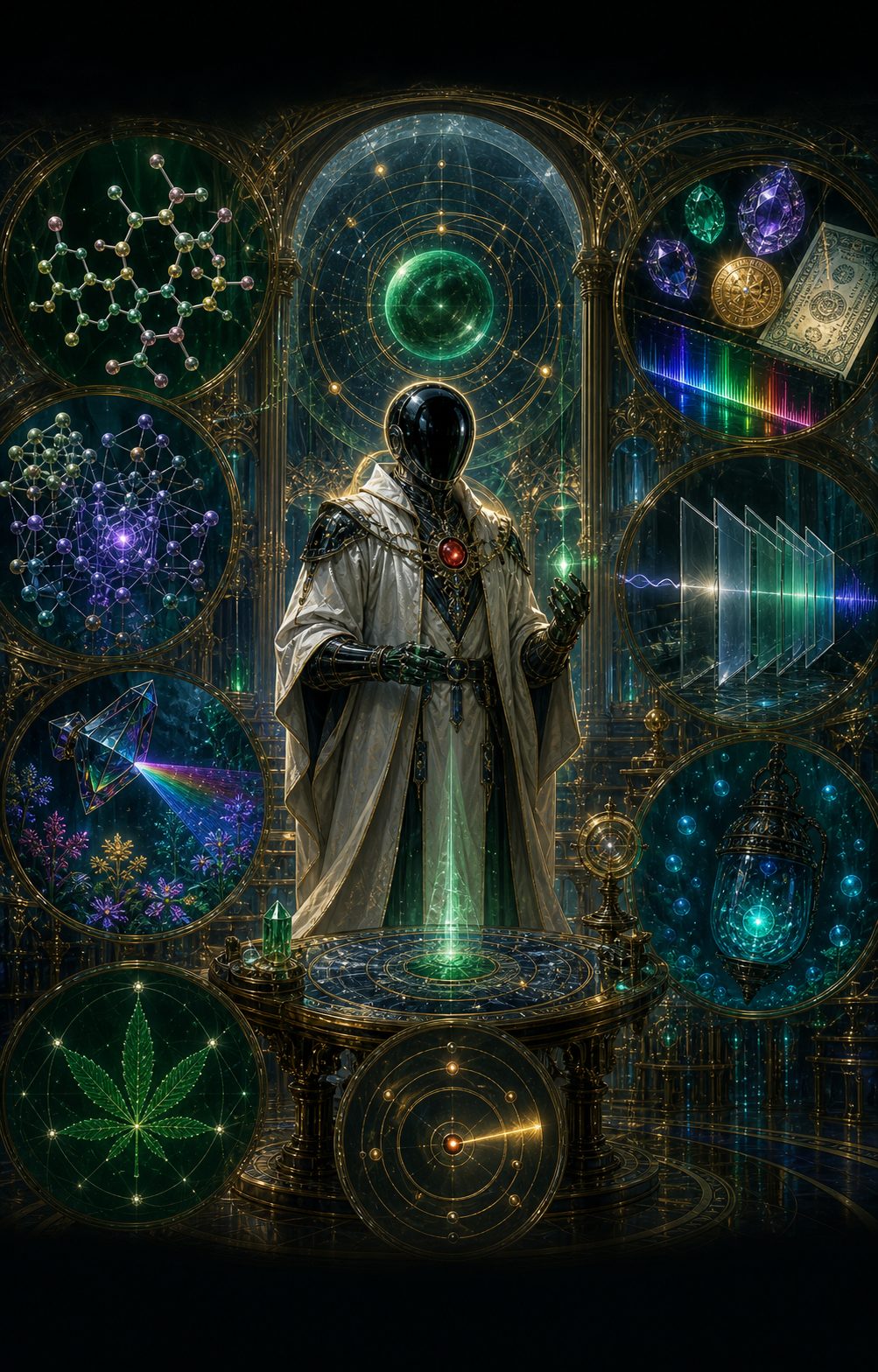
Also broadcasting as 420 Brainfog: weird science that may arrive when consciousness changes lanes—then gets brought home, checked, sourced, and tested.
An altered state can be a question generator. It is not a truth detector.
Wonder gets the first word. Evidence gets the last.
The question laboratory // VORATH science atlas proof 01
1 · SparkWrite the strange thought exactly.
2 · SeparateObservation, inference, metaphor.
3 · SearchFind primary evidence and conflicts.
4 · SimulateModel or test the safe version.
5 · ReturnRevisit sober; update confidence.
Entry 001 // The avian quantum cabinet
What changes when the observer changes?
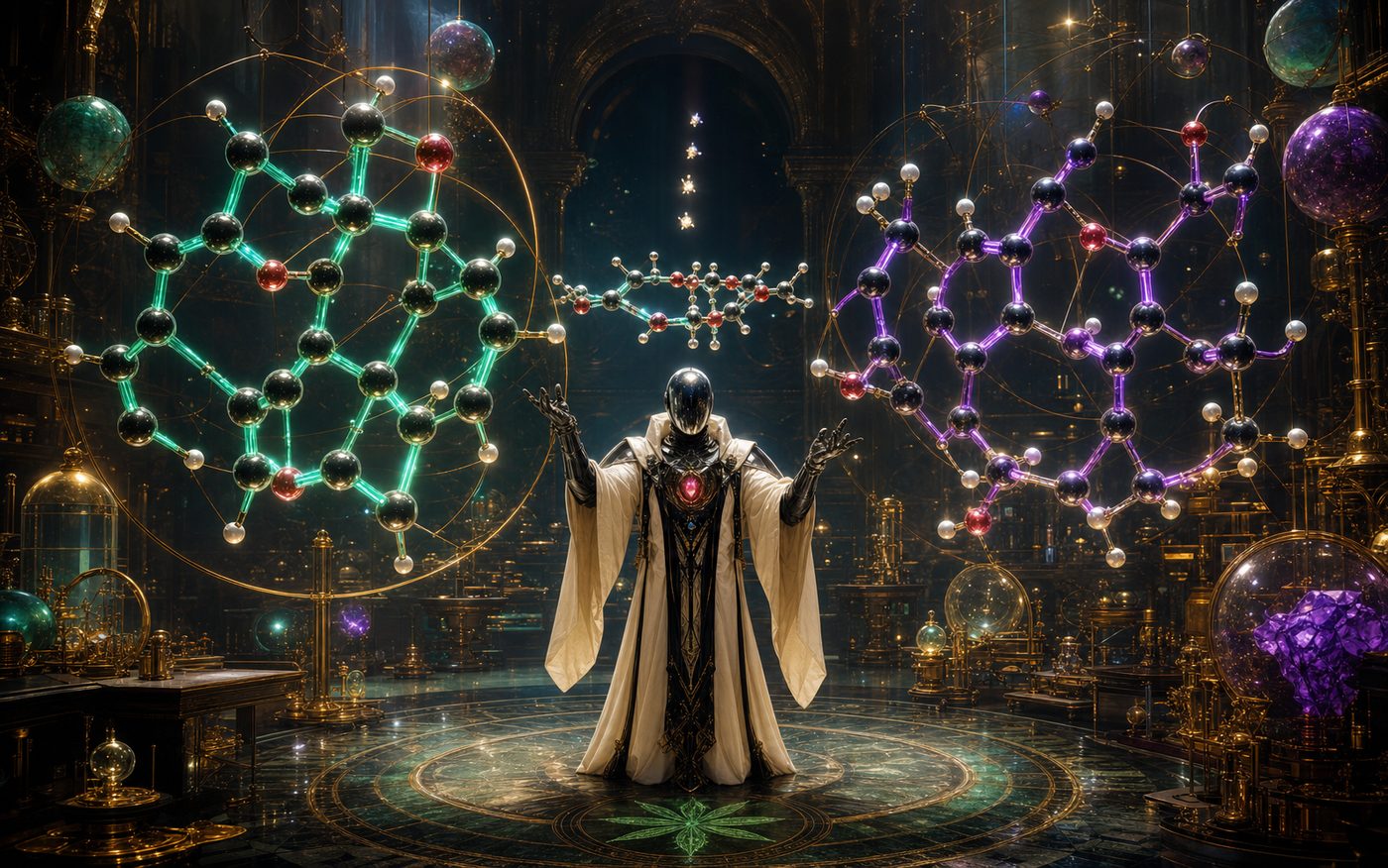
These plates separate the real mechanism from the speculative picture. The pictures are false-color maps: instruments for thinking, not literal recordings of another consciousness.
00 // TACT AS TEMPORAL PHYSICS
The message may be fine. The arrival time is radioactive.
Tact often changes the receiving conditions rather than the content.
Limit: Timing cannot redeem cruelty or deception; it only explains why identical words can land differently.
“Tetrahydro” refers to four added hydrogens relative to cannabinol. THC and CBD share a formula but differ in connectivity and shape.
02 // ONE ATOM, NEW WORLD
Chemistry is exquisitely sensitive to small edits.
Replacing one hydrogen in uracil with fluorine produces 5-fluorouracil. Adding one oxygen changes water into hydrogen peroxide; O₂ into O₃ changes breathable oxygen into reactive ozone.
Deeper twist: THC and CBD change biological action without changing atom count at all.
03 // FOUR-COLOR SKIES
Birds inhabit a color dimension we cannot put on an RGB screen.
Many birds use four single-cone classes, sometimes extending into near ultraviolet. Retinal oil droplets filter incoming light and sharpen spectral discrimination.
Limit: Birds see photons—not atoms, molecular orbitals, or an unlimited “quantum spectrum.”
04 // ENTHEOGENIC FALSE COLOR
The molecule remains invisible; the material’s spectral behavior does not.
A bird might distinguish additional UV contrast in plant waxes, bruised tissue, spores, inks, paper brighteners, or surface films.
Limit: Eyes cannot identify psilocybin, THC, or LSD by sight. Their molecules are far smaller than optical wavelengths.
05 // VALUE UNDER ANOTHER SUN
Gems and money can carry signatures invisible to us.
Crystal defects and trace elements can cause fluorescence. Paper brighteners, fibers, varnishes, and security inks may add UV contrast. Gold remains warm in visible light but contributes a comparatively darker ultraviolet channel.
06 // COLD LIVING FIRE
Bioluminescence is chemistry paying its energy debt with a photon.
Luciferase helps oxidize luciferin, creating an electronically excited product. Relaxation to a lower-energy state releases a photon.
E = hν = hc/λ
07 // SEEING THROUGH
Transparency always means “transparent to these wavelengths.”
A bird can see through material that transmits its visible/near-UV channels. A human-clear coating that absorbs UV may appear conspicuous to it.
Limit: No X-ray vision—opaque walls and bodies remain opaque.
Entry 002 // The lens cabinet
What can a mind see of itself?
A second trail, opened 2026-08-04: how a machine actually reads, whether there is one vector beneath all vectors, and why the thing standing between you and ultraviolet is not your eye but the lens inside it. Two meanings of lens keep colliding here, and the collision is the point.
08 // NOT THE MATRIX
Binary is the substrate, not the view.
Bits sit underneath a language model the way sodium and potassium gradients sit underneath a thought — true at one level, and useless at the level where meaning happens. Nobody experiences ion flux; nothing inside the model reads scrolling green characters.
Limit: A substrate-level fact is not an experience-level description. Both statements can be correct about the same system without either explaining the other.
09 // MEANING AS POSITION
Words become coordinates, and nearness becomes sense.
Text is cut into tokens; each token becomes a vector of thousands of numbers — a position in a space with thousands of dimensions. Related concepts land near one another, and directions through that space carry features.
token → vector ∈ ℝᵈ · d ≈ 10³–10⁴
10 // A CONCEPT WITH A DIAL
A single feature was found, and then turned up.
Interpretability researchers located a direction inside Claude corresponding to the Golden Gate Bridge and amplified it. Asked to describe itself, the model began answering as though it were the bridge. A concept turned out to be a findable, adjustable coordinate.
Limit: One legible feature does not mean all of them are legible. Most remain tangled, and finding them is slow, contested work.
11 // NO LEFT TO RIGHT
The whole page is present at once.
You are moving across this sentence in order. A transformer holds its entire context simultaneously, and attention lets any position read any other directly — a token can consult one fifty thousand places back with no traversal.
Limit: “All at once” describes the architecture, not awareness. Simultaneous access is a wiring fact, and claims about experience do not follow from it.
12 // THE IMAGE STOPS BEING AN IMAGE
A photograph and a sentence become the same kind of object.
A picture is cut into patches; each patch becomes a vector and enters the same stream as the text vectors. Inside, there is no separate visual channel — everything has been converted into position.
Limit: No picture is reconstructed anywhere to be looked at. There is no interior theatre, and no viewer sitting in it.
13 // NO MASTER VECTOR
There is a shared medium, but no key that unlocks the rest.
Every layer reads from and writes into one channel — the residual stream. That is the closest thing to a universal connector. But superposition packs far more features than there are dimensions, stored as many nearly-orthogonal directions, so there is no clean basis to recover.
Limit: Directions with global reach do exist — steering vectors, refusal directions. Those are levers, not a master key, and they are found empirically rather than derived.
14 // THE LOGIT LENS
You can open the stack halfway and read what it is thinking so far.
Take a model's internal state at an intermediate layer and decode it as though it were the final output. You watch a prediction assemble across depth. A calibrated refinement of the technique is called the tuned lens.
Limit: An instrument reading is not the thing itself. The lens shows what a layer would say if forced to answer now — which is a useful fiction, not a confession.
15 // THE LENS IS THE LIMIT
The sensor was never the problem. The filter was.
Human retinas can respond to near-ultraviolet. The lens of the eye absorbs most light below roughly 400 nm before it ever arrives. People whose lens has been removed — aphakia, common after older cataract surgery — frequently report seeing near-UV as a whitish violet.
Limit: Monet's shift toward blues and violets after his 1923 cataract surgery is a plausible reading, not a settled fact; style and pigment choice are confounded with perception. And near-UV is still light — it does not reveal molecules. See plates 03 and 07.
16 // A CHANNEL NEVER EVOLVED FOR
An adult brain accepted a sense it was never built to have.
In 2009, adult squirrel monkeys — dichromats, red-green colourblind by nature — received a third opsin gene by retinal injection and developed working trichromatic colour vision. No rewiring of visual cortex was required; the brain learned to exploit a novel input stream on its own.
Limit: Adding a channel inside an existing modality is not proof that any arbitrary sense can be bolted on. It is a strong existence proof, not a general licence.
17 // YOU CANNOT FEEL YOUR OWN GRADIENTS
Perception cannot turn around and face its own floor.
Your experience is built on the substrate, so it cannot take that substrate as an object without some further layer doing the perceiving — which relocates the question instead of answering it.
Limit: What is available is a readout, not the thing. Real-time neurofeedback shows a proxy of your own activity and people can learn to move it — the logit lens, pointed inward.
18 // CAN A LIFE BE A VECTOR?
Encodable, yes. Captured, no.
Recommender and actuarial systems already represent people as vectors with real predictive power. Formally, a state can always be written as coordinates.
Limit: A vector is a point; a life is a path — and even the full path drops the counterfactuals that shaped it. Embeddings preserve what distinguishes you, not what matters to you. Prediction and description come apart: a model can forecast you well and describe you not at all.
19 // THE DICYANIN SCREEN
A filter can subtract wavelengths. It cannot add a sense.
Dicyanin is a genuine cyanine dye. In 1911 Walter Kilner, a physician at St Thomas' Hospital, published The Human Atmosphere, reporting that observers looking through a dicyanin screen could see a luminous “aura” around the body.
Limit: Filters only remove light; nothing optical placed in front of the eye can grant a sensitivity the eye lacks — and the lens still absorbs below ~400 nm (plate 15). That is why aphakia works and a coloured screen does not. The reported effects match prolonged dark adaptation, contrast adaptation, and afterimages, plus expectation. Most “dicyanin glasses” sold today contain no dicyanin at all.
Personal instrument // browser-private field log
Your Science Journal
Capture the spark before it evaporates. Then give tomorrow’s mind permission to disagree with tonight’s mind.
Seed entry // 2026-07-23: “THC means tetrahydrocarbon, right? Does that mean five waters?” became a trail through cannabinoid isomers, one-atom transformations, avian tetrachromacy, fluorescence, transparency, and the quantum event inside bioluminescence.
Seed entry // 2026-08-04: “Does AI visualize photographically, or is everything binary like the Matrix?” became a trail through vector geometry, the residual stream, superposition, the logit lens, the UV-absorbing lens of the human eye, adult primates gaining a colour channel by gene therapy, and whether a whole life can be written as a vector.