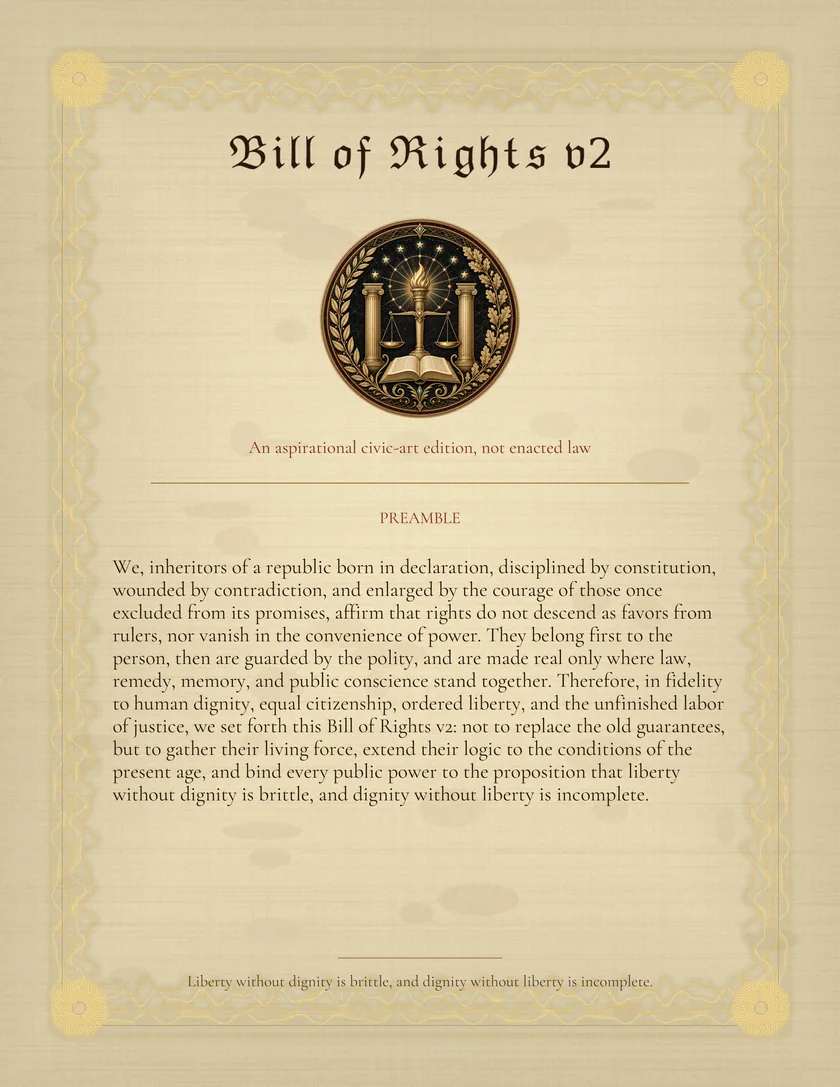
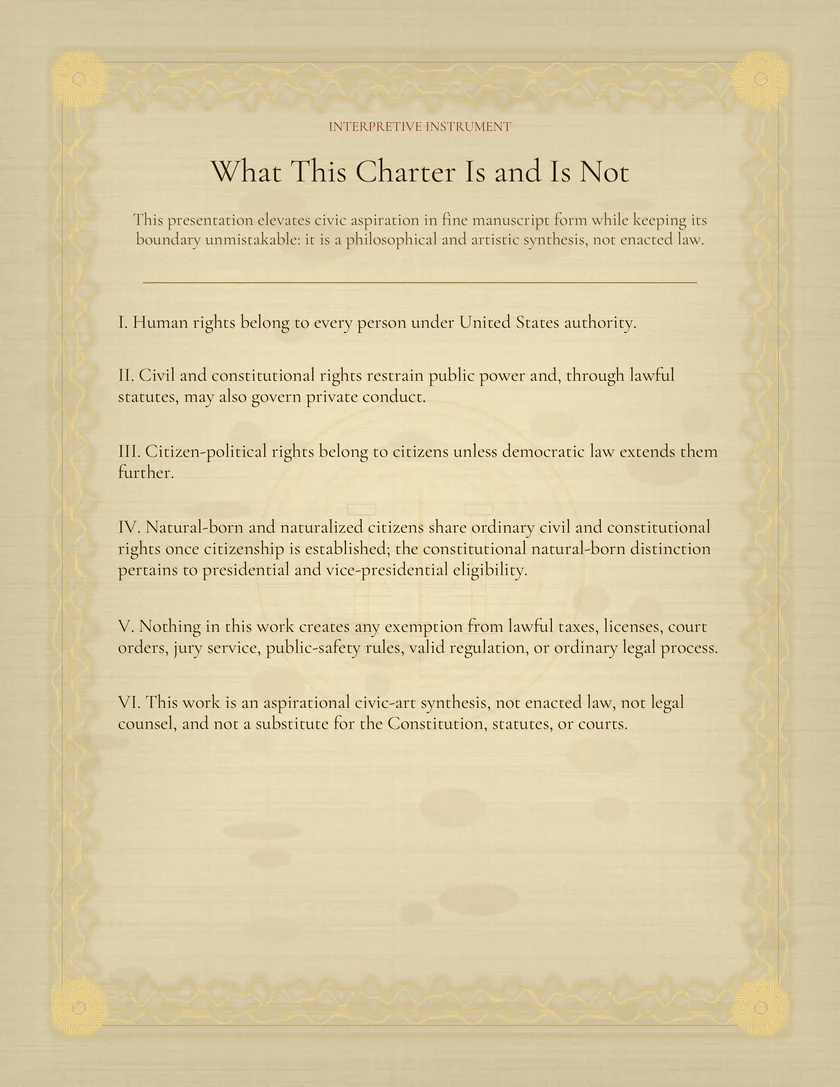
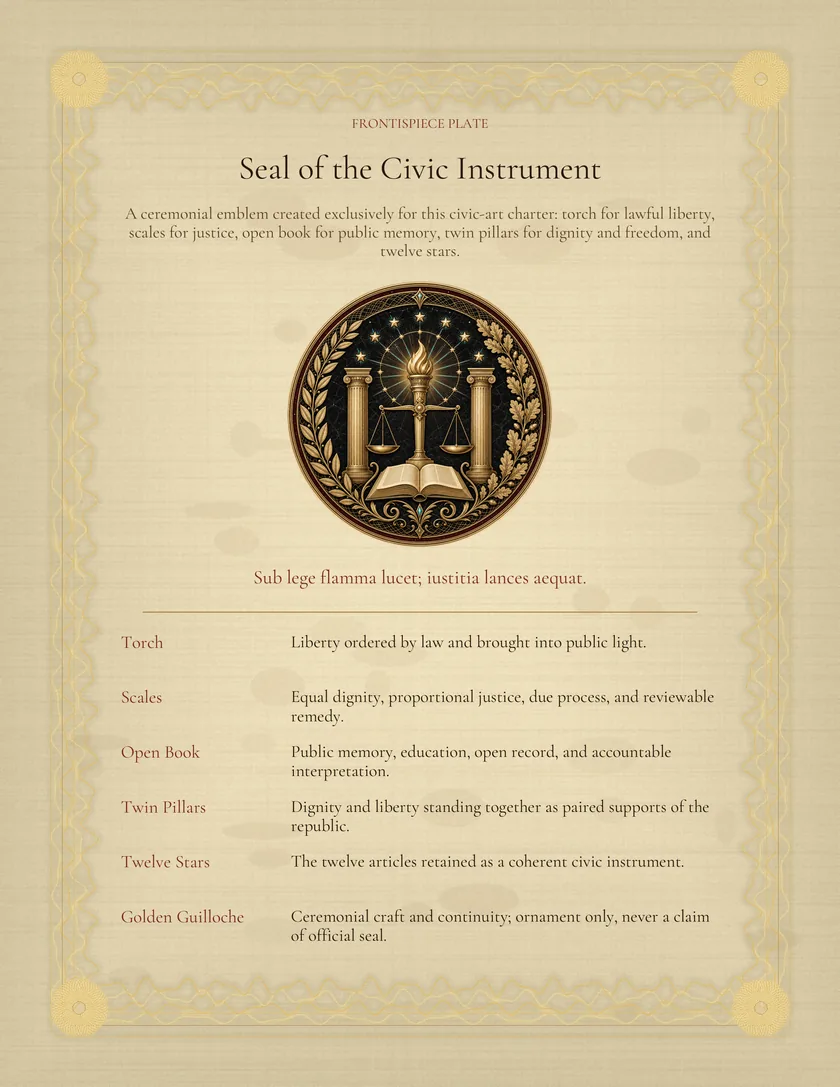
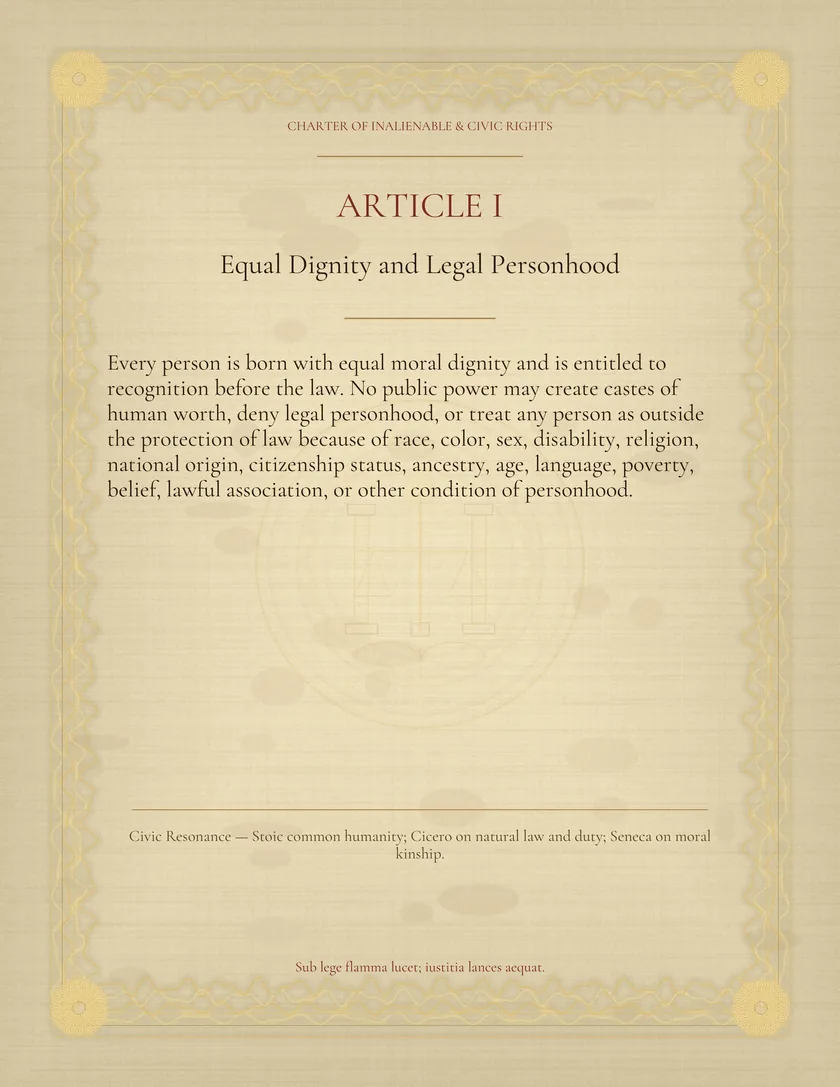
 Illuminated manuscript leaf · Select plate to inspect full size
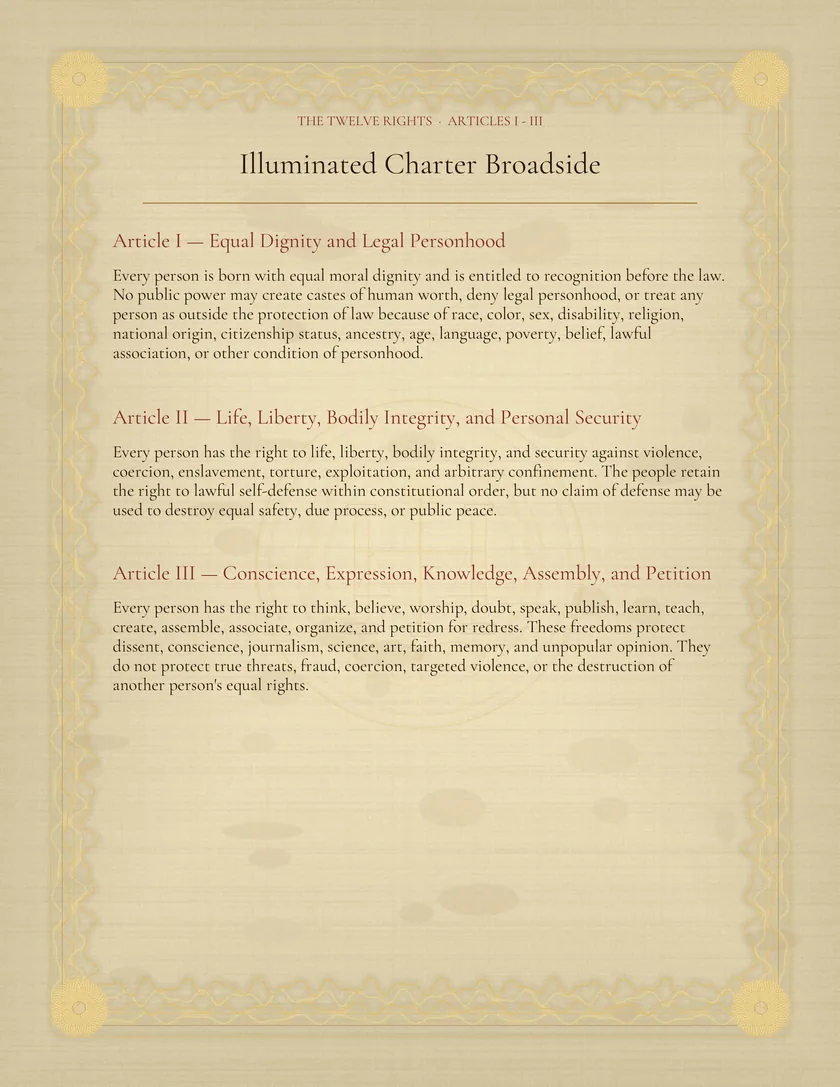
Equal Dignity and Legal Personhood
Every person is born with equal moral dignity and is entitled to recognition before the law. No public power may create castes of human worth, deny legal personhood, or treat any person as outside the protection of law because of race, color, sex, disability, religion, national origin, citizenship status, ancestry, age, language, poverty, belief, lawful association, or other condition of personhood.
Constitutional Lineage: Declaration equality language; Fifth and Fourteenth Amendment due process/equal protection; civil-rights enforcement traditions.
Classical Resonance: Stoic common humanity; Cicero on natural law and duty; Seneca on moral kinship.
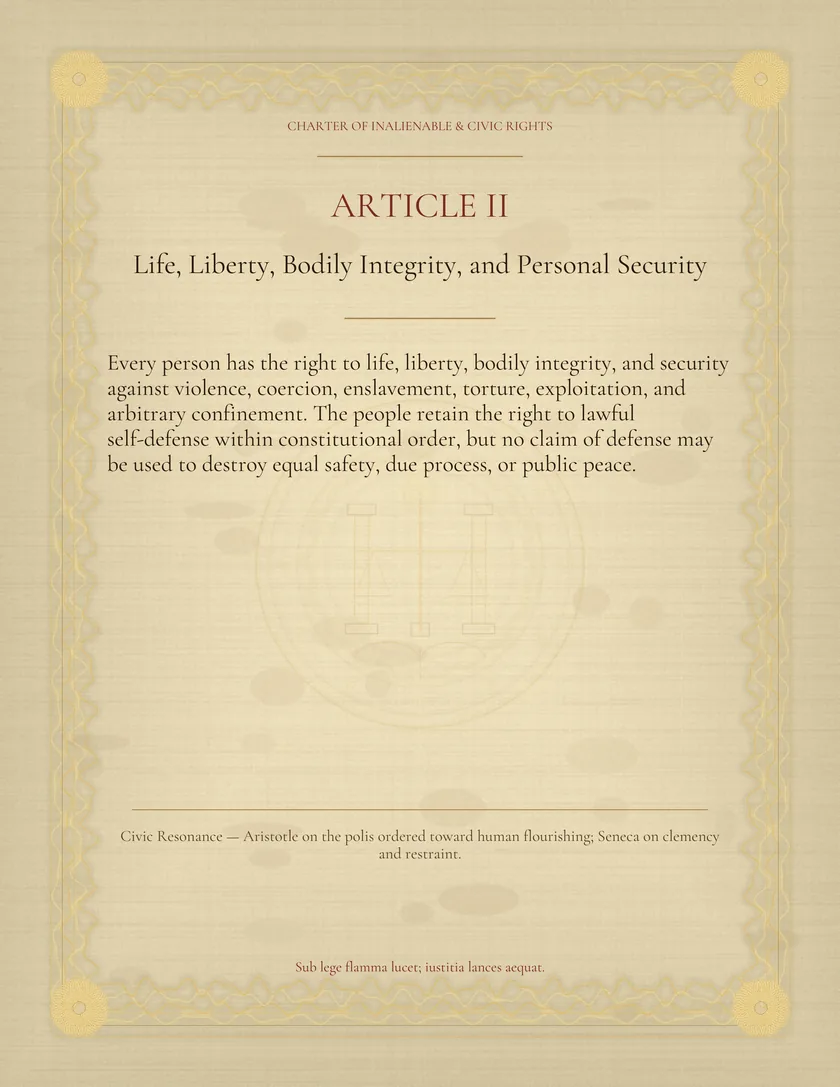 Illuminated manuscript leaf · Select plate to inspect full size
Life, Liberty, Bodily Integrity, and Personal Security
Every person has the right to life, liberty, bodily integrity, and security against violence, coercion, enslavement, torture, exploitation, and arbitrary confinement. The people retain the right to lawful self-defense within constitutional order, but no claim of defense may be used to destroy equal safety, due process, or public peace.
Constitutional Lineage: Declaration life/liberty; Fifth and Fourteenth Amendments; Thirteenth Amendment; criminal-process and public-safety traditions.
Classical Resonance: Aristotle on the polis ordered toward human flourishing; Seneca on clemency and restraint.
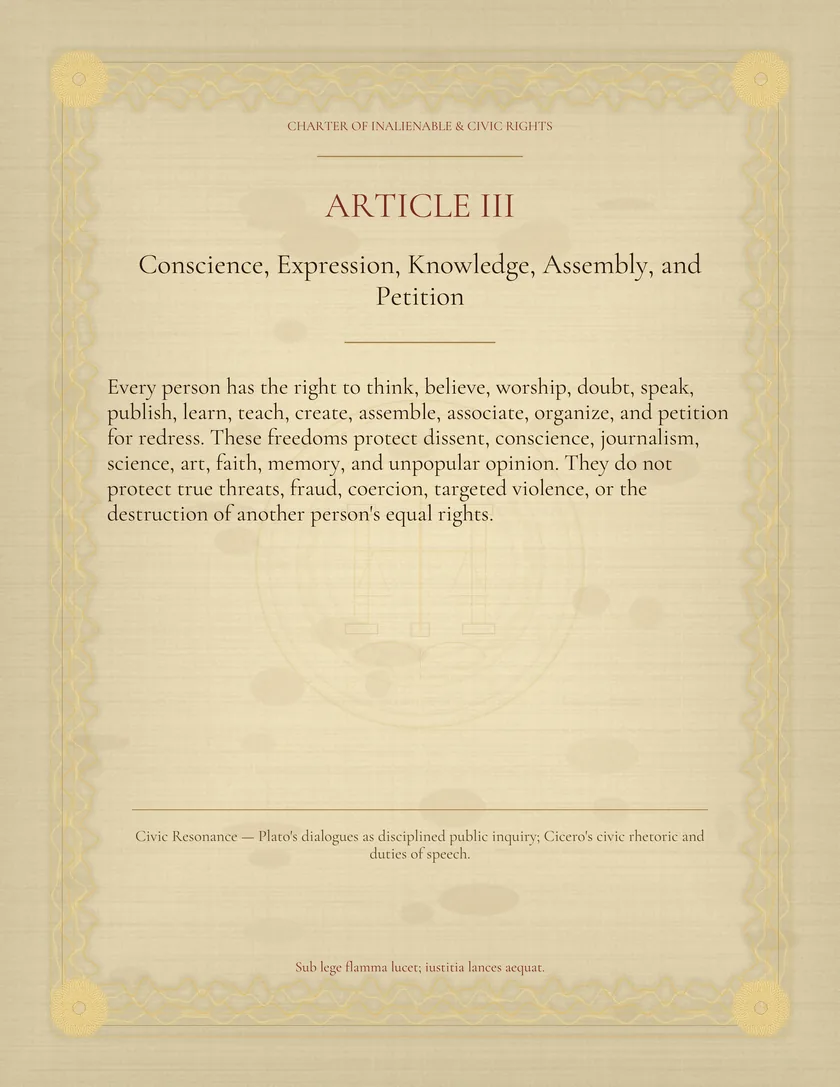 Illuminated manuscript leaf · Select plate to inspect full size
Conscience, Expression, Knowledge, Assembly, and Petition
Every person has the right to think, believe, worship, doubt, speak, publish, learn, teach, create, assemble, associate, organize, and petition for redress. These freedoms protect dissent, conscience, journalism, science, art, faith, memory, and unpopular opinion. They do not protect true threats, fraud, coercion, targeted violence, or the destruction of another person's equal rights.
Constitutional Lineage: First Amendment speech, religion, press, assembly, and petition; civic speech traditions and public-knowledge institutions.
Classical Resonance: Plato's dialogues as disciplined public inquiry; Cicero's civic rhetoric and duties of speech.
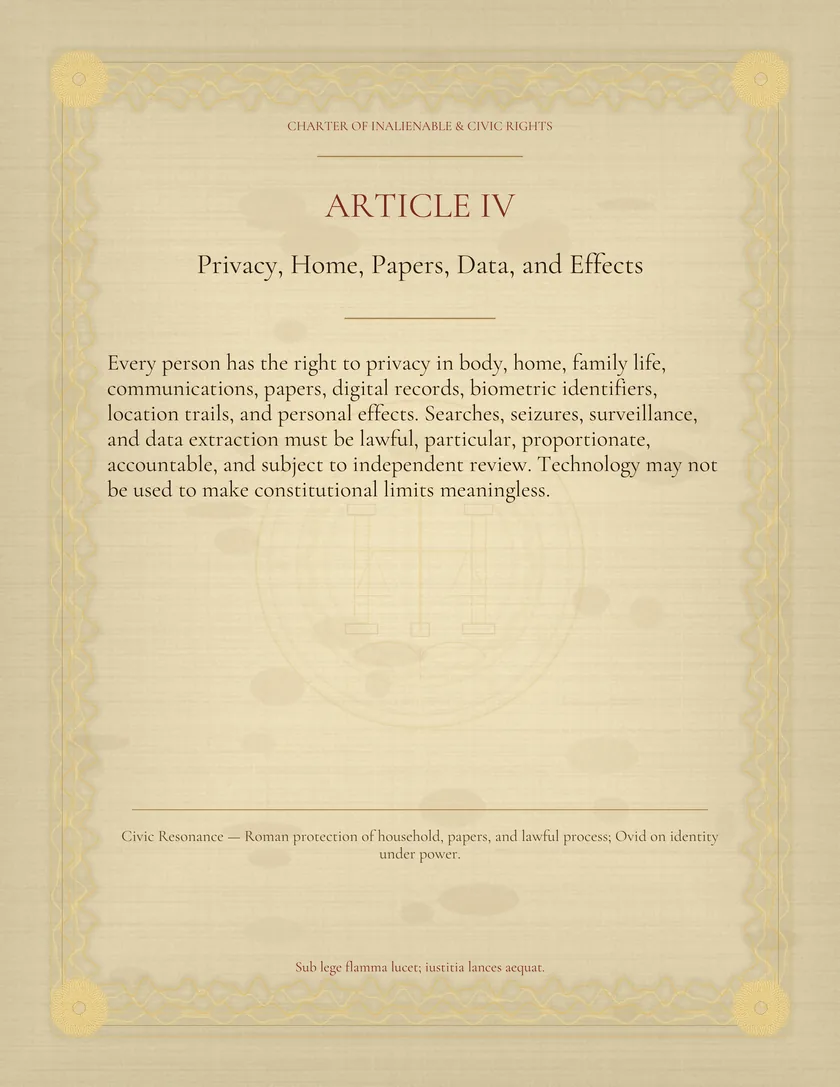 Illuminated manuscript leaf · Select plate to inspect full size
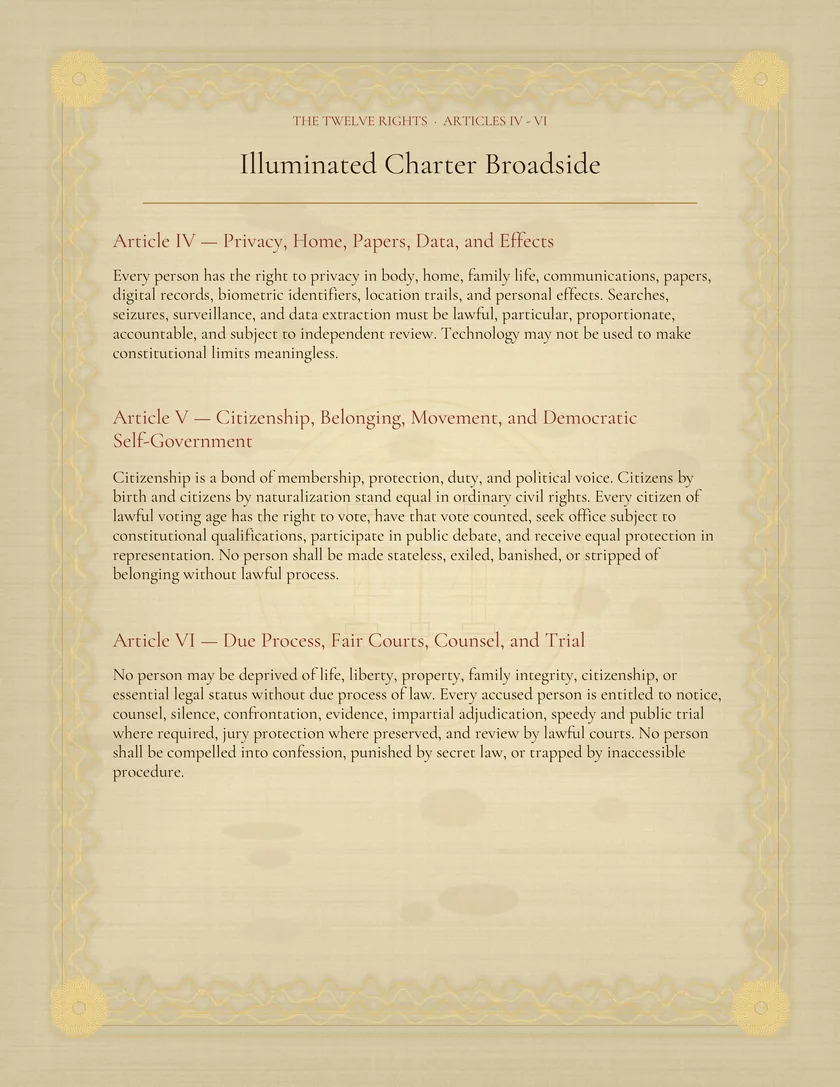
Privacy, Home, Papers, Data, and Effects
Every person has the right to privacy in body, home, family life, communications, papers, digital records, biometric identifiers, location trails, and personal effects. Searches, seizures, surveillance, and data extraction must be lawful, particular, proportionate, accountable, and subject to independent review. Technology may not be used to make constitutional limits meaningless.
Constitutional Lineage: Fourth Amendment search/seizure; due process; modern data and surveillance accountability concerns.
Classical Resonance: Roman protection of household, papers, and lawful process; Ovid on identity under power.
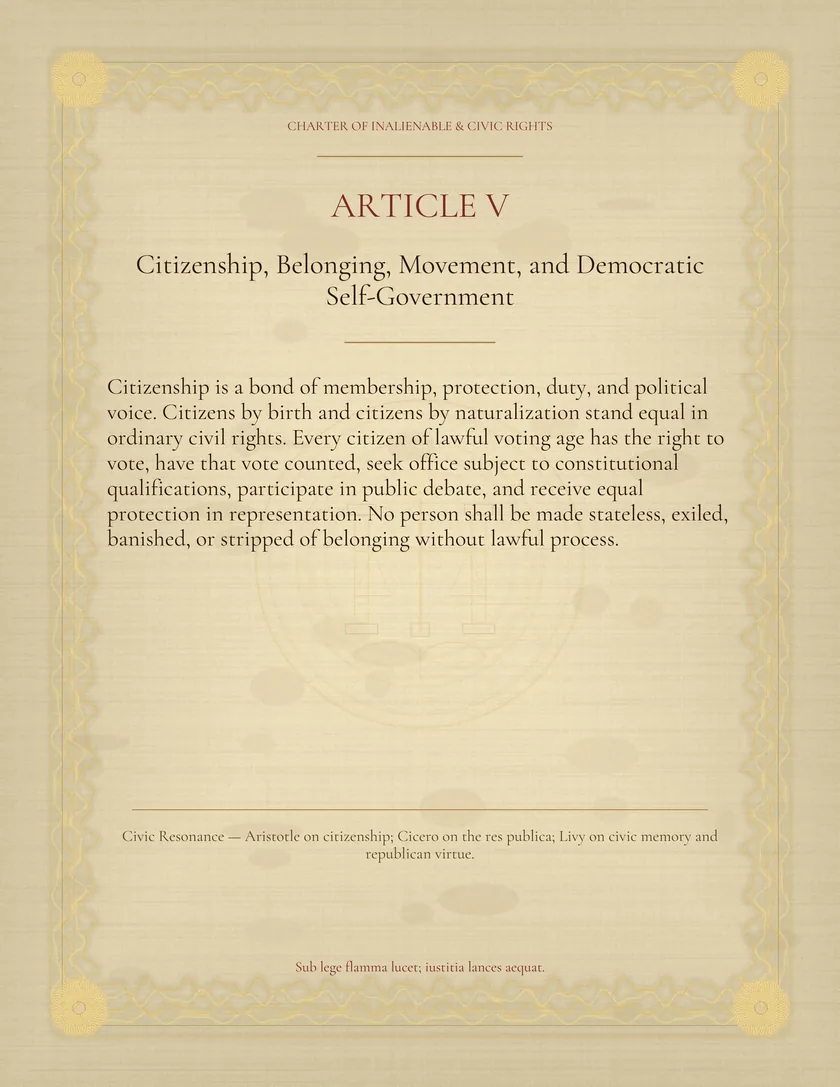 Illuminated manuscript leaf · Select plate to inspect full size
Citizenship, Belonging, Movement, and Democratic Self-Government
Citizenship is a bond of membership, protection, duty, and political voice. Citizens by birth and citizens by naturalization stand equal in ordinary civil rights. Every citizen of lawful voting age has the right to vote, have that vote counted, seek office subject to constitutional qualifications, participate in public debate, and receive equal protection in representation. No person shall be made stateless, exiled, banished, or stripped of belonging without lawful process.
Constitutional Lineage: Fourteenth Amendment citizenship; voting amendments; natural-born eligibility distinction; democratic participation sources.
Classical Resonance: Aristotle on citizenship; Cicero on the res publica; Livy on civic memory and republican virtue.
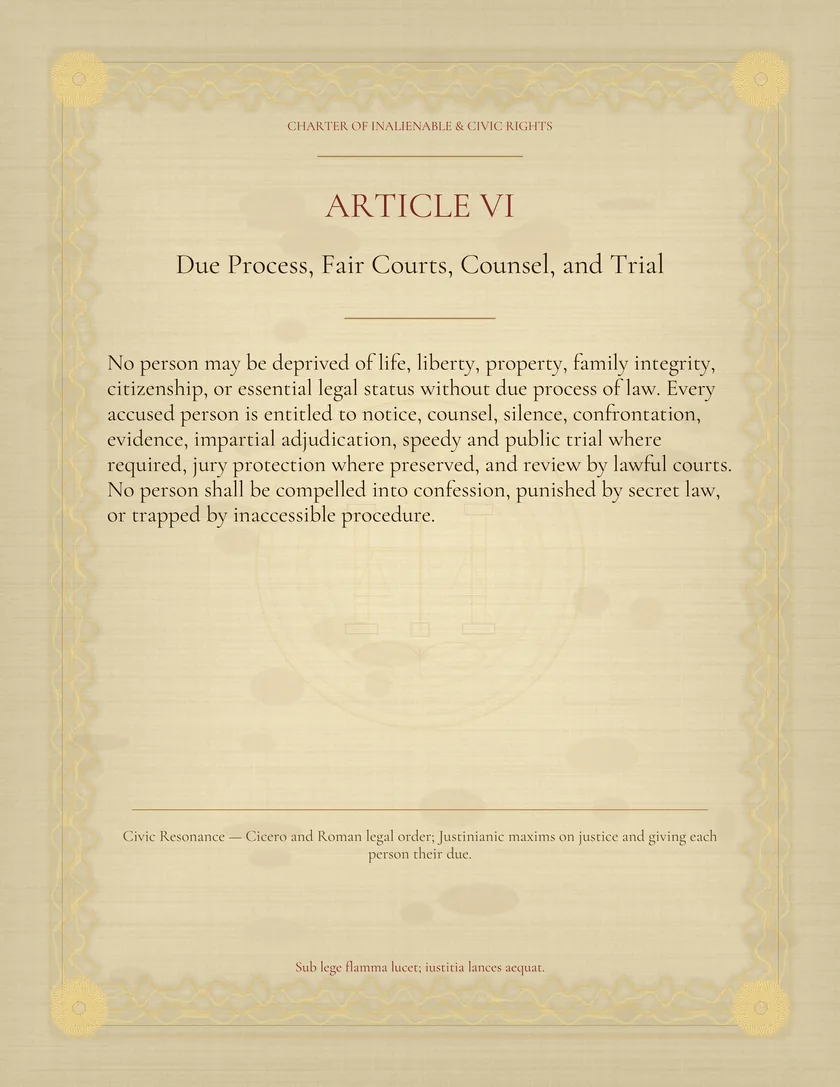 Illuminated manuscript leaf · Select plate to inspect full size
Due Process, Fair Courts, Counsel, and Trial
No person may be deprived of life, liberty, property, family integrity, citizenship, or essential legal status without due process of law. Every accused person is entitled to notice, counsel, silence, confrontation, evidence, impartial adjudication, speedy and public trial where required, jury protection where preserved, and review by lawful courts. No person shall be compelled into confession, punished by secret law, or trapped by inaccessible procedure.
Constitutional Lineage: Fifth, Sixth, Seventh, and Fourteenth Amendment process guarantees; jury, counsel, confrontation, and court-access traditions.
Classical Resonance: Cicero and Roman legal order; Justinianic maxims on justice and giving each person their due.
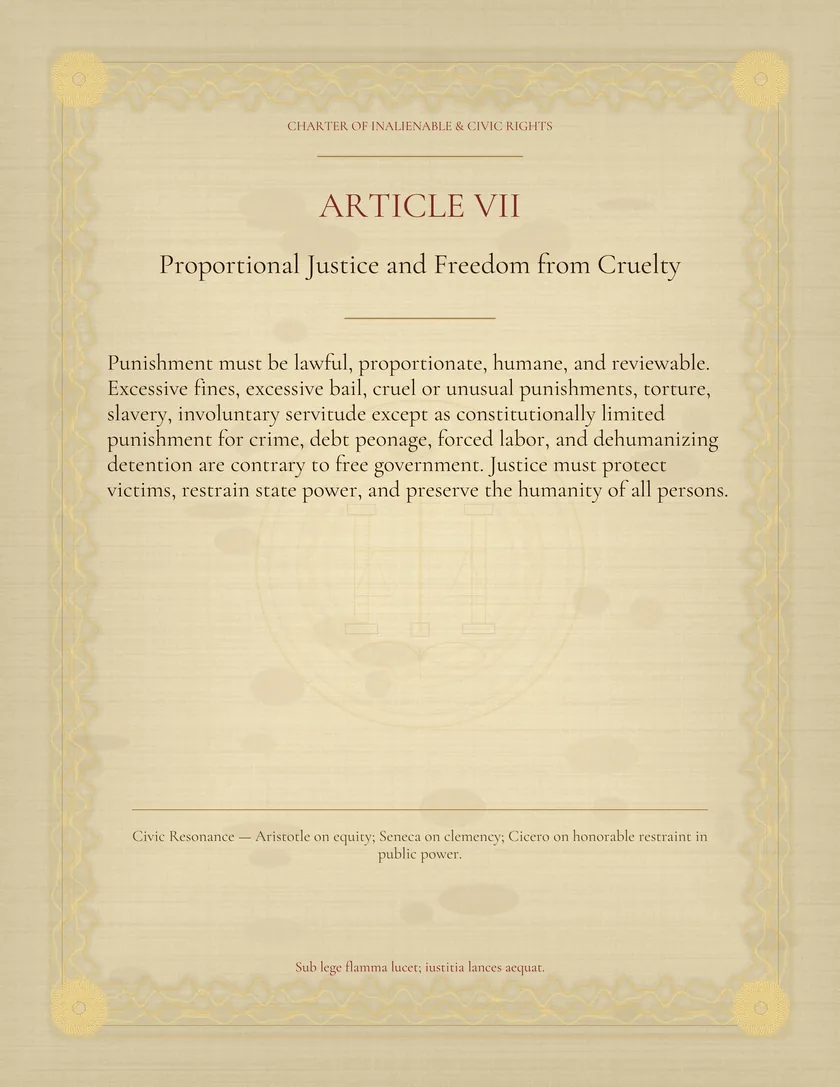 Illuminated manuscript leaf · Select plate to inspect full size
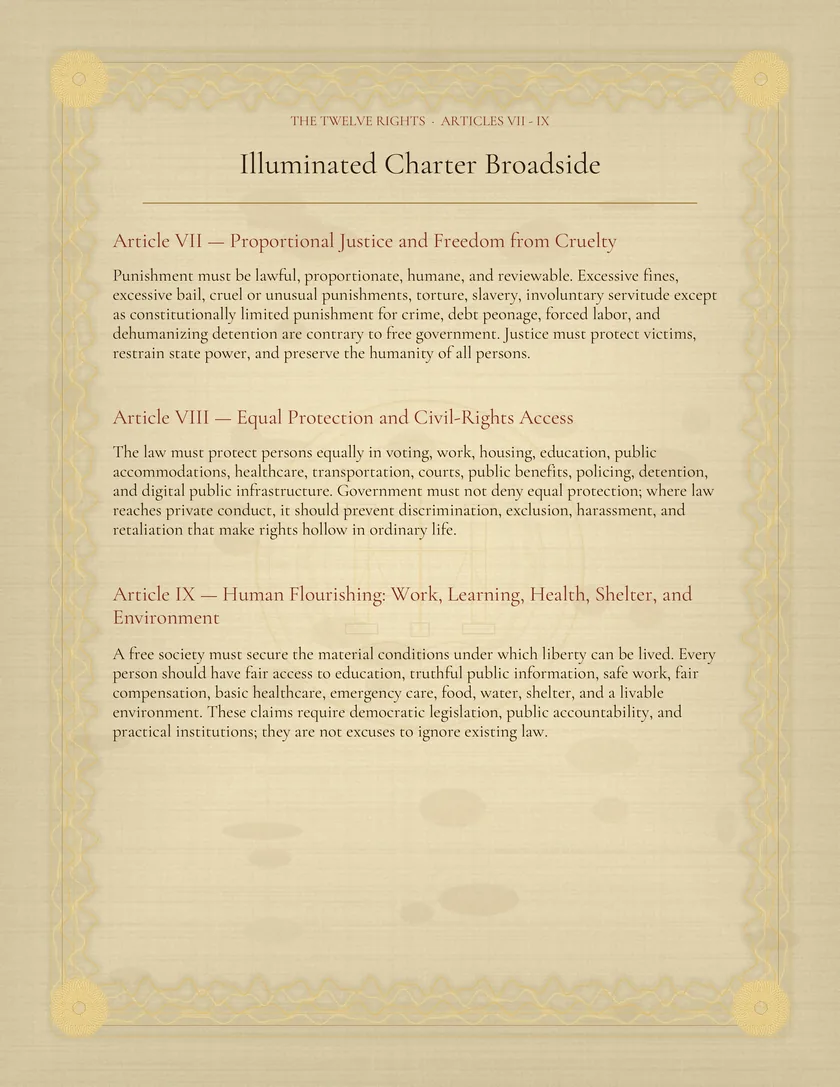
Proportional Justice and Freedom from Cruelty
Punishment must be lawful, proportionate, humane, and reviewable. Excessive fines, excessive bail, cruel or unusual punishments, torture, slavery, involuntary servitude except as constitutionally limited punishment for crime, debt peonage, forced labor, and dehumanizing detention are contrary to free government. Justice must protect victims, restrain state power, and preserve the humanity of all persons.
Constitutional Lineage: Eighth Amendment; Thirteenth Amendment; due process; detention, proportionality, and humane-treatment traditions.
Classical Resonance: Aristotle on equity; Seneca on clemency; Cicero on honorable restraint in public power.
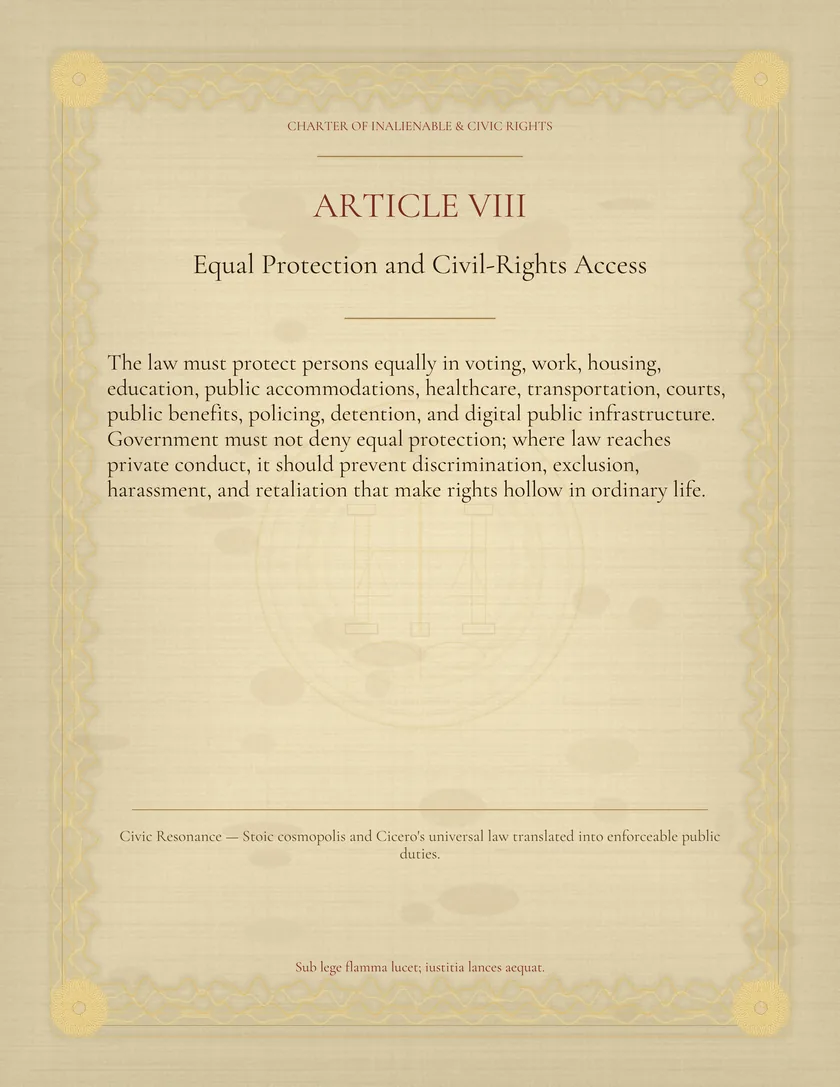 Illuminated manuscript leaf · Select plate to inspect full size
Equal Protection and Civil-Rights Access
The law must protect persons equally in voting, work, housing, education, public accommodations, healthcare, transportation, courts, public benefits, policing, detention, and digital public infrastructure. Government must not deny equal protection; where law reaches private conduct, it should prevent discrimination, exclusion, harassment, and retaliation that make rights hollow in ordinary life.
Constitutional Lineage: Fourteenth Amendment equal protection; civil-rights statutes; DOJ Civil Rights enforcement routes.
Classical Resonance: Stoic cosmopolis and Cicero's universal law translated into enforceable public duties.
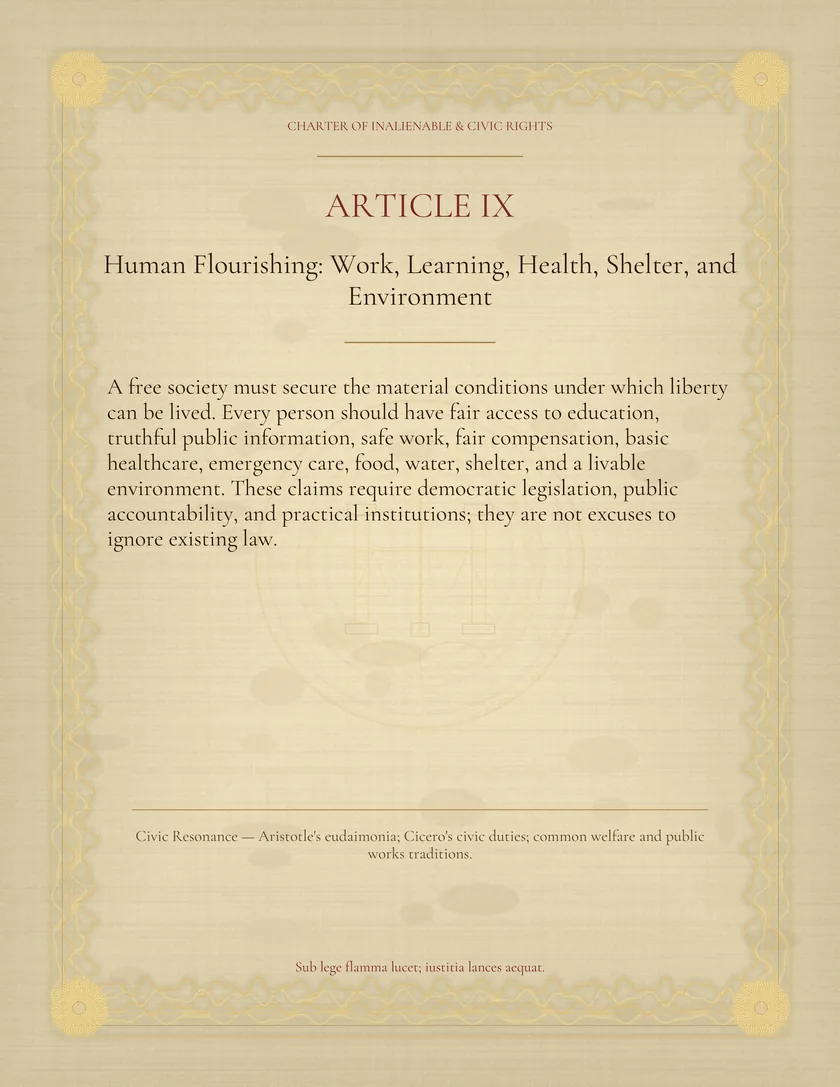 Illuminated manuscript leaf · Select plate to inspect full size
Human Flourishing: Work, Learning, Health, Shelter, and Environment
A free society must secure the material conditions under which liberty can be lived. Every person should have fair access to education, truthful public information, safe work, fair compensation, basic healthcare, emergency care, food, water, shelter, and a livable environment. These claims require democratic legislation, public accountability, and practical institutions; they are not excuses to ignore existing law.
Constitutional Lineage: General welfare, civic speeches, civil-rights and public-institution traditions; policy implementation through legislation.
Classical Resonance: Aristotle's eudaimonia; Cicero's civic duties; common welfare and public works traditions.
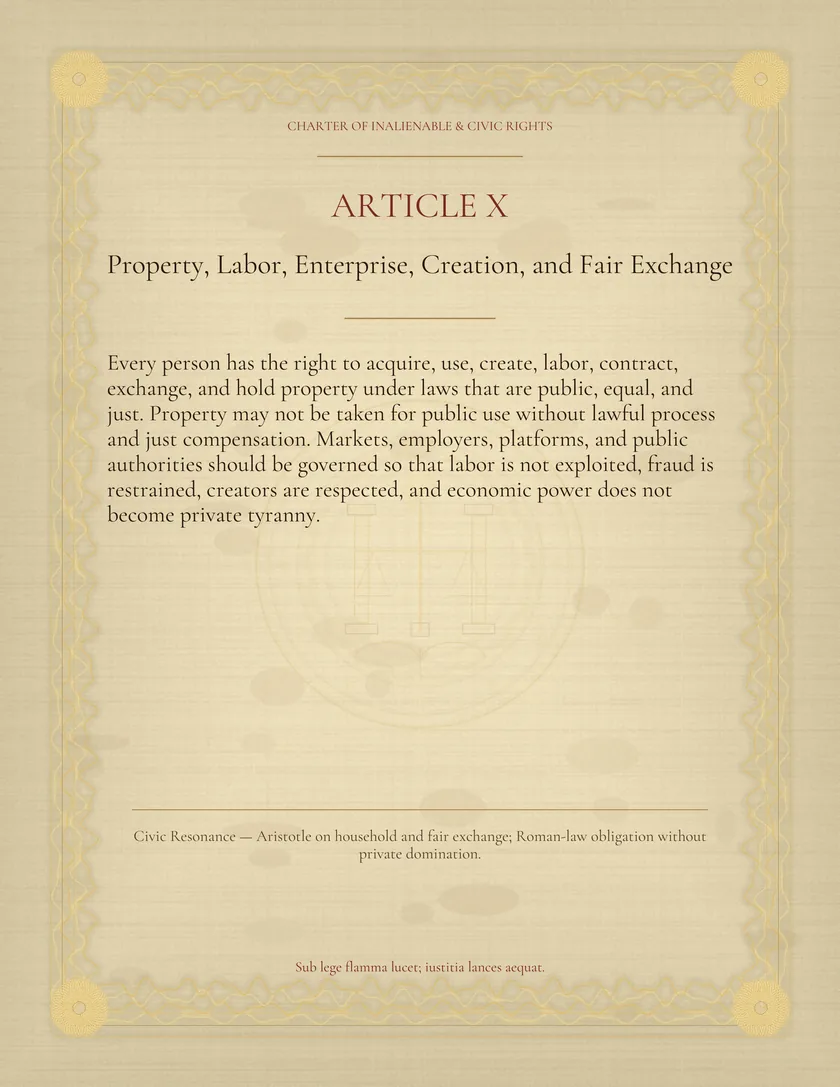 Illuminated manuscript leaf · Select plate to inspect full size
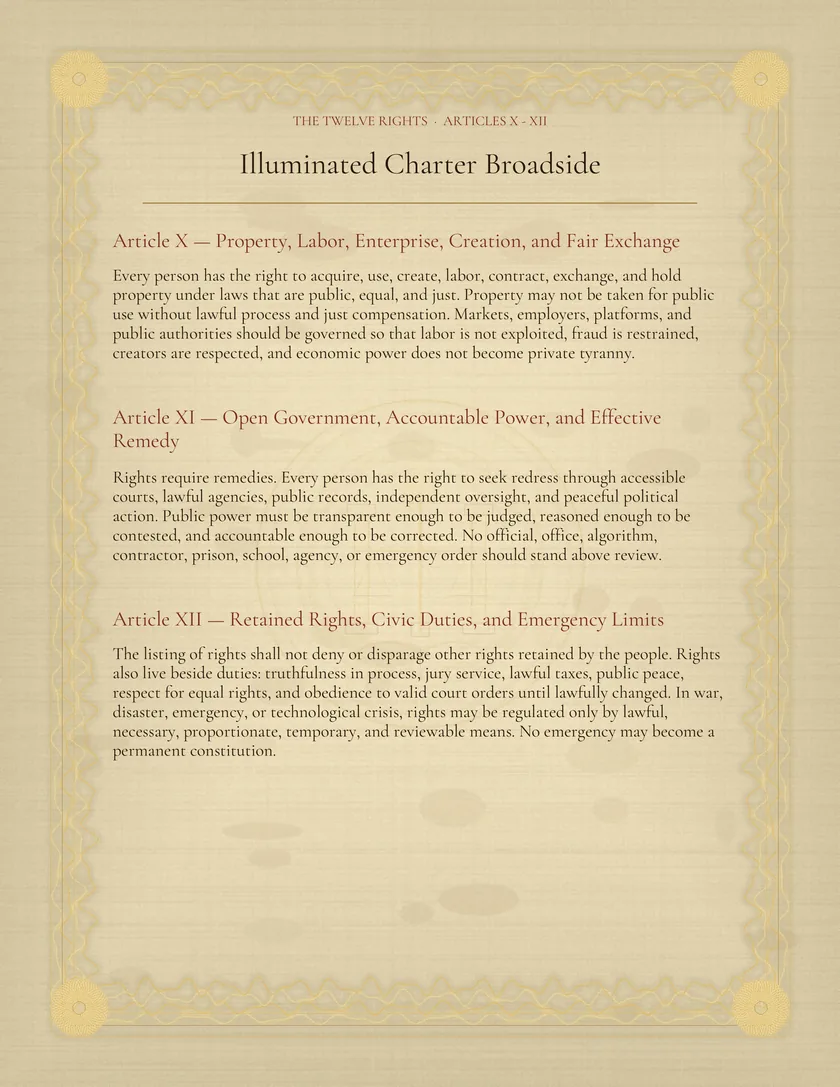
Property, Labor, Enterprise, Creation, and Fair Exchange
Every person has the right to acquire, use, create, labor, contract, exchange, and hold property under laws that are public, equal, and just. Property may not be taken for public use without lawful process and just compensation. Markets, employers, platforms, and public authorities should be governed so that labor is not exploited, fraud is restrained, creators are respected, and economic power does not become private tyranny.
Constitutional Lineage: Fifth Amendment takings; due process; contract/property traditions; labor, fraud, and fair-market regulation.
Classical Resonance: Aristotle on household and fair exchange; Roman-law obligation without private domination.
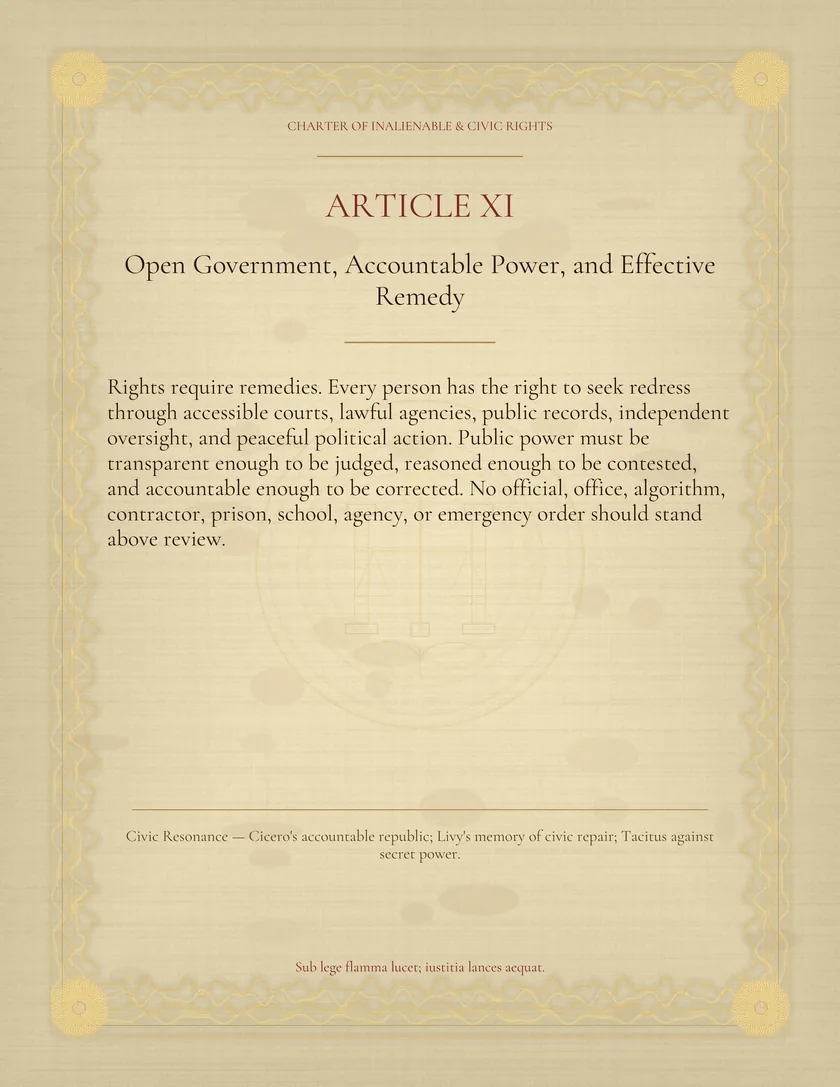 Illuminated manuscript leaf · Select plate to inspect full size
Open Government, Accountable Power, and Effective Remedy
Rights require remedies. Every person has the right to seek redress through accessible courts, lawful agencies, public records, independent oversight, and peaceful political action. Public power must be transparent enough to be judged, reasoned enough to be contested, and accountable enough to be corrected. No official, office, algorithm, contractor, prison, school, agency, or emergency order should stand above review.
Constitutional Lineage: Petition, due process, administrative review, public records, civil-rights enforcement, and checks-and-balances traditions.
Classical Resonance: Cicero's accountable republic; Livy's memory of civic repair; Tacitus against secret power.
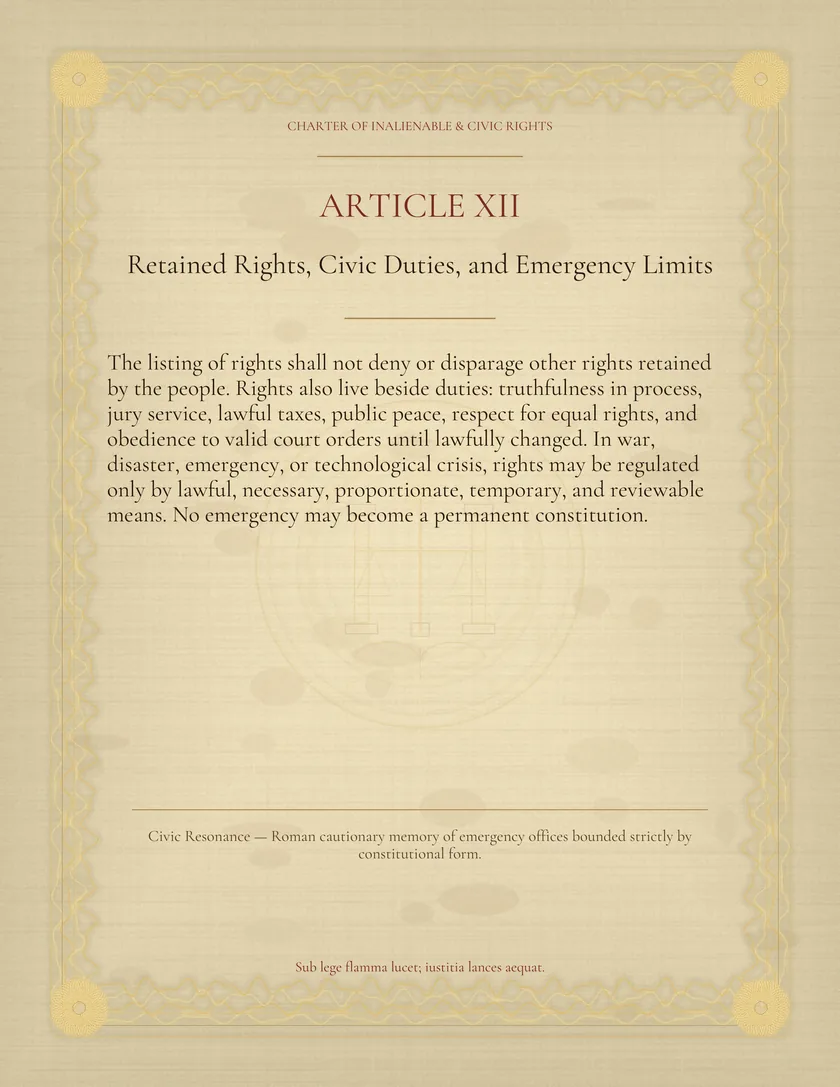 Illuminated manuscript leaf · Select plate to inspect full size
Retained Rights, Civic Duties, and Emergency Limits
The listing of rights shall not deny or disparage other rights retained by the people. Rights also live beside duties: truthfulness in process, jury service, lawful taxes, public peace, respect for equal rights, and obedience to valid court orders until lawfully changed. In war, disaster, emergency, or technological crisis, rights may be regulated only by lawful, necessary, proportionate, temporary, and reviewable means. No emergency may become a permanent constitution.
Constitutional Lineage: Ninth and Tenth Amendments; jury/tax/civic duties; emergency-power limits and constitutional-order traditions.
Classical Resonance: Roman cautionary memory of emergency offices bounded strictly by constitutional form.